To avoid these ads, REGISTER NOW!

teach me about taps

niget2002

Well-known member
Joined
Oct 2, 2012
Messages
11,454
Location
Josephine, TX
I need to put M3 bolt holes in Aluminum on a project I'm working on. I just broke a cheap tap off into a part. The part is still usable and I can make a new one if this project works out.

So, the question is, what type of tap should I get to replace it? Straight flute? Spiral flute? I'm hand taping.

Most of these bolt holes are blind if that matters, but I'm over drilling the holes by a few MM to leave room.
 
To avoid these ads, REGISTER NOW!

manwithtools

ALLIANCE MEMBER
Joined
Aug 24, 2015
Messages
14,774
Location
Lebanon, TN
Straight taps of good quality will work fine. Get some Tapfree for Aluminum or lots of WD-40. Go easy, 1/2 turn in, back out the same. Every couple of full revolutions back completely out and clean the hole of chips. Compressed air works good. Cover the hole and air nozzle with a rage and blow it out. Wear safety glasses. Blind hole really needs a bottoming tap to do it right. But you need a tapered or starting tap to get the threads started.

EDIT: Not Tapfree, but Tap Magic for Aluminum
 
Last edited:

LXCam

ALLIANCE MEMBER
Joined
Apr 23, 2013
Messages
19,373
Location
AZ
Bottoming spiral flute tap and my preference would be nitride coated. If you got a bunch of these I’d also suggest a hand tapper. That’s a small tap and as you found out real easy to break. Also get some aluminum tapping fluid.


LopezBart

Well-known member
Joined
Oct 13, 2023
Messages
2,583
Location
Lopez Island, WA
I've always found it worth buying US or Japanese-made taps, and being willing to replace them when they get dull. You'll do well with a straight tap. Unless you have a lot of space below the threaded portion of the hole, a plug or bottoming tap is needed:

1705784628201.png

I find Greenfield, OSG, Cleveland quite good quality. The marginal cost of better taps can save a lot of aggravation remaking parts. BTW, nitric acid will dissolve steel taps out of aluminum w/o hurting the part.
 
OP
N

niget2002

Well-known member
Joined
Oct 2, 2012
Messages
11,454
Location
Josephine, TX
I find Greenfield,
I was just looking at those.

That was quick help, guys. Thank-you. I'll get some of the cutting fluid.

I'll get a straight tap to get the tap started and then go ahead and pick up a bottoming tap to finish it up. The other bolt size I have on this project is M4. I'm just going to go ahead and grab a better tap for that size too.
 

LXCam

ALLIANCE MEMBER
Joined
Apr 23, 2013
Messages
19,373
Location
AZ
You absolutely don’t need a starter tap for this if you use a good spiral flute tap.

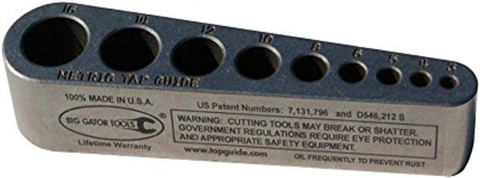
At a minimum get one of these to help you keep it perpendicular to the surface.


teagueo

Well-known member
Joined
Mar 7, 2017
Messages
464
A taper tap (first 7 or so threads are not full cutting diameter) will ease the stress on the tap.

Then follow up with a "bottoming tap" if you need fully formed threads near the bottom of the hole.

ALWAYS use lube on Aluminum as it will stick to the tap eventually.

Not really necessary for Aluminum, but you can also open the hole slightly. The drill size for M3 is 2.5 mm, but you can enlarge it and still have nearly the same thread strength but the torque needed to tap is hugely reduced. It's called Percentage of Thread, there's calculators for it.
 

teagueo

Well-known member
Joined
Mar 7, 2017
Messages
464
In my experience with tiny taps, a 2 flute spiral point (not spiral flute) taps are the strongest. Cobalt or powdered metal material if possible.

Spiral flutes are nice for blind holes because the chips evacuate out of the hole, but they tend to be weaker - might just be me though!
 
OP
N

niget2002

Well-known member
Joined
Oct 2, 2012
Messages
11,454
Location
Josephine, TX
The drill size for M3 is 2.5 mm
This is part of where I screwed up. I used the wrong size drill.

I'm using the chuck on the mill to help hold the tap straight. I have a gear wrench ratcheting tap.

Here's a picture of the part and broke tap in the background.

I really think my biggest mistake was using the wrong drill and cheap tap.

I was using some oil on the tap. Might have been too thick.

1000002088.jpg
 

manwithtools

ALLIANCE MEMBER
Joined
Aug 24, 2015
Messages
14,774
Location
Lebanon, TN
Cool fact about metric bolts. Take the diameter (in this case 3mm) and subtract the tread pitch (in this case 0.5mm) and you now have the correct tap drill (in this case 2.5mm)

3 - 0.5 = 2.5

I love this about metric fasteners. No need to have a drill chart or memorize all the common tap drills like in the imperial system. What a mess that is: - fractional, letter and number drills to get the right ones.
 

manwithtools

ALLIANCE MEMBER
Joined
Aug 24, 2015
Messages
14,774
Location
Lebanon, TN
Despite what @LXCam says, I really prefer a straight tap for the inexperienced. Once you get the hang of things a spiral tap will work wonders, but if you don't understand the finesse part of this, things will break.

And as @teagueo says, always a slight chamfer with a countersink or center drill makes things go much easier and makes a nicer looking part.
 

larry_g

Well-known member
Joined
Apr 28, 2007
Messages
16,928
Location
oregon
I'd also suggest that you get a smaller tap handle. That thing is to big to give you any tactile feedback. Looking at the piece your making, how are you putting in the holes to be tapped? If you have it fixtured in a machine, drill the hole and then without moving the part start the tap in the hole. I also second the the suggestion to use a tap guide if you have to tap by hand and chamfer the top of the hole before tapping.

Do you know if the tap broke when twisting it or did you break it off by sideward force?
 

teagueo

Well-known member
Joined
Mar 7, 2017
Messages
464
Is this the stuff I need for desolving the tap?

Hoosier Hill Farm Alum Granulated Pickle Powder, 1 Pound https://www.amazon.com/dp/B00UVAG21A?tag=atomicindus08-20
I tried that exact stuff in boiling water - saw some bubbles rising from the tap but they didn't dissolve. Might be because it wasn't a HSS tap? (High speed steel).

The sulphuric acid (5%) has been going overnight and I do see some metal chips when I swish it around. I'll post up how it turns out.
 
OP
N

niget2002

Well-known member
Joined
Oct 2, 2012
Messages
11,454
Location
Josephine, TX
I tried that exact stuff in boiling water - saw some bubbles rising from the tap but they didn't dissolve. Might be because it wasn't a HSS tap? (High speed steel).

The sulphuric acid (5%) has been going overnight and I do see some metal chips when I swish it around. I'll post up how it turns out.
Thanks. I'll hold off on this stuff then.

The part will work with only one bolt on the bottom for testing.
 

larry_g

Well-known member
Joined
Apr 28, 2007
Messages
16,928
Location
oregon
Yeah. I need to do that. If I get a smaller handle, then I can use my tap follower on the mill to help keep it straight.

I don't have a handle small enough for the smaller taps.
What I have done in the past is to grab a tap in my smallest drill chuck in the mill. Then release the chuck from the mill spindle so the spindle guides the chuck but I turn the chuck by hand. I have a couple of chucks that have a 1/4" or 3/8" spud on them so that they can be installed in an appropriate sized collet.

lg
no neat sig line
 
To avoid these ads, REGISTER NOW!

dutchgray

Well-known member
Joined
Sep 28, 2014
Messages
6,480
Location
Dorset. England.
Cool fact about metric bolts. Take the diameter (in this case 3mm) and subtract the tread pitch (in this case 0.5mm) and you now have the correct tap drill (in this case 2.5mm)

3 - 0.5 = 2.5

I love this about metric fasteners. No need to have a drill chart or memorize all the common tap drills like in the imperial system. What a mess that is: - fractional, letter and number drills to get the right ones.
This works for imperial but you have to convert the TPI value into an inch dimension first, its not as easy because of all the fractions though, but if you put everything into thousands and then use 40 thou equals 1mm and use metric drills you don't need any of the fractional, letter or number drills.
 

manwithtools

ALLIANCE MEMBER
Joined
Aug 24, 2015
Messages
14,774
Location
Lebanon, TN
This works for imperial but you have to convert the TPI value into an inch dimension first, its not as easy because of all the fractions though, but if you put everything into thousands and then use 40 thou equals 1mm and use metric drills you don't need any of the fractional, letter or number drills.
Yeah, it's a fucked up system isn't it? Why would we even begin to want to make the conversions? Just look it up on a drill chart, it's so much easier. Sometimes, I'll chose the next closest metric bit.

Don't even get me started on all the other stupid relationships in the damn imperial system.

Why we continue to cling to this is beyond me.

Btw, 1mm is not .040, it's .3937 and more.

It adds up.
 

Dave455

Well-known member
Joined
Mar 19, 2013
Messages
5,845
Location
Sussex, England
This works for imperial but you have to convert the TPI value into an inch dimension first, its not as easy because of all the fractions though, but if you put everything into thousands and then use 40 thou equals 1mm and use metric drills you don't need any of the fractional, letter or number drills.
I was just about to say the same!

Take say 1/4 x 28 UNF as an example.

Take the thread size (.250) and subtract one thread pitch (1/28 inch, or .035) and you have your tapping size (.215).

Take the appropriate number / letter drill, or convert to metric. Works for any 60 degree thread!
 

Dave455

Well-known member
Joined
Mar 19, 2013
Messages
5,845
Location
Sussex, England
I need to put M3 bolt holes in Aluminum on a project I'm working on. I just broke a cheap tap off into a part. The part is still usable and I can make a new one if this project works out.

So, the question is, what type of tap should I get to replace it? Straight flute? Spiral flute? I'm hand taping.

Most of these bolt holes are blind if that matters, but I'm over drilling the holes by a few MM to leave room.
First of all, the exact type of the tap isn’t critical.

What is critical is the following -

1) The tapping drill size. “Book” size is 2.5mm, but these sizes are tight. Unless you’re tapping holes in a spacecraft or something, use 2.6. It makes tapping way easier.

2) Don’t use cheap taps, they are prone to breaking, especially in the smaller sizes. Some will say don’t use carbon steel taps, but they are fine, provided they are from a decent maker. Get them from an industrial supplier such as MSC.

3) Taps for blind holes come in sets of three, use them in order and you will cut to 1 1/2 threads from the bottom!
 

Tostal

Well-known member
Joined
Feb 1, 2020
Messages
893
Location
The Emerald Isle
When I didn't have a tapping chart to hand, I simply measured the thread root diameter of the tap and used this as the tapping drill size.
(might have to go up a few thou to next nearest drill size)

T~
 

dutchgray

Well-known member
Joined
Sep 28, 2014
Messages
6,480
Location
Dorset. England.
Yeah, it's a fucked up system isn't it? Why would we even begin to want to make the conversions? Just look it up on a drill chart, it's so much easier. Sometimes, I'll chose the next closest metric bit.

Don't even get me started on all the other stupid relationships in the damn imperial system.

Why we continue to cling to this is beyond me.

Btw, 1mm is not .040, it's .3937 and more.

It adds up.
I know 1mm is just a touch under .040" but in terms of tap sizes the error is so small it's never going to make a difference but it makes the conversion so much easier to do in ones head. The 0.1mm drill size step is approx 4 thou anyway.
Your drill will make a hole with a bigger tolerance range.

Thread charts in metric countries list metric tap drill sizes for imperial threads anyway, so it's even easier for us metric people.
 

engineer2

Well-known member
Joined
Dec 13, 2009
Messages
11,855
Location
Chicago burbs
What dad taught me about tapping.
Use thread cutting oil if available.
There at several styles of taps depending on the process. For blind holes you will finish with a bottoming tap.
Go in a partial turn and back out to break the chips throughout the process. This prevents breaking a tap in the hole.
Tiny taps are delicate, use baby steps!! See above !!
You will need numbered and lettered drills that go with the tap being used. As is GJ custom, this is an excuse to buy more tooling.
 

teagueo

Well-known member
Joined
Mar 7, 2017
Messages
464
If you're going to dissolve the tap, go with a higher concentration than 5% sulphuric acid. It's definitely working - a hole is chewed through the center of a few of them.

DSC_9397.JPG

The offending parts and tap boneyard:

DSC_9403.JPG
 
Last edited:
OP
N

niget2002

Well-known member
Joined
Oct 2, 2012
Messages
11,454
Location
Josephine, TX

tool_scrounge

Well-known member
Joined
Jul 20, 2010
Messages
4,235
Location
Southern California
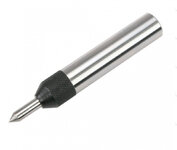
Ordering a new tap handle with a center point is a good solution.

But being the Garage Journal, I have to recommend the alternative of buying the following and modifying your tap handle

metal lathe
4 jaw chuck
dial indicator
magnetic indicator base
drill chuck for tail stock
center drill

You will find other uses for it 😛
 

CapriMikeC

Well-known member
Joined
May 31, 2019
Messages
441
Location
AZ
Haas has a good video about taps. Although much of the info is related to use in a CNC, there's a lot of explanations on tap types.


dutchgray

Well-known member
Joined
Sep 28, 2014
Messages
6,480
Location
Dorset. England.
If you're going to dissolve the tap, go with a higher concentration than 5% sulphuric acid. It's definitely working - a hole is chewed through the center of a few of them.

DSC_9397.JPG

The offending parts and tap boneyard:

DSC_9403.JPG
Possibly want to make yourself a nurled thumb wheel to drive these tiny taps with over using a tap wrench, even one as nice as those Starrett's.
 

Stubby1743

Well-known member
Joined
Jul 16, 2023
Messages
755
Location
UK
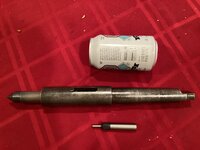
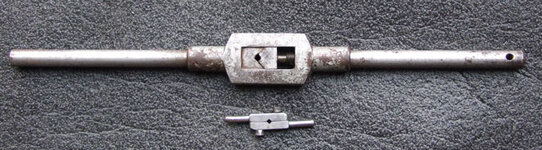
The first step in successful hand tapping is to use a size of tap holder that is appropriate for the size of tap being used. Using a tap handle that is too large gives too much potential for breaking the tap if its not perfectly aligned with the hole due to the amount of leverage available. Also, as has already been mentioned, if you use a holder that is too big/heavy, you loose some feel of what the tap is doing.

I have probably 10 or more different sizes of tap holder, which may be slight overkill in the best GJ tradition.

The long one below is 14 1/2" and the small one is 2 1/2".

DSCF9798R.jpg
 
To avoid these ads, REGISTER NOW!
Top Bottom