To avoid these ads, REGISTER NOW!

Teaching myself to TIG weld - possible?

sberry

Banned
Joined
Jun 18, 2005
Messages
35,747
Location
Brethren, Michigan
Mostly in processes like the sanitary and piping where most guys don't do it in the first place but don't practice it long enough to perfect it.
 
To avoid these ads, REGISTER NOW!

e015475

Well-known member
Joined
Jul 24, 2012
Messages
643
Location
Show Low and Mesa Arizona
I wanted to learn how to weld chromolly aircraft tube, so I bought a bag of 4130 thin wall tubing scraps from Aircraft Spruce and sat down for an hour or so every night for about a month and fish-mouthed tube and welded it together. Taught me a lot about fit up, positioning techniques and the weld process.

After I could make a presentable cluster joint of 4130 I took a welding class at the local community college and getting some direct feedback helped my technique and corrected some bad habits I'd developed teaching myself.

At this point I'm an 'ok TIG welder, but I'd like to be a 'great' TIG welder with nice tight beads and that perfect heat control. I don't think I can get there watching videos and will need someone to mentor me to the next level, so I'm looking at local vocational schools and community colleges
 

Fueler

Well-known member
Joined
Jun 22, 2006
Messages
1,620
Location
Urbana, IL
I wanted to learn how to weld chromolly aircraft tube, so I bought a bag of 4130 thin wall tubing scraps from Aircraft Spruce and sat down for an hour or so every night for about a month and fish-mouthed tube and welded it together. Taught me a lot about fit up, positioning techniques and the weld process.

After I could make a presentable cluster joint of 4130 I took a welding class at the local community college and getting some direct feedback helped my technique and corrected some bad habits I'd developed teaching myself.

At this point I'm an 'ok TIG welder, but I'd like to be a 'great' TIG welder with nice tight beads and that perfect heat control. I don't think I can get there watching videos and will need someone to mentor me to the next level, so I'm looking at local vocational schools and community colleges

That is an excellent way to learn. I kind of went the same route years ago.
I started with a stick as a kid, got a mig and then a TIG. I had race cars to build and aluminum at work I needed to do hence the need to tig.

After a couple of years I sold off the mig. I have since bought large TIG machines and can do anything I want. Saved a long time but currently use a Dynasty 350. My third tig upgrade and hopefully the last.
For stick work I can plug into the tig.

If I had production, giterdone steel work to do a mig would be the right tool but I don't have that problem.

TIG might just be the most versatile welding form out there. I have fixed little bitty things for the wife on the order of pop can thin to really heavy wall steel tubing for shop fixturing.

For aluminum TIG wonderment this guys makes most of us look silly but something to aspire to.
http://marcellamanifoldsinc.com/

This guy's video are fun to watch. I think he has too much fun.
http://6061.com/
Videos:

And of course Jodies tips and tricks was already mentioned.
 
Last edited:

01birddog

Member
Joined
Mar 14, 2019
Messages
14
Location
Abingdon, Virginia
I didn't read all replies but in order i think. Clean work piece perfect, i guess you have a good foot control which can be very helpful in arc control, good steady hand....dont dip your TIG torch in puddle, if so re sharpen and dont try to let it clean itself. I think practice is the best thing and round up someone local that is really good. Usually one look at their welding station will tell you if they are good. These are my views and don't mean squat but i have been heli arcing for almost 50 years.
 

sberry

Banned
Joined
Jun 18, 2005
Messages
35,747
Location
Brethren, Michigan
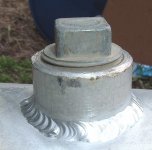
That looks super for a first try, you are a natural. Drive it like you stole it.\
That would be my first tig bead in about 5 years. A new machine can make make you feel like a super frickin hero.
 

Attachments

  • alum coupling.JPG
    alum coupling.JPG
    40 KB · Views: 49
Last edited:
To avoid these ads, REGISTER NOW!

Fix Until Broke

Well-known member
Joined
Feb 21, 2016
Messages
794
Location
SE Wisconsin
As others have mentioned, if you can gas weld well, then TIG will be relatively easy for you.

Practice, take pictures and share with us or others on welding specific forums with details of your settings and such. Start easy/small and work your way into more/more complex situations. Plain low carbon steel is the place to start. When you feel confident there, try some stainless (and get humbled :)). When you feel confident with stainless, go try some aluminum (and get humbled again :)).

Everyone is different, I know guys who can make spectacular welds on aluminum, out of position, with a rotary hand control and there's no way I can do that. My fine motor skills are in my finger tips/wrist, not my arms/shoulders. Some guys hold the torch like a baseball bat, others like a pencil (I'm a pencil holder). No right/wrong way here, just do what is most comfortable for you. I'm a big fan of the Tig Button - spendy, but worth every penny if you're not always in perfect position at a bench.

https://tigcontrol.com/

Good luck!
 

johnnyradiant

Well-known member
Joined
Mar 27, 2017
Messages
833
Location
Vancouver, BC
When I was learning we started with Oxy/Acet and progressed to stick, mig and then tig. Stick didn't feel like it did too much for me when grasping tig, but a lot of the torch work is what I felt I was using with the transition to tig. When learning don't just go by what you see and feel take the time to cut a cross section of your weld and take a good look at what lies beneath. I had some good looking stuff at first look but when we cut the cross section to look at, it was evident it was ok if I didn't need anything better than a tack, structurally it just wasn't quite there. The instructor put a smile on his face patted me on the back and sent me back to redo, and fine tune. When I was a teenager I worked as a bike mechanic. I think a lot of the bad welds I encountered on the brakes were from guys in a plant only getting as good as making it look pretty but not figuring out how to make it look good and be structurally sound too. I rewelded a lot of brake anchors on cheap off shore bikes that broke in the first few weeks after leaving the neighbouring dept store.
 

gsuty17

Well-known member
Joined
Mar 12, 2018
Messages
119
I am a passable self taught TIG welder as well. I had trouble finding specific advise, so I'll try to give you what I learned in a nutshell. I am no expert, this is all just opinion. In my experience this will be applicable for most normal situations- if you are doing something weird or specific research specifically for that exact application.

1. Watch all of Jody's videos; he is a gangster.

2. Use a 3/32 diameter 2% lanthanated tungsten, ground to a 30 degree included angle. This will work for mild steel, stainless steel, and aluminum. For thin metals- don't go to thin metals yet. Grind a steeper angle down the road once you've mastered thicker (.120 and thicker) metals.

3. Use a No. 6 or No. 8 cup with a gas lens if you have one, not a big deal if you don't have one. Pure argon ~15 cfm for most applications. Don't weld in breezy conditions if possible.

4. Use ER70S-2 filler. You'll have finer control with 1/16 diameter filler but feeding it is more difficult than 3/32. Try both. It will change your bead. Depending on the joint, you may not even need filler.

5. Start on mild steel. Remove scale and/or rust before welding. The better (closer) the joint, the better the weld. Remove all gaps.

6. Get comfortable. It's no secret that most of the **** welds you see online were often done with elaborate setups that allow you to stay as comfortable as possible for the duration of the weld.

7. Keep your tungsten closer to your work than you think. Approximately 3/32 away from your work (same as tungsten diameter). (This made a big improvement for me; I was always too far away)

8. Keep your torch perpendicular to your bead. (This made a big difference for me too)

9. Use your amperage control. Until you get comfortable, hold the pedal to the metal and limit heat by dialing down your amps. Start a few amps under the thickness of the steel in thousandths e.g. .125" thick steel, start at 100 amps. Try a bead and dial until you are happy with the heat level.

10. Get good with steel before bothering with aluminum.

11. Have fun with it! I found it more helpful to practice on a dumb project than just bead after bead after bead, although that is obviously great practice too.
 

Jayhawk_Aviator

Well-known member
Joined
Jun 2, 2015
Messages
123
I am in the exact same boat. Learning how to weld and struggling with good results. Anyone in the Kansas City area willing to give me a lesson or two for a fee? I have a Lincoln gig 200 and am generally doing all the recommendations above.
 

Samh

Well-known member
Joined
Aug 16, 2006
Messages
482
Location
Canton GA
Self taught starting out. That being said, reading something in a book or watching a video is good, but you can't replace a knowledgeable individual that can't tell you why certain things are happening and how to correct them.
 
To avoid these ads, REGISTER NOW!
Top Bottom