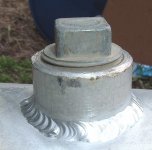
I am a passable self taught TIG welder as well. I had trouble finding specific advise, so I'll try to give you what I learned in a nutshell. I am no expert, this is all just opinion. In my experience this will be applicable for most normal situations- if you are doing something weird or specific research specifically for that exact application.
1. Watch all of Jody's videos; he is a gangster.
2. Use a 3/32 diameter 2% lanthanated tungsten, ground to a 30 degree included angle. This will work for mild steel, stainless steel, and aluminum. For thin metals- don't go to thin metals yet. Grind a steeper angle down the road once you've mastered thicker (.120 and thicker) metals.
3. Use a No. 6 or No. 8 cup with a gas lens if you have one, not a big deal if you don't have one. Pure argon ~15 cfm for most applications. Don't weld in breezy conditions if possible.
4. Use ER70S-2 filler. You'll have finer control with 1/16 diameter filler but feeding it is more difficult than 3/32. Try both. It will change your bead. Depending on the joint, you may not even need filler.
5. Start on mild steel. Remove scale and/or rust before welding. The better (closer) the joint, the better the weld. Remove all gaps.
6. Get comfortable. It's no secret that most of the **** welds you see online were often done with elaborate setups that allow you to stay as comfortable as possible for the duration of the weld.
7. Keep your tungsten closer to your work than you think. Approximately 3/32 away from your work (same as tungsten diameter). (This made a big improvement for me; I was always too far away)
8. Keep your torch perpendicular to your bead. (This made a big difference for me too)
9. Use your amperage control. Until you get comfortable, hold the pedal to the metal and limit heat by dialing down your amps. Start a few amps under the thickness of the steel in thousandths e.g. .125" thick steel, start at 100 amps. Try a bead and dial until you are happy with the heat level.
10. Get good with steel before bothering with aluminum.
11. Have fun with it! I found it more helpful to practice on a dumb project than just bead after bead after bead, although that is obviously great practice too.


 ). When you feel confident with stainless, go try some aluminum (and get humbled again