

American Locomotive
Well-known member
Not my own project, but I'm helping with it, and I figured you guys would like it.
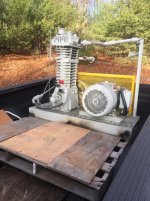
So a buddy of mine found "make your own compressor" deal on Craigslist. It was a large electric motor and cast iron pump bolted to a steel base plate for $100. It was being sold by a local company that hadn't used it for several years, and it had no tank, switch gear, etc... For $100, it was probably worth it for the motor alone. Well my friend went and picked it up, where he quickly found out he got a lot more than he expected.

For reference, it's sitting in a full-sized F-350 bed. Approximate weight of that setup, just the motor, base-plate and pump is about 750 pounds.
What my buddy ended up getting was a Blackmer HD372 pump with a 15HP 3-phase electric motor. (He had no use for the motor, which I'll be taking to build an RPC to power my Lincoln dc-250 mk motor-generator welder, but that's another project for another thread).
It turns out this isn't an ordinary compressor pump. It's an industrial "gas compressor" pump, using a cross-head design that seals and isolates the pistons from the crankcase. It's rated to compress basically any kind of gas: air, natural gas, propane - even gaseous ammonia. The crosshead design also increases durability, since the pistons only move up and down, with no side-load.
Here's a cut-away diagram showing the cross-head design:

This particular model is a twin-stage design rated to pump 24 CFM with a maximum working pressure of 600 PSI. It's also got all sorts of features on it, like an oil-pressure cutout switch, electronic/pneumatic unloaders, full-pressure lube system with a spin on filter, etc.
Luckily at reduced speed, pressure (~175 PSI) and overall flow-rate, this particular pump is rated for use with motors down to 5 HP, which is what will be installed on it. It should also live a very easy life at these sort of pressures, compared to what it normally runs at.
That's really all we got for now, still need to get the other pieces to the puzzle - like a tank and a motor. I'll be updating the thread as we progress.
So a buddy of mine found "make your own compressor" deal on Craigslist. It was a large electric motor and cast iron pump bolted to a steel base plate for $100. It was being sold by a local company that hadn't used it for several years, and it had no tank, switch gear, etc... For $100, it was probably worth it for the motor alone. Well my friend went and picked it up, where he quickly found out he got a lot more than he expected.
For reference, it's sitting in a full-sized F-350 bed. Approximate weight of that setup, just the motor, base-plate and pump is about 750 pounds.
What my buddy ended up getting was a Blackmer HD372 pump with a 15HP 3-phase electric motor. (He had no use for the motor, which I'll be taking to build an RPC to power my Lincoln dc-250 mk motor-generator welder, but that's another project for another thread).
It turns out this isn't an ordinary compressor pump. It's an industrial "gas compressor" pump, using a cross-head design that seals and isolates the pistons from the crankcase. It's rated to compress basically any kind of gas: air, natural gas, propane - even gaseous ammonia. The crosshead design also increases durability, since the pistons only move up and down, with no side-load.
Here's a cut-away diagram showing the cross-head design:
This particular model is a twin-stage design rated to pump 24 CFM with a maximum working pressure of 600 PSI. It's also got all sorts of features on it, like an oil-pressure cutout switch, electronic/pneumatic unloaders, full-pressure lube system with a spin on filter, etc.
Luckily at reduced speed, pressure (~175 PSI) and overall flow-rate, this particular pump is rated for use with motors down to 5 HP, which is what will be installed on it. It should also live a very easy life at these sort of pressures, compared to what it normally runs at.
That's really all we got for now, still need to get the other pieces to the puzzle - like a tank and a motor. I'll be updating the thread as we progress.
Attachments

Last edited: