
ConCretin
Well-known member
After years of planning, we’ve finally started construction of a new home including an attached 25x25 garage and adjoining 28x28 shop. Like so many of you, I’ve been entertained and educated by GJ over the years and am excited to contribute with a build thread of my own. Let me start with a little background.
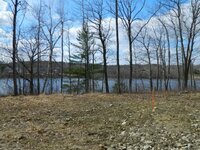
The project is located in Maine on 25 acres on the East bank of the beautiful Kennebec River. My wife and I searched for land on the river for many years before buying this parcel about 10 years ago.
The land was originally the site of an 1800‘s era ice house. Workers harvested ice from the river in winter and stored it in huge wooden structures packed in sawdust until summer when it was sold for refrigeration. The topography of the land still bears the imprint of that enterprise including old stone foundations for stables and barracks. There is even an old pier that was used to load the ice on schooner ships that would carry it all over the world.
I’ve already constructed some of the infrastructure including a 2,000 foot driveway that winds its way down to the river. Underground power takes a more direct route and measures a little over 1000 feet. The septic system is in and the wells are drilled. The actual build site has been cleared and we hauled in several thousand yards of fill to bring the grade up.
I've also constructed another garage on the property. It measures 28x32 and is located up near the main road. It’s primarily an unheated storage building although it does have a couple interesting features including an overhead bridge crane and a bifold door that was used so as not to block access to the crane. I use this garage to house snow removal equipment and as overflow space for the smallish shop down by the water.
The house is located in an environmentally protected area called the Shoreland Zone because it is within 250' of a body of water. As a result we underwent an extensive permit process and must abide by rules covering run off, tree cutting and set backs. At its nearest point the house edges up to just over 75 feet from the high water mark at the top of a 30 foot slope down to the shoreline.
Now for the interesting part. The house and garage will be of modern design and constructed entirely of concrete and steel. It won’t have a single stick of wood in it and will look something like this:
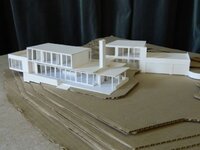
In case you are wondering why on earth we would build a concrete house, it's mostly for the challenge and novelty of it. I own a heavy commercial/industrial concrete construction business and do structural concrete on projects ranging from bridges to hospitals to waste water treatment plants. I thought that since I’m in the business, it would be cheaper than a traditional wood framed house. Like so many other things I assumed at the beginning of this process, this too has since proved wrong.
If you look to the back right of the photo, you’ll see the garage and shop. The 25x25 garage will be accessed by the wider 18’ door and will be for parking our daily drivers. The single garage door services the 28x28 shop. It was one bay wide when the model was created but has predictably grown wider and deeper since. This pushed the structure back into the slope and almost entirely underground hence the thread title.
The garage and shop have traditional reinforced concrete foundations and slabs on grade. The superstructure walls are constructed of insulating concrete forms (ICF’s) with an 8” concrete core contained within 2 1/2” foam sides. The low slope roof is a composite of steel, concrete and styrofoam that will be difficult to explain and since I’m running up the word count, I’ll come back to it later.
Heat will be in-floor radiant utilizing geothermal heat pumps fed by two standing column water wells. Electrical will be pretty standard with lots of lights and outlets including 220 for compressors, welders, etc. There is also a small water closet and a shop sink.
Though it doesn’t show in the plans, I’ve added a compressor closet to the left of the bath that will be accessed from the garage. This should keep the noise down in the shop area. An air supply system will be constructed of PVC.............not really, just checking to see if your still awake - it will be black iron pipe.
Walls and ceiling will be gypsum wall board affixed to the ICF’s or metal furring over rigid insulation on the foundation walls. The floor will probably be porcelain tiles. Other features will include an overhead bridge crane, Rotary in-floor lift and a large clerestory window bay on the roof to provide natural light and clearance for the lift.
Here is a basic floor plan that hopefully completes the overall picture. The actual shop layout hasn’t been developed yet but rest assured, this will be a working garage not a show place.

So, if you haven’t already bailed for less windy threads, I hope you’ll hang around for the build. I obviously intend to focus on primarily on the garage space but since the overall project is a little unusual, I hope you’ll feel free to ask questions about anything you care to.
I feel like I’ve worked and prepared my entire life to build this house and would be honored to share it with all of you. I’ll be back shortly with photos and I promise that in the future, I’ll try to post more pictures than paragraphs.
If you're not familiar with concrete terminology, the following is a glossary of terms as I have used them in this thread. An expanded list can be found in The Concrete Underground Glossary.
Air Entrained Concrete - Concrete that has been treated with a chemical admixture that produces millions of microscopic air bubbles that allow it to expand and contract under freeze / thaw conditions without damage.
Architectural concrete (AC) - A concrete structure that will be exposed to view and is constructed in a manner that results in a smooth uniform surface with minimal form lines.
Blockout - Formwork to create an opening in a concrete wall or floor.
Buck - A form that creates a door or window opening in an ICF wall and stays in place to provide a nailing surface for the door or window and finishes.
Control Joint - A saw cut, formed or tooled groove in concrete intended to create a plane of weakness that encourages a controlled and easily hidden shrinkage crack.
Dowels - Reinforcing bars that protrude from the concrete to connect it to future wall or slab placements.
LiteDeck - A brand of stay-in-place form used to build concrete floors or roofs consisting of styrofoam planks with longitudinal 'troughs' that create integral beams when filled with concrete.
Geothermal - A process of heating or cooling a home utilizing a constant temperature water source such as groundwater or body of water and heat pumps. We're using an open loop system that pumps water directly from a well, through the heat pumps and back into the well.
Gravel - This term varies greatly by region. In Maine gravel refers to a granular material with a well graded mix of aggregate from fines up to stone of 2" or greater. As opposed to crushed stone, which has no fines.
High Range Water Reducer - Also called a super-plasticizer is a chemical admixture added to concrete to increase flowability without additional water resulting in a slump of 7 to 9 inches (see slump)
Insulating Concrete Forms (ICF) - Stackable styrofoam blocks that are filled with concrete to create structural walls. Blocks consist of two styrofoam faces held together with plastic webs that also act as screw blocks for attaching drywall and siding.
Midrange Water Reducer - A chemical admixture added to concrete to increase flowability without additional water resulting in a slump of 5 to 6 inches (see slump)
Rustication - Strips of wood or other material attached to the face of a form to create a reveal in the concrete when removed.
Screed - A straightedge typically 2 x 4 inches used by one or more men to level concrete by dragging it across the surface.
Sleeve - Something placed in concrete formwork, usually a piece of pipe, to create an opening for something to pass through the wall after it is stripped.
Shoring - Temporary heavy duty staging that supports formwork or LiteDeck planks under elevated slabs.
Strongback - A vertical stiffener added to concrete formwork to plumb a wall and/or transfer loads to ties or braces.
Slump - A measure of the flowability of concrete typically used to determine water content. A 12" tapered metal cone is filled with concrete and pulled off and the distance the concrete 'slumps' is measured. Most concrete mix designs are based on enough water to achieve a 4" slump, which is a reasonably workable mix.
ThermoMass - A proprietary system that allows rigid insulation to be installed in a formed concrete wall. The insulation board is held in place with plastic spacers allow concrete to flow on all sides.
Tie - The device that holds the two sides of a concrete form together resisting the pressure applied by concrete. Ties come in a broad range of types and materials for both proprietary and generic form systems.
Waler - A horizontal stiffener added to concrete formwork to straighten a wall and/or transfer loads to ties or braces.
Water/Cement Ratio - Determines the ultimate compressive strength of concrete. The greater the proportion of cement relative to mix water, the higher the strength.
The project is located in Maine on 25 acres on the East bank of the beautiful Kennebec River. My wife and I searched for land on the river for many years before buying this parcel about 10 years ago.
The land was originally the site of an 1800‘s era ice house. Workers harvested ice from the river in winter and stored it in huge wooden structures packed in sawdust until summer when it was sold for refrigeration. The topography of the land still bears the imprint of that enterprise including old stone foundations for stables and barracks. There is even an old pier that was used to load the ice on schooner ships that would carry it all over the world.
I’ve already constructed some of the infrastructure including a 2,000 foot driveway that winds its way down to the river. Underground power takes a more direct route and measures a little over 1000 feet. The septic system is in and the wells are drilled. The actual build site has been cleared and we hauled in several thousand yards of fill to bring the grade up.
I've also constructed another garage on the property. It measures 28x32 and is located up near the main road. It’s primarily an unheated storage building although it does have a couple interesting features including an overhead bridge crane and a bifold door that was used so as not to block access to the crane. I use this garage to house snow removal equipment and as overflow space for the smallish shop down by the water.
The house is located in an environmentally protected area called the Shoreland Zone because it is within 250' of a body of water. As a result we underwent an extensive permit process and must abide by rules covering run off, tree cutting and set backs. At its nearest point the house edges up to just over 75 feet from the high water mark at the top of a 30 foot slope down to the shoreline.
Now for the interesting part. The house and garage will be of modern design and constructed entirely of concrete and steel. It won’t have a single stick of wood in it and will look something like this:
In case you are wondering why on earth we would build a concrete house, it's mostly for the challenge and novelty of it. I own a heavy commercial/industrial concrete construction business and do structural concrete on projects ranging from bridges to hospitals to waste water treatment plants. I thought that since I’m in the business, it would be cheaper than a traditional wood framed house. Like so many other things I assumed at the beginning of this process, this too has since proved wrong.
If you look to the back right of the photo, you’ll see the garage and shop. The 25x25 garage will be accessed by the wider 18’ door and will be for parking our daily drivers. The single garage door services the 28x28 shop. It was one bay wide when the model was created but has predictably grown wider and deeper since. This pushed the structure back into the slope and almost entirely underground hence the thread title.
The garage and shop have traditional reinforced concrete foundations and slabs on grade. The superstructure walls are constructed of insulating concrete forms (ICF’s) with an 8” concrete core contained within 2 1/2” foam sides. The low slope roof is a composite of steel, concrete and styrofoam that will be difficult to explain and since I’m running up the word count, I’ll come back to it later.
Heat will be in-floor radiant utilizing geothermal heat pumps fed by two standing column water wells. Electrical will be pretty standard with lots of lights and outlets including 220 for compressors, welders, etc. There is also a small water closet and a shop sink.
Though it doesn’t show in the plans, I’ve added a compressor closet to the left of the bath that will be accessed from the garage. This should keep the noise down in the shop area. An air supply system will be constructed of PVC.............not really, just checking to see if your still awake - it will be black iron pipe.
Walls and ceiling will be gypsum wall board affixed to the ICF’s or metal furring over rigid insulation on the foundation walls. The floor will probably be porcelain tiles. Other features will include an overhead bridge crane, Rotary in-floor lift and a large clerestory window bay on the roof to provide natural light and clearance for the lift.
Here is a basic floor plan that hopefully completes the overall picture. The actual shop layout hasn’t been developed yet but rest assured, this will be a working garage not a show place.
So, if you haven’t already bailed for less windy threads, I hope you’ll hang around for the build. I obviously intend to focus on primarily on the garage space but since the overall project is a little unusual, I hope you’ll feel free to ask questions about anything you care to.
I feel like I’ve worked and prepared my entire life to build this house and would be honored to share it with all of you. I’ll be back shortly with photos and I promise that in the future, I’ll try to post more pictures than paragraphs.
If you're not familiar with concrete terminology, the following is a glossary of terms as I have used them in this thread. An expanded list can be found in The Concrete Underground Glossary.
Air Entrained Concrete - Concrete that has been treated with a chemical admixture that produces millions of microscopic air bubbles that allow it to expand and contract under freeze / thaw conditions without damage.
Architectural concrete (AC) - A concrete structure that will be exposed to view and is constructed in a manner that results in a smooth uniform surface with minimal form lines.
Blockout - Formwork to create an opening in a concrete wall or floor.
Buck - A form that creates a door or window opening in an ICF wall and stays in place to provide a nailing surface for the door or window and finishes.
Control Joint - A saw cut, formed or tooled groove in concrete intended to create a plane of weakness that encourages a controlled and easily hidden shrinkage crack.
Dowels - Reinforcing bars that protrude from the concrete to connect it to future wall or slab placements.
LiteDeck - A brand of stay-in-place form used to build concrete floors or roofs consisting of styrofoam planks with longitudinal 'troughs' that create integral beams when filled with concrete.
Geothermal - A process of heating or cooling a home utilizing a constant temperature water source such as groundwater or body of water and heat pumps. We're using an open loop system that pumps water directly from a well, through the heat pumps and back into the well.
Gravel - This term varies greatly by region. In Maine gravel refers to a granular material with a well graded mix of aggregate from fines up to stone of 2" or greater. As opposed to crushed stone, which has no fines.
High Range Water Reducer - Also called a super-plasticizer is a chemical admixture added to concrete to increase flowability without additional water resulting in a slump of 7 to 9 inches (see slump)
Insulating Concrete Forms (ICF) - Stackable styrofoam blocks that are filled with concrete to create structural walls. Blocks consist of two styrofoam faces held together with plastic webs that also act as screw blocks for attaching drywall and siding.
Midrange Water Reducer - A chemical admixture added to concrete to increase flowability without additional water resulting in a slump of 5 to 6 inches (see slump)
Rustication - Strips of wood or other material attached to the face of a form to create a reveal in the concrete when removed.
Screed - A straightedge typically 2 x 4 inches used by one or more men to level concrete by dragging it across the surface.
Sleeve - Something placed in concrete formwork, usually a piece of pipe, to create an opening for something to pass through the wall after it is stripped.
Shoring - Temporary heavy duty staging that supports formwork or LiteDeck planks under elevated slabs.
Strongback - A vertical stiffener added to concrete formwork to plumb a wall and/or transfer loads to ties or braces.
Slump - A measure of the flowability of concrete typically used to determine water content. A 12" tapered metal cone is filled with concrete and pulled off and the distance the concrete 'slumps' is measured. Most concrete mix designs are based on enough water to achieve a 4" slump, which is a reasonably workable mix.
ThermoMass - A proprietary system that allows rigid insulation to be installed in a formed concrete wall. The insulation board is held in place with plastic spacers allow concrete to flow on all sides.
Tie - The device that holds the two sides of a concrete form together resisting the pressure applied by concrete. Ties come in a broad range of types and materials for both proprietary and generic form systems.
Waler - A horizontal stiffener added to concrete formwork to straighten a wall and/or transfer loads to ties or braces.
Water/Cement Ratio - Determines the ultimate compressive strength of concrete. The greater the proportion of cement relative to mix water, the higher the strength.
Last edited:



![raywardcarport[1].jpg](/forum/data/attachments/171/171575-298139606c72d1e7b1781e775b5d8493.jpg)

![DSCN0036[1].jpg](/forum/data/attachments/172/172051-bbe5314bb266020b04118f914bc70172.jpg)


