Hohn
Well-known member
One of my total geek-out things is electronics soldering. I actually LOVE the challenge of making the perfect joint. So here's the thread for talking about all things related to electronics soldering. I'll start us off by sharing a couple of my best tips and suggestions.
I have about a lifetime supply of leaded solder now (13#?) and each of those 1# rolls varies slightly by wire diameter as well as flux type and percentage. All but a couple are eutectic leaded solder. I find that once you get your technique down, 60/40 seems to work about as well as eutectic does. Sometimes 60/40 is cheaper to buy.
People are selling old rolls of leaded solder on Ebay for CHEAP because the big industrial packages still have a lot left they cannot use because of the RoHS baloney and the vastly overblown concern about leaded solder. (lead is toxic, but leaded solder doesn't leach and doesn't get airborne and doesn't contribute to lead levels in human blood even enough to measure).
Isn't it interesting that in mission critical electronics-- the military, space programs, and medical devices-- they get full exemption from RoHS and still use leaded solder? HMMMM.
- If you haven't soldered much or want to improve your skills, start by watching the Pace tutorial on Youtube. It's from a 1980 instructional film and it's still the best soldering how-to that's ever been done.
- Only use SN63 Eutectic leaded solder unless required to use something else.
- Don't rely on just the flux in the solder wire-- get some additional flux.
- Pay attention to flux content and type-- there are no-cleans, water cleans, and other variants. You want either no-clean or plain activated rosin (RA or RMA flux).
- Stick with thinner solder wires to have more control over the amount of solder used. 0.032" wire is borderline too heavy for most work, with 0.025" and 0.020" being excellent general-purpose wire diameters.
- Use a soldering iron or station with temperature control. It costs only a little bit more and the difference in your results is miles better. My first iron (without temperature control) would hit nearly 900F sitting in the holder. That's WAY TOO HOT and it not only ruins the tip (even if tinned), it ruins the things you are soldering.
- If you absolutely cannot get some temperature control, the next best thing is a footpedal momentary-on extension cord. I plug a cheap iron into one I got at HF and then just step on it when I need the heat. Yes, it's slower and the control is rather crude, but it works MUCH better this way and I can keep the tips nicely tinned and manage the heat (Think of it as being like a TIG pedal, only acting very slowly).
- Solder should only be applied to the tip when 1) tinning the tip or 2) making a thermal bridge to heat from the tip to the work. Otherwise, you always apply the solder to the workpiece, not the tip. This preserves the flux and lets it do its job instead of getting burned off.
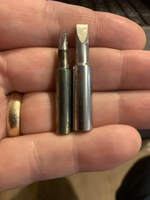
- Tip selection REALLY MATTERS. Cranking up the temperature is a poor bandaid at best for trying to get more heat from a needle-like tip with no mass. If you are soldering something that requires a lot of heat (because it has high thermal mass), then you need a large tip. There's no getting around it. A large tip at 350C/662F works MUCH better than a tiny conical tip at nuclear hot temps. Remember, heat and temperature are not the same thing. Mass matters.
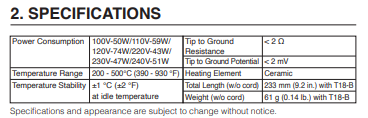
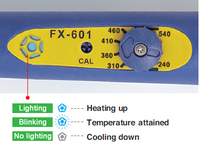
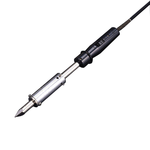
- Buy only soldering tools with a wide variety of tip sizes or you'll end up not able to do what you need to do. My favorite "cheap" soldering tool is the Hakko FX600 because it can be adapted to use tips as large as a massive 6.5mm chisel while it also can use tips that are needle like. It's the most versatile soldering tool under $100 by far.
I have about a lifetime supply of leaded solder now (13#?) and each of those 1# rolls varies slightly by wire diameter as well as flux type and percentage. All but a couple are eutectic leaded solder. I find that once you get your technique down, 60/40 seems to work about as well as eutectic does. Sometimes 60/40 is cheaper to buy.
People are selling old rolls of leaded solder on Ebay for CHEAP because the big industrial packages still have a lot left they cannot use because of the RoHS baloney and the vastly overblown concern about leaded solder. (lead is toxic, but leaded solder doesn't leach and doesn't get airborne and doesn't contribute to lead levels in human blood even enough to measure).
Isn't it interesting that in mission critical electronics-- the military, space programs, and medical devices-- they get full exemption from RoHS and still use leaded solder? HMMMM.
Last edited: