To avoid these ads, REGISTER NOW!

The Electronics Soldering Thread

Hohn

Well-known member
Joined
Aug 25, 2016
Messages
2,640
Location
Diesel Central, Indiana
One of my total geek-out things is electronics soldering. I actually LOVE the challenge of making the perfect joint. So here's the thread for talking about all things related to electronics soldering. I'll start us off by sharing a couple of my best tips and suggestions.


  • If you haven't soldered much or want to improve your skills, start by watching the Pace tutorial on Youtube. It's from a 1980 instructional film and it's still the best soldering how-to that's ever been done.
  • Only use SN63 Eutectic leaded solder unless required to use something else.
  • Don't rely on just the flux in the solder wire-- get some additional flux.
    • Pay attention to flux content and type-- there are no-cleans, water cleans, and other variants. You want either no-clean or plain activated rosin (RA or RMA flux).
  • Stick with thinner solder wires to have more control over the amount of solder used. 0.032" wire is borderline too heavy for most work, with 0.025" and 0.020" being excellent general-purpose wire diameters.
  • Use a soldering iron or station with temperature control. It costs only a little bit more and the difference in your results is miles better. My first iron (without temperature control) would hit nearly 900F sitting in the holder. That's WAY TOO HOT and it not only ruins the tip (even if tinned), it ruins the things you are soldering.
    • If you absolutely cannot get some temperature control, the next best thing is a footpedal momentary-on extension cord. I plug a cheap iron into one I got at HF and then just step on it when I need the heat. Yes, it's slower and the control is rather crude, but it works MUCH better this way and I can keep the tips nicely tinned and manage the heat (Think of it as being like a TIG pedal, only acting very slowly).
  • Solder should only be applied to the tip when 1) tinning the tip or 2) making a thermal bridge to heat from the tip to the work. Otherwise, you always apply the solder to the workpiece, not the tip. This preserves the flux and lets it do its job instead of getting burned off.
  • Tip selection REALLY MATTERS. Cranking up the temperature is a poor bandaid at best for trying to get more heat from a needle-like tip with no mass. If you are soldering something that requires a lot of heat (because it has high thermal mass), then you need a large tip. There's no getting around it. A large tip at 350C/662F works MUCH better than a tiny conical tip at nuclear hot temps. Remember, heat and temperature are not the same thing. Mass matters.
    • Buy only soldering tools with a wide variety of tip sizes or you'll end up not able to do what you need to do. My favorite "cheap" soldering tool is the Hakko FX600 because it can be adapted to use tips as large as a massive 6.5mm chisel while it also can use tips that are needle like. It's the most versatile soldering tool under $100 by far.

I have about a lifetime supply of leaded solder now (13#?) and each of those 1# rolls varies slightly by wire diameter as well as flux type and percentage. All but a couple are eutectic leaded solder. I find that once you get your technique down, 60/40 seems to work about as well as eutectic does. Sometimes 60/40 is cheaper to buy.

People are selling old rolls of leaded solder on Ebay for CHEAP because the big industrial packages still have a lot left they cannot use because of the RoHS baloney and the vastly overblown concern about leaded solder. (lead is toxic, but leaded solder doesn't leach and doesn't get airborne and doesn't contribute to lead levels in human blood even enough to measure).

Isn't it interesting that in mission critical electronics-- the military, space programs, and medical devices-- they get full exemption from RoHS and still use leaded solder? HMMMM.
 
Last edited:
To avoid these ads, REGISTER NOW!

RonRock

Well-known member
Joined
Oct 6, 2007
Messages
1,171
Location
Iowa, USA
I'll defiantly be following this. I found this as I was asking for electronics advice. Good timing.
 

Buckaroo5

Well-known member
Joined
Oct 18, 2012
Messages
822
Location
Central Ohio
Good thread. I have been looking at a new soldering station and have found these. I don't want to spend a lot of money because it would be for occasional use only but I don't want to buy junk. Suggestions?

Weller WLSK3012A - $40
Weller WE1010 - $115
Hakko FX-888D - $110
 

tool_scrounge

Well-known member
Joined
Jul 20, 2010
Messages
4,183
Location
Southern California
People are selling old rolls of leaded solder on Ebay for CHEAP because the big industrial packages still have a lot left they cannot use because of the RoHS baloney and the vastly overblown concern about leaded solder.
Or they are selling it as it is out of date. I presume the solder itself is fine but the rosin core is what degrades over time. For home use it probably is fine. Or use liquid rosin flux if needed.
 
OP
H

Hohn

Well-known member
Joined
Aug 25, 2016
Messages
2,640
Location
Diesel Central, Indiana
Good thread. I have been looking at a new soldering station and have found these. I don't want to spend a lot of money because it would be for occasional use only but I don't want to buy junk. Suggestions?

Weller WLSK3012A - $40
Weller WE1010 - $115
Hakko FX-888D - $110

The Weller 3012a is junk.

The We1010 is functional and useful, very similar to the FX888D Hakko. It's basically the "entry level" stations from those two brands that are the minimum that isn't ****. The Hakko has better quality tips. The Weller has more availability in Europe and better support in some areas. Hakko has plenty of support in USA.


The best-kept secret, though is the Hakko FX-600. It takes the same tips at the FX-888D, has adjustable temperature like the FX-888, and has the same power. But it's only $45 on Amazon and it's a truly useful pro tool. (I have it's sibling the FX-601 on my bench as I type this). I also have $800 worth of other Hakko stations on my bench, and the FX-600/1 fits right in.


If you compare the FX-600 and FX-601, you might wonder why these two Hakko models are so different in price. They are the same power output and have similar temperature adjustment ranges. THEY ARE ESSENTIALLY THE SAME IRON.
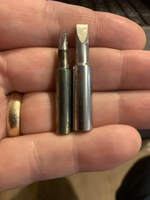
The difference is the tip series. The 600 uses the older T18 tips (like the FX-888D) while the FX601 uses the higher-heat-capacity T19 tips.

Here's the T18 vs T19 tip:
1698763087520.png

1698763117673.png


The T19 is a beefier tip series that holds more heat and overall just works better.
But you can easily convert a 600 to a 601 and vice versa just by replacing the ferrule that holds the tip over the heater. It's an $8 part when I bought mine. So get either the 600 or 601 (whichever is cheaper) and then convert to the other if you need a tip not offered in your series.


Convert a T19 FX601 to use T18s with this.
Convert a t18 FX600 to use T19s with this.
 

Buckaroo5

Well-known member
Joined
Oct 18, 2012
Messages
822
Location
Central Ohio
The Weller 3012a is junk.

The We1010 is functional and useful, very similar to the FX888D Hakko. It's basically the "entry level" stations from those two brands that are the minimum that isn't ****. The Hakko has better quality tips. The Weller has more availability in Europe and better support in some areas. Hakko has plenty of support in USA.


The best-kept secret, though is the Hakko FX-600. It takes the same tips at the FX-888D, has adjustable temperature like the FX-888, and has the same power. But it's only $45 on Amazon and it's a truly useful pro tool. (I have it's sibling the FX-601 on my bench as I type this). I also have $800 worth of other Hakko stations on my bench, and the FX-600/1 fits right in.


If you compare the FX-600 and FX-601, you might wonder why these two Hakko models are so different in price. They are the same power output and have similar temperature adjustment ranges. THEY ARE ESSENTIALLY THE SAME IRON.
The difference is the tip series. The 600 uses the older T18 tips (like the FX-888D) while the FX601 uses the higher-heat-capacity T19 tips.

Here's the T18 vs T19 tip:
1698763087520.png

1698763117673.png


The T19 is a beefier tip series that holds more heat and overall just works better.
But you can easily convert a 600 to a 601 and vice versa just by replacing the ferrule that holds the tip over the heater. It's an $8 part when I bought mine. So get either the 600 or 601 (whichever is cheaper) and then convert to the other if you need a tip not offered in your series.


Convert a T19 FX601 to use T18s with this.
Convert a t18 FX600 to use T19s with this.
Thank you - this is great information and may buy one of these. Some discussion on reviews about the fact that Japan voltage is 100V and running it at 120V US standard can prematurely burn out the ceramic heating element. Both the US version FX-601-02 and the Japanese market version FX-601-01 are the same?
 
OP
H

Hohn

Well-known member
Joined
Aug 25, 2016
Messages
2,640
Location
Diesel Central, Indiana
I've read it many times and I've actually seen the quality of the work the people at Robins AFB do when I was stationed there. All those technicians are artists and are doing NASA-acceptable work all day long. It's pretty amazing to see.

One interesting takeaway from that document is the remarks on tip temperature.
1698765333312.png

Reading the contents of the "tip temperature procedure" you realize that they are loathe to run the tip hotter. Rather, the procedure insists you clean and re-tin the tip and verify all the other aspects BEFORE you crank up the temperature.
And later on it will tell you that if you can't get results at these mild tip temperatures, you need to use a larger tip and/or preheat the parts so you can get in and out in 2 seconds without super hot tips.


Most cheap plug in irons will hit 850F or more when idling in the stand. THIS is why the tips get torched beyond hope (even if tinned) and why the results are awful.
When I first read the NAVAIR guide, I dropped my temperatures down to 300C (572F) and started slowly working my way up. It's pretty amazing how low you can go when you have clean parts, good flux, and quality solder.

As my technique improved, I was able to go a bit hotter as my skill improved and I could work faster. Still, I find rarely than anything above 680 is required, as temperature is a poor substitute for the the wrong tip geometry or poor technique.
 
OP
H

Hohn

Well-known member
Joined
Aug 25, 2016
Messages
2,640
Location
Diesel Central, Indiana
Thank you - this is great information and may buy one of these. Some discussion on reviews about the fact that Japan voltage is 100V and running it at 120V US standard can prematurely burn out the ceramic heating element. Both the US version FX-601-02 and the Japanese market version FX-601-01 are the same?
If my element ever fails, I'll let you know. It's been 3 years now and it's fine. Mine came in the blister pack with all the japanese writing on it's Japan-spec. I'll measure the current draw to confirm.
EDIT: from a cold start, the iron inrushes to 140w or so, then as it starts to warm it quickly drops to 69w-70w. Then once it's at temperature, it drops to a low-draw maintenance mode.

I set mine for 360C and it comes up to temp in about 12 seconds from dead cold.

Pretty sure the reviewers are full of baloney, airing a hypothetical concern that's not an actual concern.
 
OP
H

Hohn

Well-known member
Joined
Aug 25, 2016
Messages
2,640
Location
Diesel Central, Indiana
Thank you - this is great information and may buy one of these. Some discussion on reviews about the fact that Japan voltage is 100V and running it at 120V US standard can prematurely burn out the ceramic heating element. Both the US version FX-601-02 and the Japanese market version FX-601-01 are the same?
1698766474136.png
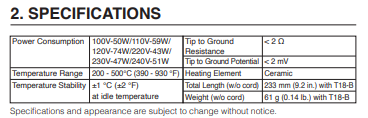
From the owner's manual. At 100V it's only rated 50w. There's no risk of "overheating" by running it at 120V as it's within the design parameters. My line voltage here is actually closer to 124V and it's fine. The ceramic heating element failures are not from overheating, but likely from having the ferrule nut too tight and cracking the element. Hand tight is always sufficient IME, no need for a tool of any kind.

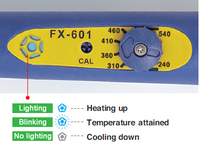
The "adjustment" referred to in by some of the Amazon commenters isn't because of a voltage difference, rather it's a calibration means for those situations where process controls require the use of a documented and verified tip temperature. It's a "pro" feature kind of out of place in a cheaper iron like this.

In reality, tip temperature isn't that important at all, as most of the time a window of 50F or so of temp will give similar results. The Pace training series highlights how temperature isn't that critical, rather it's how your technique adjusts to that temp.
 

RonRock

Well-known member
Joined
Oct 6, 2007
Messages
1,171
Location
Iowa, USA
Wow this thread too off.

I bought a Ksger T12 solder station off Bangkok or Ali express. Good reviews on YouTube. Seems good to me.
 

86turbodsl

Well-known member
Joined
Jul 1, 2005
Messages
6,556
Location
Michigan
Good thread. I went weller myself, but the Hakko's are also good. Part of it was the crazy bright colors they use... ;)

Anyone got comments on SMD workstations and equipment? I'm tooling up for that and would love to hear good tips.
 
OP
H

Hohn

Well-known member
Joined
Aug 25, 2016
Messages
2,640
Location
Diesel Central, Indiana
Weller is an excellent established brand. As is Hakko, JBC, Ersa, and PACE. All are used at the very highest levels of practice.
I'm glad people have luck with the KSGERs and chinese-based soldering tools, but I will never recommend them. There's simply too few tips available and of marginal quality for any kind of serious use. Lots of people are using them with results they're happy with, so feel free to discount my preference as snobbery.
 

WildBill

ALLIANCE MEMBER
Joined
Aug 20, 2021
Messages
2,007
Location
PNW
Look into Metcal soldering irons and the way they do temp control, best soldering irons made. I've switched three large electronic manufacturing companies to them, all had quality shoot up, scrap from damaged pcbs almost disappear, and replacement tip costs plummet. Their normal stations do not have or need an adjustable temp control as they actually maintain the tip temp even under high loads, boosting the power as needed to make it happen. They didn't used to even offer an iron with a adjustable temp but recently came out with a lower quality line that does have one. The rep said it was because people were so fixated on it, even though its not needed and actually harmful 99% of the time. You buy a tip set at whatever temp you want, usually 650F or 700F will cover everything a person needs. They are expensive new but can usually be found for cheap on ebay, I bought one not too long ago with a bunch of tips for about $80. I like the really old SP-PW1-10 system, a lot of companies used them so you can usually find them cheap. The tips last a long time, I have some tips that I have used for 20+ years now.
 
OP
H

Hohn

Well-known member
Joined
Aug 25, 2016
Messages
2,640
Location
Diesel Central, Indiana
Good thread. I went weller myself, but the Hakko's are also good. Part of it was the crazy bright colors they use... ;)

Anyone got comments on SMD workstations and equipment? I'm tooling up for that and would love to hear good tips.
SMD work is much bigger than an iron or soldering station-- that's actually the simplest part to solve. SMD means rework stations, good quality magnification (video microscopes on a large display), VERY clean working areas (lab conditions) and such.

Quality SMD work is a bit beyond the scope of most of us as home gamers if its going to be done correctly at volume. I know people are soldering 0402s at home with a $20 iron, but I can't recommend it.
 

RonRock

Well-known member
Joined
Oct 6, 2007
Messages
1,171
Location
Iowa, USA
Weller is an excellent established brand. As is Hakko, JBC, Ersa, and PACE. All are used at the very highest levels of practice.
I'm glad people have luck with the KSGERs and chinese-based soldering tools, but I will never recommend them. There's simply too few tips available and of marginal quality for any kind of serious use. Lots of people are using them with results they're happy with, so feel free to discount my preference as snobbery.
I am good with your opinion. I don't know enough about any of them to know the difference. The Ksger was cheap and seemed like a huge step up from the old Weller gun that I always used. Good to see some suggestions of decent units that don't break the bank. Maybe I'll grow into a better one.
 
OP
H

Hohn

Well-known member
Joined
Aug 25, 2016
Messages
2,640
Location
Diesel Central, Indiana
Look into Metcal soldering irons and the way they do temp control, best soldering irons made. I've switched three large electronic manufacturing companies to them, all had quality shoot up, scrap from damaged pcbs almost disappear, and replacement tip costs plummet. Their normal stations do not have or need an adjustable temp control as they actually maintain the tip temp even under high loads, boosting the power as needed to make it happen. They didn't used to even offer an iron with a adjustable temp but recently came out with a lower quality line that does have one. The rep said it was because people were so fixated on it, even though its not needed and actually harmful 99% of the time. You buy a tip set at whatever temp you want, usually 650F or 700F will cover everything a person needs. They are expensive new but can usually be found for cheap on ebay, I bought one not too long ago with a bunch of tips for about $80. I like the really old SP-PW1-10 system, a lot of companies used them so you can usually find them cheap. The tips last a long time, I have some tips that I have used for 20+ years now.
The MetCal (METal CALibration) stations are somewhat old tech at this point, but still work very well. Hakko has their own version (the FX100) which is nice-- I've had mine awhile. It's useful tech.

All curie-point style inductive heating stations are very similar. Metcal's patent is now expired (and has been for awhile) so you'll see Thermaltronics, and Hakko and others making the same kind of station.

I have a LOT of time on an induction station and perhaps even more on the FX-951 which uses cartridges like the JBC stations. In terms of sheer heat output, the Metcal style loses every time. The penny test below doesn't really tax either statione enough to reveal meaningful differences. The Metcal warms up faster, absolutely it does. But the cartridge style is just as fast (often faster) in anything other than a dead cold start.
The real advantage of the induction units (IMO) is a nice small handpiece that is nearly weightless in hand. And the tip is closer to your hand, give a real advantage in control, precision, and fatigue.

I made a video comparing the Hakko to the Metcal awhile ago.
 
OP
H

Hohn

Well-known member
Joined
Aug 25, 2016
Messages
2,640
Location
Diesel Central, Indiana
As a continuation, let's talk about heat flow and soldering station performance. Or, why the Metcal and Hakko and other stations are basically all the same in terms of thermal capability.

I've actually measure the current draw in real time of my soldering stations under different load conditions. I've testing them to an extreme case using a footlong scrap of 1" copper pipe as a brutal test as to whether a soldering station can get it hot enough to melt solder at the end. I learned a lot from that copper pipe testing, including the startling observation that a 400W station was barely-- and I mean barely-- better than a 40w station in its ability to heat the pipe up and get solder flowing.

What you find pretty early in testing is that the station isn't the limiting factor at all to thermal performance. This is why a 40W Metcal and a 120w Hakko end up performing similarly.

Stations are always reactive. If the set operating temperature is achieved, the the power dissipation of the station is just whatever is required to overcome the convective cooling at the tip. On a Curie-point station like the Metcal, the reaction is that a decrease in tip temperature take the tip below the curie point, the heating element becomes magnetic again until the Curie temperature is achieved and the cycle repeats. You can see the power demand cycle off and on as the element become magnetic or not.

On a cartridge station, the temperature drop is seen by a thermocouple which signals the station to send more juice to the heating element. In effect, it works the same as the Metcal, it just uses a thermocouple for temp sensing and PID control instead of using the induction heating tech of the Metcal. Unlike the Metcal, the PID control can find the steady state open-air current draw and so it converges to a steady state dissipation.

With either station, the only way to get more-than-idle power out of the station is for the tip temperature to drop. If you use a tiny tip, it's easy for the temperature to drop (very little mass) but the tiny tip also has tiny surface area and so it a poor thermal conductor. That means that while it's very responsive, it's also a horrible bottleneck for energy transfer. And importantly-- it won't pull heat away from the sense point and signal to the station to send more power.

The thermal gradient between the working contact area (where the heat is being lost) and the and sensing location is *critical*. If you had a long enough soldering tip (picture a long heavy wire), you could actually hold the tip in your fingertips and not see ANY increase in current draw from the station. From the perspective of the station, it's just idle current.

Until you drop the temperature at the SENSE LOCATION, the station contributes NOTHING.

So the first critical takeaway is that the tip geometry and proximity to the sensing element is absolutely paramount to station response and performance. This is why the Metcals don't have as big an advantage as one might think. While they are very sensitive to heat loss electrically, they are NOT thermally sensitive-- the heating element is the sensor and it's pretty far back up away from the tip. The cartridge stations, by contrast, have a thermocouple as close to the tip as they can place it (and it's separate from the heating element.

As a result, there are situations where either station will "outperform" the other even with similar tip geometry. If you are doing lots of work on small thermal masses, the Metcal style works brilliantly. Think of small pad PCBs and such where you won't be sustaining any kind of major load. Metcal stations work best when you are making lots of small joints and sustaining a modest power draw. If the tip size you using is 2.4mm or smaller, the Metcal can work very, very well.

But when you get into larger tip size and get off PCBs and into discrete things like heavier lugs, potentiometers and such the Metcal style will fall on its face a bit. When you can apply a higher load to the tip, that's when you will really start to see the difference between a 40w Inductive station (Metcal) and a 120w Cartridge Station (JBC/Hakko).

The vast majority of the time, there's no real world difference between them because you simply cannot load the station above 40w.

And above all remember that the TIP is the place to store energy, not the station. There's no station on earth capable of overcoming a tiny and inferior choice of tip. Always use the biggest a shortest tip you can physically fit on the workpiece. If you are using that large and short tip, you will have maximum performance regardless what station the iron is plugged into.
 
OP
H

Hohn

Well-known member
Joined
Aug 25, 2016
Messages
2,640
Location
Diesel Central, Indiana
The MetCal (METal CALibration) stations are somewhat old tech at this point, but still work very well. Hakko has their own version (the FX100) which is nice-- I've had mine awhile. It's useful tech.

All curie-point style inductive heating stations are very similar. Metcal's patent is now expired (and has been for awhile) so you'll see Thermaltronics, and Hakko and others making the same kind of station.

I have a LOT of time on an induction station and perhaps even more on the FX-951 which uses cartridges like the JBC stations. In terms of sheer heat output, the Metcal style loses every time. The penny test below doesn't really tax either statione enough to reveal meaningful differences. The Metcal warms up faster, absolutely it does. But the cartridge style is just as fast (often faster) in anything other than a dead cold start.
The real advantage of the induction units (IMO) is a nice small handpiece that is nearly weightless in hand. And the tip is closer to your hand, give a real advantage in control, precision, and fatigue.

I made a video comparing the Hakko to the Metcal awhile ago.
Here's the Metcal video to which I was responding:


Kent_B

Well-known member
Joined
Jul 4, 2013
Messages
1,406
Location
MI
One of my total geek-out things is electronics soldering. I actually LOVE the challenge of making the perfect joint. So here's the thread for talking about all things related to electronics soldering. I'll start us off by sharing a couple of my best tips and suggestions.


  • If you haven't soldered much or want to improve your skills, start by watching the Pace tutorial on Youtube. It's from a 1970s instructional film and it's still the best soldering how-to that's ever been done.
  • Only use SN63 Eutectic leaded solder unless required to use something else.
  • Don't rely on just the flux in the solder wire-- get some additional flux.
    • Pay attention to flux content and type-- there are no-cleans, water cleans, and other variants. You want either no-clean or plain activated rosin (RA or RMA flux).
  • Stick with thinner solder wires to have more control over the amount of solder used. 0.032" wire is borderline too heavy for most work, with 0.025" and 0.020" being excellent general-purpose wire diameters.
  • Use a soldering iron or station with temperature control. It costs only a little bit more and the difference in your results is miles better. My first iron (without temperature control) would hit nearly 900F sitting in the holder. That's WAY TOO HOT and it not only ruins the tip (even if tinned), it ruins the things you are soldering.
    • If you absolutely cannot get some temperature control, the next best thing is a footpedal momentary-on extension cord. I plug a cheap iron into one I got at HF and then just step on it when I need the heat. Yes, it's slower and the control is rather crude, but it works MUCH better this way and I can keep the tips nicely tinned and manage the heat (Think of it as being like a TIG pedal, only acting very slowly).
  • Solder should only be applied to the tip when 1) tinning the tip or 2) making a thermal bridge to heat from the tip to the work. Otherwise, you always apply the solder to the workpiece, not the tip. This preserves the flux and lets it do its job instead of getting burned off.
  • Tip selection REALLY MATTERS. Cranking up the temperature is a poor bandaid at best for trying to get more heat from a needle-like tip with no mass. If you are soldering something that requires a lot of heat (because it has high thermal mass), then you need a large tip. There's no getting around it. A large tip at 350C/662F works MUCH better than a tiny conical tip at nuclear hot temps. Remember, heat and temperature are not the same thing. Mass matters.
    • Buy only soldering tools with a wide variety of tip sizes or you'll end up not able to do what you need to do. My favorite "cheap" soldering tool is the Hakko FX600 because it can be adapted to use tips as large as a massive 6.5mm parchisel while it also can use tips that are needle like. It's the most versatile soldering tool under $100 by far.

I have about a lifetime supply of leaded solder now (13#?) and each of those 1# rolls varies slightly by flux type and percentage. All but a couple are eutectic leaded solder. I find that once you get your technique down, 60/40 seems to work about as well as eutectic does. Sometimes 60/40 is cheaper to buy.

People are selling old rolls of leaded solder on Ebay for CHEAP because the big industrial packages still have a lot left they cannot use because of the RoHS baloney and the vastly overblown concern about leaded solder. (lead is toxic, but leaded solder doesn't leach and doesn't get airborne and doesn't contribute to lead levels in human blood even enough to measure).

Isn't it interesting that in mission critical electronics-- the military, space programs, and medical devices-- they get full exemption from RoHS and still use leaded solder? HMMMM.
I spent the last 22 years of my working life doing just that as lead tech in the testing/repair department of an electronics manufacturer. Your advice is spot-on.
 
To avoid these ads, REGISTER NOW!
OP
H

Hohn

Well-known member
Joined
Aug 25, 2016
Messages
2,640
Location
Diesel Central, Indiana
I think the choice of soldering tools should start at the soldering tip and work backwards from there. As I said before, the station is perhaps the least important part of soldering tool performance. The tip is the key part and the handpiece that contains it is second only to that tip.

Some manufacturers are now starting to offer a tip geometry which might be the ultimate for some kinds of work-- a grooved or bevel cut into the side of the tip. Here's how JBC does it:
1698846707313.png

A tip like this can work brilliantly for through hole PCBs because it heats the pad *and* the lead of the component at the same time and gives superb thermal coupling to the work.

As a result, you can get the heat into the parts faster at the same temperature, which reduces heat soak and flux burn-off and can only make it easier to get good results.

When we're soldering, we're generally soldering a round thing (wire or lead) to another round thing or to a flat surface. Sometimes it's a flat to a flat (PCB).

Thus, you need separate tips that will work well for these combinations. A hoof tip is excellent for flat-on-flat soldering as they store a ton of heat and can drag solder very well. A notched or beveled chisel is ideal for many round things--tinning a wire, soldering to a round cup, ring terminals, turret connectors, etc.

I think Hakko is offering some of these tips now but only in their newer stations. So good are these tips that I'd considering selling my old standbys (and the dozen plus tips I have) in favor of a newer station that has these kinds of tips available.

Alas, Hakko isn't offering anything like these grooved tips yet in the series I need, but they have a notched tip that might be close enough to be useful.
 
OP
H

Hohn

Well-known member
Joined
Aug 25, 2016
Messages
2,640
Location
Diesel Central, Indiana
A post on fluxes follows. The short version is 1) You should really use separate flux, not just count on the stuff inside the solder wire, and 2) The kind of flux you use matters, so know the different kinds and what you are using.

Why do you need more flux than just the stuff inside the cored solder wire? It's a logistical problem. For effective soldering, you need the flux to come up to temperature to remove and carry away oxides, THEN have the molten solder flow to make the joint. When using only cored wire, you are trying to do things backwards and get the flux to work only after you've melted the solder. It's ready-fire-aim. By the time the solder melts, you're already overheating the flux and starting to burn it off. External flux just works better and gives easier, better results. I'd recommend you get some and see if it doesn't transform your work.

But, there are so many kinds! True, and it can be rather complicated. But for home gamer non-industrial purposes, I'd suggest one of two paths. Either use a regular rosin core that technically should have the flux removed, or use what's called a "no clean" flux. Only "no clean" fluxes are officially acceptable to leave the flux residue behind because the will not form a conductive or corrosive residue.

Now, practically speaking, regular old rosin core fluxes can also be left in place because they don't become corrosive until elevated temperatures (i.e. activation temperature). The more activators and such are in the flux, the more corrosive it will be and generally the lower the temperature is. Apart from the risk of corrosion, the typical rosin flux residue is sticky and gross and attracts dirt and moisture.

The upside to rosin core is that you can often leave the flux residue behind with no real harm, and it's always easy to clean if you want to remove it. If you use no-clean flux and decide you'd rather remove the residue, then I'll say good luck because it's not only a "no clean" in the sense that you need not remove it; it's also "no clean" in the sense that you won't be able to remove it even if you wanted to.

"NO clean" fluxes are very convenient in applications where you'd otherwise be required to clean off the residue, but I find these fluxes to have both a much more irritating fume content as well as a milky appearance that is cosmetically less attractive. A well-done leaded solder joint is mirror shiny, but a no clean flux will make it more of a cloudy appearance.

I was late to the party on no-clean fluxes and I'll tell you that for most personal usage the value is overblown. I tend to use them now only when it's exceedingly hard to actually clean the part. (crevices and cracks that you can't get a cleaning swab into). For PCBs and such where the surface is readily accessible, just use regular rosin core and clean with IPA. If you overheated it and burned the flux on, you might need a stronger solvent as IPA can struggle with some of that. (The "contact cleaner" stuff from CRC that used tetrachloroethane is good stuff and works well).

Of the 12 or so solder varieties on my bench, only two are no-clean.

Solder wire contains not only varieties of flux, but at varying rates as well. You can get wire with 3.3% flux, 2.2% flux, 1.1% flux, or no flux at all. By far the most common is the 3.3% flux content. But I will tell you this is generally a lot more flux than you really need and just makes the mess bigger. I personally have seen no real-world detriment to going to 2.2% flux content and when I'm using external flux anyway, I much prefer the 1.1% flux wire. You want enough flux to do the job. But once you have enough, more flux helps you not at all, it's all negative and no benefit.

Been awhile since I've done some XLR plugs. Here's last night's work with some Kester and Alpha solders.
IMG_0548.jpeg

It's not perfect. The insulation is too far away from the terminal (melted back a little), and a couple of the cups could use a tiny bit more solder. But you can see the wiring strands and you can see they are well-wetted into the cups. I wear nitrile gloves to protect the wires from my skin oils.
 
OP
H

Hohn

Well-known member
Joined
Aug 25, 2016
Messages
2,640
Location
Diesel Central, Indiana
Here's a pic of some guitar soldering work. Note how "wet" the solder on the potentiometer is, and that you can see the strands of the wire. This is all but impossible to do with a typical iron with a small conical point. By the time you melt the solder this thoroughly, you will have overheated the pot and ruined it because the heat transfer rate is too slow. But if you have a massive 6.5mm chisel tip on a Hakko FX-601, you can dump an enormous amount of heat into the part nearly instantly and get off and on right away. The result is a nicely wetted joint with very little total heat into the pot. I can't tell you how much I love that Han-Solo-in-carbonite look of well-wetted solder that still lets you see everything under it.
1698954376594.png
 

cycle61

Well-known member
Joined
Apr 5, 2020
Messages
500
Location
Middle of Oregon
Subscribed! I’ve been doing electrical work of some sort or another my entire career, but am an absolute amateur solderer at best. Thanks for a great thread so far!
 

Ricoch3T

Well-known member
Joined
Aug 12, 2009
Messages
74
Great thread. I’ve been trying to learn electronics repair for a while and brushing up on my soldering.
 

tool_scrounge

Well-known member
Joined
Jul 20, 2010
Messages
4,183
Location
Southern California
In regard to lead free solder, this Is the best I have founds so far for through hole PCBA work. Not quite as free flowing as lead solder, but close. Worked well enough without adding additional flux. I buy it from Digikey.image.jpg
 
OP
H

Hohn

Well-known member
Joined
Aug 25, 2016
Messages
2,640
Location
Diesel Central, Indiana
Lead Free is quite the ball of wax, because there are many lead free formulations. SAC 305 (3% silver, 0.5% copper, hence the 305)seems like it is is "industry standard" for ROHS compliance in most applications, primarily due to its relatively low cost.

Since I'm not doing anything ROHS compliant, I basically didn't do much homework on lead free, just learned enough that for my purposes I will never use if. I did learn about tin whiskers and ongoing reliability challenges with lead free in some applications that thankfully do not apply to me.

I've had good luck with SRA products and would certainly trust them for a lead free solder like that. There are many good solders on the market, and sticking with any of the "known" brands like Alpha, Kester, AIM, Indium, Multicore, SRA, etc is likely to give good results. Chinese stuff from Alibaba might disappoint.
 

tool_scrounge

Well-known member
Joined
Jul 20, 2010
Messages
4,183
Location
Southern California
For those who are still using lead solder indoors, do you have any recommendations for a solder fume extractor? I have one of the classic boxer fan with a carbon filter units but would like something more effective. Thanks
 

Jawn

Well-known member
Joined
Jul 29, 2011
Messages
3,594
Location
Stuck in traffic, GA
My favorite "cheap" soldering tool is the Hakko FX600 because it can be adapted to use tips as large as a massive 6.5mm chisel while it also can use tips that are needle like.
Thanks for that tip! I currently have a FX888D (apparently uses the same tips as the FX600), but have been thinking about getting something a bit more portable in addition. I think that looks like a winner... I'll order one shortly.
 
OP
H

Hohn

Well-known member
Joined
Aug 25, 2016
Messages
2,640
Location
Diesel Central, Indiana
Thanks for that tip! I currently have a FX888D (apparently uses the same tips as the FX600), but have been thinking about getting something a bit more portable in addition. I think that looks like a winner... I'll order one shortly.
it's basically an FX-888 all wrapped into a single iron. Similar power, arguably better heating element, same tip series. Easier to set temp though with a simple knob instead of the infamously cumbersome 888 user interface.

I opted for the 601 and then converted to the 600 (via aforementioned sleeve and tip parts) but the only practical difference between them is the temperature detents.

FX600:
1699286950812.png

FX601:
1699287008183.png

Slight difference, but a difference nonetheless. The higher temperature range of the 601 is more to my intended use of the tool, and practically for a tool like this I never use a temp lower than 310C, so I found the 601 to have a more useful temperature range, with 360C being by far my most common use.
The 601 is my go-to for BIG jobs that need a lot of heat. I put on the massive 6.5mm chisel tip, try it at 360C and see if it gets the job done. I'll step up to 410 if it doesn't, but with that huge tip I've never found the need to to 410.

The guitar pots shown above were done with the 601 this way. Pity the guitar guy trying to solder to the back of a pot or to a Strat trem claw with a conical tip on a 25w Radio Shack iron! Not happening in less than 2 seconds if it happens at all.
 
Last edited:

Jawn

Well-known member
Joined
Jul 29, 2011
Messages
3,594
Location
Stuck in traffic, GA
The 601 is my go-to for BIG jobs that need a lot of heat.
I tend to go brutally old-school for big jobs... I have a 1970s/1980s era Weller 8200 that I bought at a flea market for $4. Enough heat to solder a UHF (PL259) connector. It's 140 watts if I recall correctly.
 
OP
H

Hohn

Well-known member
Joined
Aug 25, 2016
Messages
2,640
Location
Diesel Central, Indiana
I tend to go brutally old-school for big jobs... I have a 1970s/1980s era Weller 8200 that I bought at a flea market for $4. Enough heat to solder a UHF (PL259) connector. It's 140 watts if I recall correctly.
That will certainly work. Ultimately is more about how much heat the tip and termal reservoir can store than the speed at which it can be replenished (power in wattage). Some of those old irons would work very well regardless of whether rated 100w or 400w because the all the hot mass in or near the tip.

For example:
1699292859106.png
 

goldtang

Well-known member
Joined
Feb 11, 2012
Messages
472
Location
Western Australia
If you are into a bit of reading IPC standard for soldering
IPC J-STD-001 is a widely recognised industry standard for soldering electronic

in the last 23 years I have completed the training courses 4 times
The down side I have not done much soldering in the past 10 years at work just a bit at home
work uses all PACE gear
the course and trading package is not cheep

The link below is Acceptability of Electronic Assemblies. A very good guide


more IPC training manuals, have not tried to Down load from the below link


86turbodsl

Well-known member
Joined
Jul 1, 2005
Messages
6,556
Location
Michigan
SMD work is much bigger than an iron or soldering station-- that's actually the simplest part to solve. SMD means rework stations, good quality magnification (video microscopes on a large display), VERY clean working areas (lab conditions) and such.

Quality SMD work is a bit beyond the scope of most of us as home gamers if its going to be done correctly at volume. I know people are soldering 0402s at home with a $20 iron, but I can't recommend it.
I'm doing one-offs. I don't need production level stuff. I DO need to be able to see tiny smd components with 54 year old eyes and don't want to spend a ton. hot air / reflow products, and cheap diy video setups are what i'm looking at. I think an alibaba 4k hdmi camera and a c mount lens is where i'm leaning, i HATE microscopes. I know everybody says go that way, but i just can't do it.
 
OP
H

Hohn

Well-known member
Joined
Aug 25, 2016
Messages
2,640
Location
Diesel Central, Indiana
Defintely you want a video scope. Nobody in production environments is using stereo optical really anymore. It’s just too slow and fatiguing on operators.
 

Shortbuscandid8

Active member
Joined
Nov 29, 2013
Messages
37
I don't know about tiny SMD component soldering, but this headset really helps my 62yo eyes with many detail tasks, including soldering. Wearing my 1.5x cheaters with the 2 2x lenses down, I can read the numbers off of. 85mmx2.0mm SMD resistors very clearly from about 3" away. I'd probably wind up soldering my eyeball to the board at that range.. lol. It's 15 bucks and very handy!


SE Illuminated Dual Lens Flip-In Head Magnifier, Head Magnifier, Tools for Repair & Precision Work, Adjustable Headlamp, 4.5X Loupe Magnifying, Black https://www.amazon.com/dp/B08J2V8M8Y/?tag=atomicindus08-20
 
OP
H

Hohn

Well-known member
Joined
Aug 25, 2016
Messages
2,640
Location
Diesel Central, Indiana
I don't know about tiny SMD component soldering, but this headset really helps my 62yo eyes with many detail tasks, including soldering. Wearing my 1.5x cheaters with the 2 2x lenses down, I can read the numbers off of. 85mmx2.0mm SMD resistors very clearly from about 3" away. I'd probably wind up soldering my eyeball to the board at that range.. lol. It's 15 bucks and very handy!


SE Illuminated Dual Lens Flip-In Head Magnifier, Head Magnifier, Tools for Repair & Precision Work, Adjustable Headlamp, 4.5X Loupe Magnifying, Black https://www.amazon.com/dp/B08J2V8M8Y/?tag=atomicindus08-20
Great link! I use something similar. I'm a decade or so behind you but my farsighted eyes got a headstart on needing the cheaters up close.
 

Monza Harry

Well-known member
Joined
Dec 29, 2018
Messages
1,433
Location
Windsor ON
Here is what I use at work, for spotting [hand grinding mating parts for a near perfect fit] that light is pretty good for even, no head shadows lighting. That battery box is frustrating though, I reworked mine. Oh better pricing should be easily achieved with a little searching. Harry
 

mv213

Well-known member
Joined
Sep 29, 2014
Messages
660
Location
Dallas, OR (the OTHER "Big D")
Here is what I use at work, for spotting [hand grinding mating parts for a near perfect fit] that light is pretty good for even, no head shadows lighting. That battery box is frustrating though, I reworked mine. Oh better pricing should be easily achieved with a little searching. Harry
I’ve used the Optivisor for years although mine is the unlighted version. I see Amazon sells a few clones for less money these days but the Optivisor is quality, with glass lenses.
 
To avoid these ads, REGISTER NOW!
Top Bottom