To avoid these ads, REGISTER NOW!

The Ex-Files--acid sharpening dull files

Richard Givan

Well-known member
Joined
Nov 26, 2008
Messages
230
Location
Richmond, KY
Cleaning out the attic storage over the garage, I recently found a gallon of muriatic acid the brick masons left here after they did their job 17 years ago. I had read somewhere on the net--including here, I believe--about acid sharpening old files. The information was all over the map, though. Besides muriatic acid, nitric acid, old battery acid--all sorts of different strengths-- even "cleaning vinegar" were touted as doing the job. Having a free couple of hours, a gallon of acid and, Lord knows, lots of dull files, what's a guy to do?

I went through the probably 200 files I had in boxes, most of them coming from my dad's estate. I chucked a ruined bolt in the vice and went at it with each one. One or two strokes was enough to tell the tale. A surprising number were still sharp enough to use, so I put them aside. The dull ones went into another box.

I retrieved a reasonably sturdy plastic cake cover from the trash to hold the acid bath. Elbow-length rubber gloves and safety glasses (down to my last pair of eyeballs, you know) would have to provide the safeguards. I performed these actions outside and planned to hold my breath whenever in close proximity.

I picked out six files that fit into the plastic tray. Here's a pic:
IMG_7493.jpg

The files went into the tray, and I poured in enough acid (full strength--muriatic acid is a 40% concentrate of hydrochloric acid) to cover the files. Enough of the scent of the acid came through to tell me that it was strong stuff--glad I chose to do it outside.

Here's what the tray looked like with the acid just having been poured into the tray:
IMG_7494.jpg

I busied myself with things, mostly shifting handles from dull files to sharp ones for about 35-40 minutes. The acid bath was bubbling fairly actively and looked like this:
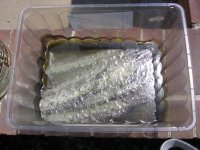
IMG_7496.jpg

At that time I turned the files over the let the bottom have equal opportunity to cook. Had I been a little more forsightful, I would have put some sort of spacers on the bottom of the tray to suspend them, but I hadn't. I then went away for another 40 minutes.

After that (total cook time of about 1:20), I began to worry that I would find a bunch of shivs in the acid, so I fished out one file and dunked it into a two-gallon bucket of water to neutralize the acid and test it. I could tell right away upon handling it that it was sharper. It had that sticky feeling of a new file.

Bringing it inside, I tried in on the bolt, and it bit in nicely. This was the same file that had skated across the bolt like Kristi Yamaguchi before the acid dunk. In fact, I would go on record that, scientifically speaking, the file was "a whole lot sharper" after the treatment than before.

I pulled all the files, dunked them in the water bath, took them out and blotted them mostly dry, and sprayed them liberally with WD-40, before they flash-rusted before my eyes. Here is a pic that doesn't do justice because the WD is shining so much in the sunlight. These files really did clean up nicely in addition to sharpening.
IMG_7497.jpg

Is that time of immersion optimum? I'd be shocked if it were. I didn't try any other times. I suspect the age of the acid, the heat of the day, and probably other factors were variables. But they were definitely sharper coming out than going in.

I realize that most of you don't use files much anymore. I don't either. But sometimes when you just need to remove a nasty burr or take a few thous off some metal it's easier and quicker to reach into a drawer and pull out a good file than air up the compressor, drag out a die grinder, find the little wrenchs, oil the tool--you know the drill.

Anyway, this is a start. I may be inspired to do some more file sharpening even though I have what's surely a lifetime supply of sharp files already. I would enjoy seeing somebody expand on this little experiment. Just be careful--acid is nasty stuff.
 
To avoid these ads, REGISTER NOW!

Fins/413

Well-known member
Joined
Jan 27, 2009
Messages
161
Good info. I'd also dump some baking soda in the neutralizer bucket. Also for any other folks make sure to use a plastic container, be sure not to use aluminum as it will liberate copious amounts of Hydrogen if I remember correctly.
 

Bigrhamr

Well-known member
Joined
Apr 16, 2009
Messages
293
Location
North Idaho
Yup,
neutralize in soda or most powdered laundry detergent works too. Also keep the jug of Muriatic outside. The vapors, even from a closed jug will rust up everthing in sight as I found out the hard way.
 
OP
R

Richard Givan

Well-known member
Joined
Nov 26, 2008
Messages
230
Location
Richmond, KY
Righto on both points, fellows. I have a box of washing soda somewhere that I got in preparation for some rust-busting by electrolysis. If I had been a bit more ambitious, I would have found it and mixed some into the water to wash off the acid.

And for the acid rusting stuff, I wondered why every steel item within 10 feet of that acid bottle was showing serious rustage until I finally figured it out. It's now stored underneath my deck (securely fenced in) until I am certain I'm through with it. Then comes the issue of safe disposal.
 

nate379

Banned
Joined
Feb 2, 2009
Messages
7,279
Location
Palmer, AK
Interesting.

Only files I have are 2 or 3 for sharpening my chainsaw. I normally use a grinder for anything else.

Yeah the acid is nasty. I acid etched my garage floor and all the non painting metal like my gas line, screws on my boiler, etc all rusted up. I forgot my good ratchet and a rack of sockets on my garage door brace and it rusted those up too. Oh... turned my copper pipes all green and black as well.
 

69lm69gp

Well-known member
Joined
Jul 26, 2007
Messages
57
Location
Northwest, CT
I suspect that the acid is not sharping the file but rather cleaning out the gunk stuck in the grooves. Usefull no matter how it is actually working though.
 
OP
R

Richard Givan

Well-known member
Joined
Nov 26, 2008
Messages
230
Location
Richmond, KY
While the acid did serve to clean out a lot of gunk, some of the dull files were quite clean. After the acid, they were definitely sharper. It does seem counter-intuitive that a destructive process like acid etching can sharpen, but I am convinced of it. My net research prior to my experiment turned up some commercial enterprizes that do the process for a fee.

The consensus seems to be that acid baths work, but the finished file will not last quite as long as a newly made one and that you can only do it so many times before the law of diminishing returns is enforced.
 

robin1731

Well-known member
Joined
Dec 25, 2007
Messages
483
Location
Decatur, Indiana
I worked in a cabinet shop for 22 years. We did a lot of laminate work so I used files all the time. We tried sending files out to get chemically sharpened. It did work very well but as stated they don't last as long. I don't know why but they only sent them out a couple of times then quit doing it. We would go through a lot of files in a short period of time. If you were doing a lot of work you might go through 2-4 files in an 8 hour day. With about 10-12 guys doing the filing that would add up in a hurry.
 

Junkman

Well-known member
Joined
Dec 18, 2006
Messages
6,635
Location
Northeastern CT
You can dump the acid into your septic system. This is what they use to clean septic systems that have gunked up with grease. Most septic systems are at least 1000 gallons, so a gallon of acid isn't going to be a problem.
Always keep in mind that you can add acid to water, but you can't add water to acid. Pouring water into acid will cause you severe acid burns when the acid comes flying at you. Seen it happen all too often when people have made this mistake. That is why it is so difficult to purchase concentrated acids today... too great a liability for the sellers...
 

-B-

Well-known member
Joined
Feb 4, 2009
Messages
1,567
Location
Northshore of Boston
I worked in a cabinet shop for 22 years. We did a lot of laminate work so I used files all the time. We tried sending files out to get chemically sharpened. It did work very well but as stated they don't last as long. I don't know why but they only sent them out a couple of times then quit doing it. We would go through a lot of files in a short period of time. If you were doing a lot of work you might go through 2-4 files in an 8 hour day. With about 10-12 guys doing the filing that would add up in a hurry.


What happens is the hardened steel is eaten away and exposed to hydrogen embrittlement which removes the proper temper of the steel.
 

nate379

Banned
Joined
Feb 2, 2009
Messages
7,279
Location
Palmer, AK
Never heard that one before. I have poured water into acid many times.

Pouring water into acid will cause you severe acid burns when the acid comes flying at you. Seen it happen all too often when people have made this mistake. That is why it is so difficult to purchase concentrated acids today... too great a liability for the sellers...
 

LoneGunman

Well-known member
Joined
Mar 27, 2007
Messages
2,081
Location
The Gunshine state
You can dump the acid into your septic system. This is what they use to clean septic systems that have gunked up with grease. Most septic systems are at least 1000 gallons, so a gallon of acid isn't going to be a problem.
Always keep in mind that you can add acid to water, but you can't add water to acid. Pouring water into acid will cause you severe acid burns when the acid comes flying at you. Seen it happen all too often when people have made this mistake. That is why it is so difficult to purchase concentrated acids today... too great a liability for the sellers...

Uh huh, businesses have to protect themselves from the lawsuit happy morons who feel no need to read instructions and then sue when they are blinded or disfigured. I had a hell of a time buying nitric acid. Ended up buying it on Ebay.
 

Stuey

Well-known member
Joined
Jan 8, 2008
Messages
11,034
Location
28m above sea level
Never heard that one before. I have poured water into acid many times.
Then you had a very diluted acid or you are very lucky. I was always taught to remember the three A's, Always Add Acid
Agreed.

About a year back, a colleague of mine went to rinse out what she thought was a dry beaker. BOOM! I looked over - the beaker propelled itself into the sink the moment the water hit and shattered explosively. I thought maybe the water pressure was super high (I've seen people break beakers b/c of that before), but it was rather low. There had been some acidic or basic residue at the bottom of the glass. Once the water made contact, it reacted violently.

Doesn't that also apply to any chemical that may be mixed with water not just acid?
I guess that depends. I suppose that it's just prudent to just follow that procedure unless indicated otherwise.

As for acid sharpening - I don't quite see how this would work. Unless the file is simply clogged up, the acid will indiscriminantly wear away the file. Yes it might make it sharper temporarily, but it's not the best solution. It's kind of like using a grinder to reshape a screwdriver - yes it can be done, yes it will do the job, but no it won't be as good as a brand new replacement.
 
OP
R

Richard Givan

Well-known member
Joined
Nov 26, 2008
Messages
230
Location
Richmond, KY
Agreed.

As for acid sharpening - I don't quite see how this would work. Unless the file is simply clogged up, the acid will indiscriminantly wear away the file. Yes it might make it sharper temporarily, but it's not the best solution. It's kind of like using a grinder to reshape a screwdriver - yes it can be done, yes it will do the job, but no it won't be as good as a brand new replacement.

Well, I don't understand exactly how satellite tv works, either, but it seems to muddle along successfully just the same.

I have already reported that folks with a lot more experience than I feel that acid-sharpened files don't have quite as long a useful life as a newly-cut one, but they claim the retreads don't lag too far behind.

For that matter, what's wrong with deftly reshaping a screwdriver? I've done it a few times and don't see anything wrong with it. But then I'm used to taking a brand new wood chisel, flattening the back and polishing it (along with sharpening the front, of course) and making it ten times sharper and better than it was as it came from the store. I've tuned up (what the Brits call "fettling" new wood planes as well. By your reckoning, a plane that I've spent hours tuning and that can whisper through hardwood cutting a shaving you can read through is no good.
 

Stuey

Well-known member
Joined
Jan 8, 2008
Messages
11,034
Location
28m above sea level
Curious - where do you ever see me saying that honing chisels and planes is a bad thing...?

Reshaping a screwdriver alters the precision of a tip, not to mention its physical properties. I've seen reshapen drivers that ended up resembling shivs more than screwdrivers.
 
Last edited:

jvitez

Well-known member
Joined
Nov 30, 2009
Messages
2,429
Location
Big Sky Country, Canada
Agreed.

About a year back, a colleague of mine went to rinse out what she thought was a dry beaker. BOOM! I looked over - the beaker propelled itself into the sink the moment the water hit and shattered explosively. I thought maybe the water pressure was super high (I've seen people break beakers b/c of that before), but it was rather low. There had been some acidic or basic residue at the bottom of the glass. Once the water made contact, it reacted violently.

I

If you work in a lab you must be closer to inorganic chemistry than I am (my undergrad days are sadly a long time in the distance). I remember being taught this too, but the chemistry escapes me. Initially I thought it was just a mechanical thing: pour acid into water, and if you're a doofus and it splashes back at you, most likely it will be mostly water with a little acid, or low concentration. The opposite would be worse, with high concentration acid splashing back.

But in your example of a flying fat Florence, it must have been a chemical reaction that occurred, exothermic perhaps? I'm still puzzled how simply adding water could create such a vigorous reaction. Any chemists here?
 

W-Cummins

Well-known member
Joined
Jan 9, 2006
Messages
1,641
Location
Iowa
Yes, it's a VERY exothermic reaction and cause the mixture to boil in small areas as it's added, this results in the production of steam . This causes the acid to spit and splash all over the place. I guess 10 years of collage chemistry is good for some thing!

William.....
 
To avoid these ads, REGISTER NOW!

gahrajmahal

Well-known member
Joined
Dec 12, 2008
Messages
2,537
Location
Cincinnati, Ohio
Found a 1/2 gallon of hydrochloric acid in my now rusty cabinet. I don't have a septic tank, so what is the proper disposal method besides waiting until township hazardous disposal day?
 

BlindViper

Well-known member
Joined
Dec 1, 2009
Messages
1,307
Location
York, PA
Curious - where do you ever see me saying that honing chisels and planes is a bad thing...?

Reshaping a screwdriver alters the precision of a tip, not to mention its physical properties. I've seen reshapen drivers that ended up resembling shivs more than screwdrivers.

That's because people think the colors mean they are doing something.
 

ng8264723

Well-known member
Joined
Aug 28, 2006
Messages
732
Location
Oakham MA
It sounds like there was magnesium in that beaker. This will cause a nasty exothermic reaction. I've found the best way to clean files is take a piece of copper pipe and hammer it flat. You can then file the copper across the file. It will remove the gunked debri. Try it sometime it works amazingly well
 

metalwork

Active member
Joined
Dec 29, 2009
Messages
31
Location
Northeast USA
I have not tried to acid resharpen but the method is detailed in Modern Blacksmithing by Weygers. The author was a proponent of it. I use muriatic to derust tools and it is phenomenal for that task.
 

uhcrandy

Well-known member
Joined
Dec 12, 2007
Messages
283
Most transition metal, like Sodium, magnesuim etc react violently with water.
 

Bruce Lancaster

Well-known member
Joined
Apr 3, 2006
Messages
1,642
I once read of a technique used by commercial resharpeners in which the files were lightly painted (by roller??) so that only the very tips of the teeth were covered. They then went into the acid to have the protected edges undercut by the acid. No other details survive in my memory.
 

tim9lives

Member
Joined
Dec 19, 2012
Messages
18
Just been reading up on this acid sharpening process. I just wanted to add that if anyone does this...Try to use sulfuric acid. Or I think you can also use acetic acid...AKA-Vinegar.
Some of the other acids such as Hydrochloric acid (or Muriatic ) will cause Hydrogen embrittlement. And that's not good for metal.
 

jimgood

Well-known member
Joined
Aug 4, 2014
Messages
2,394
Location
Marshall, VA
I keep meaning to give this a try. I have a pile of farrier rasps and a few smaller files that need sharpening.
 

TLCObsession

Well-known member
Joined
Aug 30, 2011
Messages
328
Location
Bellingham, WA
Yes, it's a VERY exothermic reaction and cause the mixture to boil in small areas as it's added, this results in the production of steam . This causes the acid to spit and splash all over the place. I guess 10 years of collage chemistry is good for some thing!

William.....

Just not spelling!:lol_hitti
 

wayne55

Well-known member
Joined
Oct 28, 2010
Messages
359
I did something very similar. I did dilute the muriatic acid with water for about a 50/50 mix and left the files in there for about 4 hours, turning them at halfway. I then rinsed them and put them in a baking soda bath for a half hour, rinsed them and sprayed with WD40. They came out nice, clean, and sharper. I cannot report on how long the new sharpness lasts, however.
 

SCMARA

New member
Joined
Feb 12, 2023
Messages
2
I found an article many years back that was the history of the Nicholson file company. It explained the processes that Nicholson used to make files. From the making of the billets, flattening them, rotary hammering the teeth, tempering, acid etching, a molten lead bath to bring the hardness right out to the tips of the teeth, and blasting with aluminum oxide (grit not mentioned) at a specific angle (also not mentioned because it was a process that was kept a secret) I have been unable to find that article again. If I find it again I will post it here. Acid will sharpen files that have become dull. If the file has aluminum, babbitt, copper, etc. stuck in the teeth it will remove that as well. I find it better to remove it if you can with a file card, an empty rifle cartridge with the neck smashed flat to push through the grooves, or even a big sewing needle. The file seems to sharpen more evenly. Light/medium rust is fine but if the teeth are pitted the acid just makes it worse. Same thing if any of the teeth are (shelled) broken. The acid just makes it worse. I leave the acid in the gallon jug and can get 3 or 4 10" to 12" files to go in the neck. I put the cap back on if possible. For smaller files I make slip knots in strands of nylon rope to be able to lower them into the jug and carefully put the cap back on with the strand end hanging out. The small opening of the jug neck cuts way down on the fumes. I also keep the jug in a 5 gallon bucket with a lid. Files go from the acid bath to a bucket mixed with lots of baking soda and water to be neutralized and wire brushed with the solution. Towel dry or compressed air blow gun. Wire brushed again with a fine stainless wire brush and sprayed out with carburetor cleaner starting at the tang down to the tip of the file. Towel or compressed air dry. Coat with WD40. Wait for a couple hours. Remove WD40 with another shot of carb cleaner. Wire brush once more and done. Acid droplets on the jug or in the 5 gallon bucket get a splash of neutralizer and the bucket lid put on. That helps keep everything in the surrounding area from rusting. Safety glasses, face shield, acid proof gloves and a respirator with the correct organic vapor rating are a really good idea. I use muriatic acid. Immersion time is 45 minutes to an hour but there are some considerations. If your acid is brand new, it cuts faster. As the acid gets older the cutting action will slow down and it will take longer. One of those really long triple jointed needle nosed pliers works good for any escapees in the acid jug.
)
 

SCMARA

New member
Joined
Feb 12, 2023
Messages
2
One other thing I forgot to mention. I don't screw the cap down tight on the jug if I have files in it. Leave it loose for gas to escape.
 

flyingblind

Well-known member
Joined
Aug 16, 2011
Messages
624
Location
Washington
Found a 1/2 gallon of hydrochloric acid in my now rusty cabinet. I don't have a septic tank, so what is the proper disposal method besides waiting until township hazardous disposal day?
Add Baking soda till PH 7 and pour down the drain. PH strips from the pool store or Amazon or the pet store.
Just remember HCL will cut Carbon steal faster than sulfuric.
 

no704

Well-known member
Joined
Apr 27, 2016
Messages
5,224
Place I used to work at, an auto upfitter, so lots of bare metal around. The maintenance guy decided it would be a good idea to clean the evap coolers with muriatic acid. That did not go well!
 

Old Sneelock

New member
Joined
Sep 13, 2019
Messages
1
Location
Richland, MI
Cleaning out the attic storage over the garage, I recently found a gallon of muriatic acid the brick masons left here after they did their job 17 years ago. I had read somewhere on the net--including here, I believe--about acid sharpening old files. The information was all over the map, though. Besides muriatic acid, nitric acid, old battery acid--all sorts of different strengths-- even "cleaning vinegar" were touted as doing the job. Having a free couple of hours, a gallon of acid and, Lord knows, lots of dull files, what's a guy to do?

I went through the probably 200 files I had in boxes, most of them coming from my dad's estate. I chucked a ruined bolt in the vice and went at it with each one. One or two strokes was enough to tell the tale. A surprising number were still sharp enough to use, so I put them aside. The dull ones went into another box.

I retrieved a reasonably sturdy plastic cake cover from the trash to hold the acid bath. Elbow-length rubber gloves and safety glasses (down to my last pair of eyeballs, you know) would have to provide the safeguards. I performed these actions outside and planned to hold my breath whenever in close proximity.

I picked out six files that fit into the plastic tray. Here's a pic:
IMG_7493.jpg

The files went into the tray, and I poured in enough acid (full strength--muriatic acid is a 40% concentrate of hydrochloric acid) to cover the files. Enough of the scent of the acid came through to tell me that it was strong stuff--glad I chose to do it outside.

Here's what the tray looked like with the acid just having been poured into the tray:
IMG_7494.jpg

I busied myself with things, mostly shifting handles from dull files to sharp ones for about 35-40 minutes. The acid bath was bubbling fairly actively and looked like this:
IMG_7496.jpg

At that time I turned the files over the let the bottom have equal opportunity to cook. Had I been a little more forsightful, I would have put some sort of spacers on the bottom of the tray to suspend them, but I hadn't. I then went away for another 40 minutes.

After that (total cook time of about 1:20), I began to worry that I would find a bunch of shivs in the acid, so I fished out one file and dunked it into a two-gallon bucket of water to neutralize the acid and test it. I could tell right away upon handling it that it was sharper. It had that sticky feeling of a new file.

Bringing it inside, I tried in on the bolt, and it bit in nicely. This was the same file that had skated across the bolt like Kristi Yamaguchi before the acid dunk. In fact, I would go on record that, scientifically speaking, the file was "a whole lot sharper" after the treatment than before.

I pulled all the files, dunked them in the water bath, took them out and blotted them mostly dry, and sprayed them liberally with WD-40, before they flash-rusted before my eyes. Here is a pic that doesn't do justice because the WD is shining so much in the sunlight. These files really did clean up nicely in addition to sharpening.
IMG_7497.jpg

Is that time of immersion optimum? I'd be shocked if it were. I didn't try any other times. I suspect the age of the acid, the heat of the day, and probably other factors were variables. But they were definitely sharper coming out than going in.

I realize that most of you don't use files much anymore. I don't either. But sometimes when you just need to remove a nasty burr or take a few thous off some metal it's easier and quicker to reach into a drawer and pull out a good file than air up the compressor, drag out a die grinder, find the little wrenchs, oil the tool--you know the drill.

Anyway, this is a start. I may be inspired to do some more file sharpening even though I have what's surely a lifetime supply of sharp files already. I would enjoy seeing somebody expand on this little experiment. Just be careful--acid is nasty stuff.
I have sharpened many files in this way.
The basics of what I learned are:
1. You have to clean the file first. Acid works on the steel it is exposed to. If there is oil or dirt on the file the acid has to remove the contaminates before it hits steel. That section will get less etch than the exposed parts. You will end up with a blotchy job.
2. The acid is a reduction method. If the file teeth are chipped, broken, or just missing it won't grow new ones.
3. Use a solution of acid mixed at about 10% strength. Sulfuric is best. I use drain cleaner. Cheap and easy to dispose of. Make sure you pour a couple gallons of plain water down the drain after you dump the sharpening bath. You don't want to leave any acid in the P Trap.
The acid can eat through the brass drains on a sink in a matter of minutes.
4. When the files are done rinse them in running water and then dip them in a saturated solution of water with baking soda or washing soda.
Don't put baking soda or a mixture of baking soda and water in the drain or mix it with the sharpening solution. It can cause rapid heating and splash the chemicals all over.
5. The files won't be new and won't last as long as a new file in the same use. The process is a reduction and the teeth come out smaller than they were.
If you are interested I have done many videos showing my methods. I learned the basics 25 years ago from the Old Tools Mailing List. A fine group of galoots who were willing to share their knowledge with a newbie in a spirit of sharing.
Dave Nighswander
aka Old Sneelock
 

tester19

Well-known member
Joined
Apr 25, 2021
Messages
225
Location
chigago
You can also send them out for re sharpening? I don't think this place uses acid but I don't really know. I have contacted them about price and how to ship my files but have not yet sent any off?

Looks like a real old time place too!
Boggs Tool & File Sharpening Company


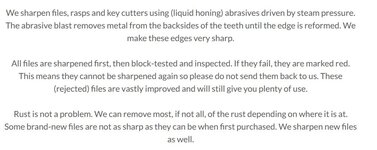
Here is their explanation about the sharpening process.

File Sharpening.JPG
.
.
.
 
To avoid these ads, REGISTER NOW!
Top Bottom