Richard Givan
Well-known member
Cleaning out the attic storage over the garage, I recently found a gallon of muriatic acid the brick masons left here after they did their job 17 years ago. I had read somewhere on the net--including here, I believe--about acid sharpening old files. The information was all over the map, though. Besides muriatic acid, nitric acid, old battery acid--all sorts of different strengths-- even "cleaning vinegar" were touted as doing the job. Having a free couple of hours, a gallon of acid and, Lord knows, lots of dull files, what's a guy to do?
I went through the probably 200 files I had in boxes, most of them coming from my dad's estate. I chucked a ruined bolt in the vice and went at it with each one. One or two strokes was enough to tell the tale. A surprising number were still sharp enough to use, so I put them aside. The dull ones went into another box.
I retrieved a reasonably sturdy plastic cake cover from the trash to hold the acid bath. Elbow-length rubber gloves and safety glasses (down to my last pair of eyeballs, you know) would have to provide the safeguards. I performed these actions outside and planned to hold my breath whenever in close proximity.
I picked out six files that fit into the plastic tray. Here's a pic:

The files went into the tray, and I poured in enough acid (full strength--muriatic acid is a 40% concentrate of hydrochloric acid) to cover the files. Enough of the scent of the acid came through to tell me that it was strong stuff--glad I chose to do it outside.
Here's what the tray looked like with the acid just having been poured into the tray:

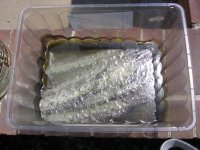
I busied myself with things, mostly shifting handles from dull files to sharp ones for about 35-40 minutes. The acid bath was bubbling fairly actively and looked like this:
At that time I turned the files over the let the bottom have equal opportunity to cook. Had I been a little more forsightful, I would have put some sort of spacers on the bottom of the tray to suspend them, but I hadn't. I then went away for another 40 minutes.
After that (total cook time of about 1:20), I began to worry that I would find a bunch of shivs in the acid, so I fished out one file and dunked it into a two-gallon bucket of water to neutralize the acid and test it. I could tell right away upon handling it that it was sharper. It had that sticky feeling of a new file.
Bringing it inside, I tried in on the bolt, and it bit in nicely. This was the same file that had skated across the bolt like Kristi Yamaguchi before the acid dunk. In fact, I would go on record that, scientifically speaking, the file was "a whole lot sharper" after the treatment than before.
I pulled all the files, dunked them in the water bath, took them out and blotted them mostly dry, and sprayed them liberally with WD-40, before they flash-rusted before my eyes. Here is a pic that doesn't do justice because the WD is shining so much in the sunlight. These files really did clean up nicely in addition to sharpening.

Is that time of immersion optimum? I'd be shocked if it were. I didn't try any other times. I suspect the age of the acid, the heat of the day, and probably other factors were variables. But they were definitely sharper coming out than going in.
I realize that most of you don't use files much anymore. I don't either. But sometimes when you just need to remove a nasty burr or take a few thous off some metal it's easier and quicker to reach into a drawer and pull out a good file than air up the compressor, drag out a die grinder, find the little wrenchs, oil the tool--you know the drill.
Anyway, this is a start. I may be inspired to do some more file sharpening even though I have what's surely a lifetime supply of sharp files already. I would enjoy seeing somebody expand on this little experiment. Just be careful--acid is nasty stuff.
I went through the probably 200 files I had in boxes, most of them coming from my dad's estate. I chucked a ruined bolt in the vice and went at it with each one. One or two strokes was enough to tell the tale. A surprising number were still sharp enough to use, so I put them aside. The dull ones went into another box.
I retrieved a reasonably sturdy plastic cake cover from the trash to hold the acid bath. Elbow-length rubber gloves and safety glasses (down to my last pair of eyeballs, you know) would have to provide the safeguards. I performed these actions outside and planned to hold my breath whenever in close proximity.
I picked out six files that fit into the plastic tray. Here's a pic:
The files went into the tray, and I poured in enough acid (full strength--muriatic acid is a 40% concentrate of hydrochloric acid) to cover the files. Enough of the scent of the acid came through to tell me that it was strong stuff--glad I chose to do it outside.
Here's what the tray looked like with the acid just having been poured into the tray:
I busied myself with things, mostly shifting handles from dull files to sharp ones for about 35-40 minutes. The acid bath was bubbling fairly actively and looked like this:
At that time I turned the files over the let the bottom have equal opportunity to cook. Had I been a little more forsightful, I would have put some sort of spacers on the bottom of the tray to suspend them, but I hadn't. I then went away for another 40 minutes.
After that (total cook time of about 1:20), I began to worry that I would find a bunch of shivs in the acid, so I fished out one file and dunked it into a two-gallon bucket of water to neutralize the acid and test it. I could tell right away upon handling it that it was sharper. It had that sticky feeling of a new file.
Bringing it inside, I tried in on the bolt, and it bit in nicely. This was the same file that had skated across the bolt like Kristi Yamaguchi before the acid dunk. In fact, I would go on record that, scientifically speaking, the file was "a whole lot sharper" after the treatment than before.
I pulled all the files, dunked them in the water bath, took them out and blotted them mostly dry, and sprayed them liberally with WD-40, before they flash-rusted before my eyes. Here is a pic that doesn't do justice because the WD is shining so much in the sunlight. These files really did clean up nicely in addition to sharpening.
Is that time of immersion optimum? I'd be shocked if it were. I didn't try any other times. I suspect the age of the acid, the heat of the day, and probably other factors were variables. But they were definitely sharper coming out than going in.
I realize that most of you don't use files much anymore. I don't either. But sometimes when you just need to remove a nasty burr or take a few thous off some metal it's easier and quicker to reach into a drawer and pull out a good file than air up the compressor, drag out a die grinder, find the little wrenchs, oil the tool--you know the drill.
Anyway, this is a start. I may be inspired to do some more file sharpening even though I have what's surely a lifetime supply of sharp files already. I would enjoy seeing somebody expand on this little experiment. Just be careful--acid is nasty stuff.