Pinemarten
Well-known member
Metric impact sockets deep set is a fail because it doesn't thread an M12 bolt into the threads straight. 19mm socket. Pittsburgh brand. Thank you for your time.
Above M10, you want to use the Icon semi-deep sockets.


Metric impact sockets deep set is a fail because it doesn't thread an M12 bolt into the threads straight. 19mm socket. Pittsburgh brand. Thank you for your time.
Thank you!Above M10, you want to use the Icon semi-deep sockets.
Starting the bolt on an engine mount on a VW. It was easier with a bare socket, no ratchet or impact socket.What were you doing exactly? I'm confused.
Why are you not starting it by hand, with your fingers on the head?Starting the bolt on an engine mount on a VW. It was easier with a bare socket, no ratchet or impact socket.
I picked one up recently when they were $50 for ITC, and wound up grabbing a M18 2888 that was an amazing deal also. I've decided to keep both and make the Hercules a dedicated cutting-wheel rig and use the adjustable speed, cord-free Milwaukee as a jack-of all trades. I haven't had a chance to use the Hercules yet, so good to know.Needed a heavier angle grinder so went for this model paid $80 a while back. Never used one much before.
Using it almost new yesterday, Had a diamond cup, grinding pretty hard on some concrete edges. the head started getting pretty hot. WTF! a little research showed most all angle grinders get more than a little warm in the head, with heavy use.Used it about an hour non stop today. The head got a little less hot nothing special.
It's a real ripper. Pass.

13 Amp 4-1/2 in. to 6 in. Trigger Grip Angle Grinder
Amazing deals on this 4-1/2In 13Amp Angle Grinder at Harbor Freight. Quality tools & low prices.www.harborfreight.com
Looks great. My sense of balance along with my OCD would force me to add a locker to the other end ( whether I needed it or not )
Series 2 72 inch top and bottom. Had since the series two came out. PASS big time. Locker is a pass also
It's easier with a bare socket. Because it's tight clearance and my hands are big and clumsy.Why are you not starting it by hand, with your fingers on the head?
 www.harborfreight.com
 www.harborfreight.com
I’ve had one for several years and have no complaints. A definite PASSHas anyone used this oil extractor? I just bought one, so I'll provide feedback after I get to use it. I couldn't find any of the plastic ones that were big enough.

They're backordered for an unknown amount of time so they canceled my order unfortunately.I’ve had one for several years and have no complaints. A definite PASS
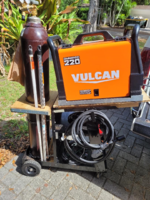



These carts are a pass. I've had my orange one for about a year and it's my go-to in my shop.The US General 1-drawer service cart is definitely a pass. Simple to assemble and sturdy. Easy to maneuver with swiveling wheels with one set of locking wheels. $99 with ITC. New color slate grey has black handles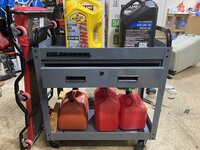
I've had a set of those for a few years, they're holding up just fineCan't find if I already posted this but here goes again, since recent more in-depth use.
Like the HF ratchet wrenches, but didn't use them a whole lot. Ex wife borrowed the 1/2" and I didn't want the hassle of demanding it back, plus I have not been using SAE much.
Enter old Ford tractor where seeming everything is 1/2" and in tight spaces. I thought about just buying a whole other HF set (just for the 1/2") , but saw they had the flex head set, so I thought I'd give them a try, especially now having 1/2.
They are actually pretty sweet and I find myself using them in place of a socket very often. Just flip the head 90 degrees (or less) and twist with the finders much faster, especially in tight places.
Might be a new favorite - PASS
Flex-Head SAE Ratcheting Combination Wrench Set, 5 Piece
Amazing deals on this 5Pc Sae Flex-Head Combo Ratcheting Wrench at Harbor Freight. Quality tools & low prices.


Wow, it's a little difficult to find USA made stuff @ harbor freight.Hercules porta band blades HA279-C4418 and HA279-C24. Bought them to use in my DeWalt portaband. USA made. Don't have a ton of time on them, but they cut nice and after going through exhaust tubing, it hasn't lost any teeth and is still sharp (18 tpi). $15.99 for a two pack
Preliminary pass


HF has been adding more and more USA made items lately. It's nice to see! For example I think they have a pair of Doyle wire strippers, and some Icon strippers and snap ring pliers as well.Wow, it's a little difficult to find USA made stuff @ harbor freight.
Thank you very much! I don't get into harbor freight very often.HF has been adding more and more USA made items lately. It's nice to see! For example I think they have a pair of Doyle wire strippers, and some Icon strippers and snap ring pliers as well.
That's a good option. Just a hair more expensive on a price per blade basis than a 3 pack of Milwaukee from home depot. That said, I don't go though them quickly enough that a 3 pack is necessary. I would rather keep more blade options around with fewer of them.Hercules porta band blades HA279-C4418 and HA279-C24. Bought them to use in my DeWalt portaband. USA made. Don't have a ton of time on them, but they cut nice and after going through exhaust tubing, it hasn't lost any teeth and is still sharp (18 tpi). $15.99 for a two pack
Preliminary pass
Over the last several years they've added more and more. People still grump at them for it.Wow, it's a little difficult to find USA made stuff @ harbor freight.


 (I intend to replace the spindle rack altogether with something using ball bearings) A 3/32" stainless steel shim under the spindle rack fixed that, and now it's dead on the CL of the stock to be notched.
It Claims to be precision, but it isn’t. People complain about shotty parts that fail, and you had to do considerable modifications to have it work to your satisfaction.OK....here we go, down the rabbit hole. I read a ton of reviews, watched a bunch of videos on youtube, and against all better judgment...including my own...I did it anyway. I bought the HF tube notcher.
TLDR version: PASS....with caveats. Lots of caveats.
Where do I begin?
Everything you've read or heard is true: This is NOT a precision machine, and is NOT going to make rollcage-perfect notches. That said, let's not overlook two essential ingredients:
1.) It's a $60 notcher....not $600 (or more) notcher.
2.) If you're buying a notcher, you either a.) have extremely-odd proclivities that border on unhealthy fetishes, or b.) you're a fabricator / welder. For the sake of GJ decorum, Let's assume the latter...please!
Bluntly, does this cut notches, right out of the (cosmoline-soaked) box? Yes. Inaccurate, off-center, sloppy notches, to be sure...but notches nevertheless. But since you're a fabricator / welder / tool tinkerer, there's hope! Modifying this to work in a reasonably accurate manner is doable. And I modified mine greatly.
I am not going to go into all of my mods, as that's beyond the scope of this thread. But issue #1 is that the pivot bolt in the backplate has two fatal flaws: 1.) it ought not be a bolt/nut anyway because the back-and-forth turning of the plate will...in time...loosen the nut (and since the hole is so excessively large & sloppy, accuracy is lost), and 2.) the freakin' hole is mis-located to begin with! So I TIG-filled the pivot hole, drilled a new one in in the right spot, TIG welded in a threaded stud, and re-affixed the plate with a nylon stop-nut. Fixed. (this is one of the reasons the protractor is so inaccurate) Pivoting is now accurate & repeatable...and congruent with the protractor (that I had to remove & reposition).
Next, the clamp Vs are not welded in place square to the clamp plate. So do NOT square the plate to the drill...mount some stock and square the material to the drill. Amazing.
The threaded adapter for the spindle (so larger holesaws can be used) was internally threaded non-concentrically, so the holesaw had a dizzying elliptical orbit. Thrilling to watch, but don't try drilling! A DeWalt replacement was bought at the local hardware store.
To keep the bronze bushings from falling out, there's a dinky retaining screw in the face of the spindle rack. If, when done notching, you pull your drill back al the way, the adapter nut in the holesaw will lockup against that screwhead and the reverse torque of your drill will just about break your wrist. Ask me how I know...
People complain that the washers on the bolts that hold the clamp plate in place are thin and distort into the slot. True. Heavier washers are a fast way out, but I fabricated a backplate that slides congruently with the clamp plate. Easy.
The spindle does NOT meet the stock on the stock's centerline. I've read reviews saying the spindle is too low while others say it's too high. Being made of the finest-grade chineseum available, harvested exclusively from the western slopes of the andolusian mountains...and with a level of QC attention never before seen, I can say absolutely with certainty that my spindle was exactly......too low.
So what's the verdict? Your mileage may vary, but if you go into this with your eyes wide open, it's a PASS, with the clear & present caveat that, if you do some mod work, you'll have a notcher that actually works.
Some would say that "I shouldn't have to do all THAT to make it work", and you're not wrong at all. But we're tool guys, right? Screwing around on little side projects is fun, no? Again, YMMV, and if you need to be making money notching tube right from the start, then just spend the big bucks, buy a good one and forget you read this. But for guys like me that need to notch 5 times a year (maybe), this can be a functional tool *IF* you put the time into tweaking it.
That's my story and I'm sticking to it. Thanks for reading.
Entertaining and informative. Seems like fixing all that **** and making it an $80+ hole thingy would be a better idea...OK....here we go, down the rabbit hole. I read a ton of reviews, watched a bunch of videos on youtube, and against all better judgment...including my own...I did it anyway. I bought the HF tube notcher.
TLDR version: PASS....with caveats. Lots of caveats.
Where do I begin?
Everything you've read or heard is true: This is NOT a precision machine, and is NOT going to make rollcage-perfect notches. That said, let's not overlook two essential ingredients:
1.) It's a $60 notcher....not $600 (or more) notcher.
2.) If you're buying a notcher, you either a.) have extremely-odd proclivities that border on unhealthy fetishes, or b.) you're a fabricator / welder. For the sake of GJ decorum, Let's assume the latter...please!
Bluntly, does this cut notches, right out of the (cosmoline-soaked) box? Yes. Inaccurate, off-center, sloppy notches, to be sure...but notches nevertheless. But since you're a fabricator / welder / tool tinkerer, there's hope! Modifying this to work in a reasonably accurate manner is doable. And I modified mine greatly.
I am not going to go into all of my mods, as that's beyond the scope of this thread. But issue #1 is that the pivot bolt in the backplate has two fatal flaws: 1.) it ought not be a bolt/nut anyway because the back-and-forth turning of the plate will...in time...loosen the nut (and since the hole is so excessively large & sloppy, accuracy is lost), and 2.) the freakin' hole is mis-located to begin with! So I TIG-filled the pivot hole, drilled a new one in in the right spot, TIG welded in a threaded stud, and re-affixed the plate with a nylon stop-nut. Fixed. (this is one of the reasons the protractor is so inaccurate) Pivoting is now accurate & repeatable...and congruent with the protractor (that I had to remove & reposition).
Next, the clamp Vs are not welded in place square to the clamp plate. So do NOT square the plate to the drill...mount some stock and square the material to the drill. Amazing.
The threaded adapter for the spindle (so larger holesaws can be used) was internally threaded non-concentrically, so the holesaw had a dizzying elliptical orbit. Thrilling to watch, but don't try drilling! A DeWalt replacement was bought at the local hardware store.
To keep the bronze bushings from falling out, there's a dinky retaining screw in the face of the spindle rack. If, when done notching, you pull your drill back al the way, the adapter nut in the holesaw will lockup against that screwhead and the reverse torque of your drill will just about break your wrist. Ask me how I know...
People complain that the washers on the bolts that hold the clamp plate in place are thin and distort into the slot. True. Heavier washers are a fast way out, but I fabricated a backplate that slides congruently with the clamp plate. Easy.
The spindle does NOT meet the stock on the stock's centerline. I've read reviews saying the spindle is too low while others say it's too high. Being made of the finest-grade chineseum available, harvested exclusively from the western slopes of the andolusian mountains...and with a level of QC attention never before seen, I can say absolutely with certainty that my spindle was exactly......too low.
So what's the verdict? Your mileage may vary, but if you go into this with your eyes wide open, it's a PASS, with the clear & present caveat that, if you do some mod work, you'll have a notcher that actually works.
Some would say that "I shouldn't have to do all THAT to make it work", and you're not wrong at all. But we're tool guys, right? Screwing around on little side projects is fun, no? Again, YMMV, and if you need to be making money notching tube right from the start, then just spend the big bucks, buy a good one and forget you read this. But for guys like me that need to notch 5 times a year (maybe), this can be a functional tool *IF* you put the time into tweaking it.
That's my story and I'm sticking to it. Thanks for reading.

thats secret code for the price is going up.They're backordered for an unknown amount of time so they canceled my order unfortunately.
thats a fail.OK....here we go, down the rabbit hole. I read a ton of reviews, watched a bunch of videos on youtube, and against all better judgment...including my own...I did it anyway. I bought the HF tube notcher.
TLDR version: PASS....with caveats. Lots of caveats.
Where do I begin?
Everything you've read or heard is true: This is NOT a precision machine, and is NOT going to make rollcage-perfect notches. That said, let's not overlook two essential ingredients:
1.) It's a $60 notcher....not $600 (or more) notcher.
2.) If you're buying a notcher, you either a.) have extremely-odd proclivities that border on unhealthy fetishes, or b.) you're a fabricator / welder. For the sake of GJ decorum, Let's assume the latter...please!
Bluntly, does this cut notches, right out of the (cosmoline-soaked) box? Yes. Inaccurate, off-center, sloppy notches, to be sure...but notches nevertheless. But since you're a fabricator / welder / tool tinkerer, there's hope! Modifying this to work in a reasonably accurate manner is doable. And I modified mine greatly.
I am not going to go into all of my mods, as that's beyond the scope of this thread. But issue #1 is that the pivot bolt in the backplate has two fatal flaws: 1.) it ought not be a bolt/nut anyway because the back-and-forth turning of the plate will...in time...loosen the nut (and since the hole is so excessively large & sloppy, accuracy is lost), and 2.) the freakin' hole is mis-located to begin with! So I TIG-filled the pivot hole, drilled a new one in in the right spot, TIG welded in a threaded stud, and re-affixed the plate with a nylon stop-nut. Fixed. (this is one of the reasons the protractor is so inaccurate) Pivoting is now accurate & repeatable...and congruent with the protractor (that I had to remove & reposition).
Next, the clamp Vs are not welded in place square to the clamp plate. So do NOT square the plate to the drill...mount some stock and square the material to the drill. Amazing.
The threaded adapter for the spindle (so larger holesaws can be used) was internally threaded non-concentrically, so the holesaw had a dizzying elliptical orbit. Thrilling to watch, but don't try drilling! A DeWalt replacement was bought at the local hardware store.
To keep the bronze bushings from falling out, there's a dinky retaining screw in the face of the spindle rack. If, when done notching, you pull your drill back al the way, the adapter nut in the holesaw will lockup against that screwhead and the reverse torque of your drill will just about break your wrist. Ask me how I know...
People complain that the washers on the bolts that hold the clamp plate in place are thin and distort into the slot. True. Heavier washers are a fast way out, but I fabricated a backplate that slides congruently with the clamp plate. Easy.
The spindle does NOT meet the stock on the stock's centerline. I've read reviews saying the spindle is too low while others say it's too high. Being made of the finest-grade chineseum available, harvested exclusively from the western slopes of the andolusian mountains...and with a level of QC attention never before seen, I can say absolutely with certainty that my spindle was exactly......too low.
So what's the verdict? Your mileage may vary, but if you go into this with your eyes wide open, it's a PASS, with the clear & present caveat that, if you do some mod work, you'll have a notcher that actually works.
Some would say that "I shouldn't have to do all THAT to make it work", and you're not wrong at all. But we're tool guys, right? Screwing around on little side projects is fun, no? Again, YMMV, and if you need to be making money notching tube right from the start, then just spend the big bucks, buy a good one and forget you read this. But for guys like me that need to notch 5 times a year (maybe), this can be a functional tool *IF* you put the time into tweaking it.
That's my story and I'm sticking to it. Thanks for reading.
I got the cheap Titanium 125 for $100 NIB at a pawn shop when I was in college. That thing has been to pretty much every one of my friend's houses to weld something at some point in time.How can ya beat using HFT's own shekels? I bought the Vulcan Omnipro 220 multi-process welder, the spool gun for welding aluminum, a TIG torch, a cart, and a foot pedal. I didn't use it for awhile after buying it, but recently have set it up and have had it used on frame welding on a project car, I had an experienced welder doing it instead of trying it myself. The LCD screen helps to set the machine up. It tells you:
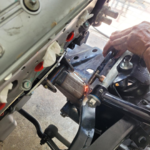
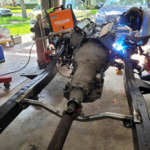
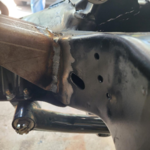
The recommended settings the experienced welder saw the machine select were 'in the ballpark' (we were using the MIG process), he had me dial-down the wire feed and the voltage slightly, after doing a couple test-welds on some re-bar, and he went to work. The work being done was welding steel motor mounts, a steel transmission frame cross-member and hangers, and a steel frame cross-member for top of rear shock mounts.
- what gas to use
- what cables to use
- where to attach the cables
- the wire feed speed
- The thickness of materials
- the type of metal being worked
- the voltage to set (besides 120/240V)
The work was easily accomplished, no waiting for the machine to cool-down, no popping the circuit breaker (all work done on 240V) no machine shut-down because of exceeding the duty cycle. When he was done, he said, "the machine worked very-well. I didn't think Harbor Freight welders were very-good, but I have no issues with the way this worked."
See for yourself.
My remark about 'using HFT's money/shekels?' I filed for the Harbor Freight class-action lawsuit settlement, and got two gift certificates/store credit which I used to partially-pay for the welder and accessories. I waited until it went on sale, and bought. The current price, no coupons is about 230% more than I paid for my multi-process welder, so yeah, I used 'their money.'
PA$$!

Could you elaborate on this please? Is it good or bad?Hercules 13A 4.5"-6" angle grinder: PASS
I got this for $50 on ITC sale (normally $99) a few weeks ago. I wound up with a Milwaukee brushless M18 too, and decided to keep both. The brushed Hercules is a LOT grumpier than the Milwaukee with is listed as 11A, but doesn't feel nearly as powerful.
Pass = Good. As the text says, it feels a lot more powerful than 'just' 2 additional amps would imply vs. my Milwaukee M18.Could you elaborate on this please? Is it good or bad?
"Pass" in this thread is good, as in pass or fail.Could you elaborate on this please? Is it good or bad?