To avoid these ads, REGISTER NOW!

The Lugzsonian - A Virtual Tour

OP
P

Private Lugnutz

Well-known member
Joined
Mar 30, 2012
Messages
30,606
Location
The Authentic Jersey Shore
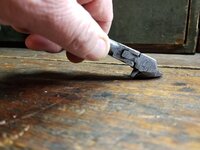
The only marking is a small "62 H&S" on the inside of a handle, which might be a date and a German mfgr. See Pic 1.

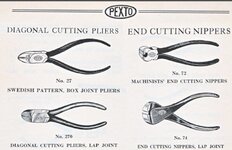
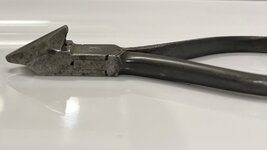
The Curator was already thinking Europe and dentistry or jewelry based on the oddity and the box joint, just some little data points he has picked up from GJ'er @rlitman along the way, when @BlueBomber reminded him on the Garage Sale thread that he had found an identical pair marked 'ACIER FONDU' (cast steel in French) and 'FRANCE' a few years ago, also marked 'E.O. JEWEL'(RY). See Pics 2 & 3.

The Acquisitions Dept doesn't much care either way, because that crude, evil butcher knows they're going to end up in the miscellany drawer of the cabinet, and he thinks they look great for all kinds of cutting, ripping, and prying, including small critters.
 

Attachments

  • 20220219_104702.jpg
    20220219_104702.jpg
    509.3 KB · Views: 49
  • BB 1.jpg
    BB 1.jpg
    167.9 KB · Views: 27
  • BB 2.jpg
    BB 2.jpg
    148.9 KB · Views: 22
To avoid these ads, REGISTER NOW!
OP
P

Private Lugnutz

Well-known member
Joined
Mar 30, 2012
Messages
30,606
Location
The Authentic Jersey Shore
Those look more like nippers than dykes, but I definitely see what you mean with the jaws being canted.

@LesserSon said he saw them in the 1967 Utica catalog, but I haven't been able to find them in that catalog or in any of the other 60's era Utica catalogs on IA/ITCL. EDIT: He clarified. He was referring to nippers No. 63 and No. 64, similar to yours.
 
Last edited:

LesserSon

Well-known member
Joined
Feb 7, 2016
Messages
5,075
Location
PA USA
I am vague on this point: WHAT is the difference between a nipper and a cutter? A casual web search suggests the terms are interchangeable - several “nipper/cutter” hits.
I have read your replies here and on the GS thread. Is this it?987178F9-205A-4662-8403-52CA4333C0CF.jpeg
The difference is in where the mass of the head is? Or the method of manufacture? Function?
Please elucidate, or better, illustrate, if I’m not capturing the distinguishing element.
 

four.cycle

Well-known member
Joined
Oct 19, 2015
Messages
28,953
Location
Tacoma, Washington
Lugnutz:
I cannot help but wonder about that unit of yours-
Picture: repetitive cuts on a soft wire or rod. Would that unit of yours snip them off at the same angle each time?
100% shot in the dark stuff, of course.
 
OP
P

Private Lugnutz

Well-known member
Joined
Mar 30, 2012
Messages
30,606
Location
The Authentic Jersey Shore
I had put the difference down to a monarchist vs. rebel thing.
Snerk.
WHAT is the difference between a nipper and a cutter? A casual web search suggests the terms are interchangeable - several “nipper/cutter” hits.
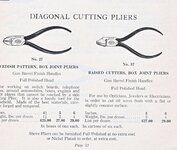
Those terms might be interchangeable out of context, but they certainly aren't within context. I suspect you know the difference between dykes and nippers. A casual search in any period catalog from any mfgr will turn up the same, LS, but here are a few excerpts, including the mfgr you suggested, and just a few of my examples. Diagonal cutting pliers are side-cutters, like linesman's pliers. Nippers are not pliers, they're nippers. And the jaws are oriented 90* difference from side-cutting pliers, including dykes.

What I have would never be misconstrued as a nipper. They're dykes with jaws built up on the top on an oblique angle.
 

Attachments

  • Dykes and Nippers Pexto.jpg
    Dykes and Nippers Pexto.jpg
    82.4 KB · Views: 25
  • Dykes and Nippers Utica.jpg
    Dykes and Nippers Utica.jpg
    109.9 KB · Views: 26
  • 20220220_111416.jpg
    20220220_111416.jpg
    320.2 KB · Views: 30

LesserSon

Well-known member
Joined
Feb 7, 2016
Messages
5,075
Location
PA USA
I’m not manufacturing my mystification, and I remain mystified. “Out of context” and “within context” are meaningless if you do not specify the context, such as “web search.”
The Utica No63 22.5° diagonal nippers are NOT much like the No65 90° end nippers shown below them, yet they are both termed “nippers.”
“Dykes” is jargon for “diagonal cutting pliers” of the specific, familiar type shown, which I spelled “dikes,” so yes, I would know the difference between dykes and end nippers, but your mystery tool is NOT end nippers, but rather diagonal nippers, so I do not think you have addressed the underlying question: other than the angle of the cutting edge to the angle of the handles, what is the difference between side- and diagonal- cutting pliers on the one hand, and nippers on the other?
Or, from another perspective, can there be such a thing as “end-cutting pliers,” other than the familiar “end nippers”? Are you stating that nippers are not pliers?
In my mind, “pliers” seems a generously broad, structural category, indicating any tool comprised of two long members joined by/at a pivot, the vast majority of which adapt or amplify hand grip. Tongs would be included.
I think the addition of cutting edges to pliers blurs that category into the functional category of “shears,” indicating any tool that severs or sections material, including (but not limited to) pivoting tools like scissors, snips, loppers, and bypass pruners, with anvil pruners and pvc cutters blurring back toward pliers.
 
Last edited:
OP
P

Private Lugnutz

Well-known member
Joined
Mar 30, 2012
Messages
30,606
Location
The Authentic Jersey Shore
"Out of context” and “within context” are meaningless if you do not specify the context...
I have specified the context, LS. Industry standards! Vintage hand tools as commonly defined and described by their own manufacturers in their own catalogs. Why would you Google the terms, generically, when you can see how the terms are actually used by mfgrs in a document explicitly used to describe and distinguish them? Utica, Pexto, and every other mfgr make the same distinction between pliers that cut, such as the diagonal cutting pliers we're discussing, and nippers.
I do not think you have addressed the underlying question:
If you mean your underlying question - the difference between two terms that functionally mean the same thing, generically, in so far as they imply severing an object - I have not. Nor have I attempted to. Nor would I. Cut and nip are as interchangeable as snip and sever and slice etc. But my tool would not be identified as a slicer or snips any more than nippers. I'm not mystified by the difference in the term "cutter" and "nipper" outside of the context of hand tools, where the distinctions are clear and indisputable. I don't know how the distinction could be better evidenced than the terms mfgrs of the tools in question used to describe them.

In the respect, your question isn't for me, it's for industry. "Hey, Utica, Pexto, Klein, etc, etc, etc, why did you call these tools 'nippers' and these other tools 'pliers with side-cutters,' when they could both, under certain circumstances, be used to cut the same object?"

I'm fine with their terminology.
 
OP
P

Private Lugnutz

Well-known member
Joined
Mar 30, 2012
Messages
30,606
Location
The Authentic Jersey Shore
Quick add: I understand where you're coming from in questioning the industrial etymology of terms mfgrs have commonly come to use to distinguish pliers that cut wire and pins and brads etc from nippers that can be used to perform the same function. That line of inquiry has no impact on how the tools are identified, though.

Users and collectors know the difference between diagonal cutting pliers and nippers. In that regard, I will re-emphasize that I think the tool in question resembles diagonal side cutting pliers. The way the jaws are raised and slanted is interesting, but they still look unmistakably like dykes to me.

I saw that the modern made in England example you provided in the GS thread were called nippers. So you seem to have some credence on your side there. Mine look older, though, and I've never seen dykes called nippers in vintage catalogs.
 

LesserSon

Well-known member
Joined
Feb 7, 2016
Messages
5,075
Location
PA USA
7D182051-323F-4B3F-AD5D-94B080B2D82D.jpeg68113508-71ED-4FF1-B553-B19BB149BE28.jpeg952157E9-D50B-4C06-B760-8F00F4AD1421.jpeg
I was right about LesserDaughter2 having these. These seem to be marked C. Weiland. Inc Germany. So made for the English-speaking market. I’ve had no luck tracking down the manufacturer.
 
Last edited:
OP
P

Private Lugnutz

Well-known member
Joined
Mar 30, 2012
Messages
30,606
Location
The Authentic Jersey Shore
The Stinkdriver Study

Armed with the a priori knowledge of Snap-on's infamous 1930's and 40's vintage "Insuloid" handle composition (DuPont's "Pyralin", made from pyroxylin), a practice and substance he also already knows was shared by Herbrand's "ProtectoGrip" handles of the same era, and spurned on by the burning questions about the scarcity of wartime Duro-Chrome "Duro-Lite" 1/4-inch drive spinners and the rare surviving specimens usually found in some form of familiar whitening, powdering, and cracking, if not already in crumbles, the Curator decided to do a mini deep dive on the subject of vintage, desiccating, off-gassing "Stinkdrivers" in general.

Using the handy search functions on Mark Stansbury's International Tool Catalog Library, hosted on the Internet Archive, I searched his entire library of hand tool catalogs on the terms "Pyralin" and then "Cellulose Acetate Butyrate".

These are the results...

Pyralin

Cornwell, Gray, Herbrand, Indestro, KRW, MAC, New Britain (1940, also implicating Long C Craftsman), Old Forge, OTC, Snap-on, Truth, and Williams.

CAB

Boker, Craftsman (all 1950 or later), Millers Falls, Stanley, Wiss, and X-Acto.

Two interesting side-notes:

- He did not notice any crossover. In other words, mfgrs (or more likely their suppliers) seemed to stick with one or the other plastic.

- Several Park Metalware catalogs for their Xcelite brand tools make reference to using a composition "similar to Pyralin." Whatever it was, the Curator would say the empirical evidence suggests it held up much better! He could be wrong, but he doesn't think of Xcelite nut drivers as decaying or malodorous.

For comprehensiveness and good measure, he also searched ITCL on "Tenite", made by Eastman. Those results did show some crossover, but after 1950, so perhaps better described as a moving on to a product with more durable mechanical, thermal, electrical, and optical properties.

Tenite

Blackhawk (74), Bridgeport, Craftsman, Crescent (50->), DASCO (51), Duro (62), ETF (50), Herbrand (57, 66), Indestro, Klein, Red Devil, Ryan, Stanley (58), Upson, Utica/Bonney, Vlchek (55)
 
Last edited:

d42jeep

Well-known member
Joined
Oct 22, 2014
Messages
16,555
Location
Northern California
My experience with Xcelite is that they are often stinkdrivers, although I haven’t done any sniff testing of whether the earliest drivers smell as bad as the slightly more modern ones. When I open the box of Xcelite drivers the immediate odor is unmistakable. They don’t seem to deteriorate, however some get the white powdery coating which usually wipes right off.
-Don
 
Last edited:

Arne73

Well-known member
Joined
Mar 20, 2010
Messages
1,477
Your observation regarding Xcelite is interesting-
I have a Xcelite briefcase tool kit that reeks when opened but no powdery coating or decomposition of any of the handles.
My Vaco nutdriver set has one handle that gets the powdered coating (red 9/16) but none of the others are affected.
Xcelite may have tweaked the formula over time to perfect it, we may never know.
 
Last edited:
OP
P

Private Lugnutz

Well-known member
Joined
Mar 30, 2012
Messages
30,606
Location
The Authentic Jersey Shore
Thanks for the feedback, guys. We may need a cross-trained narcotics or explosives K-9 in a controlled test environment for the odor assessment. :) Also, in the 'some guys think their sh*t don't stink' category, one man's cologne is another man's toxic waste dump. I have Snap-on, NB, and Craftsman BE (NB) spinners that are lightly powdering, but don't smell so bad until I get my sniffer in close proximity.
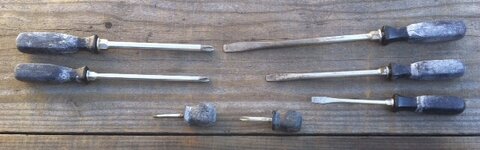
Observation: Note that Walden catalogs don't show up in the Pyralin, CAB, or Tenite searches. Now, that may not mean anything more than not using those words in their catalogs. But it's interesting coupled with the fact that they don't really have a bad reputation for being terribly deteriorating or smelly, either.
 

Outlawmws

Well-known member
Joined
Aug 9, 2011
Messages
39,267
Location
The Badlands
Lugz, anything on the Proto Empire or Vaco plastics? My Sniff test shows a SLIGHT plastic smell on the reds, (almost nothing on the other colors, but it's also cold in the shop...) but I can't say it's the infamous Stench. plastics DO have odors to one degree or another and higher temps increase this (closed up cars on a hot day easily verify this...)

I do know that some Xcelites will stink, but not all :dunno:

Guys general Q: is it THE STENCH (vomit like), or just a plastic smell? there is a difference.
 
OP
P

Private Lugnutz

Well-known member
Joined
Mar 30, 2012
Messages
30,606
Location
The Authentic Jersey Shore
Lugz, anything on the Proto Empire or Vaco plastics?
I wrote down every vintage hand tool maker name I saw, but I could've missed a few. I plan to re-run the search and record all the dates of all the catalogs this time to see of I can see some chronological pattern emerge.

I'm not really drawing any conclusions above. Just sorting the hand tool makers by major plastics and time, and, as I said, I'm going to get more detailed on the time.
is it THE STENCH (vomit like), or just a plastic smell? there is a difference.
I think that's what I meant when I half-jokingly said we'd need a canine or a machine. The putrid stench you're referring to has been blamed on Craftsman, for example, but is everyone really smelling the same thing? I think deterioration is less subjective. Everyone can see what they look like when they're powdering and crumbling.

And yes, environmental factors hasten the deterioration, especially humidity.
 
To avoid these ads, REGISTER NOW!

four.cycle

Well-known member
Joined
Oct 19, 2015
Messages
28,953
Location
Tacoma, Washington
just a note on one of your comments above:
Duro/Indestro was still offering wood-handled screwdrivers in their 1961 catalog No. 22A. That may have something to do with the scarcity of early Duro/Indestro plastic-handled screwdrivers.
I own a couple early yellow-handled models - the 136 pocket screwdriver - and there's no smell or deterioration on them at all. Maybe I have a later version? :dunno:
 

d42jeep

Well-known member
Joined
Oct 22, 2014
Messages
16,555
Location
Northern California
For the most part, it seems like most manufacturers improved their plastics by the time the 50s came along. Although I have several Plomb spinners that show signs of deterioration, out of dozens of Proto spinners and screwdrivers I’ve owned none have gone bad. Snap-on in the 60s and 70s had problems with their black plastic handles and are probably still replacing them under their warranty. Here is a set I bought off the truck back then.
-DonEDA50C0F-2B23-4F35-9BDA-7640F75E6ECE.jpeg
 
Last edited:
OP
P

Private Lugnutz

Well-known member
Joined
Mar 30, 2012
Messages
30,606
Location
The Authentic Jersey Shore
For the most part, it seems like most manufacturers improved their plastics by the time the 50s came along.
That was always my working assumption as well, but I think the infamous vomit stench handles that Outlaw is referring to, which I further think have been attributed to Craftsman, are 1950's or even later. Maybe Outlaw will weigh in on that.

This is why I want to get a working chronology going, in swim lane charts, showing mfgrs and plastics across time. Then collectors can check the actual stinkdrivers in their boxes and "map" (correlate) them to the charts. By doing that, we might be able to identify the culprits. Or we might just find that all early plastics deteriorated and stunk equally bad. :)
 
OP
P

Private Lugnutz

Well-known member
Joined
Mar 30, 2012
Messages
30,606
Location
The Authentic Jersey Shore
Meanwhile, we are very pleased to announce the addition of a leather case for the antique Wiggy, which the Acquisitions Dept found by complete surprise and accident in a pawn shop outside the main gate at Fort Huachuca. Even though it is probably a couple decades later, we think it's a handsome match, especially the golden Square D logo and the Square D logo on the brass data plate.
 

Attachments

  • 20220228_144444.jpg
    20220228_144444.jpg
    396.9 KB · Views: 18
  • 20220228_144420.jpg
    20220228_144420.jpg
    348.2 KB · Views: 17
  • 20220228_144301.jpg
    20220228_144301.jpg
    601.6 KB · Views: 19
  • 20220228_144311.jpg
    20220228_144311.jpg
    480.4 KB · Views: 21

Outlawmws

Well-known member
Joined
Aug 9, 2011
Messages
39,267
Location
The Badlands
Lugs, My personal Craftsman drivers are NOT stinking, but some of the Xcelites do.

I'm not convinced its JUST the materials - the coloring agents appear to have an effect (red smelling more then yellow...) and then there are whatever the plastics have been subjected to or stored with. - why do some stink, but others from the same Mfg, don't? something causes the difference.

I once cleaned my drafting machine scale (Clear Plastic) with a product called Bestine. the scale rapidly cracked crumbled, adn disintegrated in to rubble. sort of like that fast motion aging scene in Raiders of the Lost Arc. And very much like the crumbling handle disease...
 

RTM

Well-known member
Joined
May 13, 2019
Messages
13,191
Location
SF Bay Area
I once cleaned my drafting machine scale (Clear Plastic) with a product called Bestine. the scale rapidly cracked crumbled, adn disintegrated in to rubble. sort of like that fast motion aging scene in Raiders of the Lost Arc. And very much like the crumbling handle disease...

terrifying isn’t it. I was a non driving teenager when I saw something similar. Some (probably now banned) solvent, wiped on a radio case in a garage setting. The color went from white to ivory, then desiccated horribly, then crumbled into nothing.

I doubt the Bestine of today (heptane) is what it was ten or thirty or fifty years ago.
 
OP
P

Private Lugnutz

Well-known member
Joined
Mar 30, 2012
Messages
30,606
Location
The Authentic Jersey Shore
I am going to post a chart below. But just to re-explain what I did here, first...

- I searched ITCL (again, @Mark Stansbury 's massive hand tools catalog library on Internet Archive) on the terms "Pyralin", "Tenite", "Cellulose Acetate Butyrate", and then just "Cellulose", "Acetate", and "Butyrate" individually, because "Cellulose Acetate Butyrate" got very few hits. (Just as a side-note, they are all celluloids.) Each search produced a mess of catalogs.

- In each case, I made a list of the names of the mfgrs and the dates of the catalogs in which the words appeared. It could appear once or on multiple pages. I did not record that.

- I started to keep track of the types of tools, but after a while it became tedious and also unnecessary. Most of the instances were drivers, soft-face hammer tips, or hacksaw handles.

- I populated an Excel file with the data (I "smoodged" the dates + or - 1 year if they were an even year for fit) and sorted it A-Z.

- Lastly, I assigned colors to each plastic because it was easier to 'see' the data than reading it. The colors have nothing to do with the color of the plastic. They all came in several colors, mainly amber, red, green, and black, with additives, but also translucent. Do not misconstrue the pale yellow as amber, etc. I mnemonically picked Teal for Tenite, Pink for Pyralin, and Chartreuse for any combination of C/A/B.

Stinkdriver Study Roadmap.jpg
 
Last edited:
OP
P

Private Lugnutz

Well-known member
Joined
Mar 30, 2012
Messages
30,606
Location
The Authentic Jersey Shore
I was hoping a little infographic would help show a pattern, and I was right, I think it did.

Some comments:

- In general, across the entire industry, the use of Pyralin (DuPont) clearly proceeded and predominated the use of Tenite (Eastman) among toolmakers for handles, but Pyralin looks to have been overtaken by Tenite after 1950 or so.

- It looks like some Mfgrs moved from Pyralin to Tenite. See Cornwell and Herbrand, for example, and even though they stuck with it fairly long, see also Snap-on.

- Note that Craftsman seems to have moved from Tenite to C/A/B, though. Although I'm thinking the amber-handled tools in the 40's may have been Pyralin (see New Britain).

- Interestingly, Snap-on liked Pyralin for drivers, and C/A/B for soft-face hammer tips. (Don - special note to you - those problematic black handles are Tenite.)
 
OP
P

Private Lugnutz

Well-known member
Joined
Mar 30, 2012
Messages
30,606
Location
The Authentic Jersey Shore
Oh, that's a good nudge for another search. Pyroxylin was the name of the underlying compound. As I noted several years ago here on GJ somewhere, it's just a few chemical ingredients away from liquid jet fuel. But I never suspected a mfgr would use the term. Pyralin was DuPont's brand name for it.
 
OP
P

Private Lugnutz

Well-known member
Joined
Mar 30, 2012
Messages
30,606
Location
The Authentic Jersey Shore
Well, that answers Outlaw's question. I just searched ITCL on "Pyroxylin" instead of "Pyralin" and five (5) Plomb cats immediately came up (No.'s 15-A, 16-B, 17-B, 18-A, and 19), which is 1936 through 1943. No other hand tool makers used the term. Just Plomb. Oh, and Camillus, for pocket knife handles, in 1950. The search is linked here if anyone wants to see. That perfectly fits the pattern that's already shown in the chart. They must've switched to something else after the war, and if I was betting man, I'd bet it was Tenite or something else.
 
Last edited:

RTM

Well-known member
Joined
May 13, 2019
Messages
13,191
Location
SF Bay Area
Nice work. Fun to see MF and Red Devil ahead of the curve on Tenite.

the Shelton Versatool too obscure to get a catalog on ITCL, with their jump to Tenite.
 

Outlawmws

Well-known member
Joined
Aug 9, 2011
Messages
39,267
Location
The Badlands
Excellent Research Lugz1

Hmm. If we can get a track record for the wasting disease and the vomit smells I'd bet that would map similarly...

We know the early Duro stuff had the wasting disease - Who else? I'm not sure about the branding or dates on the plastic face mallets I have that have had it. (cast iron base heads...)
 

d42jeep

Well-known member
Joined
Oct 22, 2014
Messages
16,555
Location
Northern California
Thanks for the feedback, guys. We may need a cross-trained narcotics or explosives K-9 in a controlled test environment for the odor assessment. :) Also, in the 'some guys think their sh*t don't stink' category, one man's cologne is another man's toxic waste dump. I have Snap-on, NB, and Craftsman BE (NB) spinners that are lightly powdering, but don't smell so bad until I get my sniffer in close proximity.

Observation: Note that Walden catalogs don't show up in the Pyralin, CAB, or Tenite searches. Now, that may not mean anything more than not using those words in their catalogs. But it's interesting coupled with the fact that they don't really have a bad reputation for being terribly deteriorating or smelly, either.
A fairly thorough search of Walden advertisements and available catalogs shows that Walden only refers to their handles as “plastic”. Whatever plastic they used, I’ve never seen one deteriorate like many of their contemporaries. I did notice a fairy mild aroma similar to Xcelite from one spinner yesterday but I’ve never even seen one with a powdery coating. They seem to have figured it out from when they began using handles other than wood.
-Don
 
To avoid these ads, REGISTER NOW!
Top Bottom