To avoid these ads, REGISTER NOW!

The Machine Work Thread

To avoid these ads, REGISTER NOW!

Toolmaker51

Well-known member
Joined
Nov 26, 2015
Messages
176
Location
Missouri
Out of idle curiosity what was the hex size? Some are only a few .001's difference between inch and metric.
The few .001's difference isn't the end of the problem. It's what difference a few .001's and slightly rounded apex of a wrench miss the corner and barely engage the flat of hex socket. Fine until it gets a little torque and de-broaches the hex contour.
That's why Torx are seemingly infinite size differences, none will drive imperial or mm hex, and engage like a spline. The best example is increased life of Torx over hex, no longer prevalent for insert tool holders, even the tiniest.
 

RoninB4

Well-known member
Joined
Jul 22, 2020
Messages
3,474
Location
Under My House
The few .001's difference isn't the end of the problem. It's what difference a few .001's and slightly rounded apex of a wrench miss the corner and barely engage the flat of hex socket. Fine until it gets a little torque and de-broaches the hex contour.
That's why Torx are seemingly infinite size differences, none will drive imperial or mm hex, and engage like a spline. The best example is increased life of Torx over hex, no longer prevalent for insert tool holders, even the tiniest.
Valid points points but I still think Torx Sux. The "broached" depth is seldom deep enough to get what I feel is a solid grip on the fastener. Also, once the opening is fubar'd it's more difficult to extract while a standard hex still has a few possibilities for extraction. My final objection to Torx is, particularly with cutting tool inserts, that people will still over-torque the fastener so that rounding the Torx pocket is possible. Replacing that trashed fastener is not as readily available. JMO
 

sanddan

Well-known member
Joined
Jul 7, 2005
Messages
708
Location
Oregon
One of my veedubs had a constant exhaust leak from the high quality import exhaust I used. I didn’t feel like pulling the exhaust and lengthening the tube that slides over the heater box so I made a full circle exhaust clamp.
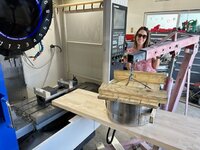
Nice!
 

kazlx

Well-known member
Joined
Oct 30, 2012
Messages
2,851
Location
Tustin, CA
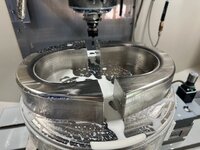
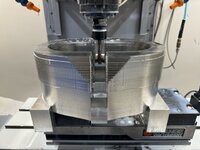
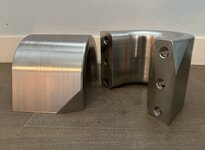
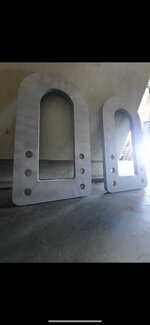
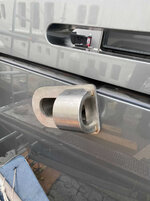
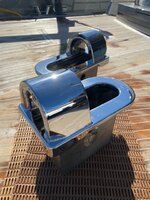
Wrapped up the most stressful machining job I've done so far. Turned a 345 lb block of 316 stainless into two 43 lb parts for a giant yacht, all in 3 days. Worth it. Started out with parts that neatly fit into a 9" D x 7" thick round. After some last minute design changes, it turned into a 14" diameter x 7" thick round, that ended up being 14-3/16 x 7.5" when it arrived. I did this all in my 30 taper Speedio. Got the call on a a Monday, was supposed to have material Tuesday, which turned into that Wednesday. Ended up getting started about 5pm and had to have the parts finished that Saturday before flying to Cancun first thing that Sunday morning. Nailed it. Here's some pics.IMG_4589.jpgIMG_4617.jpgIMG_4648.jpgIMG_4665.jpgIMG_4666.jpgIMG_4667.jpg4BA63236-E24D-4FAC-A399-84CC797B5EDE.JPGFA0A8C9B-6AE6-44A9-85E6-3127217F4C7C.JPGIMG_9165.JPEGIMG_9197.JPEG
 

slodat

ALLIANCE MEMBER
Joined
Feb 6, 2010
Messages
3,679
Location
Central-ish, WA
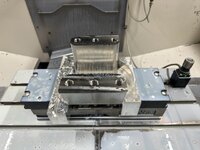
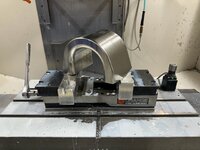
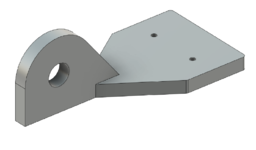
This is a component of a tooling kit I make.

1670815333415.png

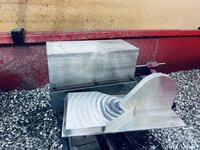
Been a fun one to get sorted out. It's starting to look like something. Getting the soft jaws, toolpaths, and everything setup on this part has taken a lot of time. So far, so good. What it starts out as in the rear, after OP1 in foreground.

E4A54BF6-A52A-4410-AD3A-26830C02C99F.jpeg
 

whateg01

Well-known member
Joined
Mar 13, 2006
Messages
11,182
Location
doo dah, kansas, usa
This is a component of a tooling kit I make.

1670815333415.png

Been a fun one to get sorted out. It's starting to look like something. Getting the soft jaws, toolpaths, and everything setup on this part has taken a lot of time. So far, so good. What it starts out as in the rear, after OP1 in foreground.

E4A54BF6-A52A-4410-AD3A-26830C02C99F.jpeg
I'm sure you have your reasons, but that sure looks like it would have been better as a weldment.
 

Toolmaker51

Well-known member
Joined
Nov 26, 2015
Messages
176
Location
Missouri
I'm sure you have your reasons, but that sure looks like it would have been better as a weldment.
I look at drawings and see geometric forms, and yes, most would produce that as a weldment. Impossible to say that's wrong way to get so and so part.
That geometry, I see being excised by bandsaw. Easier (and less) chips to clean, plus a nice bit of usable material remains.
On other hand, the upright end with larger hole hasn't a lot of contact with flat side, maybe a clearance issue, for a weld.
Often, prototypes get carved from billet as there isn't tooling to support a fabricated version. It's not a small part, completely covers width of what is likely a 6 inch vise.
 
To avoid these ads, REGISTER NOW!

Toolmaker51

Well-known member
Joined
Nov 26, 2015
Messages
176
Location
Missouri
I've got some time in weldments too. We'd make various pieces, they'd be welded - normalized - blasted or tumbled and come back for 2nd operations like boring and milling. Seems most weren't items for end user but components of fixtures and tooling. There was a lot of marine engineering, that was certain.
Elsewhere, I worked for some partially illiterate (or just failed phonics) clowns whose diction pronounced it weld-ae-ments. Very impressive to say the least.
Sturgeon MO, huh? Hit many small areas around there, but not specifically. Puts you about 2-1/4 hours west of me, good ol' I-70.
 

slodat

ALLIANCE MEMBER
Joined
Feb 6, 2010
Messages
3,679
Location
Central-ish, WA
The reason it's carved out of a chunk is because it meets the design intent of the part. And, I don't have a big enough AC TIG to weld 1/2" aluminum.
 

bored350

Well-known member
Joined
Mar 17, 2011
Messages
222
Location
Arkansas
Curious, since it's for a tooling jig (and presumably not structural), could you get away with a 3d printed piece if this was needed in more than just a few pieces?
 

slodat

ALLIANCE MEMBER
Joined
Feb 6, 2010
Messages
3,679
Location
Central-ish, WA
This component is part of an electrical testing tool kit. Kind of surprised a machining thread is full of "why don't you weld it" comments, but whatever.. I was sharing because I'm excited to have gotten the part this far.
 

bored350

Well-known member
Joined
Mar 17, 2011
Messages
222
Location
Arkansas
This component is part of an electrical testing tool kit. Kind of surprised a machining thread is full of "why don't you weld it" comments, but whatever.. I was sharing because I'm excited to have gotten the part this far.
Please don't take my question as a dig on your machining, it's quite opposite actually. I recognize the amount of setup and/or programming involved in your accomplishment and the fact that sometimes using a solid billet is in fact the best way to go. Perhaps you can expand on what it took to get the part this far for those who aren't well versed in the process?

A weldment isn't always the most cost effective solution contrary to the belief of many.
 

slodat

ALLIANCE MEMBER
Joined
Feb 6, 2010
Messages
3,679
Location
Central-ish, WA
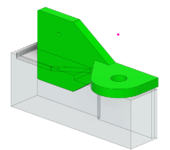
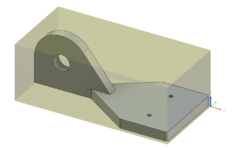
Ahh.. Not intending to come across defensive. This part, and the tooling kit, are used to temporarily connect a high current test set to various circuit breakers for primary current injection testing. I don't have a big enough AC TIG to weld the 1/2 aluminum. And, I'd need some consistency/predictability in a weldment to then machine it to final shape and size. Making from one billet means I can run the part in a few setups. Stock prep is a bandsaw cut and move on to machining. This part is three operations because of the large hole.

OP1:
1670873237648.png

All of the toolpaths:
1670873281448.png

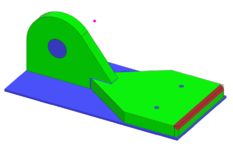
After OP1:
1670873336902.png

I don't model the chamfer shown in red or the fillets shown in blue. The fillets are done with a 0.060 radius end mill. There's no benefiit to modeling the chamfers.

Part setup in softjaw for OP2:
1670873423192.png

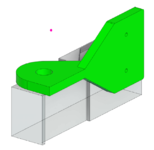
OP2 removes the carrier, drill and thread mill the two holes, and outside chamfer. OP3 turns the part on its side to bore the large hole and chamfer. I'm pretty sure I'll go ahead and flip the part and do an OP4 to get the other side chamfers.

1670873622766.png

1670873651676.png
 

bugnut

ALLIANCE MEMBER
Joined
Jul 14, 2012
Messages
3,831
Location
Central Ohio
Working in fabrication I often had to weigh cost to manufacture. Many times, unattended machining time is much cheaper than welding. Especially if it is a handful of parts, that require second, third or other operations. Just my $.02...YMMV
 

kazlx

Well-known member
Joined
Oct 30, 2012
Messages
2,851
Location
Tustin, CA
Ahh.. Not intending to come across defensive. This part, and the tooling kit, are used to temporarily connect a high current test set to various circuit breakers for primary current injection testing. I don't have a big enough AC TIG to weld the 1/2 aluminum. And, I'd need some consistency/predictability in a weldment to then machine it to final shape and size. Making from one billet means I can run the part in a few setups. Stock prep is a bandsaw cut and move on to machining. This part is three operations because of the large hole.

OP1:
1670873237648.png

All of the toolpaths:
1670873281448.png

After OP1:
1670873336902.png

I don't model the chamfer shown in red or the fillets shown in blue. The fillets are done with a 0.060 radius end mill. There's no benefiit to modeling the chamfers.

Part setup in softjaw for OP2:
1670873423192.png

OP2 removes the carrier, drill and thread mill the two holes, and outside chamfer. OP3 turns the part on its side to bore the large hole and chamfer. I'm pretty sure I'll go ahead and flip the part and do an OP4 to get the other side chamfers.

1670873622766.png

1670873651676.png

Get a double chamfer mill or a threadmill and hit top and bottom (well technically left and right I guess) on op3.
 

Toolmaker51

Well-known member
Joined
Nov 26, 2015
Messages
176
Location
Missouri
This component is part of an electrical testing tool kit. Kind of surprised a machining thread is full of "why don't you weld it" comments, but whatever.. I was sharing because I'm excited to have gotten the part this far.
Generally, if not absolutely, no one is saying otherwise. When a "I made this........." shows up, knowing there are countless ways to process most anything, and none of us have matching facilities, "I made this....." instantly becomes "How would I make that......". Personally, of all the different items I've made, none caught enough interest for me to consider production.

At the same time, answering posts is rarely aimed only who wrote OP; I'm addressing anyone who reads it from that moment on.
For example, a part might have a perfect sound weld, but that doesn't mean the features haven't moved in some manner, exactly why a lot of weldments get machined. Point is, there will (hopefully) be a steady stream of newbies, armed with nothing beyond a few terms and desire to learn.
 

slodat

ALLIANCE MEMBER
Joined
Feb 6, 2010
Messages
3,679
Location
Central-ish, WA
Generally, if not absolutely, no one is saying otherwise. When a "I made this........." shows up, knowing there are countless ways to process most anything, and none of us have matching facilities, "I made this....." instantly becomes "How would I make that......". Personally, of all the different items I've made, none caught enough interest for me to consider production.

At the same time, answering posts is rarely aimed only who wrote OP; I'm addressing anyone who reads it from that moment on.
For example, a part might have a perfect sound weld, but that doesn't mean the features haven't moved in some manner, exactly why a lot of weldments get machined. Point is, there will (hopefully) be a steady stream of newbies, armed with nothing beyond a few terms and desire to learn.
Impressively well said! Thank you!
 

sanddan

Well-known member
Joined
Jul 7, 2005
Messages
708
Location
Oregon
As soon as i noticed it was aluminum I guessed it was due to difficulty of welding aluminum in that size. If loading stress allowed a bolted joint, and if was for me, I would have made it two pieces bolted together. Or in steel, two pieces welded. My Tig isn’t big enough either, only 185 amps. End result looks like the print and that’s what counts. Good job.
 

fartymarty

Well-known member
Joined
Nov 9, 2012
Messages
1,348
Location
Fort Worth
Wow!,... over a year since anybody posted in this thread. Probably the intimidation factor scaring the amateur machinists away...how are you gonna show off the spacer you made on your mini lathe after seeing something like this:
img_4667-jpg.1765020


Well, I don't really have anything to show of my own. I'm here more to ask a question. I've done some machining at home and many decades ago I did it for a living. Perhaps I've lived a sheltered life when it comes to cutting threads. In high school machine shop we had a project where we had to cut double acme threads both internal and external. By double I mean acme threads that started 180 degrees opposite each other on the shaft and in the bore, but both were right handed threads. Until recently I thought that would probably be the most complicated thread I'd ever see (for a real application not just spectacle). Until now that is. I'm refurbishing a used Delta wood lathe (circa 1957) to give as a present to my nephew and I notice that the face plate is purposely cross threaded (1" 8TPI R.H. & L.H.) so that it will spin on to either a right hand thread or a left hand thread. I see why they did it, so that bowls and larger items could be turned on the back side of the head stock. I think it is pretty cool really but since I've never seen such a thing before I was curious if there are many applications for such cross threading and it is really a very wide spread process that I've never heard of. Are there many applications beside wood lathes that use cross threads of both R.H. and L.H in the same bore? How about shafts? All my personal cross threads have been unintentional.:cry:
 
Last edited:
To avoid these ads, REGISTER NOW!
Top Bottom