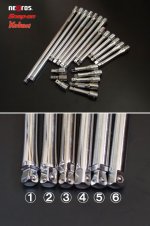
I think there was some discussion about the durability of the chrome on Nepros products.
There are many factors that are involved in creating a strong, long-lasting finish. It's not as simple as hanging the tools on a rack and dumping them into a series of bath solutions, and voila, you end up with a durable shiney finish. The manufacturing stage previous to that is equally, if not more important than the surface finishing stage.
Each manufacturing stage affects the following stages. Just like in the construction trade, where the quality of the framing and forming trade will affect how the drywall trade can do their fit and finish. Likewise, in the tool production, each stage is affected by the quality of the preceding production stage. If each of those production stages are executed properly, the final product will be of top quality---this is the model the Nepros brand follows.
Before the tools get to the surface finishing stage, they undergo a heat treating process. The heat treating process is absolutely vital, a crucial production stage, that will largely determine the strength the toughness of the metal. KTC does the heat treating differently for their Nepros brand. They invested in the purchase of two vacuum furnaces dedicated for the heat treating of all Nepros items, at a price tag of 1 million US $, each.
Typically, after a tool gets its heat treatment, they are transported to the next manufacturing stage by a conveyor system for transport (either by a system of belts or wheeled, or a combination of both); however, with all Nepros items, the tools are arranged neatly and spaced away from each other so that there’s no chance of surface damage during transport. It’s quite unlikely that any other brand in the world treats their tools like that.
In the same orderly fashion, the tools are placed into the vacuum furnace. The advantage of a vacuum furnace is its ability to create an environment free of oxygen.
Here’s an excerpt from Wikipedia on the purpose and benefits of a vacuum furnace:
----------------------------
A vacuum furnace is a type of furnace that can heat materials, typically metals, to very high temperatures and carry out processes such as brazing, sintering and heat treatment with high consistency and low contamination.
In a vacuum furnace the product in the furnace is surrounded by a vacuum. The absence of air or other gases prevents heat transfer with the product through convection and removes a source of contamination. Some of the benefits of a vacuum furnace are:
• Uniform temperatures in the range 1100–1500°C (2000–2800°F)
• Temperature can be controlled within a small area
• Low contamination of the product by carbon, oxygen and other gases
• Quick cooling (quenching) of product.
• The process can be computer controlled to ensure metallurgical repeatability.
Heating metals to high temperatures normally causes rapid oxidation, which is undesirable. A vacuum furnace removes the oxygen and prevents this from happening.
----------------------------
Another side benefit to this process is that hydrogen embrittlement is eliminated. Any hydrogen diffused into the metal can result in an increased chance of cracking.
Once they are heat treated the tools are transported to the surface finishing facility. With the regular KTC line, the tools will be placed into a vibratory polishing unit until the desired finish is attained. However, with the Nepros brand, the tools are placed into a different vibratory unit with the appropriate polishing slurry and ceramic stones. Unlike the standard KTC line where there's a lot of tools done at once, with Nepros, they limit the number of tools in the unit so that they are not hitting eachother during the process. They spend about twice the time in the vibratory machine compared to the KTC line, and specially trained eyes ensure the desired polishing is achieved.
Following this stage, the tools are set to undergo the 3-stage electro-plating process. AFAIK, the difference here between the KTC and Nepros line is how the tools are hung on the racks. Typically, the tools are hung vertically for the duration of the plating process. With the Nepros line, they either stagger the tools so that the liquid solution doesn't drip onto the tools hung below, or they limit the number of tools to be hung on the dipping rack so that there's no chance of receiving a drip.
As a final measure, the Nepros tools are placed into a heat chamber, like an oven, for 24 hours, under 200*C. This is to ensure the tools are absolutely free of any and all moisture. This marks the final stage of the surface finishing stage.
I hope this write up shows the level of quality in surface finishing that KTC pushes for their Nepros brand. Kyoto is argueably the center for Japan's craftsmen--excellent craftsmanship is in their DNA, I suppose.