Oggy
Well-known member
I’m redoing the second bathroom in our house (circa 1948) and was delighted to find that this seems to be the only room I’ve done electrical work in that has a ground. Was this common for homes built in/around 1948?
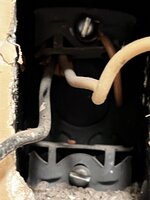


Grounding receptacles have been around a lot longer than you would think.It used to be fairly common that bathrooms (and kitchens) would have a ground wire run from a cold water pipe nearby and bonded to the metal box via the clamping screw just like in the picture. They still stuck a two prong receptacle in though, as this was done before the three prong.
That’s where I’m at with the rest of the house. If there really is a ground run with the radiator (baseboard) it’ll make adding a ground much easier. We’ve lived here for a few years and this is the first time I’ve looked that closely at the prints…Half of my '63 house is ungrounded. Bunch of 12/2 NM running around.
I'm not quite sure yet if I'll rewire everything, or just run grounds everywhere.
My best friend's first house, which he purchased back in San Francisco the 80s, originally had natural gas lighting throughout, with ceiling-mounted gas lamps and 'switches' (on-off valves) next to each doorway (apparently this was a popular option back in the day, if you could afford it). A previous owner had subsequently removed all of the gas fixtures but left all of the black pipe, which was then used as conduit for wiring for electric lighting. He kept it that way, and when sold it was considered a charming feature of the house. The buyer had an idea to restore some of the gas lighting, but I have no idea if he ever followed up on it.Agree probably added during a renovation. I lived in a house that was built early 1900s for about a year. Almost everything was in metal conduit and metal boxes that acted as ground.
I have uncovered some very old wiring (thankfully was no longer connected) that were two separate wires nailed to rafters with porcelain insulators apparently no ground. That stuff was scary lol.
Yeah there were old gas lighting fixtures in the hallways that were converted to "modern" incandescent probably in the 1950s or 60s. The house (well mansion really) was really quite spectacular and belonged to the same family for generations. The granddaughter sold it a couple years ago. I believe house was built by her great grandfather in 1905.My best friend's first house, which he purchased back in San Francisco the 80s, originally had natural gas lighting throughout, with ceiling-mounted gas lamps and 'switches' (on-off valves) next to each doorway (apparently this was a popular option back in the day, if you could afford it). A previous owner had subsequently removed all of the gas fixtures but left all of the black pipe, which was then used as conduit for wiring for electric lighting. He kept it that way, and when sold it was considered a charming feature of the house. The buyer had an idea to restore some of the gas lighting, but I have no idea if he ever followed up on it.
And that dreadful old wiring setup that you found (it's known as knob-and-tube-wiring) was actually cutting edge, and perfectly adequate back when it was installed. I do admit I shudder when I think that twisted-and-taped splices behind walls (no boxes) were perfectly acceptable in that era. My first house, purchased in 1983 (but constructed in 1948), was all knob-and-tube, with a little 30 amp four-circuit Edison-base fuse box. We lived there for ten years with no wiring/electrical problems whatsoever before I finally had the wiring upgraded.
Knob-and-Tube Wiring
Learn how to inspect knob-and-tube wiring during a certified home inspection by reading InterNACHI's article in the InterNACHI Inspector Library.www.nachi.org
Back in the sixties the NEC allowed concealed knob & tube in places of assembly, bought a old lighting fixture at a yard sale that had a cap that allowed the fixture to suspended off the now discontinued gas outlet, the wiring was old & crunchy also.The NEC still allows the installation of knob and tube wiring in limited cases.
It probably doesn't go to the panel. It's more than likely that it is clamped on to the cold water pipe at the sink or in the basement (if it's a metallic pipe). It's still done that way today when grounding the old two wire receptacles. A problem that wasn't forseen with this method was PEX. A pipe breaks, something gets changed or added and a chunk of PEX replaces the copper pipe and the ground has been lost.Simply because you see a bare copper wire connected to an electrical box do not assume the other end is connected as we would today. I would never trust that ground unless I personally checked every connection back to the Fusebox that is likely still being used.
If you really want to know if that “ground” can carry current try putting a 100-watt incandescent lamp from hot to the “ground” and see if it has the same voltage at the lamp as it does from hot to neutral.
Even then you cant be sure some fool did not connected the “ground” to the neutral someplace outside of the Fusebox.
The wire you are seeing was not installed in 1948. My guess is the bathroom got an outlet for the first time between 1958-1968.
Walt
This is incorrect. Early 60a 2-wire services were 120v. There was most certainly a neutral. Otherwise you’d have 240v. How would you power 120v appliances and light bulbs if you only had 240v? Remember, you need a neutral to get 120v.The knob and tube I've removed was all 10G or bigger and there was 1 ft. or more (most were 2') between the conductors all of the take off circuits were soldered and taped with more of the knitted (?) Tube dlid over the connection. Major safety issue to me was touching a live wire in the attic with a loosely knitted cotton (?) insulation to save me. I'm not 100% on this, but the 60A 2 wire services back when new didn't have a neutral therefore both wires were live. [Early 2 prong receptacles were not polarized further indicating no neutral] So not as unsafe in the walls as some think, but attics, stripped walls could be deadly AF! Harry
As others have indicated, this is called knob and tube wiring. Since it's disconnected, I would remove it if you haven't already done so - you don't want a pre-purchase house inspector to ever see stuff like this, even when it's unenergized.I have uncovered some very old wiring (thankfully was no longer connected) that were two separate wires nailed to rafters with porcelain insulators apparently no ground.
This is incorrect. Early 60a 2-wire services were 120v. There was most certainly a neutral. Otherwise you’d have 240v. How would you power 120v appliances and light bulbs if you only had 240v? Remember, you need a neutral to get 120v.
Furthermore, neutrals on receptacles werent polarized back then. The absence of polarization doesnt mean there isnt a neutral.
The knob and tube I've removed was all 10G or bigger and there was 1 ft. or more (most were 2') between the conductors all of the take off circuits were soldered and taped with more of the knitted (?) Tube dlid over the connection. Major safety issue to me was touching a live wire in the attic with a loosely knitted cotton (?) insulation to save me. I'm not 100% on this, but the 60A 2 wire services back when new didn't have a neutral therefore both wires were live. [Early 2 prong receptacles were not polarized further indicating no neutral] So not as unsafe in the walls as some think, but attics, stripped walls could be deadly AF! Harry
Not my house and I don't live there anymore. Property was sold. That stuff was up in the floor joists under plaster I only found it after bathroom renovation and ceiling was replaced due to water damage. It was a very large house (approx 11,000 sq ft) and I suspect was loaded with that stuff no practical way to remove it. There were a number of service panels throughout house and it was all "modern" breakers and wiring. I believe there was a major renovation done sometime in the 1960s where a entire section ("wing") was added to the house assuming that's when the electrical was replaced but don't know for sure.As others have indicated, this is called knob and tube wiring. Since it's disconnected, I would remove it if you haven't already done so - you don't want a pre-purchase house inspector to ever see stuff like this, even when it's unenergized.
I don't see anything wrong with a qualified electrician correcting your post. That he did also helps people learn.By the '60's those were powered off of a 3 wire system with a neutral, however those were originally a two wire system, and I did state that I wasn't 100% sure that was actually that way, that predates my birth so I couldn't check one to know for certain. Look at this board and the confusion the three wire system creates in discussions how would a teenager struggling to learn this get info from the general public about this? I am quite aware of how our system works [now] and the neutral is just the "center tap" on the secondary side of the transformer and being at dead center never has any potential [voltage]. I wasn't around to check or sk people that knew to completely understand, the same with the 50Hz to 60Hz conversion or when that happened I just know that it did. Sorry to have tried to help I'm thinking it is time to find a different hobby than Garage Journal! Harry
Knob and Tube Wiring, properly installed and maintained was a very safe wiring system.Agree probably added during a renovation. I lived in a house that was built early 1900s for about a year. Almost everything was in metal conduit and metal boxes that acted as ground.
I have uncovered some very old wiring (thankfully was no longer connected) that were two separate wires nailed to rafters with porcelain insulators apparently no ground. That stuff was scary lol.
No reason to get **** hurt and defensive over getting corrected, especially since someone on here might know even less than you and could think you are correct. If the old two wire services didn't have a neutral, they would be 240 volt, therefore, by default, they had to be 120 volt or there would have been a lot smoke coming out of the radios everyone gathered around every night back in the day. And, there are still a few around and in use. I've seen several and unless they've been upgraded in the last couple of years, I know where two 30 amp 120 volt services are. All of the appliances are gas, no central AC, and have an owner that is old enough to have voted for Lincoln.By the '60's those were powered off of a 3 wire system with a neutral, however those were originally a two wire system, and I did state that I wasn't 100% sure that was actually that way, that predates my birth so I couldn't check one to know for certain. Look at this board and the confusion the three wire system creates in discussions how would a teenager struggling to learn this get info from the general public about this? I am quite aware of how our system works [now] and the neutral is just the "center tap" on the secondary side of the transformer and being at dead center never has any potential [voltage]. I wasn't around to check or sk people that knew to completely understand, the same with the 50Hz to 60Hz conversion or when that happened I just know that it did. Sorry to have tried to help I'm thinking it is time to find a different hobby than Garage Journal! Harry
What conversion are you referring to?By the '60's those were powered off of a 3 wire system with a neutral, however those were originally a two wire system, and I did state that I wasn't 100% sure that was actually that way, that predates my birth so I couldn't check one to know for certain. Look at this board and the confusion the three wire system creates in discussions how would a teenager struggling to learn this get info from the general public about this? I am quite aware of how our system works [now] and the neutral is just the "center tap" on the secondary side of the transformer and being at dead center never has any potential [voltage]. I wasn't around to check or sk people that knew to completely understand, the same with the 50Hz to 60Hz conversion or when that happened I just know that it did. Sorry to have tried to help I'm thinking it is time to find a different hobby than Garage Journal! Harry
Don't let the door hit you where the good Lord split you.My problem is with the tone of "I am better than you" posters! I wrote I wasn't sure but "Originally" both may have been hot! In 1930 most houses didn't have any electrical service. When my father was just moving out on his own the parcel of land he purchased in the early 1950's didn't have power on his street! Then remember many rural washing machines were powered by a gasoline engine [into the twenties then the depression hit so time stood still/backed up] or was a small (¼HP) wringer washer. Clotheslines were the norm not dryers and rarely if ever electric. A home welder not ever, Air conditioning, not! Electric ranges I doubt it! So why in the #€!! Would the utility run 240/3 wire service into residential areas? By the sixties 3 wire was almost everywhere and all the 2 wire services were using only one side and the neutral. I've looked and cannot find what was the standard before the utilities hung 3 wire on the polls [like pre WWII]. I am aware that the cloth insulation is called " loom" but it is in my parents house knitted cotton, and offers almost no protection. Loom meant that in the early 1900's but today most envision a plastic covering to hold cables together not single conductos, so correct as that was, it has many meanings, but I chose words with imagery that I feel were accurate. These were my points but the little people have to show everybody that I didn't use 25,000 words to convey a simple concept, and correct everything that isn't wrong just not expressed as smoothly as possible (maybe just not their way)! I am not an eglish major or an author forgive me! Don't bother, I have never attacked people with this tone or the one that has become the "norm" on here. This forum has gone to **** lately with this childish mentality! Instead of "YOU'RE WRONG" how about "I thought ... ""or in my experience..." and an adult conversation can take place working forward to a broader understanding for all! Now think about these parting words going forward, "DO onto others as you would have them do onto you!" Good Bye! Harry
I'm not 100% on this, but the 60A 2 wire services back when new didn't have a neutral therefore both wires were live. [Early 2 prong receptacles were not polarized further indicating no neutral]
This is incorrect. Early 60a 2-wire services were 120v. There was most certainly a neutral.
This forum has gone to **** lately with this childish mentality! Instead of "YOU'RE WRONG" how about "I thought ... ""or in my experience..." and an adult conversation can take place working forward to a broader understanding for all! Now think about these parting words going forward, "DO onto others as you would have them do onto you!"

Good Bye! Harry
My problem is with the tone of "I am better than you" posters! I wrote I wasn't sure but "Originally" both may have been hot! In 1930 most houses didn't have any electrical service. When my father was just moving out on his own the parcel of land he purchased in the early 1950's didn't have power on his street! Then remember many rural washing machines were powered by a gasoline engine [into the twenties then the depression hit so time stood still/backed up] or was a small (¼HP) wringer washer. Clotheslines were the norm not dryers and rarely if ever electric. A home welder not ever, Air conditioning, not! Electric ranges I doubt it! So why in the #€!! Would the utility run 240/3 wire service into residential areas? By the sixties 3 wire was almost everywhere and all the 2 wire services were using only one side and the neutral. I've looked and cannot find what was the standard before the utilities hung 3 wire on the polls [like pre WWII]. I am aware that the cloth insulation is called " loom" but it is in my parents house knitted cotton, and offers almost no protection. Loom meant that in the early 1900's but today most envision a plastic covering to hold cables together not single conductos, so correct as that was, it has many meanings, but I chose words with imagery that I feel were accurate. These were my points but the little people have to show everybody that I didn't use 25,000 words to convey a simple concept, and correct everything that isn't wrong just not expressed as smoothly as possible (maybe just not their way)! I am not an eglish major or an author forgive me! Don't bother, I have never attacked people with this tone or the one that has become the "norm" on here. This forum has gone to **** lately with this childish mentality! Instead of "YOU'RE WRONG" how about "I thought ... ""or in my experience..." and an adult conversation can take place working forward to a broader understanding for all! Now think about these parting words going forward, "DO onto others as you would have them do onto you!" Good Bye! Harry
When I bought my built in 1886 house, there was one circuit of knob and tube wiring in the breaker box. The original wiring in the first floor ceiling was actually in great shape and original splices were absolutely trustworthy. The insulation in the part that was exposed in the unfinished basement though, was starting to be on the edge of loosing some of it's flexibility and I found one cheesy place where someone tapped in a ceiling fixture with a piece of zip cord. The bigger problem was that since this knob and tube was probably the only circuit when the house got electric lights, it went everywhere and so was the easiest circuit to tap into when more lights and receptacles were added. One day I was out in the garage using a circular saw when the power went out. I went into the house to reset the breaker and nearly everything in the house was off. I thought that I must have lost one of the hot legs to the service, but it was just that most of the 120v loads in the house were on that one breaker with the knob and tube. My wife came home to several holes in the ceiling and me on a ladder fishing several new runs of Romex up from the basement.Knob and Tube Wiring, properly installed and maintained was a very safe wiring system.
Unfortunately everyone who knew how to do that is no longer active. Most are dead and the rest retired long ago.
It allows the installation of knob and tube?The NEC still allows the installation of knob and tube wiring in limited cases.
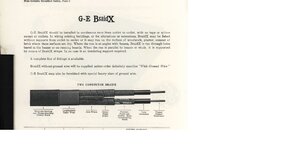
I highly doubt a 1930's house would have 2 wire plus ground NM cable. Most probable explanation is that the house was rewired around 1960 when 2 wire plus ground was introduced.My parent's house was built in the early 1930s and the original wiring is NM cable with a grounding wire included. Even though grounded receptacles were almost unheard of, the safety advantage of having the metal junction/device boxes grounded was understood, so early NM cable was available with an optional (often downsized) grounding wire. I have often found the grounding wire on the old cloth covered NM wire to have been wrapped around the cable jacket so the strain relief clamp will ground the box. Other times, someone "didn't need that wire" and cut back the grounding wire to the jacket. In either case, don't assume that there is no grounding wire in old cloth covered NM cable just because it is not visible when you look in the box.
My 1886 cottage was sold in 1918 when the original owner passed on. The auction listing does not mention the house having electricity but it does mention it having a gas stove. There is mention of a wood stove but it does not mention an oil furnace. I removed an old oil tank from the basement 2 years ago.When I bought my built in 1886 house, there was one circuit of knob and tube wiring in the breaker box. The original wiring in the first floor ceiling was actually in great shape and original splices were absolutely trustworthy. The insulation in the part that was exposed in the unfinished basement though, was starting to be on the edge of loosing some of it's flexibility and I found one cheesy place where someone tapped in a ceiling fixture with a piece of zip cord. The bigger problem was that since this knob and tube was probably the only circuit when the house got electric lights, it went everywhere and so was the easiest circuit to tap into when more lights and receptacles were added. One day I was out in the garage using a circular saw when the power went out. I went into the house to reset the breaker and nearly everything in the house was off. I thought that I must have lost one of the hot legs to the service, but it was just that most of the 120v loads in the house were on that one breaker with the knob and tube. My wife came home to several holes in the ceiling and me on a ladder fishing several new runs of Romex up from the basement.
Here is a catalog page from 1939 (the earliest one I could easily find)I highly doubt a 1930's house would have 2 wire plus ground NM cable. Most probable explanation is that the house was rewired around 1960 when 2 wire plus ground was introduced.
Every single pre 1945 house I have ever seen had knob and tube as the original wiring. Going back to pre-1910 there would normally have only been 2 fused circuits. I know for every rule there is an exception but I am likely correct for 99% of the houses out there.
I love learning new stuff. Thanks.Here is a catalog page from 1939 (the earliest one I could easily find)