To avoid these ads, REGISTER NOW!

Between 265 & 485 SQ/FT The Scooter Workshop

Workspaces sized between 265 and 485 squarefeet.

Modern Jess

Well-known member
Joined
Jan 2, 2011
Messages
1,362
Location
Bay Area, California
Current Status, April 5th, 2015:

The fourth wall is just about done, and there's only a little bit of drywall detail around the shop to address.


making_covers-5.jpg


Current Status, February 26th, 2014:

The first wall is done and it's starting to look like an actual workshop!


firstwall-13.jpg


firstwall-15.jpg


Read on for the whole story!
 
Last edited:
To avoid these ads, REGISTER NOW!
OP
M

Modern Jess

Well-known member
Joined
Jan 2, 2011
Messages
1,362
Location
Bay Area, California
The Story

About a year and a half ago, my wife and I bought a new house. My commute (100 miles a day, 50 miles each way through the SF Bay Area) was killing me, and I desperately needed a break. I also needed a garage, having never had one of my own. The house we eventually bought is only 7 miles from work, has an attached garage (which I've already finished, see Casa de Scoota) and looks just like every other house in the neighborhood. Literally. Just another tract home from the 1960s, when most of the area was developed.

This house has a secret, though: there's a second garage, completely detached, right behind the main garage. You can't see it from the street, and in fact the MLS listing for the house failed to mention it or show any pictures of it whatsoever. It's a completely legal and permitted structure, so the selling agents blew it. I only knew it was there because I was looking for exactly this kind of house, checking the satellite view of over 800 houses before I found the perfect candidate.

You see, I've got a scooter problem. You know, Vespas and their ilk. I have more than I can count at any given moment, and they take up a lot of space. I have motorcycles too (two of them, at the moment) but scooters are my thing. In addition to needing a place to park all the damn things, I need a place to work on them. I'm also an amateur fabricator / machinist / welder, though not skilled at any of those things. In an effort to get better (and continue to work on scooters) I need a space that can get dirty.

The Starting Point
This building was built specifically to be a workshop in 1966, and has been a workshop for its entire existence. It's about the same size as the garage (20x22) and had some very, very old shelves and benches when I got my hands on it. All the walls were 1/8" MDF wood paneling, too -- nice and flammable.

Here's what it looked like at the start:

workshop-a-01.jpg


workshop-a-02.jpg


workshop-a-03.jpg


workshop-a-04.jpg


workshop-a-05.jpg


workshop-a-06.jpg


workshop-a-07.jpg


workshop-a-08.jpg


workshop-a-09.jpg


workshop-a-10.jpg
 
Last edited:
OP
M

Modern Jess

Well-known member
Joined
Jan 2, 2011
Messages
1,362
Location
Bay Area, California
The Doors
While the main house was getting a new kitchen, we had a couple weeks of downtime waiting for the @#$%& kitchen cabinets to be delivered, and my contractor was, errr... idle. I turned him loose on one of the more pressing workshop projects, which was getting rid of the rotting flip-up garage door.

The big door on the workshop was facing the back wall of the garage, which had also had its own matching garage door at some point in the past, presumably to pull cars all the way through to the rear shop. The rear door of the garage had long since been filled in, though, and so the big flip-up garage door was largely useless. In addition to being rotten (wood on concrete, duh) it was also drafty and an open invitation to pests.

My contractor took off most of the front wall, installed a concrete curb, and re-framed the wall. He also scored a pair of matching four-foot-wide commercial doors (one for the garage and one for the workshop, they face each other) so that I could pull scooters (and motorcycles, heh) straight through without doing the handlebar dance.

I can't tell you how awesome these doors are. No, really. Trust me on this.

The original man door got filled in as well. We needed some re-stuccoing elsewhere on the house, so the wall of the workshop got done at the same time, and the painters painted the whole thing to match the house sometime shortly after these pictures were taken.

workshop-b-1.jpg


workshop-b-2.jpg


workshop-b-3.jpg


workshop-b-4.jpg


workshop-b-5.jpg


workshop-b-6.jpg


workshop-b-7.jpg


workshop-b-8.jpg


workshop-b-9.jpg
 
OP
M

Modern Jess

Well-known member
Joined
Jan 2, 2011
Messages
1,362
Location
Bay Area, California
The Workbench

After the dust from the house remodel had settled a bit, I started digging in to the workshop. It had a really solid built-in workbench, which was probably original to the building. It was made (I discovered) from three 20' 2x7 boards, which looked suspiciously identical to the rafters and rafter ties. It was actually a fairly nice bench, but it was keeping me from putting up drywall, and it was in the wrong spot. So sadly, it had to go.

Man. That thing was solid. Between the four gazillion nails holding down the plywood on top of the 20' planks, the planks themselves pretty much refused to come out without a fight.

The shelf above it came down next, along with all of the thin fake paneling.

workshop-c-1.jpg


workshop-c-2.jpg


workshop-c-3.jpg


workshop-c-4.jpg


workshop-c-5.jpg
 
OP
M

Modern Jess

Well-known member
Joined
Jan 2, 2011
Messages
1,362
Location
Bay Area, California
Nature Hates a Vacuum

I'll bet you guys know what happened next. As we moved in to the house (and as I refined the main garage into a showplace) things started, errr... migrating into the workshop. It quickly became little better than a glorified storage unit.

workshop-d-1.jpg


workshop-d-2.jpg


workshop-d-3.jpg


workshop-d-4.jpg


workshop-d-5.jpg
 
OP
M

Modern Jess

Well-known member
Joined
Jan 2, 2011
Messages
1,362
Location
Bay Area, California
Cannonball

And then Cannonball happened. In the scooter world, there's this all-important event (to me) called the Scooter Cannonball Run. It's basically a coast-to-coast timed endurance event, set up as a ten-day stage race, much like the Tour de France. I participated in 2008, sat out 2010, and was compelled to ride again in 2012.

Cannonball is like that ex-girlfriend that you know you shouldn't go back to, but you do anyway. It is simultaneously ecstatic and miserable, equal parts anxiety, danger, discomfort, and joy.

The next four months were spent preparing my bike (seen below) for Cannonball, and preparing myself for the misadventure I had signed up for. All progress on the workshop ceased.

I did manage to buy a really nice motorcycle lift, though!

(The gouge on the side of the bike is from Cannonball 2008. I had a bit of a disagreement with a steep gravel switchback out in the remote wilds of Utah. Needless to say, I lost).

workshop-e-1.jpg


workshop-e-2.jpg
 
Last edited:

Dillithium

Well-known member
Joined
Dec 14, 2011
Messages
151
That's looking pretty sweet! I'm looking forward to see what it will turn into.
So, for these scooter runs, do you stick with 50cc?
 
OP
M

Modern Jess

Well-known member
Joined
Jan 2, 2011
Messages
1,362
Location
Bay Area, California
So, for these scooter runs, do you stick with 50cc?

Not me, though it's been done. There are a whole range of scooter sizes that compete, both vintage and modern. Times are scored according to a handicap (which takes into account the size and age of the bike) in order to level the playing field. A 50cc scooter has a ridiculously low handicap, but doing it in 10 days (350-ish miles per day) means getting up in the wee hours of the morning and getting in to the designated hotel long after everyone else has gone to sleep. So you kind of miss the social aspect of the event altogether.

And nobody has ever come close to winning on a 50cc scooter, either. The sweet spot is somewhere around 200cc to 250cc, depending on the specific bike. Mine is "kitted" (large bore 259cc cylinder with high-performance cylinder head) and I use an auxiliary gas tank on the back so that I can ride all day without stopping, or stopping once at most.
 
Last edited:
OP
M

Modern Jess

Well-known member
Joined
Jan 2, 2011
Messages
1,362
Location
Bay Area, California
After Cannonball, I avoided the shop (and scooters) for a while. My wife and I adopted a dog from the local dog pound, I finished off a few projects around the house, and generally ignored the 400 square foot gorilla in the back yard.

Eventually, though, I had to get back to it.

Electrical

I'm not afraid of electricity, but I am afraid of putting an outlet in the wrong spot, or needing to rip open a wall when I want to re-arrange things. This is especially true when there are dedicated 220v outlets for the larger equipment. Basically, I'm afraid to commit to a specific location for anything.

My solution (borrowed from a friend of mine) was to run Wiremold 4000 conduit around the perimeter of the shop, and have none of the electrical behind drywall. Unfortunately, Wiremold conduit is a little on the expensive side, and I was reluctant to sink that much cash into conduit. Fortunately, the same friend that introduced me to the concept also had access to an industrial building that was being demolished, and secured permission to salvage some of the extensive amounts of Wiremold from the building. We spent a day removing tons of conduit, fittings, and accessories from the building, working around the crew that was getting the last of the massive newspaper printing press equipment out of the building.

That left me with a giant pile of Wiremold on my garage floor, which I am slowly fitting into the workshop. Theoretically, I'll be able to rewire the entire workshop just by popping off the panels and running new wire and outlets.

(The feed to the subpanel is temporary, as is the feed to the lights coming off the top of the panel -- in the near future, a proper service entrance will be installed and the lights will be fed from conduit running up the wall).

workshop-f-1.jpg


workshop-f-2.jpg
 

Kevin54

MEMBER EMERITUS
Joined
Jan 12, 2005
Messages
29,341
Location
Urbana, Ohio
Look great so far. Question though, why didn't you cover the walls before putting the Wiremold on, or are you going to but drywall or whatever wall covering up to it?

Looking forward to some more pics!!!
 
OP
M

Modern Jess

Well-known member
Joined
Jan 2, 2011
Messages
1,362
Location
Bay Area, California
Look great so far. Question though, why didn't you cover the walls before putting the Wiremold on, or are you going to but drywall or whatever wall covering up to it?

Ah. Forgot to mention that detail. I'm going to build out the walls similar to a Mooney Wall, which adds an extra 1.5" of insulation to an existing wall.

The climate around here isn't very cold, but it does get fairly hot in my part of the SF Bay Area, and unconditioned buildings tend to get fairly uncomfortable from solar gain alone. Plus, my shop is situated uncomfortably close to the neighbors on all sides (including their bedroom windows) and so noise abatement is also an issue. Thickening up the walls using horizontal furring will reduce heat conduction through the studs and also limit the amount of noise that escapes through those same studs.

And conveniently, this will also put the Wiremold conduit nearly flush with the finished wall.
 
OP
M

Modern Jess

Well-known member
Joined
Jan 2, 2011
Messages
1,362
Location
Bay Area, California
I spy a Hazet cart!

Cool build.

Thanks! Yep. I discovered the Hazet carts right here on Garage Journal, and lusted after them until I could stand it no more. It's perfect for going back and forth between the shop and the garage, wherever I happen to need to work on a scooter.

You scooter guys are more nuts than us motorcycle guys! LOL

It's a different flavor of the same disease. ;)
 
OP
M

Modern Jess

Well-known member
Joined
Jan 2, 2011
Messages
1,362
Location
Bay Area, California
How do you like your lift? I've been looking at lifts for a while, and the MC615R is on the short list. Is it made in the US or imported?

The lift is awesome. Really well made. I bought it locally, direct from the distributor, who happens to be in the area. That (and that it was reputed to be a great lift) drove my decision. Unfortunately, it is imported, though the quality is very good.

My only complaint is that, as a completely air-based lift, it takes a good bit of compressed air to get all the way up. I get two or maybe three lifts from my little 10-gallon compressor before it cycles back on. Not a dealbreaker, but something to be aware of.
 
To avoid these ads, REGISTER NOW!
OP
M

Modern Jess

Well-known member
Joined
Jan 2, 2011
Messages
1,362
Location
Bay Area, California
Hey you **** with the two garages! Looking forward to more.

Hey, thanks! It took some doing. As I started the house hunt, I quickly realized that if I wanted some space in addition to the garage, I was going to have to actively look for it. And since there's no "workshop" checkbox on Redfin, I had to take matters into my own hands.

Every morning, first thing as I stumbled out of bed, I logged in to Redfin and looked around in a fairly wide area (we weren't searching by city or school district) for houses in our price range, plus a little bit above our price range. Whenever there was a new listing, I would pull up the address on Google's satellite view first, before I even looked at the picture. I got good at identifying house layouts by looking at the roofline, rotating around to get a look at front, back, and side walls at the same time. Sometimes I used street view as well.

I repeated that process for over 800 houses over a six month period, looking for the back / side wall of the garage to see what kind of expansion possibilities were there. A few of them had interesting layouts, and a couple candidates had actual outbuildings in the backyard. This house was one of only a couple with an outbuilding. The picture below tells the whole story.

satellite.jpg

I noticed it as soon as it was listed in the afternoon, and by the next morning our agent was unlocking the door for us, the very first buyers through the door. We made an offer that afternoon, survived two additional rounds of bidding, and closed less than thirty days later.
 
Last edited:

Stuart in MN

Well-known member
Joined
Sep 8, 2005
Messages
22,983
Location
Minneapolis
Looks like a great place, and you're doing a great job of documenting the process.

Ah. Forgot to mention that detail. I'm going to build out the walls similar to a Mooney Wall, which adds an extra 1.5" of insulation to an existing wall.

I've been following Mooney and Smith's construction methods for a long time now, they build some really nice (and really efficient) homes.
 

Dillithium

Well-known member
Joined
Dec 14, 2011
Messages
151
Not me, though it's been done. There are a whole range of scooter sizes that compete, both vintage and modern. Times are scored according to a handicap (which takes into account the size and age of the bike) in order to level the playing field. A 50cc scooter has a ridiculously low handicap, but doing it in 10 days (350-ish miles per day) means getting up in the wee hours of the morning and getting in to the designated hotel long after everyone else has gone to sleep. So you kind of miss the social aspect of the event altogether.

And nobody has ever come close to winning on a 50cc scooter, either. The sweet spot is somewhere around 200cc to 250cc, depending on the specific bike. Mine is "kitted" (large bore 259cc cylinder with high-performance cylinder head) and I use an auxiliary gas tank on the back so that I can ride all day without stopping, or stopping once at most.

Thanks for explaining, I have a 50cc dirtbike, and while it's super comfortable I can't imagine doing more than 100 miles a day with it.
Do these scooters come stock as 200cc and up? Or do you just replace the cylinder after getting them? I'd love to see pics of the mechanicals.
 
OP
M

Modern Jess

Well-known member
Joined
Jan 2, 2011
Messages
1,362
Location
Bay Area, California
Do these scooters come stock as 200cc and up? Or do you just replace the cylinder after getting them? I'd love to see pics of the mechanicals.

Scooters come in a broad variety of sizes. At the high end of the "scooter" class, there are maxi scooters, which many argue are not scooters at all but automatic motorcycles. These beasts are 400 to 650cc and will easily do 100mph. There aren't any Vespas in this range, though there are a few from Vespa's parent company Piaggio.

In the upper middle (where I usually find myself) are the 200cc to 300cc machines. Vespa has had quite a bit of success with these (relatively speaking) over the last few years, and I think 250cc is the best engine they've put out to date. The 250cc and 300cc models have four-stroke, liquid cooled, fuel injected engines coupled with automatic transmissions. Out of the box and properly broken in, they top out at 82mph, on a good day. Mine is a tricked-out race bike, and I've had it up to 94mph, downhill, on a very good day.

In the lower middle are the 125cc (in Europe) and 150cc (in the US) bikes, which are really good city bikes but not very good for touring or any kind of distance. They're light and nimble and have as much speed as you'd ever need on surface streets.

At the bottom end are 50cc bikes, which are largely considered "liquorcycles" in most of the US. The 50cc model that Vespa makes is overpriced and underpowered, and not worth owning. A few other manufacturers have done a decent job wringing every last ounce of power out of 50cc, but not Vespa.

The bikes described above are all "modern" Vespas -- built since 1998 or so, and largely four-stroke automatic models. Prior to that, Vespa (as many of you will remember) had a very long run of two-stroke bikes, which are all now considered "vintage". I own both varieties, but favor the modern ones.
 
OP
M

Modern Jess

Well-known member
Joined
Jan 2, 2011
Messages
1,362
Location
Bay Area, California
Okay, back to the build. I hope you guys like excruciating detail, because I tend to overthink everything.

Corner Braces

The house and workshop are both stucco-clad structures, and built without sheathing. There's no plywood under there. I'm not entirely sure how I feel about that, but all the houses in the neighborhood are built that way.

To make up for the lack of sheathing (especially considering we're right on the San Andreas Fault) the house has lots of corner bracing in every possible plane. The workshop, though it was built four years after the house, is built in exactly the same way.

These particular braces, though, were in my way. Running just under the rafter ties in the workshop, they were preventing me from mounting drywall flush up against the ties.

So I moved them. I'm hoping I don't regret this someday when the workshop comes down on my head. :D

The new braces are cut into one of the rafter ties, and bolted and nailed to the top plate, next to where they were originally mounted.

workshop-g-1.jpg


workshop-g-2.jpg


workshop-g-3.jpg


workshop-g-4.jpg


workshop-g-5.jpg
 
OP
M

Modern Jess

Well-known member
Joined
Jan 2, 2011
Messages
1,362
Location
Bay Area, California
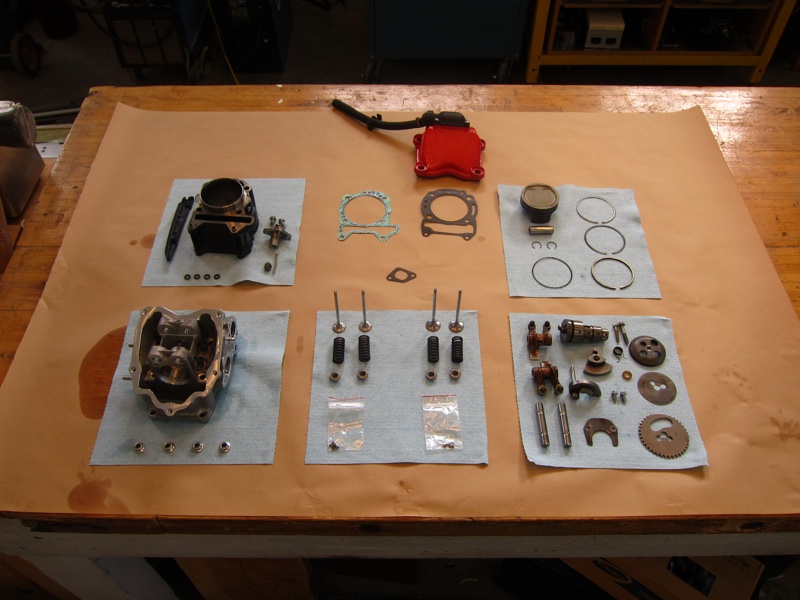
What brand of cylinder head is that, I have an old vespa i want to fix up one day.

The cylinder head is a Malossi V4 head, and only fits a narrow range of modern four-stroke Vespa engines. It's primarily for the Quasar engine range, found in the Vespa GTS250 and GTS300, plus a few assorted Piaggio bikes. Here, I'm fitting it to the 200cc Leader engine, which took some creative modification of the piston in order to allow clearance for the oversized valves.

Just to be clear, this cylinder head definitely will not fit older two-stroke Vespas. There are quite a few top end kits for those, though -- mostly from Malossi, Polini, and a few others. I'm not an expert in those kits, though. What kind of Vespa do you have? What era?
 

vegar

Well-known member
Joined
Jun 22, 2010
Messages
279
Location
Fredrikstad, Norway
Nice garage. I like the electrical solution a lot.

I am looking at buying a late 70s -early 80s 200 ccm Vespa to have at our house in Croatia :)
 

theoldwizard1

Well-known member
Joined
Feb 22, 2011
Messages
43,076
Location
SE MI
Looking at that notch would drive me crazy :eyecrazy: , but I'm not sure how to patch it.

Maybe cut a piece od 2-by lumber to fill the void and then a long (2' ?) piece of 1" wide 0.090-0.125 steel secured to the under side of that rafter tie (yes, you need to un-nail your new brace) secured with at least 4 4" long screws on each side. For "good measure" jack that rafter tie up about 1/2-1" in the center before installing the metal. This makes the bottom surface a little shorter. When you remove the jack (You could use just a long 2x6 between the rafter tie and the floor. Just bang it in at the bottom.), that piece of steel will now be in tension, like it should be.


workshop-g-2.jpg
 
OP
M

Modern Jess

Well-known member
Joined
Jan 2, 2011
Messages
1,362
Location
Bay Area, California
Looking at that notch would drive me crazy :eyecrazy: , but I'm not sure how to patch it.

:confused:

That notch is the one I cut. In the photo above, the old brace is next to it, before I added the new brace. In subsequent photos, you can see where I filled the void with the new brace.

But the strap idea is a good one -- I could easily strap across the bottom of the rafter tie, across the new brace. It wouldn't interfere with drywall (much).
 

fergus

Well-known member
Joined
Oct 4, 2009
Messages
1,620
Location
Yolo County CA
Sheathing is a relatively new thing...my uncle is a stucco contractor and as a kid I worked for him. Paper and wire was the only thing on the outside of many old houses (under the stucco). And that's all we put up before we started with a scratch coat. But that was like 15-20 years ago so...
 
OP
M

Modern Jess

Well-known member
Joined
Jan 2, 2011
Messages
1,362
Location
Bay Area, California
Sheathing is a relatively new thing...my uncle is a stucco contractor and as a kid I worked for him. Paper and wire was the only thing on the outside of many old houses (under the stucco). And that's all we put up before we started with a scratch coat. But that was like 15-20 years ago so...

Ah! Did not know that. Thanks for that bit of history.
 

Dillithium

Well-known member
Joined
Dec 14, 2011
Messages
151
Here's a good representative picture of a 200cc top end during reassembly with a high performance cylinder head and modified piston.

img_2386_176.jpg


4cd5aea9d0f9f.jpg

50cc is a class of its own where I live(Holland, EU). We can drive them without a ''real'' drivers license so a lot of people have them. It ranges from vespa's to scooters, and 2 strokes(new and old, even liquid cooled two strokes).

Do I spot 2 cam shafts for that single cylinder by the way? Looks interesting!
I'd love to take one of those apart, keep the pics coming!(the garage and the mechanical bits:) )
 
To avoid these ads, REGISTER NOW!
Top Bottom