

You are using an out of date browser. It may not display this or other websites correctly.
You should upgrade or use an alternative browser.
You should upgrade or use an alternative browser.
The Track Saw Discussion . . .
- Thread starter IRQVET
- Start date


kyrbz
Well-known member
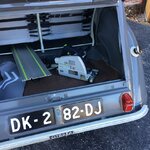
I think I probably bought into the Festool track saw system when it was first released in the US. I previously had been using a homemade track with a Makita circular saw. One of the rubs with that was the inability to plunge cut and the awkwardness and weight of my homemade system. I remember seeing an ad in Woodworker News for the Festool system and immediately knew I had to have it. A track saw is definitely one of my most used fabrication tools.
acer66
Well-known member
Is that a CV2?I think I probably bought into the Festool track saw system when it was first released in the US. I previously had been using a homemade track with a Makita circular saw. One of the rubs with that was the inability to plunge cut and the awkwardness and weight of my homemade system. I remember seeing an ad in Woodworker News for the Festool system and immediately knew I had to have it. A track saw is definitely one of my most used fabrication tools.
kyrbz
Well-known member
Yes, it was originally supposed to be for the wife because she's always wanted one, but since she never drives it, I wish we would have bought a Fourgonnette instead. Not that I don't like the 2CV, but because I could load a Fourgonnette with tools and materials, I think I'd actually use a Fourgonnette a lot more than I drive the 2CV.Is that a CV2?
acer66
Well-known member
I like CV2 but the Fourgonnette would be defiantly my choice too.Yes, it was originally supposed to be for the wife because she's always wanted one, but since she never drives it, I wish we would have bought a Fourgonnette instead. Not that I don't like the 2CV, but because I could load a Fourgonnette with tools and materials, I think I'd actually use a Fourgonnette a lot more than I drive the 2CV.
When I worked in a metal shop in the 80’s we had these super basic small Renault panel vans.
Always overloaded, basic suspension, noisy and very slow but very reliable but defiantly no coolness factor like the Fourgonnette.
I think people eventually become a fan of the tool they own.Thoughts?
Discussion?
Other experiences?
I've been on the Dewalt 20V platform for years, so that was my base and I compared other saws to it. While there are head-to-head comparisons where someone prefers A over B for one feature or B over C for another, meh. I knew how I was going to use the saw, and none of the comparisons made me think I was making a fatal tool mistake by going yellow, so I stuck with the Dewalt.
I have to say I love the tool. It may be better than others in some way, or worse in another, but only they know that, not me. I've had it for several years now and I use it in the shop and on site. Out of the box I had to adjust the knife, but other than that there's nothing about it I don't like. The cordless is fabulous for location flexibility.
Tracks, definitely get a short to start with and a long when you can. I actually have a Dewalt short track and because of the inability to source a long track when I was buying, I eventually settled for two Powertec short tracks that I tack welded with TIG to turn them into a long track. The tracks get stored on my shop ceiling. They lay flat and are easy to access.
Vacuum? Sometimes I use it, sometimes I don't. For the track saw I have a vacuum drop from the ceiling, it never gets in the way or drags when using the saw.
It is needed? It's another accessory. If limited on shop space, a track saw can make not having a table saw not so bad. I do the same as others, I cut sheet goods on scrap pieces of 2" thick XPS.
I have ome 4/4 sapele boards that are rough cut, with a bow to them. To establish a straight edge, I'd normally either joint them or clamp them to a shooting board and run the shooting board through the table saw. Today I used the track saw. Fast. So fast. Lay down the track, cut. Done. Then run the board through the table saw to straighten the second edge.
A lot of the cabinetry I do involves face frames and inset doors. Need a tapered shave cut off one side of the door, from 1/16th" to nothing? Done, easily and accurately, with no worry that the cut will go awry.
Track saws, they're pricey. You can do what they do with other tools, though care needs to be taken for accuracy. But for me, the convenience, the speed, the accuracy? The ability to batch cuts in a fairly quick manner? I honestly think the versatility of a track saw will be a bit of a revelation once you have one in your shop.
Vacuum? Sometimes I use it, sometimes I don't. For the track saw I have a vacuum drop from the ceiling, it never gets in the way or drags when using the saw.
Got any pics of the vac setup to share? I'm wanting to do something similar
Nothing fancy. The main vacuum line is above the ceiling, there's just a stub out in the ceiling. The gate is on the other end of the branch. Ceiling surface is 1/2" ply. I use the same overhead line for things like handheld sanders and for the router table.Got any pics of the vac setup to share? I'm wanting to do something similar

Last edited:
While certainly do-able the eventual downfall to systems like this is doing math for offsets, bit sizes etc.
I realized this right away, but I think the value is still there. It'll take a minute or two to get the guide setup straight.
I plan on making a spare block or two to make the setup quicker. Cut the blocks to the thickness needed to spare the circular saw to the cut.
Mostly I just need it for ripping down sheets of plywood for cabinets, so at the moment I only need one setup Jig.
alinc100
Well-known member
Here's a jig I made a long time ago from a commercially available clamp/guide. It does eliminate the math:https://photos.app.goo.gl/XXCtXmZAPUGeE3Td8
mike93lx
ALLIANCE MEMBER
I live those Porter Cable saws. Bought mine around 2000 while working at sears.Here's a jig I made a long time ago from a commercially available clamp/guide. It does eliminate the math:https://photos.app.goo.gl/XXCtXmZAPUGeE3Td8
At this point if you havent bought into a track saw system you are either
a) not needing that kind of accuracy and speed
b) love the "set up time" and process
The fact that a track saw will hold X + Y + Z axis (some models for angle cuts) is clearly an advantage
add to that:
superior dust collection
splinter reduction
plunge safety
blade to shoe edge offset for tight cuts
ability to 2x 3x etc... track length easily
Do you, but please dont say they are basically the same thing
a) not needing that kind of accuracy and speed
b) love the "set up time" and process
The fact that a track saw will hold X + Y + Z axis (some models for angle cuts) is clearly an advantage
add to that:
superior dust collection
splinter reduction
plunge safety
blade to shoe edge offset for tight cuts
ability to 2x 3x etc... track length easily
Do you, but please dont say they are basically the same thing
Love this right on. The bevel was a big part of my decision to upgrade from a circ saw that runs on track to a real track saw.At this point if you havent bought into a track saw system you are either
a) not needing that kind of accuracy and speed
b) love the "set up time" and process
The fact that a track saw will hold X + Y + Z axis (some models for angle cuts) is clearly an advantage
add to that:
superior dust collection
splinter reduction
plunge safety
blade to shoe edge offset for tight cuts
ability to 2x 3x etc... track length easily
Do you, but please dont say they are basically the same thing
In carpentry, just being able to do a 5 degree bevel is huge. When I was making windows, I installed all my sills at 5 degrees with bevels inside and out for a nice plumb fit and no gaps to collect rain (despite flashing)
I made the new jambs out of pvc, again angling the sills 5 degrees with the outside face plumb with the ground for a nice finished appearance. Track saws can also plunge to a depth so the capillary stop groove under the sills was possible.

Here they are ready to get installed. Most of the cuts were just cut to length. It’s the bottoms of these that really needed the track saw.
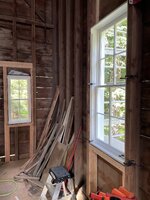
Here they are installed. Notice the inside edge of the framing all nice and plumb.
Now I could have done all this with a table saw, but I don’t own a table saw and that’s kinda the point. This is my future home, not a woodshop. I move my stuff to clear the work I’m doing.
Can’t really see from the picture but the sash are the originals from 1912, and the glass is original. We actually removed the panes, polished them with cerium oxide and reinstalled with tradition glazing compound.
In case anyone asks- no I didn’t want double pane insulated glass. I like the crystalline wavy glass these windows have. From outside, they shimmer as you pass by. From inside, there’s an impressionistic blur when you look quickly, but if you stop to gaze out, you don’t really see the distortion. The sashes run against modern plastic seals like any other window and are as air tight as the best windows. (That was tricky). I think air infiltration is the bigger energy loss with windows. Insulated glass is 2 or 3x better than single pane, but 2x r1 still ain’t good.
Last edited:
jollygreengiant
Well-known member
Love this right on. The bevel was a big part of my decision to upgrade from a circ saw that runs on track to a real track saw.
So is this the advantage of an actual track saw over one of the clamp on styles? I see that kreg has a couple models that you attach a circular saw to a sled on their track, and I thought that would work well enough for breaking down sheet goods.
Yes. Cutting bevels is one advantage of a proper track saw versus a circ saw with an adapter plate that runs on track. So if you look back on this trhead, you will see I have both types, what I would call a proper plunging track saw, and a circular saw that has an integral groove that runs on track and I use them both!So is this the advantage of an actual track saw over one of the clamp on styles? I see that kreg has a couple models that you attach a circular saw to a sled on their track, and I thought that would work well enough for breaking down sheet goods.
In terms of comparisons, both are FAR better than a circ saw and straight edge. There is no watching the cut. I move the saw down the track as fast as a can, using the sound of the saw to instruct me. Its one handed, safe, face is away from the debris etc etc. Any kind of track saw is better than a saw and a straight edge for long cuts. I use a speed square and circ saw for square cuts in framing lumber. If the cross cut is any precise angle, I clamp on a short length of track.
The other advantage of a real track saw I never hear discussed in the trade magazines is starting and ending the cut. With a plunging track saw, you drop the saw anywhere on the track and slide it back to where you want to start, pull the trigger and plunge. Technically, the track need only hang off the back end of the stock enough to complete the plunge. (so, a small amount, depending on the thickness of the cut)
For a circ saw on track, you really want to support most of the saw off the stock or at least from the front edge of the blade to most of the rest of the shoe. You don't want to start the saw and slide it on to the track because you'll cut the track. You can't practically plunge the saw by tipping the saw down onto the stock and the track simultaneously. Or at least I can't. On the far end, you can kinda have the track pretty close to flush with the end of the stock, and you run the saw off the track, but you need to be carefull there and push it straight off.
Point is, with the plunging saw, it really never has to leave the track so is much much easier to use. The tracks are all pretty much designed to be longer than you will need to rip or cross cut 4x8 sheets. So you can make the circ saw work and I have. But the plunging saw just works better and the track lengths are designed for them. The advantages of the circ saw (besides cost) are its light weight and usefulness for other cuts. (I dont' use my track saw off the track at all)
For me personally, I'm currently framing mezzanine floors in my barn. I use my little 18V Bosch saws for the solid lumber and I complete that task with that saw. Then I will switch to decking the floor with plywood and for that I only use my Milwaukee track saw. In my case, I'll set up a cutting station on a piece of rigid foam. And I run that saw stooped over, so the plunge is a real labor saver.
If I could only have one circular saw, I would obviously choose the non plunging, light weight guy for its usefulness with solid lumber. But the convenience of the track saw, its ergonomics, ability to bevel, ability to do stopped cuts, plunge cuts, really makes it tough to do without.
Firebrick43
Well-known member
Where are you getting the modern sealsLove this right on. The bevel was a big part of my decision to upgrade from a circ saw that runs on track to a real track saw.
In carpentry, just being able to do a 5 degree bevel is huge. When I was making windows, I installed all my sills at 5 degrees with bevels inside and out for a nice plumb fit and no gaps to collect rain (despite flashing)
I made the new jambs out of pvc, again angling the sills 5 degrees with the outside face plumb with the ground for a nice finished appearance. Track saws can also plunge to a depth so the capillary stop groove under the sills was possible.
Here they are ready to get installed. Most of the cuts were just cut to length. It’s the bottoms of these that really needed the track saw.
Here they are installed. Notice the inside edge of the framing all nice and plumb.
Now I could have done all this with a table saw, but I don’t own a table saw and that’s kinda the point. This is my future home, not a woodshop. I move my stuff to clear the work I’m doing.
Can’t really see from the picture but the sash are the originals from 1912, and the glass is original. We actually removed the panes, polished them with cerium oxide and reinstalled with tradition glazing compound.
In case anyone asks- no I didn’t want double pane insulated glass. I like the crystalline wavy glass these windows have. From outside, they shimmer as you pass by. From inside, there’s an impressionistic blur when you look quickly, but if you stop to gaze out, you don’t really see the distortion. The sashes run against modern plastic seals like any other window and are as air tight as the best windows. (That was tricky). I think air infiltration is the bigger energy loss with windows. Insulated glass is 2 or 3x better than single pane, but 2x r1 still ain’t good.
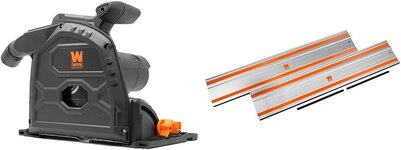
I ended up with the Milwaukee M18 track saw with the Wen tracks. I bought two sets of tracks from Amazon just in case they were messed up. One track in each box had the orange slider strips adhered incorrectly, they weren’t straight along the ridge, so they could tip the saw during cuts. I made one good set and returned the “bad” one. I have been using the saw for a bunch of 1/2” and 3/4” plywood and some rip cuts on fir 2x8 boards I used to add Racedeck to my garage steps. I’m really pleased with the saw and tracks, it has made me more confident in my projects knowing that I can get a straight line without the need for the table saw.
As for batteries, I‘ve used a mix of 5.0 and 6.0 batteries, both worked fine. I didn’t notice the 5.0 battery struggling at all, but my blade is still pretty new and sharp.
I modified a packout ammo can to fit the saw for storage, it bulges the side out a little but fits fine. I was looking at drilling a pair of holes in the tracks so I could hang them on the wall for storage.
As for batteries, I‘ve used a mix of 5.0 and 6.0 batteries, both worked fine. I didn’t notice the 5.0 battery struggling at all, but my blade is still pretty new and sharp.
I modified a packout ammo can to fit the saw for storage, it bulges the side out a little but fits fine. I was looking at drilling a pair of holes in the tracks so I could hang them on the wall for storage.
rlitman
Well-known member
I can't speak for AEAdam, but I got mine on Amazon. In 2020, it was $5 for a 16' strip. Looks like the price is even better now.Where are you getting the modern seals