Beerhippie
Well-known member
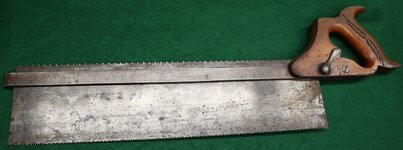
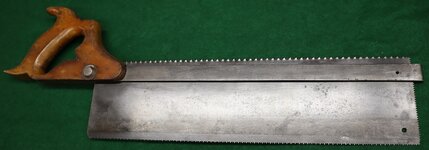
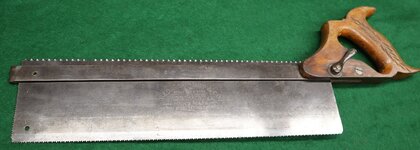
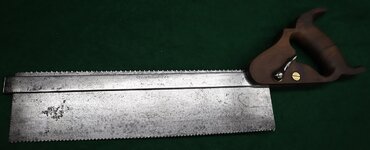
Just to clarify, when I mentioned "teeth on the tip of the saw", I didn't mean the tip of the normal blade. I meant this:

Teeth on the tip of the saw.
Teeth on the tip of the saw.


Still gotta wonder about the teeth on the end
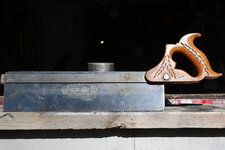
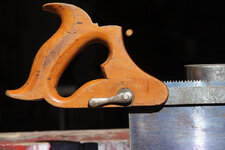
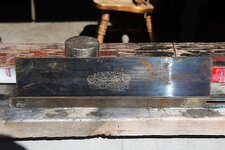
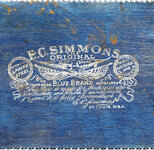
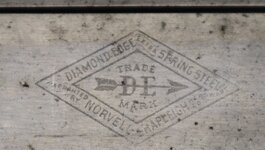
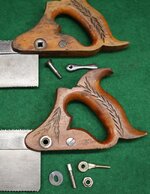
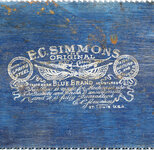
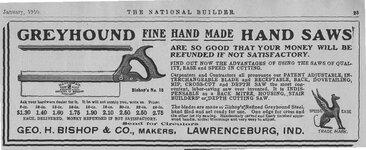
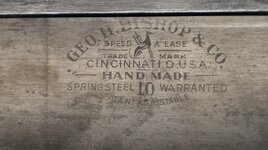
This is one of the earlier versions of the Bishop #10 saw but not the first version. Close though. The first version had several distinctive features. First was the wheat carvings going in several directions. Next would be the patent applied for on the handle. This one has the second style of locking lever. I have been wondering about how the blue was put on and then the etch. The etched area never seems to rust. On one I have the back was also blued, but most was gone when I got it. Found some blue left where it was protected by the handle.Here's another oddball saw for your viewing pleasure:
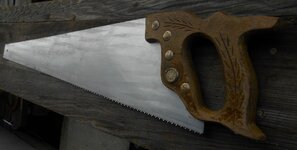
I assumed that it was a combination cross-cut/rip saw, but it clearly says "made for use by mechanics". And what's up with the short section of fine teeth on the end of the blade?
Here's some history of the Simmons Hrdwre Co. I was able to drum up:
http://www.thckk.org/history/simmons-hdwe.pdf
Another forgotten cool tool from my own garage!
Post it here, post it here, with LOTS of good pix.Should I start a new thread or post on this one?
Hear, hear!Post it here, post it here, with LOTS of good pix.
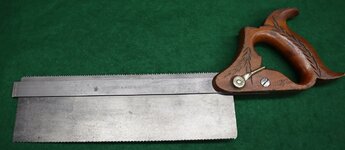
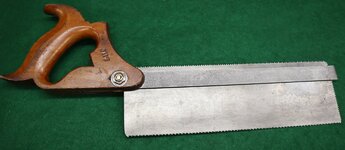
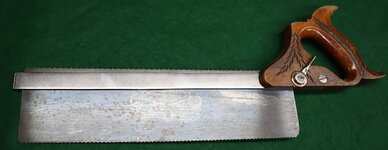
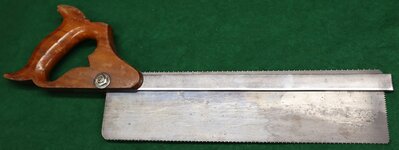
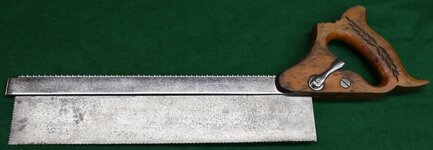
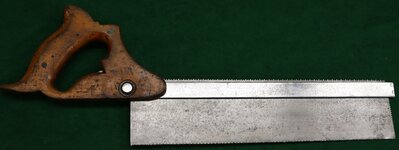
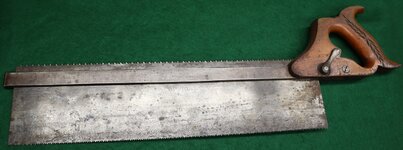
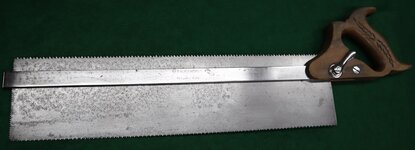
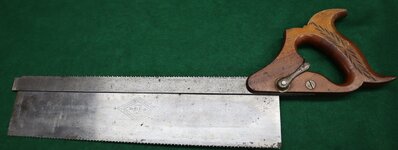
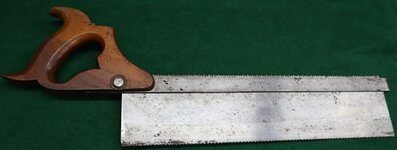
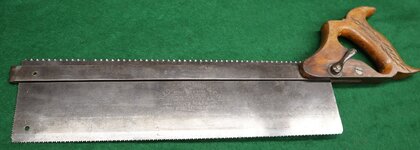
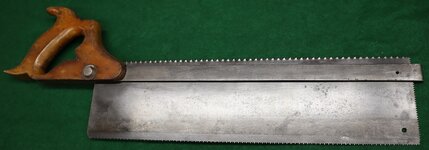
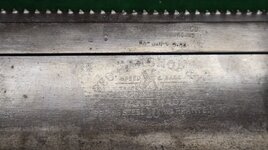
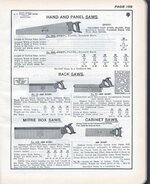
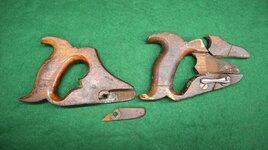
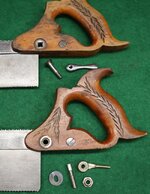
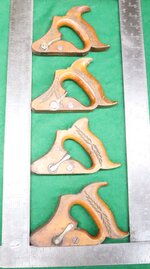
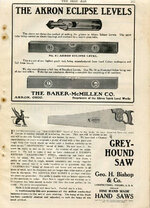
Bishop Adjustable Backsaw Model 10 Type Study. Second post.
Type 2-B
Same as 2-A except longer, with a thicker back. The blade is 11 PPI crosscut and 7 PPI rip. 16” long.
The handle is now 7 ¼” long and the lever bolt hole has been moved down also. Because of the thicker back, a wider slot was cut into the handle.
Type 2-C
Same as 2B except the font for Geo. Biship & Co. now a larger font.
Type 2-D
Same as 2-A except the blade is 12 PPI crosscut and 8 PPI rip. 14” long. This example has a Shapleigh etch on the blade. The back is only marked with patent date.
Group 3
Type 3-A
Same as 2-D except for markings. This one is marked on the back three lines. Top: Geo. H. Bishop & Co. Middle: Lawrenceburg, Ind. Bottom: PAT. JAN’Y 6-09
The blade etch shows the Cincinnati location.
Nice job. Almost looks unused. Almost. (But that's good, don't want perfect)finished re-working this beauty last night. was a bit on the rough side when I got it and I just didn't like how it looked.
Craftsman hand saw 09/03/24
("before" shots below)


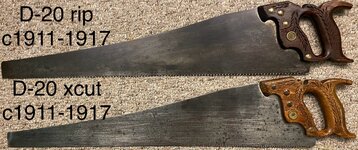


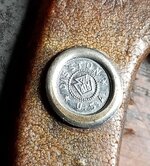


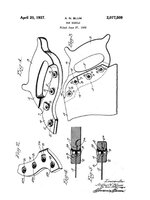
Nice get, don’t recall seeing one in real life. Not sure I would have bought it up, just admired it.I found a very atypical vintage Disston hand saw this morning with a two-part, two-tone composite handle

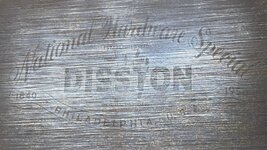
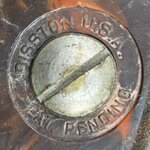 Most interesting to me is the pending status molded where your earlier design has a patent number. Obviously, the handle design is different, but I don’t see an obvious candidate on DATAMP.
The boldfaced sentiment is often expressed, less-clearly demonstrated.I never restored an old saw. I may clean them up or do some maintenance or repair if needed to get them usable, but if you look at any mature genre of collecting, or any knowledgeable or educated collector, you will see that a "restoration" destroys the value of most any antique, erasing it's history and patina. So if you want to make a saw shiny and polish it, make sure it is not very valuable or historical.
Thanks. I was pleased. I was hoping to see a "Masterpiece" (now there's a superlative!) etch after a light cleaning, but no such luck. I noted that Disston led off their 1949 catalog with lightweight saws and the D-95 is actually the very first saw in the book at the top of the page.That cleaned up better than I thought it would - nice job!
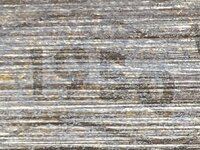
With the "top" (apex above the mean line) missing, I am seeing either 1955, 1956, or possibly 1958, and I think those are the only possibilities based on the font. Does it look like nylon? Does nylon show particulates like Tenite does? Or is it a uniform solid? According to the DI, the D-111 was nylon and it was the last model they made in Philly before HK Porter moved production to Danville, Virginia "in the late 1950's". Do you know exactly when that occurred? That could eliminate 1958. It all seems to match up with info available on IA. The only plastic handled saw the 1954 Illustrated Price List includes, as far as I can tell, is the D-95.“National Hardware Special 1940-1955(6?).” I’m not sure what model number it is, maybe D-111.
That is interesting. I suppose a new patent may have had something to do with either the one-piece design, the composition, the slightly different shape, its entire construction, or all of the above.Most interesting to me is the pending status molded where your earlier design has a patent number.
I understand your point. But these saws would have never sold for what they looked like when I purchased them. The Keen Kutter was in very bad shape. And the guys selling the Disston thought it just had a hole in the handle. Two handed saw.I have a couple hundred old hand saws, from keyhole to two-man crosscuts, dating from the 1850s to the 1950s. The most common saw manufacturer to find is Disston, as they were the first saw maker with their own steel mill at a very early date, so could undercut the prices and production of all other saw manufacturers, and they either bought all the others up or put them out of business. After Disston the other most common vintage saws are Atkins then Simonds. Hand saw production peaked in the 1890s and early 1900s before WWI, so even today it is very easy to find saws from this era, especially Disstons. It is actually harder to find a Disston saw made between WWI and WWII than it is to find one made in the 1890s and early 1900s because of this. After WWI electric saws started showing up, the great depression hit and the economy did not recover until WWII, and by then and especially the 50s the country was swarming with hand-held electric circular saws.
I never restored an old saw. I may clean them up or do some maintenance or repair if needed to get them usable, but if you look at any mature genre of collecting, or any knowledgeable or educated collector, you will see that a "restoration" destroys the value of most any antique, erasing it's history and patina. So if you want to make a saw shiny and polish it, make sure it is not very valuable or historical. I have one of the Cortland Wood saws from the early 1850s, made at Sing Sing prison, which my father gave to me, and it is all original and in good shape, never anything done to it, and that is how it is most valuable as a historical document. I like using hand saws, and using them also uses them up, making the blade smaller with sharpening, maybe damaging the handle etc., so when I use a saw I like to use one of the common easy-to find Disston saws from after WWII or from the 15 or so years right before WWI, or some other saw that has little or no historical value.


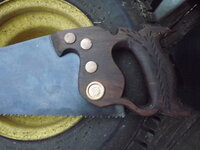
That sounds about right!The Keystone K-6-1/2 Challenger is described in the 1949 catalog with a “moulded plastic handle, attractive mottled brown”.
I don't know for sure, but there was a National Hardware organization, operating like a clearinghouse or brokers, I think, who published a bulletin. I see them show up all the time in Google Books searches. It seems like the kind of business entity with which Disston would've had such a long relationship that it deserved an anniversary saw.Dunno what NHS is - an expo, maybe?




Factory grind, or has it been resharpened to match standard saws?A Disston Acme 120 thumbhole rip saw that was hanging in the basement at a local estate sale earlier this year. I did not think much of it at first and brought it home and put it in the thumbhole rip-pile, but then later on I started thinking about how the handle had some carving in it and how that meant it must not be a run-of-the-mill D8. Sure enough with a bit of cleaning the "acme 120" etch came out. ;