To avoid these ads, REGISTER NOW!

The Vintage Hand Saw Thread

B Halverson

Well-known member
Joined
Sep 26, 2024
Messages
304
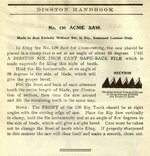
Factory grind, or has it been resharpened to match standard saws?

I would have to go find it and look at it again, I think I threw it in the "good pile" under the bench in the basement after I took the photos. I think the Acme120 series was for cutting dry hard woods with no offset in the teeth. I have a crosscut acme120 also out in the garage I found some years ago so looked them up then. If I ever find myself doing any sort of precision pattern-making or piano-building I guess I will have to make sure they are tuned to factory specs.
 
To avoid these ads, REGISTER NOW!

RTM

Well-known member
Joined
May 13, 2019
Messages
13,167
Location
SF Bay Area
If I ever find myself doing any sort of precision pattern-making or piano-building I guess I will have to make sure they are tuned to factory specs.
Needs a special safe back cant file to sharpen it. Directions somewhere on the web. Gonna haul mine out in a year or two and give it a go.
 

LesserSon

Well-known member
Joined
Feb 7, 2016
Messages
5,065
Location
PA USA
But…the example under discussion IS a RIP saw. The handle is for ripping, the depth of the blade is for ripping. It’s filed for ripping. So it does not need a special file meant for filing special crosscut teeth…does it?
I mean, even typical rip teeth do not require much (if any) set, because when ripping, a wedge can be used to keep the kerf from closing on the blade.
 
Last edited:

RTM

Well-known member
Joined
May 13, 2019
Messages
13,167
Location
SF Bay Area
…the example under discussion IS a RIP saw. The handle is for ripping, the depth of the blade is for ripping.
Ok, maybe you are right there. Apparently it was available both ways, but I've never seen one, and only four 120s total, so my bias is apparent. 😉

"The No. 120 Acme was available in the longest lengths with the thumbhole or "dual grip" handle. The 28" and 30" inch saws were mostly rip saws, but there were some sold with crosscut teeth in those lengths with the thumbhole handle. The thumbhole handle was also available on the D-8 and D-100 models."

From:


AntiqueBen

Well-known member
Joined
Aug 4, 2021
Messages
1,438
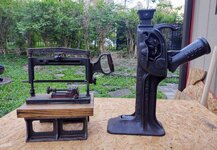
I found an old Goodell & Pratt Co. mitre saw...I think? I haven't researched anything yet, but I think it's a machinist mitre saw & it has a cool little vise mounted to the cast base. I might have read this was called the No. 1 Saw or Mitre Saw or something like that. I would like to know more about it. I had the railroad jack out in the sun wiping it down today & thought I'd take a pic of the Goodell & Pratt.
 

Attachments

  • IMG_20250420_195544360.jpg
    IMG_20250420_195544360.jpg
    1.1 MB · Views: 24
  • Screenshot_20250420-201119~2.png
    Screenshot_20250420-201119~2.png
    2.3 MB · Views: 14
  • IMG_20250420_195619003~2.jpg
    IMG_20250420_195619003~2.jpg
    1.1 MB · Views: 12
  • IMG_20250420_195641152.jpg
    IMG_20250420_195641152.jpg
    421.9 KB · Views: 13

AntiqueBen

Well-known member
Joined
Aug 4, 2021
Messages
1,438
So, I found another Goodell-Pratt no. 1 Saw on eBay for $400 after shipping & taxes. HERE is the link to it.

It has no vise, no saw blade, has some chips & is in cosmetically poor condition. Does this pricing sound right? How much would one go for that is complete in good working condition? Not sure if someone is just over pricing or is this somewhat of a scarce or rare tool?
 

WisJim

Well-known member
Joined
Dec 20, 2010
Messages
2,282
Location
Menomonie, WI
That one on eBay hasn't sold yet, and that seems kind of high. Hard to say what it might go for. I passed on one, no vise, for $100 at a tool meeting a year or two ago.
 

AntiqueBen

Well-known member
Joined
Aug 4, 2021
Messages
1,438
That one on eBay hasn't sold yet, and that seems kind of high. Hard to say what it might go for. I passed on one, no vise, for $100 at a tool meeting a year or two ago.
I suppose I got a good deal then. I found it at an antique mall for $45. Then I made the base it's attached to. Pretty cool tool.
 

Eric Brown

ALLIANCE MEMBER
Joined
Jun 14, 2024
Messages
678
So, I found another Goodell-Pratt no. 1 Saw on eBay for $400 after shipping & taxes. HERE is the link to it.

It has no vise, no saw blade, has some chips & is in cosmetically poor condition. Does this pricing sound right? How much would one go for that is complete in good working condition? Not sure if someone is just over pricing or is this somewhat of a scarce or rare tool?
Sounds high to me, especially since it's missing the vice. Suggest keep looking or make them an offer. If there is no "make offer" button, use the "contact seller" button.
 

AntiqueBen

Well-known member
Joined
Aug 4, 2021
Messages
1,438
Sounds high to me, especially since it's missing the vice. Suggest keep looking or make them an offer. If there is no "make offer" button, use the "contact seller" button.
I was just curious what they might sell for. Not looking to buy another one. Mine is complete & in much better shape. I'm not seeing to many of these online for sale. Must not be common to find, especially with an original vise.
 

AntiqueBen

Well-known member
Joined
Aug 4, 2021
Messages
1,438
Bench saw. I posted a catalog link in the hacksaw thread. Gotta go a few years older to get the GP version.
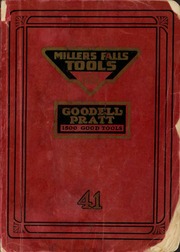
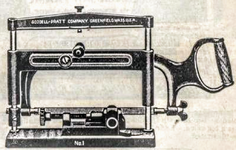
I enhanced the pic in the 1935 Millers Falls catalog that you referenced (pic below). I know you can't always go by how a tool is stamped in catalog or ad pics, but the one in the ad is marked differently than mine. I was wandering maybe how to tell the early version of this tool vs. the later ones?
 

Attachments

  • Screenshot_20250421-140909~2.png
    Screenshot_20250421-140909~2.png
    888.7 KB · Views: 11

Eric Brown

ALLIANCE MEMBER
Joined
Jun 14, 2024
Messages
678
I was just curious what they might sell for. Not looking to buy another one. Mine is complete & in much better shape. I'm not seeing to many of these online for sale. Must not be common to find, especially with an original vise.
If you start looking for them with the online tool dealers you will examples come up every few months. Sometimes you need to ask. They could even source one sometimes. I might be wrong, but thinking they are around 200 to 300.
 

RTM

Well-known member
Joined
May 13, 2019
Messages
13,167
Location
SF Bay Area
the one in the ad is marked differently than mine. I was wandering maybe how to tell the early version of this tool vs. the later ones?
If yours is a GP, it's definitely earlier. Go into the ITCL, and look for only GP catalogs, look for the bench saw, and look at those printers blocks, see if they are closer to yours.

My buddy looked for over 5 years, then finally found that one, after passing over stupid expensive ones on vintage sellers sites, in not pristine condition. The one shown was not very nice, but he wanted a user. I think it was like <$50, 14 years ago
 

AntiqueBen

Well-known member
Joined
Aug 4, 2021
Messages
1,438
If yours is a GP, it's definitely earlier. Go into the ITCL, and look for only GP catalogs, look for the bench saw, and look at those printers blocks, see if they are closer to yours.

My buddy looked for over 5 years, then finally found that one, after passing over stupid expensive ones on vintage sellers sites, in not pristine condition. The one shown was not very nice, but he wanted a user. I think it was like <$50, 14 years ago
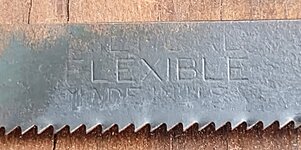
Good info 👍 I'll check out some catalogs over on ITCL. I believe GP sold what they called "flexible" hacksaw blades. If so, this one even has its original saw blade (pic below).
 

Attachments

  • IMG_20250421_151525195~2.jpg
    IMG_20250421_151525195~2.jpg
    418.5 KB · Views: 10
To avoid these ads, REGISTER NOW!

AntiqueBen

Well-known member
Joined
Aug 4, 2021
Messages
1,438
The oldest GP catalog I can find on ITCL is their No. 8 catalog printed in 1907. The no. 1 bench saw is still marked differently than mine. It's marked the same as it is in the 1935 Millers Falls catalog with the exception of not having the No. 1 stamped on the front of the base (pic below). I'm going to look at pics online & see if I can find any variations.
 

Attachments

  • Screenshot_20250421-155330~2.png
    Screenshot_20250421-155330~2.png
    1 MB · Views: 8

AntiqueBen

Well-known member
Joined
Aug 4, 2021
Messages
1,438
All of the pics I'm seeing online is marked like mine. Maybe the catalog markings on the GP no. 1 saw is just the artist's interpretation.
 

AntiqueBen

Well-known member
Joined
Aug 4, 2021
Messages
1,438
I found a pic online of the earliest version of the GP no. 1 saw. It's marked "Pat Pending" on one side & Goodell, Son & Co. on the other. It looks like the saw may have been red like the vise?
 

Attachments

  • Screenshot_20250421-172324~3.png
    Screenshot_20250421-172324~3.png
    815.8 KB · Views: 7
  • Screenshot_20250421-172341~2.png
    Screenshot_20250421-172341~2.png
    906.9 KB · Views: 7
  • Screenshot_20250421-172403~2.png
    Screenshot_20250421-172403~2.png
    805 KB · Views: 7
Last edited:

AntiqueBen

Well-known member
Joined
Aug 4, 2021
Messages
1,438
The only other difference I see is some have a hyphen between the Goodell & Pratt, and some don't. I believe the older version of these is the one without the hyphen.
 

Attachments

  • IMG_20250421_171800945.jpg
    IMG_20250421_171800945.jpg
    693.2 KB · Views: 12

Private Lugnutz

Well-known member
Joined
Mar 30, 2012
Messages
30,575
Location
The Authentic Jersey Shore
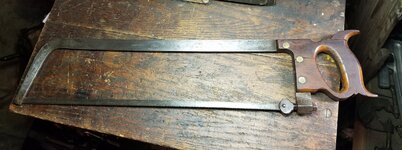
Question for the hand saw aficionados. (That means you, @Eric Brown, @LesserSon, @pfaustus, @WisJim, et al.) About Disston saws, the Disstonian Institute states, "We can identify saws made after 1875 because they have domed cap screws instead of split nut fasteners." Is this a fuzzy rule of thumb we might reasonably apply to the industry writ large for dating saws, in general? Reason I ask is I found a butcher saw this morning made by C.E. Jennings with split nut fasteners. I looked through some C.E. Jennings ads and catalogs on IA/ITCL from 1900 to 1913 hoping it would help, but the hardware is not really illustrated or addressed.
 

Attachments

  • 20250627_120409.jpg
    20250627_120409.jpg
    559.4 KB · Views: 10
  • 20250627_121140.jpg
    20250627_121140.jpg
    862.6 KB · Views: 11
  • 20250627_121124.jpg
    20250627_121124.jpg
    872.5 KB · Views: 13

Eric Brown

ALLIANCE MEMBER
Joined
Jun 14, 2024
Messages
678
Question for the hand saw aficionados. (That means you, @Eric Brown, @LesserSon, @pfaustus, @WisJim, et al.) About Disston saws, the Disstonian Institute states, "We can identify saws made after 1875 because they have domed cap screws instead of split nut fasteners." Is this a fuzzy rule of thumb we might reasonably apply to the industry writ large for dating saws, in general? Reason I ask is I found a butcher saw this morning made by C.E. Jennings with split nut fasteners. I looked through some C.E. Jennings ads and catalogs on IA/ITCL from 1900 to 1913 hoping it would help, but the hardware is not really illustrated or addressed.
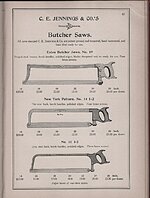
Looking in my catalogs from 1907 and 1913, your 14 1/2 saw is not listed in the 1913 catalog. It is listed in the 1907 as a "New Your Pattern No. 14 1/2. Flat steel back, polished edges, Four brass screws. However, the illustration only shows three screws and the handle shape looks more like the Extra Butcher saw. The screw heads also look very flat, like yours.
 

Attachments

  • CE Jennings 1907 page 87.jpg
    CE Jennings 1907 page 87.jpg
    228.8 KB · Views: 11

Private Lugnutz

Well-known member
Joined
Mar 30, 2012
Messages
30,575
Location
The Authentic Jersey Shore
Thanks, Eric. I agree with your observations. The other piece that stands out for me is that tensioner. It's oval and much larger than the same component in the ads and catalogs I was looking at, including yours. Do you think "brass screws" could imply that they had, like Disston, already stopped using split nuts? I can't find any 1880's or 1890's references for C.E. Jennings.
 

Eric Brown

ALLIANCE MEMBER
Joined
Jun 14, 2024
Messages
678
Thanks, Eric. I agree with your observations. The other piece that stands out for me is that tensioner. It's oval and much larger than the same component in the ads and catalogs I was looking at, including yours. Do you think "brass screws" could imply that they had, like Disston, already stopped using split nuts? I can't find any 1880's or 1890's references for C.E. Jennings.
I really don't know. To make things even more confusing is sometimes I think they simply used what they could buy or was easier to make.
Like you, I don't have any earlier references. Probably made by one of their many companies and stamped with the Jennings name. Not sure if these companies had their own catalogs or not.
 

RTM

Well-known member
Joined
May 13, 2019
Messages
13,167
Location
SF Bay Area
About Disston saws, the Disstonian Institute states, "We can identify saws made after 1875 because they have domed cap screws instead of split nut fasteners." Is this a fuzzy rule of thumb we might reasonably apply to the industry writ large for dating saws, in general?
I personally put a bit of delay on other manufacturers. Disston was the big fish, and probably was at the leading edge of the transitions in the industry. Other, and smaller manufacturers, might be a few years, to a decade behind Disston in the adoption of the various patents listed in the Disstonian.

This is not an official opinion, only mine, based on stuff I’ve learned from other, more modern industries. While Disston had a huge volume, or owned the patent, they may turn over their inventory faster, or see a cost savings from the transition. Smaller makers may get several years out of a box of fasteners, while Disston may have used that in a few shifts.

¢¢
 

Eric Brown

ALLIANCE MEMBER
Joined
Jun 14, 2024
Messages
678
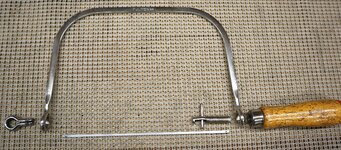
Here are three similar coping saws. They are all marked "FULTON BF". Alloy Artifacts says that the BF was used as the manufacturing code for primarily tools from Japan made for Sears. However my third example is not from Japan. Going on the assumption that the thicker, heavier ones are older as newer ones using less metal made them less expensive to make and sell. These all take a 6 1/2" blades with pins.

The first example has a thick frame that measures .354" wide by .2" thick in the name stamp area. It has a 5" throat. The handle is made with a metal insert and ferrule that screws onto a 1/4-20 adjuster. The two levers for blade orientation have flats on both sides.

Coping 1.jpg

The second example has a thinner frame but has a 5 1/4" throat. The frame is .3" wide by .125" thick. The blade holders are similar to the first example. The handle has a red painted end. The two levers are smaller diameter and round.

Coping 2.jpg

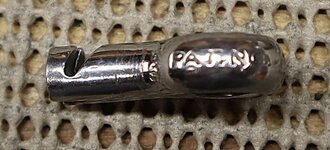
The third example has a frame .263" wide by .125" thick. It has a 4 7/8" throat. The frame has a different design in that the ends where the adjuster go has been formed from round wire that is formed into loops. The adjuster end has a 5/16-20 thread and the lever protrudes on both sides. The other end looks like it was made from a 1/4" cotter pin with a groove cut in for the pin on the blade. This is marked "PAT. NO. 1929989". This would be D.E. Priest patent of Oct 10, 1933. This patent was assigned to Parker Wire Goods of Worcester Mass.

Coping 3a.jpg

Coping 3b.jpg


Coping 3d.jpg

Comparing the name stamp area and the handle shapes, these all appear to have been made by the same company.

Coping 4.jpg

The above mentioned patent is not listed on Datamp.org and Alloy Artifacts does not mention Parker Wire Goods as a maker of a coping saw under the Fulton name for Sears.

Personal opinion: The first example has a stiffer frame and the blade makes a nice higher pitched sound than the other two, which seem much weaker.
 

Attachments

  • Coping 3c.jpg
    Coping 3c.jpg
    499.6 KB · Views: 4

four.cycle

Well-known member
Joined
Oct 19, 2015
Messages
28,926
Location
Tacoma, Washington
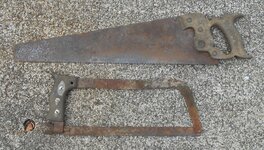
Found these in a shed about four miles from the Pacific Ocean. These will be restored and returned to the owner.
One appears to be an Atkins with an elaborately decorated handle.
How do I get those medallions loose without damaging stuff? That old Craftsman I dolled up wasn't anywhere near this rough.

The lower saw appears to be a hack saw or possibly a bone saw (which would make perfect sense in that area.) I'm not seeing any markings, but the rust may be hiding any that might be there. Any clue as to manufacturer? Is this one ringing any bells?

Joe saws 101825 01.jpgJoe saws 101825 02.jpg
 

Eric Brown

ALLIANCE MEMBER
Joined
Jun 14, 2024
Messages
678
Found these in a shed about four miles from the Pacific Ocean. These will be restored and returned to the owner.
One appears to be an Atkins with an elaborately decorated handle.
How do I get those medallions loose without damaging stuff? That old Craftsman I dolled up wasn't anywhere near this rough.

The lower saw appears to be a hack saw or possibly a bone saw (which would make perfect sense in that area.) I'm not seeing any markings, but the rust may be hiding any that might be there. Any clue as to manufacturer? Is this one ringing any bells?

Joe saws 101825 01.jpgJoe saws 101825 02.jpg
You should be able the unscrew the Adkins and just pop the medallion side out.
 

RTM

Well-known member
Joined
May 13, 2019
Messages
13,167
Location
SF Bay Area
How do I get those medallions loose without damaging stuff?
I like to use a modified wood screw clamp, with a hole drilled thru one jaw, large enough to fit the screw to be loosen thru. Clamp down on the medallion head, and the wood on the other side, and try to relieve pressure on the hardware. If it’s a split nut, be very cautious, see below. A slightly more modern nut without the threaded bit showing, can take a bit more pressure than the split nut. Use the screwdriver that fits the nut best, and try very gently too loosen it. Tighten then loosen may help. Be careful with Kroil etc, it may stain the wood.

For a split nut, grind a screwdriver bit to fit.

Clean the slots out for best screwdriver fit
 

Lesserstore

Well-known member
Joined
Mar 18, 2020
Messages
864
Location
Texas
Here are three similar coping saws. They are all marked "FULTON BF". Alloy Artifacts says that the BF was used as the manufacturing code for primarily tools from Japan made for Sears. However my third example is not from Japan. Going on the assumption that the thicker, heavier ones are older as newer ones using less metal made them less expensive to make and sell. These all take a 6 1/2" blades with pins.

The first example has a thick frame that measures .354" wide by .2" thick in the name stamp area. It has a 5" throat. The handle is made with a metal insert and ferrule that screws onto a 1/4-20 adjuster. The two levers for blade orientation have flats on both sides.

Coping 1.jpg

The second example has a thinner frame but has a 5 1/4" throat. The frame is .3" wide by .125" thick. The blade holders are similar to the first example. The handle has a red painted end. The two levers are smaller diameter and round.

Coping 2.jpg

The third example has a frame .263" wide by .125" thick. It has a 4 7/8" throat. The frame has a different design in that the ends where the adjuster go has been formed from round wire that is formed into loops. The adjuster end has a 5/16-20 thread and the lever protrudes on both sides. The other end looks like it was made from a 1/4" cotter pin with a groove cut in for the pin on the blade. This is marked "PAT. NO. 1929989". This would be D.E. Priest patent of Oct 10, 1933. This patent was assigned to Parker Wire Goods of Worcester Mass.
Coping 3a.jpg

Coping 3b.jpg


Coping 3d.jpg

Comparing the name stamp area and the handle shapes, these all appear to have been made by the same company.

Coping 4.jpg

The above mentioned patent is not listed on Datamp.org and Alloy Artifacts does not mention Parker Wire Goods as a maker of a coping saw under the Fulton name for Sears.

Personal opinion: The first example has a stiffer frame and the blade makes a nice higher pitched sound than the other two, which seem much weaker.
When I did my article of Craftsman screwdrivers, I found that BF was the code for Fuller Tools. It's mostly associated with Japanese made Craftsman wrenches made by KTC, and imported by Fuller (KTC also made Fuller's line), which is why most people assume BF was a code for Japanese manufacturer. Fuller however manufacturered their own screwdrivers, which is why you'll find BF coded US made Craftsman, Dunlap, Companion, and Sears screwdrivers.
Sears Fulton line was from the 30s and 40s mainly, and Fuller was just getting started then, so this could be another manufacturer like Parker, but they had the circle I code already. Another possibility is Fuller sourced the tools from Parker and sold them to Sears.
 

four.cycle

Well-known member
Joined
Oct 19, 2015
Messages
28,926
Location
Tacoma, Washington
Be careful with Kroil etc, it may stain the wood.
^ That was precisely why I asked. I have Kroil, Knock-er-Loose, MMO, and 3-in-One oil.
I definitely own screwdrivers that will fit properly. (I used to rebuild a lot of carburetors.)
I'm wary of damaging that fancy-schmantzy handle on that thing - it seems to be all there (no ears broken off or anything.)
Once I get the wood handle off I'll drop the entire mess into an Evaporust bath for a week or so.
Also have the guy's axe they were still using in the woodshed. When I found more pieces of plastic handle laying around on the floor I figured it was in everyone's best interests to put a new handle on it.... in my book this is like driving a car with bald tires and no brakes:
 

Attachments

  • Joe axe 101825.jpg
    Joe axe 101825.jpg
    786.1 KB · Views: 11

Bobthewrench

Well-known member
Joined
May 30, 2026
Messages
82
Question for the hand saw aficionados. (That means you, @Eric Brown, @LesserSon, @pfaustus, @WisJim, et al.) About Disston saws, the Disstonian Institute states, "We can identify saws made after 1875 because they have domed cap screws instead of split nut fasteners." Is this a fuzzy rule of thumb we might reasonably apply to the industry writ large for dating saws, in general? Reason I ask is I found a butcher saw this morning made by C.E. Jennings with split nut fasteners. I looked through some C.E. Jennings ads and catalogs on IA/ITCL from 1900 to 1913 hoping it would help, but the hardware is not really illustrated or addressed.


USA made saws probably all did away with the "split nut" fastners about the same time, but saws made in the U.K., which are fairly common in the USA, used the old-style split-nut fastners well into the 20th century.
 
To avoid these ads, REGISTER NOW!
Top Bottom