To avoid these ads, REGISTER NOW!

Theories why power tools aren't higher voltage

bsaint

Well-known member
Joined
Apr 26, 2010
Messages
5,109
Location
Manchester, CT
Theories why electric power tools aren't higher voltage

0.5hp air motor (like on a die grinder) would be tiny with a 400v ac motor. 0.75a. Probably the same size as the air tool counterpart but with higher efficiency than an air motor.
 
Last edited:
To avoid these ads, REGISTER NOW!

Professional Tool User

Well-known member
Joined
Apr 9, 2018
Messages
1,835
Location
BC
If you are talking about corded tools, I'm guessing that the additional electronics for stepping up the wall outlet voltage would be too expensive and that it would generate a ton of heat. Another potential problem is that your household outlet wiring won't cut it.

As for cordless tools, the last time I checked, lithium ion batteries have a standard voltage of 3.7V. Cordless battery packs are just batteries hooked up in series. So any increase in voltage will necessitate an increase in battery pack size.
 

rlitman

Well-known member
Joined
Oct 18, 2010
Messages
24,642
Location
Long Island
Re: Theories why electric power tools aren't higher voltage

0.5hp air motor (like on a die grinder) would be tiny with a 400v ac motor. 0.75a. Probably the same size as the air tool counterpart but with higher efficiency than an air motor.

Wait, what? Voltage doesn't significantly change motor size.
My 3HP tablesaw motor can be connected to 120V or 240V depending on how you wire it up, but the motor is still the same size.

If you want to get smaller AC motors, you need to step up the frequency.

...As for cordless tools, the last time I checked, lithium ion batteries have a standard voltage of 3.7V. Cordless battery packs are just batteries hooked up in series. So any increase in voltage will necessitate an increase in battery pack size.

The limit here is that too many batteries in series becomes dangerous.
 

GerMec

Well-known member
Joined
Feb 7, 2014
Messages
78
Battery cells have a voltage of eeh around lets say 3V. That would make around 120 cells in series connection. Pretty heavy cordless tool...
Plus safety is an issue with those high voltages.
 
OP
B

bsaint

Well-known member
Joined
Apr 26, 2010
Messages
5,109
Location
Manchester, CT
Re: Theories why electric power tools aren't higher voltage

Wait, what? Voltage doesn't significantly change motor size.
My 3HP tablesaw motor can be connected to 120V or 240V depending on how you wire it up, but the motor is still the same size.

If you want to get smaller AC motors, you need to step up the frequency.


The limit here is that too many batteries in series becomes dangerous.


Voltage does change physical size when you can use smaller wire. Lets mix high voltage and high frequency. And 400v batteries. Now we are cooking with fire


Sent from my iPhone using Tapatalk
 

PhysicsDude

Well-known member
Joined
Jan 28, 2013
Messages
805
Location
Dallas, TX
They'd make higher voltage tools if they could easily make higher voltage battery cells.

3-10 18650 battery cells work pretty well for most handheld tools.

I'm no battery engineer or anything, but from what I understand, if you make a battery much smaller than an 18650 cell, you get less power density and its harder to draw a reasonable amount of current from the cell. Pretty true for most battery chemistries as far as I understand.

If you put 20 tiny battery cells to make 80v or whatever, but you have half the capacity of a 5 cell 18650 battery of the same overall size, then you're still at a disadvantage, even if you can theoretically make a more efficient tool with the higher voltage.

I'm pretty impressed with what they can do with 18V brushless motors. Most of the major brands have an 18V circular saw that's pretty darn near as powerful as a 12amp corded one, not to mention stuff like the 36V or 60V tools. When you can achieve those kind of results with 18V, its hard to justify going to higher voltages with bigger batteries.

Maybe in the future they'll have some new battery type that can be a smaller form factor, or have a higher cell voltage or something, but for now, li-ion batteries and tools are so impressive, its kind of hard to argue that we need to radically improve them.
 

dr_clyde

Well-known member
Joined
Jan 7, 2009
Messages
6,461
Location
Holland, MI
God I can’t imagine the carnage if you turned the general public loose with 400v+ batteries. Most folks can’t be trusted with a 9 volt.

Seriously, 400v+ is extremely dangerous if not handled properly. Have you ever been around 480v power? Yeah the wires are smaller, but all the rest of the system is bigger and more robust due to the ability for higher voltages to arc bigger gaps. Breakers, receptacles and everything is also $$$ due to the higher volts.
 

theoldwizard1

Well-known member
Joined
Feb 22, 2011
Messages
43,237
Location
SE MI
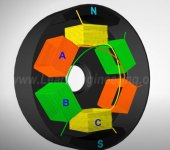
Brushless tools are tiny three phase AC motors. Vary the frequency to vary the speed.

Thats why they are brushless.

I can't be 100% sure on brushless power tool motors, but they are not true "phased" motors. Typical brushless motor have powerful rare earth magnets attached the inner part of the rotor shell. (N and S in the image below.) A true DC current is applied to sets of winding (A, B or C), one at a time, synchronized with the position of the magnet.

Watch the video. How Does a Brushless DC Motor Work


There are some "battery powered" motors that DO convert the DC to true 3 phase AC. They do vary the frequency for speed control. More electronics required.
 

Attachments

  • Capture.JPG
    Capture.JPG
    59.1 KB · Views: 23

theoldwizard1

Well-known member
Joined
Feb 22, 2011
Messages
43,237
Location
SE MI
Somewhere in the deep. dark, recesses of my brain, I seem to recall that "power" out of a motor is proportion the number of turns of wire (N which implies the size of the magnetic field) and current (I), so N*I.

Any EE power engineers here ?
 

Robbie B

Well-known member
Joined
Jun 24, 2014
Messages
1,320
Location
Sunny side of hell
Re: Theories why electric power tools aren't higher voltage

Wait, what? Voltage doesn't significantly change motor size.

My 3HP tablesaw motor can be connected to 120V or 240V depending on how you wire it up, but the motor is still the same size.


If you want to get smaller AC motors, you need to step up the frequency.


The limit here is that too many batteries in series becomes dangerous.


Voltage changes amperage load in electric motors. Frequeny also doesn’t change the size of the motor. Frequency adjusts the speed through a VFD. A/C and D/C motors don’t work the same. The more voltage you put through a D/C motor the faster it will go until it self destructs, on an A/C motor if you put to much voltage to it you just burn up the windings.


Sent from my iPhone using Tapatalk
 

zkling

Well-known member
Joined
Jan 23, 2007
Messages
16,939
God I can’t imagine the carnage if you turned the general public loose with 400v+ batteries. Most folks can’t be trusted with a 9 volt.

Seriously, 400v+ is extremely dangerous if not handled properly. Have you ever been around 480v power? Yeah the wires are smaller, but all the rest of the system is bigger and more robust due to the ability for higher voltages to arc bigger gaps. Breakers, receptacles and everything is also $$$ due to the higher volts.

:spit: This
 

rlitman

Well-known member
Joined
Oct 18, 2010
Messages
24,642
Location
Long Island
Re: Theories why electric power tools aren't higher voltage

Voltage changes amperage load in electric motors. Frequeny also doesn’t change the size of the motor. Frequency adjusts the speed through a VFD. A/C and D/C motors don’t work the same. The more voltage you put through a D/C motor the faster it will go until it self destructs, on an A/C motor if you put to much voltage to it you just burn up the windings.

Frequency absolutely does change the size of AC motors. Why do you think airplanes run their 120V power systems at 400Hz?

Or, why do you think that motors rated at 60Hz have derated speed and HP output at 50Hz?
 

JRC3

Well-known member
Joined
Jun 30, 2014
Messages
12,481
Location
Southwestern OH
When I was like 14 I got an idea to put a standard 6" grinding wheel on an old electric lawn mower motor...I was trying to one-up my grandfather's old washer motor bench grinder setup. I did not end well. lol
 

lafester

Well-known member
Joined
Mar 1, 2017
Messages
2,191
Location
Northern CO
The milwaukee mx fuel stuff looks interesting as far as high power goes.
For regular tools I like the where Dewalt is going with power detect and even flexvolt in some cases.
 

Firebrick43

Well-known member
Joined
May 12, 2015
Messages
14,152
Location
West central Indiana
Re: Theories why electric power tools aren't higher voltage

Frequency absolutely does change the size of AC motors. Why do you think airplanes run their 120V power systems at 400Hz?

Or, why do you think that motors rated at 60Hz have derated speed and HP output at 50Hz?

Its more because the gear reduction ratio to generate 60 hertz with a turbine running 24000 rpm would be huge, in the neighbor of 12:1 for a 4 pole or 6:1 with a 2 pole! Or we can just have a minimal single reduction of 2:1 or so which is already present in the accessory gear box or even direct drive if its a 2 pole generator

but smaller motors, smaller capacitors, smaller transformers all make for lighter planes also
 
To avoid these ads, REGISTER NOW!

dutchgray

Well-known member
Joined
Sep 28, 2014
Messages
6,468
Location
Dorset. England.
There is a 3 phase 400Hz power standard in industry, the Germans use it a bit, and their higher end tool makers make corded power tools for it, it provides increased reliability and efficiency and allows smaller motors.

Safety is a major concern, DC is more dangerous than AC so 400V cordless is definitely out.
We even use 110V tools here in the UK on construction sites even though all our power is 240V for safety (though there is no real need nowadays since RCD's became common)
 

exmaxima1

Well-known member
Joined
Jun 25, 2011
Messages
6,343
Location
Midwest
.....
Safety is a major concern, DC is more dangerous than AC so 400V cordless is definitely out.
We even use 110V tools here in the UK on construction sites even though all our power is 240V for safety (though there is no real need nowadays since RCD's became common)

I think you have that reversed: AC is alot more dangerous than DC, roughly 4 times as dangerous. There are multiple movies about Edison (DC) and Westinghouse (AC) arguing that very fact. Prisoners once called being electrocuted, "Being Westinghoused".

That said, I get pretty nervous when working on tube guitar amplifiers and poking around 400-500 volts DC.
 

Showkey

"MEMBER EMERITUS"
Joined
Aug 9, 2014
Messages
8,638
Location
Wausau WI
When the vehicle manufacturers were thinking 24-36-42-48 volt systems for the public use.

Safety and cost were the BIG problems or concerns .......safety, was arc voltage and sustainable arcing that killed the idea.

Hybrid at high voltage were deemed an acceptable risk. Whole vehicle at 48 volts was not acceptable.
 
Last edited:

matt_i

Well-known member
Joined
Mar 14, 2008
Messages
10,741
Location
SE Michigan
Battery cells have a voltage of eeh around lets say 3V. That would make around 120 cells in series connection. Pretty heavy cordless tool...
Plus safety is an issue with those high voltages.

Trying to maintain balance in the series-ed cells is the issue. Any single cell that gets out of line is a limiter in the overall current flow.

Keeping the number of cells lower makes a higher probability the cells will stay in balance just by open-loop equivalent internal chemistry and construction.
 

seber

Well-known member
Joined
May 31, 2016
Messages
4,204
Location
Deep East Tx.
I think you have that reversed: AC is alot more dangerous than DC, roughly 4 times as dangerous. There are multiple movies about Edison (DC) and Westinghouse (AC) arguing that very fact. Prisoners once called being electrocuted, "Being Westinghoused".

That said, I get pretty nervous when working on tube guitar amplifiers and poking around 400-500 volts DC.

When I first started as as a customer engineer we had solenoid operated tube systems. The solenoids and relays were DC. For that reason we were limited to 48 VDC. High voltage DC is a killer. Touch it and you are unable to let go. Back when it was being debated they were still trying to figure it out. We now know that DC is the more dangerous system.
As stated before, higher voltage allows smaller wires and less metal mass but the insulation required generally cancels the advantage.
Motors are derated for 50 htz because the slower speed with the same torque means less hp. Simple math.
 

rlitman

Well-known member
Joined
Oct 18, 2010
Messages
24,642
Location
Long Island
I think you have that reversed: AC is alot more dangerous than DC, roughly 4 times as dangerous. There are multiple movies about Edison (DC) and Westinghouse (AC) arguing that very fact. Prisoners once called being electrocuted, "Being Westinghoused".

That said, I get pretty nervous when working on tube guitar amplifiers and poking around 400-500 volts DC.


The true history is that Edison paid people to use AC for electrocutions (there is even gruesome film of an elephant being executed on Edison’s dime) in order to spread the false perception that AC power was more dangerous.
 

exmaxima1

Well-known member
Joined
Jun 25, 2011
Messages
6,343
Location
Midwest
When I first started as as a customer engineer we had solenoid operated tube systems. The solenoids and relays were DC. For that reason we were limited to 48 VDC. High voltage DC is a killer. Touch it and you are unable to let go. Back when it was being debated they were still trying to figure it out. We now know that DC is the more dangerous system.
.

Do a quick search and virtually every study has concluded that AC is the more dangerous. While DC does tend to contract the muscles (limiting the ability to let go), it is amperage that kills. The capacitive nature of skin allows more AC to flow than DC. Basically your "resistance" (actually impedance) is lower for AC so it takes less AC voltage to kill you. You might be able to handle several hundred volts DC, but even 40-50 volts AC can be lethal under some circumstances due to the frequency and the skin passing it thru.

Here's an example I referenced from:

https://www.electronicsforu.com/resources/learn-electronics/ac-dc-current-body-dangerous
 
Last edited:

Robbie B

Well-known member
Joined
Jun 24, 2014
Messages
1,320
Location
Sunny side of hell
Re: Theories why electric power tools aren't higher voltage

Frequency absolutely does change the size of AC motors. Why do you think airplanes run their 120V power systems at 400Hz?


Or, why do you think that motors rated at 60Hz have derated speed and HP output at 50Hz?


But that size reduction isn’t a function of the Hz. It’s a function of design for the application. Motors have decreased speed and HP at lower hz because when you decrease the Hz in an electric motor you are decreasing the speed and hp. I never said you couldn’t make a high Hz motor small, but size doesn’t necessarily change relative to Hz. Motor size is determined by application.


Sent from my iPhone using Tapatalk
 

cycle61

Well-known member
Joined
Apr 5, 2020
Messages
500
Location
Middle of Oregon
Re: Theories why electric power tools aren't higher voltage

But that size reduction isn’t a function of the Hz. It’s a function of design for the application. Motors have decreased speed and HP at lower hz because when you decrease the Hz in an electric motor you are decreasing the speed and hp. I never said you couldn’t make a high Hz motor small, but size doesn’t necessarily change relative to Hz. Motor size is determined by application.


Sent from my iPhone using Tapatalk

It absolutely is a function of frequency. At higher frequencies, the magnetic field is building and collapsing much faster, which results in a higher counter-emf and more physical force generated for the same size winding.

20 years ago I was in the Navy, and I can tell you from personal experience that a 5hp electric motor off an F-14 Tomcat can be held in your hand.

https://fcxinc.com/why-the-aviation-industry-operates-on-400-hz-power/
 

Mechanical Noise

Well-known member
Joined
Apr 25, 2014
Messages
2,635
Location
Southeast of O'Hare
Do a quick search and virtually every study has concluded that AC is the more dangerous. While DC does tend to contract the muscles (limiting the ability to let go), it is amperage that kills. The capacitive nature of skin allows more AC to flow than DC. Basically your "resistance" (actually impedance) is lower for AC so it takes less AC voltage to kill you. You might be able to handle several hundred volts DC, but even 40-50 volts AC can be lethal under some circumstances due to the frequency and the skin passing it thru.

Here's an example I referenced from:

https://www.electronicsforu.com/resources/learn-electronics/ac-dc-current-body-dangerous

I don't understand this part:

Due to the capacitive behaviour of the skin coming in contact with the current carrying conductor, more current can pass through the body if the voltage is rapidly changing. Studies have shown that twofold of increase in the voltage increases sevenfold increase in the current.

Even if the dielectric effect if skin is significant, the relationship between voltage and current should remain linear. Doubling the voltage should double the current. I can imagine a non-linear relationship considering ion flow in the skin but that's just based on my intuition, not my education. And I'd think that nonlinear relationship would hold at least as much for DC as AC.

How significant is the dielectric effect of skin? How much additional current flows? If the dielectric effect was significant at 60Hz, shouldn't we we get at least a tingle when we grab a vinyl insulated wire? Even more with the very thin polymer insulation on magnet wire.
 

Mechanical Noise

Well-known member
Joined
Apr 25, 2014
Messages
2,635
Location
Southeast of O'Hare
The true history is that Edison paid people to use AC for electrocutions (there is even gruesome film of an elephant being executed on Edison’s dime) in order to spread the false perception that AC power was more dangerous.

There were high voltage AC arc street light systems in use in a few localities when Edison started his DC system. The high voltage was necessary because the arc street lights were wired in a series string. Arc light don't work well in parallel because whichever arc light fires at the lowest voltage hogs all the current.

Edison's low voltage incandescent bulbs were significantly safer than series string arc lights. Safe enough to be used inside the home. Of course, Edison's incandescent bulbs worked perfectly well on AC and improvements in AC transformers and such posed an existential threat to Edison's empire.

So, Edison was happy with any sort of ******** argument telling people that the AC system was still more dangerous than the DC system.
 

Vvmvbb

Well-known member
Joined
Aug 5, 2011
Messages
746
Location
CT
I don't understand this part:

Due to the capacitive behaviour of the skin coming in contact with the current carrying conductor, more current can pass through the body if the voltage is rapidly changing. Studies have shown that twofold of increase in the voltage increases sevenfold increase in the current.

Even if the dielectric effect if skin is significant, the relationship between voltage and current should remain linear. Doubling the voltage should double the current. I can imagine a non-linear relationship considering ion flow in the skin but that's just based on my intuition, not my education. And I'd think that nonlinear relationship would hold at least as much for DC as AC.

How significant is the dielectric effect of skin? How much additional current flows? If the dielectric effect was significant at 60Hz, shouldn't we we get at least a tingle when we grab a vinyl insulated wire? Even more with the very thin polymer insulation on magnet wire.

—-you might be overthinking it a little there, mech noise. People are dielectric. We are capacitors. No current flows through capacitors at DC. Impedance of a capacitor decreases with frequency so, for any voltage, more current will flow with increasing frequency. That’s the primary effect going on.

Two secondary effects arise. 1) leakage through the ‘capacitor’. We are imperfect capacitors. Imagine a high, ordinary resistance in parallel with our capacitance. That resistance is generally too high to permit much current flow, but this leakage current will be proportional to voltage so will become dangerous at some high voltage 2) dielectric break down. At some high voltage, the dielectric that makes up the capacitor transforms into a highly conductive plasma permitting very large currents to flow. The plasma ordinarily burns out like a fuse so the current surge is short lived. But that’s flesh burning out like a fuse when people are the capacitors.
 

Norcal

Well-known member
Joined
Mar 16, 2008
Messages
13,767
The true history is that Edison paid people to use AC for electrocutions (there is even gruesome film of an elephant being executed on Edison’s dime) in order to spread the false perception that AC power was more dangerous.

Edison coined the term referring to electrocution with AC as being "Westinghoused" as we can see it did not take off.
 

Mechanical Noise

Well-known member
Joined
Apr 25, 2014
Messages
2,635
Location
Southeast of O'Hare
—-you might be overthinking it a little there, mech noise. People are dielectric. We are capacitors. No current flows through capacitors at DC. Impedance of a capacitor decreases with frequency so, for any voltage, more current will flow with increasing frequency. That’s the primary effect going on.

Two secondary effects arise. 1) leakage through the ‘capacitor’. We are imperfect capacitors. Imagine a high, ordinary resistance in parallel with our capacitance. That resistance is generally too high to permit much current flow, but this leakage current will be proportional to voltage so will become dangerous at some high voltage 2) dielectric break down. At some high voltage, the dielectric that makes up the capacitor transforms into a highly conductive plasma permitting very large currents to flow. The plasma ordinarily burns out like a fuse so the current surge is short lived. But that’s flesh burning out like a fuse when people are the capacitors.

OK, current in a capacitor increases with frequency. But power line AC is going to stay the same, so that's not an issue.

As the author of the cited article states:

Studies have shown that twofold of increase in the voltage increases sevenfold increase in the current.

This is somehow peculiar to AC? How?

With either a resistance or capacitance, AC current changes linearly with voltage. Twice the voltage, twice the current.

Would something akin to ion flow/insulation breakdown account for a seven fold increase of current with a doubling of voltage? I think so. But such breakdowns aren't peculiar to AC. DC voltage does it, too.
 

theoldwizard1

Well-known member
Joined
Feb 22, 2011
Messages
43,237
Location
SE MI
When the vehicle manufacturers were thinking 24-36-42-48 volt systems for the public use.

I have been in and around the automotive industry for almost 50 years. 48V has come up every few years for the past 20 or 30. Too many cheap 12V devices out there to justify the DC-DC converter and a 48V battery.
 

theoldwizard1

Well-known member
Joined
Feb 22, 2011
Messages
43,237
Location
SE MI
... we were limited to 48 VDC. High voltage DC is a killer.
Most safety standards classify anything about 50V (AC or DC) as "high voltage" with totally different safety requirements.

The telephone system gets away with it (max ringer voltage is about 96V ?) because they were around long before any standards were written and the are an intermittent voltage source AND current limited.
 

theoldwizard1

Well-known member
Joined
Feb 22, 2011
Messages
43,237
Location
SE MI
As with almost everything, it boils down to COST ! Add in feasibility at the time when the technology was rolled out. I can not imagine anyone at Westinghouse thinking of anything much higher than 60Hz in the late 1800s !
 
To avoid these ads, REGISTER NOW!
Top Bottom