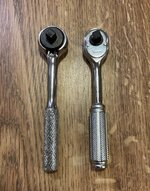
For the ratchet debate, I’ll add:
Ratchet designs are compromises between back drag and strength. You can’t have low back drag and high strength. You must pick one.
Typically, fine teeth (and light pawl spring pressure) will really help reduce back drag. But fine teeth are smaller, so you have more load reacted by a smaller area. Lightening the spring pressure, which Koken may have done, can cause the ratchet to slip under load. My guess is, since back drag ultimately is effected by friction, Koken may have polished their gear teeth.
SK came up with a solution in the 1930s with the round head ratchet that made them famous. Their gear/head was larger than the competition. That’s how they made a reasonably strong ratchet, but it was never, will never, be as strong as other ratchets.
Dual 80, is a 2 pawl ratchet, where each pawl has multiple teeth. The multiple teeth, along with the precision in the manufacturing, allows multiple teeth to react the torque we apply, overcoming the #1 short coming of fine toothed ratchets. It’s an amazing design made possible by advanced manufacturing processes unavailable years ago.
Matco & etc came out with a stacked pawl design, that functioned a little like the Snap On, but with thinner pawls, which are technically weaker and more prone to wear, but somehow strong enough.
So the questions become how strong do you need your ratchet to be? What arc angle is acceptable for a ratchet used for restricted access in modern engine bays? And how little back drag do we really need?
I‘ll give you my opinions and would like to hear yours:
1) I don’t need strong short ratchets. That’s not what I use them for. I want low back drag in my short ratchets, high strength in my long ratchets. The trouble is, tool manufacturers use the same mechanisms for all ratchets of a given drive size regardless of length. Therefore, there is no optimal brand or design in my opinion.
2) I don’t care about tooth count or arc angles, I care about distance required to make the ratchet click. A long ratchet benefits from high tooth count so it can click in a reasonable amount of space. Short ratchets, tooth count doesn’t really matter.
3) Back drag only shows up when you are installing fresh hardware, or removing loosened hardware. I don’t do either task with my long ratchets because I’m impatient. I typically switch to my smallest ratchet for both these tasks because they ratchet faster. So do you need your long, strong ratchets to have low back drag? It can be convenient for those few times where you are almost done and too lazy to switch ratchets. But I’ve never once thought, ”man I wish this FHFL80 had lower back drag” Not once. This is where the reviews and testing let us down.
My advice: don’t think in terms of brands, or ratchet designs, think in terms of your tasks and find ratchets to support what you do. For me, it’s long, strong, and fine tooth to crack stuff free or apply near final torque, and as short as possible, low back drag and comfortable to hold, for fast installations and removals.
PS snap on makes some long 1/4” drive flex head ratchets which are very strong and they are very nice to have (THLF72). I’m thinking seriously about converting one to 3/8” drive. This is the one concession I’m willing to make to a mid length ratchet.
PPS All ratchets‘ back drag diminishes as they wear. I have a worn F80 (not my favorite form factor) that is oh so smooth and easy to click. I bought it used with the intention of rebuilding it and couldn’t bring myself to do that.