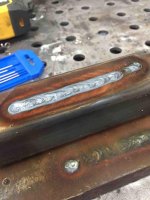
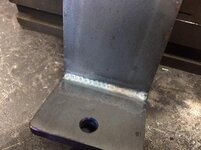
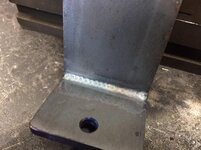
Playing with my new tig machine. Man soooo much harder then mig!! One question I cannot find an answer to hoping you guys might know. Playing with various amps and just tried filler wire tonight. I’m fine at keeping a puddle but when I add filler into the mix I get confused. I know the puddle should be melting the filler rod but the puddle doesn’t seem to be big enough or forward of the torch enough to have this happen. It seems to be getting stuck to the workpiece. Not the torch but the rod. Using 3/32 rod with 80 amps on top of scrap 1/8 tube. At a higher amp it was burning through. Any suggestions?
Sent from my iPhone using
The Garage Journal mobile app
Like mentioned, a standard rule of thumb is 1 amp per .001" material thickness. I've found that works well with most ferrous metals but non-ferrous I kick it at least another 10 and sometimes 20% because they dissipate heat so quickly.
As for your rod getting stuck, try using a smaller filler rod, but if .120" wall thickness I would be a little higher on amperage and smaller on filler rod. Too low of heat and travel speed can create much more heat into a part than higher amperage moving at a slightly faster pace. At 80 amps 3/32" rod is way to large and even 1/16" is pushing it as far as I'm concerned. Personally I would be using .045" at that amperage but it would also depend on the material and joint configuration.
You are correct to want to melt the rod via the puddle vs. the arc which is what most beginners struggle with but a 3/32" filler rod is a lot to melt @ 80 amps even with full-pedal. Personally, I like to push the filler rod a little so I can kind of "feel" the rod going into the puddle and with too large a filler rod it will stick before it melts in the puddle.
For example, last night I was welding some .065" wall tubing and used .045" filler rod rather than 1/16" filler and the ripples came out much more uniform and the weld was more rhythmic than because the rod was melting off easily and as expected rather than sticking. Next I stepped up to some .120" thick plate and I went to 1/16" filler rod for the same reasons. I did have to move a bit quicker but for me that helps with the uniformity because it is easier to get into a rhythm going a bit faster than too slow.
Some people like to pump the pedal to get that burst of current into the work then dap then back off the pedal (current) and advance then hammer down the pedal again. While this works and is easy to get nice stacked dimes I prefer to keep a more steady current input and let the addition of the filler rod create the actual freeze line or puddle. Granted on very thin materials using a pulser or manual pulsing the pedal is sometimes necessary, I don't do it unless the situation calls for it.
Depending on the material and joint configuration and using the 1 amp per .001" material thickness, if you start off with a weld and it at full pedal takes more than about 4 seconds to get a molten puddle, bump the amperage up a bit. I like to get a nice puddle going at startup within about 2-3 seconds, then I know I am nearly spot on with the current setting. Going along with that one thing I like to do as I'm moving along is as I'm advancing the puddle I will keep a short arc length as I move the puddle forward then just as I'm dipping the rod I will pull the torch upward and to the rear of the puddle ever so slightly, dip the rod, retract the rod slightly (keeping it in the gas stream), go back down and forward with the arc to keep the short arc length moving the puddle forward with the torch and repeat. As I'm adding the filler rod I like to "feel" the rod going into the puddle but also watch the puddle grow in height and if the tungsten is too close you can actually push the puddle up and contact the tip. This technique allows good addition of filler rod to the puddle without worrying about tungsten contamination as well as adding enough filler rod to avoid having a weak joint by being too concave.
Hope all that makes sense.