To avoid these ads, REGISTER NOW!

Tig help?

Kaizen

Well-known member
Joined
Jan 9, 2015
Messages
6,936
Location
New England
Playing with my new tig machine. Man soooo much harder then mig!! One question I cannot find an answer to hoping you guys might know. Playing with various amps and just tried filler wire tonight. I’m fine at keeping a puddle but when I add filler into the mix I get confused. I know the puddle should be melting the filler rod but the puddle doesn’t seem to be big enough or forward of the torch enough to have this happen. It seems to be getting stuck to the workpiece. Not the torch but the rod. Using 3/32 rod with 80 amps on top of scrap 1/8 tube. At a higher amp it was burning through. Any suggestions?


Sent from my iPhone using The Garage Journal mobile app
 
To avoid these ads, REGISTER NOW!

RADcustom

Well-known member
Joined
Aug 1, 2011
Messages
180
Location
NW Louisiana
Start with a piece of mig wire on some flat plate. It sounds like too much rod is drawing your heat from the puddle. Are you using a peddle or finger tip control? Timing and coordination are key.
 

fordkid88

Well-known member
Joined
Nov 10, 2013
Messages
680
1 amp for every .001 material thickness, so you would want to have your amps set to 125 amps and move rather fast. I would use 1/16th filler rod for that size and just add more filler on each dab. fitment also plays a huge deal when tig welding.
 
OP
K

Kaizen

Well-known member
Joined
Jan 9, 2015
Messages
6,936
Location
New England
Start with a piece of mig wire on some flat plate. It sounds like too much rod is drawing your heat from the puddle. Are you using a peddle or finger tip control? Timing and coordination are key.


Haven’t tried the pedal yet. Figured I would take it all in baby steps. I’m able to get a puddle and move that across plate using back and forth motions. I will get smaller rod. I thought it was sized for material thickness


Sent from my iPhone using The Garage Journal mobile app
 
OP
K

Kaizen

Well-known member
Joined
Jan 9, 2015
Messages
6,936
Location
New England
1 amp for every .001 material thickness, so you would want to have your amps set to 125 amps and move rather fast. I would use 1/16th filler rod for that size and just add more filler on each dab. fitment also plays a huge deal when tig welding.


That’s a good rule of thumb to use. Speed is definitely a problem. At those amps I was making holes and turning the whole piece cherry.


Sent from my iPhone using The Garage Journal mobile app
 

matt_i

Well-known member
Joined
Mar 14, 2008
Messages
10,717
Location
SE Michigan
Agree on the 1/16" rod and use the foot-pedal. Put the rod down at first and just fusion-weld some flat bar pieces together.

You need a little more heat when the work is "cold" but as you go toward a corner or an edge then letting up some is always a good idea...you will learn to "see" it in the color of the base material with experience and when you see its too hot and about to disappear then you can back off the throttle.

I don't even mess with the peak amps, maybe once a year for really thin something-or-other, I just set it at 250A and modulate with the pedal.

After you fusion weld a bit, don't be afraid to start with basically that, then dab the filler at the end. Don't rush to put the filler rod right under the arc. Heat the base material first. You can see little silvery vortex pools form on the base material (at least I do lol) when the material is getting molten, locally. When doing a fillet you can get two of those started to remind you that heat is going into both sides of the joint. If your torch placement is wrong and the heat is imbalanced you won't be melting one side relative to the other.

Keep your tip pointed, it helps focus the arc energy. Dip the tip or it gets malformed then stop and fix, it takes a lot more energy to keep the arc focused with a bad tip.
 
Last edited:

alexb2000

Well-known member
Joined
Feb 7, 2010
Messages
664
Location
Fort Worth, TX
To me the pedal is everything when tig welding.

I have a hand control on my torch that I never use because it would have to be perfectly tuned for the job (ie. factory work) and that is never the scenario I'm in. Rather I set my amps a little higher than I need maybe 105-110% of what would be needed for the material, one so I can tack quick and hot and two so when the metal is cold I have enough to get full fusion without lingering too long waiting on heat.

For less than perfect fit-up (pretty common), different material thickness', rework, or other more challenging conditions: I generally push down far enough 80-90% to get full melt with a little keyhole at the leading edge, then I dab the rod in the keyhole, as soon as the dab melts I quickly lift off to about 50-60% while moving the torch forward, then repeat. This allows me to adjust on the fly and really watch for the moment of complete fusion with just the right amount of heat.

For tight fit-ups, clean steel, and consistent material you can just hold your pedal down to the point where it flows and concentrate on even rod feeding. In this scenario you use more pedal to start when the material is cold and taper it off as you go along and things heat up (really lighten up as you approach an edge at the end of a weld).

I'm sure some true experts will be commenting, but that is the way I handle fabrication/repair type work at my place.
 
OP
K

Kaizen

Well-known member
Joined
Jan 9, 2015
Messages
6,936
Location
New England
Agree on the 1/16" rod and use the foot-pedal. Put the rod down at first and just fusion-weld some flat bar pieces together.

You need a little more heat when the work is "cold" but as you go toward a corner or an edge then letting up some is always a good idea...you will learn to "see" it in the color of the base material with experience and when you see its too hot and about to disappear then you can back off the throttle.

I don't even mess with the peak amps, maybe once a year for really thin something-or-other, I just set it at 250A and modulate with the pedal.

After you fusion weld a bit, don't be afraid to start with basically that, then dab the filler at the end. Don't rush to put the filler rod right under the arc. Heat the base material first. You can see little silvery vortex pools form on the base material (at least I do lol) when the material is getting molten, locally. When doing a fillet you can get two of those started to remind you that heat is going into both sides of the joint. If your torch placement is wrong and the heat is imbalanced you won't be melting one side relative to the other.

Keep your tip pointed, it helps focus the arc energy. Dip the tip or it gets malformed then stop and fix, it takes a lot more energy to keep the arc focused with a bad tip.


Great advise. Point question...if I dip it and go to grind I see blackened on the side of the tungsten past the ground point. Do I need to grind all of that off? Then make a point?


Sent from my iPhone using The Garage Journal mobile app
 

Mark_17

Well-known member
Joined
Jun 27, 2018
Messages
742
Location
NJ
TIG is all about practice practice practice.

Personally I only use the finger trigger when I need to tack weld something and I'm out of position.

I agree with just using the foot pedal and fusion welding. Just play around and you'll quickly find what works and what doesn't.

Once you get better, check out some videos online and fine tune your skills.
 
OP
K

Kaizen

Well-known member
Joined
Jan 9, 2015
Messages
6,936
Location
New England
To me the pedal is everything when tig welding.

I have a hand control on my torch that I never use because it would have to be perfectly tuned for the job (ie. factory work) and that is never the scenario I'm in. Rather I set my amps a little higher than I need maybe 105-110% of what would be needed for the material, one so I can tack quick and hot and two so when the metal is cold I have enough to get full fusion without lingering too long waiting on heat.

For less than perfect fit-up (pretty common), different material thickness', rework, or other more challenging conditions: I generally push down far enough 80-90% to get full melt with a little keyhole at the leading edge, then I dab the rod in the keyhole, as soon as the dab melts I quickly lift off to about 50-60% while moving the torch forward, then repeat. This allows me to adjust on the fly and really watch for the moment of complete fusion with just the right amount of heat.

For tight fit-ups, clean steel, and consistent material you can just hold your pedal down to the point where it flows and concentrate on even rod feeding. In this scenario you use more pedal to start when the material is cold and taper it off as you go along and things heat up (really lighten up as you approach an edge at the end of a weld).

I'm sure some true experts will be commenting, but that is the way I handle fabrication/repair type work at my place.


Yea after thinking about it I know me not using the pedal is an issue. I really need the soft start to get the puddle and then give it the amps. Right now I have been setting it low so I didn’t blow through but that’s not melting the rod. I’ll hook up the pedal tonight.


Sent from my iPhone using The Garage Journal mobile app
 

zmotorsports

ALLIANCE MEMBER
Joined
Oct 20, 2009
Messages
21,312
Location
Northern Utah
Playing with my new tig machine. Man soooo much harder then mig!! One question I cannot find an answer to hoping you guys might know. Playing with various amps and just tried filler wire tonight. I’m fine at keeping a puddle but when I add filler into the mix I get confused. I know the puddle should be melting the filler rod but the puddle doesn’t seem to be big enough or forward of the torch enough to have this happen. It seems to be getting stuck to the workpiece. Not the torch but the rod. Using 3/32 rod with 80 amps on top of scrap 1/8 tube. At a higher amp it was burning through. Any suggestions?


Sent from my iPhone using The Garage Journal mobile app

Like mentioned, a standard rule of thumb is 1 amp per .001" material thickness. I've found that works well with most ferrous metals but non-ferrous I kick it at least another 10 and sometimes 20% because they dissipate heat so quickly.

As for your rod getting stuck, try using a smaller filler rod, but if .120" wall thickness I would be a little higher on amperage and smaller on filler rod. Too low of heat and travel speed can create much more heat into a part than higher amperage moving at a slightly faster pace. At 80 amps 3/32" rod is way to large and even 1/16" is pushing it as far as I'm concerned. Personally I would be using .045" at that amperage but it would also depend on the material and joint configuration.

You are correct to want to melt the rod via the puddle vs. the arc which is what most beginners struggle with but a 3/32" filler rod is a lot to melt @ 80 amps even with full-pedal. Personally, I like to push the filler rod a little so I can kind of "feel" the rod going into the puddle and with too large a filler rod it will stick before it melts in the puddle.

For example, last night I was welding some .065" wall tubing and used .045" filler rod rather than 1/16" filler and the ripples came out much more uniform and the weld was more rhythmic than because the rod was melting off easily and as expected rather than sticking. Next I stepped up to some .120" thick plate and I went to 1/16" filler rod for the same reasons. I did have to move a bit quicker but for me that helps with the uniformity because it is easier to get into a rhythm going a bit faster than too slow.

Some people like to pump the pedal to get that burst of current into the work then dap then back off the pedal (current) and advance then hammer down the pedal again. While this works and is easy to get nice stacked dimes I prefer to keep a more steady current input and let the addition of the filler rod create the actual freeze line or puddle. Granted on very thin materials using a pulser or manual pulsing the pedal is sometimes necessary, I don't do it unless the situation calls for it.

Depending on the material and joint configuration and using the 1 amp per .001" material thickness, if you start off with a weld and it at full pedal takes more than about 4 seconds to get a molten puddle, bump the amperage up a bit. I like to get a nice puddle going at startup within about 2-3 seconds, then I know I am nearly spot on with the current setting. Going along with that one thing I like to do as I'm moving along is as I'm advancing the puddle I will keep a short arc length as I move the puddle forward then just as I'm dipping the rod I will pull the torch upward and to the rear of the puddle ever so slightly, dip the rod, retract the rod slightly (keeping it in the gas stream), go back down and forward with the arc to keep the short arc length moving the puddle forward with the torch and repeat. As I'm adding the filler rod I like to "feel" the rod going into the puddle but also watch the puddle grow in height and if the tungsten is too close you can actually push the puddle up and contact the tip. This technique allows good addition of filler rod to the puddle without worrying about tungsten contamination as well as adding enough filler rod to avoid having a weak joint by being too concave.

Hope all that makes sense.
 
OP
K

Kaizen

Well-known member
Joined
Jan 9, 2015
Messages
6,936
Location
New England
Like mentioned, a standard rule of thumb is 1 amp per .001" material thickness. I've found that works well with most ferrous metals but non-ferrous I kick it at least another 10 and sometimes 20% because they dissipate heat so quickly.


As for your rod getting stuck, try using a smaller filler rod, but if .120" wall thickness I would be a little higher on amperage and smaller on filler rod. Too low of heat and travel speed can create much more heat into a part than higher amperage moving at a slightly faster pace. At 80 amps 3/32" rod is way to large and even 1/16" is pushing it as far as I'm concerned. Personally I would be using .045" at that amperage but it would also depend on the material and joint configuration.


You are correct to want to melt the rod via the puddle vs. the arc which is what most beginners struggle with but a 3/32" filler rod is a lot to melt @ 80 amps even with full-pedal. Personally, I like to push the filler rod a little so I can kind of "feel" the rod going into the puddle and with too large a filler rod it will stick before it melts in the puddle.


For example, last night I was welding some .065" wall tubing and used .045" filler rod rather than 1/16" filler and the ripples came out much more uniform and the weld was more rhythmic than because the rod was melting off easily and as expected rather than sticking. Next I stepped up to some .120" thick plate and I went to 1/16" filler rod for the same reasons. I did have to move a bit quicker but for me that helps with the uniformity because it is easier to get into a rhythm going a bit faster than too slow.


Some people like to pump the pedal to get that burst of current into the work then dap then back off the pedal (current) and advance then hammer down the pedal again. While this works and is easy to get nice stacked dimes I prefer to keep a more steady current input and let the addition of the filler rod create the actual freeze line or puddle. Granted on very thin materials using a pulser or manual pulsing the pedal is sometimes necessary, I don't do it unless the situation calls for it.


Depending on the material and joint configuration and using the 1 amp per .001" material thickness, if you start off with a weld and it at full pedal takes more than about 4 seconds to get a molten puddle, bump the amperage up a bit. I like to get a nice puddle going at startup within about 2-3 seconds, then I know I am nearly spot on with the current setting. Going along with that one thing I like to do as I'm moving along is as I'm advancing the puddle I will keep a short arc length as I move the puddle forward then just as I'm dipping the rod I will pull the torch upward and to the rear of the puddle ever so slightly, dip the rod, retract the rod slightly (keeping it in the gas stream), go back down and forward with the arc to keep the short arc length moving the puddle forward with the torch and repeat. As I'm adding the filler rod I like to "feel" the rod going into the puddle but also watch the puddle grow in height and if the tungsten is too close you can actually push the puddle up and contact the tip. This technique allows good addition of filler rod to the puddle without worrying about tungsten contamination as well as adding enough filler rod to avoid having a weak joint by being too concave.


Hope all that makes sense.


Totally get it. Thanks for the write up. Lots of good tips that I will work through and try. Pedal manipulation is definitely going to help


Sent from my iPhone using The Garage Journal mobile app
 

zmotorsports

ALLIANCE MEMBER
Joined
Oct 20, 2009
Messages
21,312
Location
Northern Utah
Totally get it. Thanks for the write up. Lots of good tips that I will work through and try. Pedal manipulation is definitely going to help


Sent from my iPhone using The Garage Journal mobile app

You're welcome.

When you say "pedal manipulation", please don't get carried away and pump that pedal like you're churning butter. That's not conducive to becoming a good welder and in my opinion a hard habit to break once you get started. There are times when it is necessary to manipulate the pedal for things like very thin materials and/or filling a gap but practice on .120" or slightly thicker and learn proper amperage and puddle control by travel speed and adding filler. In the long run this will build and fine tune your skillset much better.
 

zmotorsports

ALLIANCE MEMBER
Joined
Oct 20, 2009
Messages
21,312
Location
Northern Utah
Lots more heat with a pedal to start the puddle and then pulse it with the pedal or automatically.

Bill

Again, don't get in the habit of pulsing everything. That is a crutch that is hard to kick the habit of and then when you need heat for say something like thicker aluminum where you need to pound the heat into the part you won't have a good feel for what you're doing by keeping the current going, dabbing and moving.

Pulsing has its place but I would recommend not making it your go to technique for everything.
 
OP
K

Kaizen

Well-known member
Joined
Jan 9, 2015
Messages
6,936
Location
New England
Again, don't get in the habit of pulsing everything. That is a crutch that is hard to kick the habit of and then when you need heat for say something like thicker aluminum where you need to pound the heat into the part you won't have a good feel for what you're doing by keeping the current going, dabbing and moving.


Pulsing has its place but I would recommend not making it your go to technique for everything.


No I will be focusing on consistent pedal pressure. Manipulating meaning changing amps as needed as opposed to a single setting like I have been using with just the torch


Sent from my iPhone using Tapatalk
 

matt_i

Well-known member
Joined
Mar 14, 2008
Messages
10,717
Location
SE Michigan
I've also used the pedal always as if its a car or truck and trying to drive smoothly and steadily. Of course always acceptable to take your foot off quickly.

My thought is that any discolored area upwards of the ground taper doesn't need to be dressed unless something really bad sticks up there and its really grown in size. Normally I don't mess with that OD. From time to time I go into our plant's shop and find the tungsten ground "sideways" instead of with the point headed tangentially to the wheel. Then I try to go ferret out whoever did it that way and give them some coaching about how to do it properly. The pool has definitely gotten smaller over time. :)
 
To avoid these ads, REGISTER NOW!

Bigblue&Goldie

Well-known member
Joined
Mar 12, 2009
Messages
10,662
Location
AZ
You have gas and/or contamination issues. A clean weld with plenty of gas coverage will have none of those porosity bubbles and have more color. If you truly are cleaning your metal properly than try ramping up your gas flow significantly.

I don't have any better example pics on my phone, but this is a fusion weld with clean metal and good gas flow. No porosity at all; everything just melts together nice and clean.

Self learning TIG is extremely frustrating and humbling. Stick with it. I can do ok these days, but if I had the time I would be at my local community college doing their TIG program.
 

Attachments

  • 20190511_181440.jpg
    20190511_181440.jpg
    59.7 KB · Views: 71
Last edited:
OP
K

Kaizen

Well-known member
Joined
Jan 9, 2015
Messages
6,936
Location
New England
You have gas and/or contamination issues. A clean weld with plenty of gas coverage will have none of those porosity bubbles and have more color. If you truly are cleaning your metal properly than try ramping up your gas flow significantly.

I don't have any better example pics on my phone, but this is a fusion weld with clean metal and good gas flow. No porosity at all; everything just melts together nice and clean.

Self learning TIG is extremely frustrating and humbling. Stick with it. I can do ok these days, but if I had the time I would be at my local community college doing their TIG program.


You are correct it had millscale and oil on it. Right now still working on the mechanics of movement before I worry about that kind of stuff. This “achievement “ was just to get a bead down without sticking filler rod or taking a swim.
Funny story the rest of this tube I used to make a welding cart last weekend. Wanted it to be professional so I used acetone and cleaned it up nice. Beveled the edges. Cut perfect angles. Started laying a mig bead and caught the acetone soaked paper towels I left on my bench. Thank god I had welding gloves on to carry it outside cause it was not going out. Two steps forward,,,,


Sent from my iPhone using The Garage Journal mobile app
 

Shadowdog500

Well-known member
Joined
Dec 7, 2009
Messages
9,826
Location
Down the shore
Learning on your own or via forum posts can be difficult. Do you know someone who knows how to TIG weld. Perhaps they can show you and look over your shoulder to give you pointers. If there was an evening class in your area that would be even better.
 
OP
K

Kaizen

Well-known member
Joined
Jan 9, 2015
Messages
6,936
Location
New England
Learning on your own or via forum posts can be difficult. Do you know someone who knows how to TIG weld. Perhaps they can show you and look over your shoulder to give you pointers. If there was an evening class in your area that would be even better.


I actually prefer this way to learn. One step at a time. Slow and methodically learning. Unfortunately my friends are not into this type of stuff. Taught myself mig in a few hours. Im sure with practice and Learning I will figure it out in less time then a classroom


Sent from my iPhone using The Garage Journal mobile app
 

zmotorsports

ALLIANCE MEMBER
Joined
Oct 20, 2009
Messages
21,312
Location
Northern Utah
You are correct it had millscale and oil on it. Right now still working on the mechanics of movement before I worry about that kind of stuff. This “achievement “ was just to get a bead down without sticking filler rod or taking a swim.

Funny story the rest of this tube I used to make a welding cart last weekend. Wanted it to be professional so I used acetone and cleaned it up nice. Beveled the edges. Cut perfect angles. Started laying a mig bead and caught the acetone soaked paper towels I left on my bench. Thank god I had welding gloves on to carry it outside cause it was not going out. Two steps forward,,,,


Sent from my iPhone using The Garage Journal mobile app


Like Bb&G mentioned, clean your material properly to avoid contamination. I see you mentioned this was merely a practice piece but I would still recommending cleanliness of material even on practice and/or learning pieces otherwise you aren't taking full advantage of your time practicing and learning curve can be way off course.

I'm fully self taught and it can be difficult but not impossible so take every advantage to the get the most of the time spent welding. I used to tell people that welding is 5% theory and 95% practice. What has taken me more time is researching and learning about metallurgy and material selection, etc.

Also when making changes to something try to only make one change at a time otherwise you can end up chasing your tail wondering what worked or what went wrong.

When I was learning I would try a new technique or a new setting and was looking for a better or worse scenario. IF it was better then go a little more in the same direction. IF it was worse you know you went the wrong way. Once you get close you can make little tweaks to sneak up on it.

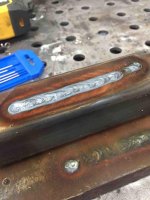
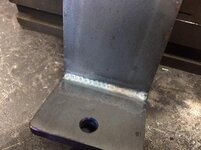
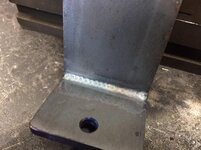
These are just a few pictures I had on my phone from recent work but in the first and second picture you can see where I knocked the mill scale back about 3/4” prior to welding. The first weld is autogenious (no filler) and the second picture is with ER70S-2. The last picture is using cold rolled and DOM tubing so no scale to deal with.

Also notice the differences in the ripples. The first two were standard dip and move technique whereas the last picture is hitting the work with more current and just motoring along shoving wire in. There was a void due to the curvature if the tubing and I wanted to push as much wire into the root as possible to get penetration.

852559d71dfe5050446128ee8400ba3e.jpg

5c4d74914fe6b3e5b0e06cd8d085fef1.jpg

0669166b7d54cc4a9f4b4afa0a595da7.jpg
 

Attachments

  • 852559d71dfe5050446128ee8400ba3e.jpg
    852559d71dfe5050446128ee8400ba3e.jpg
    82.5 KB · Views: 0
  • 5c4d74914fe6b3e5b0e06cd8d085fef1.jpg
    5c4d74914fe6b3e5b0e06cd8d085fef1.jpg
    96.8 KB · Views: 0
  • 0669166b7d54cc4a9f4b4afa0a595da7.jpg
    0669166b7d54cc4a9f4b4afa0a595da7.jpg
    87.3 KB · Views: 0
Last edited:

Aaron_W

Well-known member
Joined
Feb 6, 2018
Messages
2,888
Location
Northern California
You are correct it had millscale and oil on it. Right now still working on the mechanics of movement before I worry about that kind of stuff. This “achievement “ was just to get a bead down without sticking filler rod or taking a swim.
Funny story the rest of this tube I used to make a welding cart last weekend. Wanted it to be professional so I used acetone and cleaned it up nice. Beveled the edges. Cut perfect angles. Started laying a mig bead and caught the acetone soaked paper towels I left on my bench. Thank god I had welding gloves on to carry it outside cause it was not going out. Two steps forward,,,,


Sent from my iPhone using The Garage Journal mobile app


I'm currently taking a TIG class, and one thing I quickly learned is clean your metal, always even if it is just practice. TIG is very sensitive to any dirt, rust, mill scale etc. It isn't like other kinds of welding where there is some tolerance for crud on the metal, maybe just making not as nice of a weld.
With TIG it is a huge issue, it can mess with the arc, changes how the puddle forms etc.

I'm enjoying TIG, but there is so much more prep than stick or MIG. When I took the stick class I'd just grab a stack of metal, a handful of rods and just run beads for almost 2 hours. Pretty much the same with MIG. With TIG if I get 45 minutes of actual welding done I'm doing good, the rest of the time is prep.
 

Monza Harry

Well-known member
Joined
Dec 29, 2018
Messages
1,433
Location
Windsor ON
"Matt i" mentions setting the machine at "a Power" setting (250) and using the pedal for power control. That tells me he has a newer well featured machine. I was working at a shop with a guy that could lay down a "nice stack of dimes" we were having a discussion about the machine settings as I went to use it after him and he had the power set way up and he was welding something smaller, so I says why do you have that cranked up for that little thing, he responds that it doesn't matter he just uses less pedal to control the power. I reply that isn't good practice, The plant we were at had a brand new Lincoln 250 TIG [Square Wave if my memory is correct] when the company consolidated facilities he had to use the "Antique" Ideal Arc (transformer) machine one day, later he wanders over and tells me that he couldn't believe how much difference the setting made on that machine. Transformer machines I've dealt with use a coil around the output lead to limit current ["Amptrol Coil"] unlike the "Inverter" machines that actually produce less power based on pedal activity. Transformer uses different taps to create the needed and Holds back the unwanted therefore the "Amptrol Coil" has it's limitations. Just like others have mentioned practice is important but a grade school Phys Ed teacher pointed out "Practice Makes Perfect" is a flawed statement. "Perfect Practice Makes Perfect" was his statement, So clean prep and execute the way you will always do it, you will rarely forget a step if you always do it the same way "Routine is Your Friend". Pedal pumping is useful for widely different thicknesses I can't normally do that fast or even enough for anything pretty. "Just Sayin' that's how it works for me.
I started out self "Teaching" myself bad habits, Then I enrolled in a Province sponsored "certificate" course with a teacher that spent two years fusion welding the root pass on a pipe line that was to be stick welded over afterwards, he said that they could see if there were going to be any voids/leaks with the TIG and this allowed excellent penetration/fusion/strength with the speed of the stick, as a result of this education I fusion weld anything that requires any amount of strength first then I add filler to taste.
I know how to weld, now if my right and left hand would just get along with each other I could maybe show a non-embarrassing weld, 'till then I can can share the thermodynamic/electrical/theory, making it pretty has to somebody else's job, I just can't do it with any predictability. Dr Clyde see's the same thing I see with your first couple of posted welds with a shielding issue, that can also be caused by excessive stick out and also your Tungsten looks to be sharpened a little blunt. The course I took specified the cone should be 2 1/2 times the diameter of the electrode and that is all the should be out of the glass*.The mould trade welders have moved to ~4x the dia. for the cone to aid in gas flow. Harry *[More if your trode is in a tight void that prevents the gas from washing away]
 
Last edited:

freshintulsa

Active member
Joined
Jun 18, 2013
Messages
33
Location
Tulsa, OK
Another helpful tip when learning is to pay close attention to your angle between the torch and the filler metal. This should be as close to a 90 degree angle as possible. The angle of the torch to the base metal is also important, but that can change as long as the angle of the filler to the torch changes with it. For example, if you torch is 45 degrees counter clockwise from the metal, the filler should be 45 degrees clockwise from the metal (90 degrees from the torch). This will help with your filler getting "stuck" in the puddle. Also, if you start to have problem with your filler "balling" up on the end (melting away uncontrollably) you likely have too large an angle (over 90 degrees). Kick your filler up toward your torch and that should stop.

Good luck! TIG is relatively easy to pick up to a beginner skill set, but takes years to get to a "master welder" state, but if you stick with it and ask questions when you run into an issue you'll get there and have a new skill that will stick with you for life!
 

fordkid88

Well-known member
Joined
Nov 10, 2013
Messages
680
Learning on your own or via forum posts can be difficult. Do you know someone who knows how to TIG weld. Perhaps they can show you and look over your shoulder to give you pointers. If there was an evening class in your area that would be even better.

I completely agree to this. Until i enrolled in an advance metal fab program i thought i could tig, turns out i could lay good looking undersized beads. Now i can look at a blue print read my weld symbols and lay down the appropriate sized beads. I can also do thin sheet pulse free in multiple positions. I still hate overhead though.
 
OP
K

Kaizen

Well-known member
Joined
Jan 9, 2015
Messages
6,936
Location
New England
Yea you are all on the money. I’m recognizing my failures at this. Ran a few rods tonight on clean metal and this everlast welder is a beast. Blew through 1/8 inch wall on 120 amps. Ran at 90 and did ok but ugly. Will be looking for hands on training if I continue with tig. Soooo many variables to get right


Sent from my iPhone using The Garage Journal mobile app
 

alexb2000

Well-known member
Joined
Feb 7, 2010
Messages
664
Location
Fort Worth, TX
The problem with TIG is it takes more than eye-hand coordination, it takes, eye-hand-foot-other hand coordination.

You can break that down so your brain doesn't overload.

How about just running a no filler flat weld and concentrating on making the bead consistent? Forget the rod and setup amps for full foot pedal so you can just stomp it and focus only on the puddle.

Once you can do that start working on the rod dipping on a flat weld.

From there you can keep adding to your technique.

Just my non-expert .02, but there is no substitute for practice
 

3 Gun Shooter

Well-known member
Joined
Jan 29, 2015
Messages
880
I'm currently taking a TIG class, and one thing I quickly learned is clean your metal, always even if it is just practice. TIG is very sensitive to any dirt, rust, mill scale etc. It isn't like other kinds of welding where there is some tolerance for crud on the metal, maybe just making not as nice of a weld.
With TIG it is a huge issue, it can mess with the arc, changes how the puddle forms etc.

I'm enjoying TIG, but there is so much more prep than stick or MIG. When I took the stick class I'd just grab a stack of metal, a handful of rods and just run beads for almost 2 hours. Pretty much the same with MIG. With TIG if I get 45 minutes of actual welding done I'm doing good, the rest of the time is prep.

Sounds like you are learning. TIG welding is a lot of cleaning and prep, especially aluminum. I see you are in Nor Cal, where are you going to school?
 

Aaron_W

Well-known member
Joined
Feb 6, 2018
Messages
2,888
Location
Northern California
Sounds like you are learning. TIG welding is a lot of cleaning and prep, especially aluminum. I see you are in Nor Cal, where are you going to school?

Mendocino College, but the class is held at Kelseyville High School in Lake Co. 80 mile round trip for me twice a week, but it has been worthwhile. No idea how I got along without a welder all these years.
 

pi_guy

Well-known member
Joined
Jul 27, 2014
Messages
2,808
Location
N/A
I actually prefer this way to learn. One step at a time. Slow and methodically learning. Unfortunately my friends are not into this type of stuff. Taught myself mig in a few hours. Im sure with practice and Learning I will figure it out in less time then a classroom

I am going to chime in here with it is better with an instructor. You can learn on your own but some one with experience will make your time practicing worth while.
Also depends on what type of welder your dealing with a production guy or a repair guy. There are some items that your never going to get perfectly clean but you can still get a satisfactory weld on it.

Actually have 4 or 5 people that wanted me to run them through welding, was waiting till it got warm but now we are on life hold.
 
OP
K

Kaizen

Well-known member
Joined
Jan 9, 2015
Messages
6,936
Location
New England
By the time this is over and the world gets back on a schedule I think I will be fully self taught. I’ve been running a few rods a night and they are getting better. I think observation is my super power. So if I do something and it’s great I know what I changed or did even accidentally so I can refine my technique.
One problem I’m having is my welding hood. Using an autodarkening Lincoln that is great for mig but I can’t turn it down AND not feel a little flash burn to clearly see the puddle. Anyone have any suggestions under 300? I read the other threads in types. Those were more for mig. Not sure if I’m missing one great for tig clarity


Sent from my iPhone using Tapatalk
 

Wsidr1

Member
Joined
Mar 18, 2020
Messages
14
Location
Indiana
I am also just learning to TIG. One thing I have been doing to help me is I put an 8" piece of masking tape on my table. I marked off 0.1" tick marks. I practice as if the machine was on, doing everything I would if actually welding. I count 1001, 1002, ... to keep a steady rate of movement along the tape, also using the pedal and dipping filler rod.

Then after 10-15 passes like that, I flip the switch and make a run on a piece of plate. It's really helping me with getting the coordination of motions down.
 
OP
K

Kaizen

Well-known member
Joined
Jan 9, 2015
Messages
6,936
Location
New England
I am also just learning to TIG. One thing I have been doing to help me is I put an 8" piece of masking tape on my table. I marked off 0.1" tick marks. I practice as if the machine was on, doing everything I would if actually welding. I count 1001, 1002, ... to keep a steady rate of movement along the tape, also using the pedal and dipping filler rod.

Then after 10-15 passes like that, I flip the switch and make a run on a piece of plate. It's really helping me with getting the coordination of motions down.

excellent suggestion. creating muscle memory.
 
To avoid these ads, REGISTER NOW!
Top Bottom