To avoid these ads, REGISTER NOW!

Tig welding

Joe69

Well-known member
Joined
Sep 6, 2009
Messages
2,371
Location
Muncie, Indiana
I've been playing with my tig, trying to get good at welding aluminum. I've discovered it's like learning to weld all over again. I'm an experienced welder, I just never had the opportunity to learn to tig until now. It's fun to be challenged, but it gets a little frustrating at times. I will master this, it's just taking longer than I thought.

Joe
 
To avoid these ads, REGISTER NOW!

HTGTS350

Banned
Joined
Mar 2, 2010
Messages
603
Don't give up, it will come, it might cost three bottles of gas and about 50 sticks of filler but it will come.
 

brookscooper

Well-known member
Joined
Jul 27, 2009
Messages
71
I am also a total NOOB at welding Al. I tried with the foot control for power and found it much easier for me to use the wheel on the gun with my thumb, rather than the foot control. You might try both.

I've used up about 3/4 of my bottle and can get a decent looking, functional weld on Al about 20% of the time. Happy with that progress.
 

wawaw

Active member
Joined
Jan 8, 2012
Messages
41
Welding alum can be difficult if some things that are required are not done. Because things move fast when you apply heat to alum there these things that will help. 1 CLEAN EVERYTHING. This inccludes using solvents that dont leave residue.2 Design of the joint takes very good fitup & clamping.Its very important that when running a bead that the metal dosent move around.3 There are many theories on what tungstens,type of gas,& torch expendables to use when welding alum but for most applications using the same things as used to weld t.i.g on steel work on alum. Finally there are some alloys that should not be welded. They are the 2000 class & 7000 class alloys.
 

t100

Well-known member
Joined
Sep 3, 2009
Messages
6,101
my #1 tip would be keep the angle between the tungsten and filler rod at 90* angle at all times.
#2. set up the torch has very short stick out, maybe 1/8". that reduces the changes of you dip the filler rod into the electrode or have the electrode come in contact with work piece.

#3. start with thick stuff. 3/16" 6061 plates are very easy to weld. it helps you to build up confidence.
 

Jagmandave

Well-known member
Joined
Nov 6, 2011
Messages
6,299
Location
Overland Park, Ks.
For you tig experts, how do you weld down into an area that's difficult to reach? For example, a set of headers where the pipe turns quickly near the flange, leaving a very tight space between the pipe and the flange on the inside radius of the pipe? Do they make longer tungsten electrodes? Can you sharpen the end of the electrode so that it's shaped more like a #2 pencil than a golf pencil? Do they make bent electrodes that you can get into a crevice? The problem is that the flange is very thick and the pipe is very thin by comparison, so you have to focus the heat on the flange and draw the metal to the pipe......how do you do that if you can't get the electrode into the space at the correct angle?
 

t100

Well-known member
Joined
Sep 3, 2009
Messages
6,101
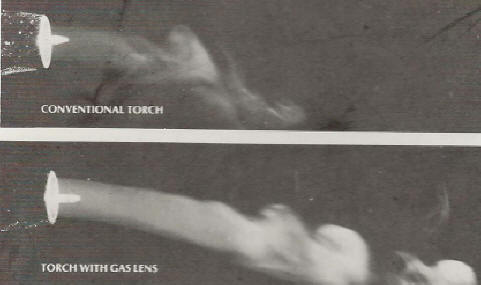
Gas_Lens_Flow.jpg


http://www.weldcraft.com/2008/01/gas-lens-basics-for-tig/
 
To avoid these ads, REGISTER NOW!

J_G

Well-known member
Joined
Sep 16, 2012
Messages
74
This should be interesting to follow...I recently bought a new Hobart 190 and Model 100 spool gun, to learn aluminum welding. I too have experience with steel, but 0 with aluminum. Any tips are always appreciated.
 

d_rock

Well-known member
Joined
Apr 14, 2012
Messages
192
Location
Denver
For you tig experts, how do you weld down into an area that's difficult to reach? For example, a set of headers where the pipe turns quickly near the flange, leaving a very tight space between the pipe and the flange on the inside radius of the pipe? Do they make longer tungsten electrodes? Can you sharpen the end of the electrode so that it's shaped more like a #2 pencil than a golf pencil? Do they make bent electrodes that you can get into a crevice? The problem is that the flange is very thick and the pipe is very thin by comparison, so you have to focus the heat on the flange and draw the metal to the pipe......how do you do that if you can't get the electrode into the space at the correct angle?

They make different style torches and cups. stubby torch combined with a stubby cup, combined with sticking the electrode out a little further and you would be surprised the places you can reach!
 

dr_clyde

Well-known member
Joined
Jan 7, 2009
Messages
6,425
Location
Holland, MI
Something beginners seem to struggle with is the "rules of TIG welding". There is no such thing. There is what works and what doesn't work. People get confused thinking there are hard and fast ways to prep your tungsten, clean your metal, set your machine, ect. They are, for the most part, suggestions. Each scenario is different, and will require different prep, gas flow, cup size, tungsten point shape, ect.

As a professional welder, here is what I would recommend for 1/8 sheet alum. I assume you are using 3003 alloy, which is the most common in the sheet metal world. Some grades used in aircraft production are of the unweldable variety, so be aware. I would set my machine at 150 amps, with a balanced arc, leaning toward the penetration side (electrode positive). If you have an inverter, I would run my frequency fairly high, perhaps start at around 120hz and adjust as needed.

I would personally use a #20 watercooled torch with a 3/32" ceriated or thoriated tungsten. I would run a gas lens setup with a #8 cup. Cups are numbered in 1/16th inch increments in opening size, so a #8 cup would have a 8/16" oriface, or 1/2". Run 20 CFH on your flow rate. Pure argon would work fine for thinner aluminum, but when you need to squeeze a bit more heat out of your arc, you can run a blend of argon and helium. The helium runs a tad hotter, so you can get get around preheating some things this way.

Grind a taper 2:1 on your tungsten. 2 times the diameter. Don't bother balling up your tungsten. If you have an inverter, it will keep it's point and allow you better arc control. If you have a transformer, it will take it's own shape after a few beads. I avoid pure tungsten. It loses it's stability at high amperage and won't work for other metals. I've never had an issue with ceriated (orange band), thoriated (red band) or lanthanated (yellow band). Point shape is not as critical as its made out to be. Pretty much any shape will weld, as long as its not severely contaminated. 2:1 just is a pretty optimal universally acceptable shape.

Don't stress too much about cleaning your aluminum. Obvious grease, dirt, powder coat, paint, ect would need to be removed. But, if your metal is clean from the mill, don't waste your time wiping with solvents, and scrubbing. Aluminum oxide is not removed by any common solvents, and the electrode positive side of the AC arc removes most of the oxide layer. I very seldom have to prep extruded tubing or rolled sheets. I just light up and weld. If you have an abnormally thick oxide layer or its giving you greif, lightly sand it with a 2" roloc scotchbrite prep pad on a die grinder. This will break the oxide layer and not grind away the base metal.

Above all, there is no way to be good at welding without practice. Arc-on time is the only way to get better. These tips are how I would proceed if it was me welding, but there are many other setups that would work just as well. As I said, there is only what works, and what doesn't work. Good luck!
 

bullnerd

Well-known member
Joined
Sep 17, 2012
Messages
5,690
Location
Jersey
I wont repeat what everone else said.

So my tips are,

Breathe!

Stay calm!

Practice your feeder technique! Torch control is cake,but if you cant feed smooth and steady you'll never make long clean beads.

Good luck.
 

d_rock

Well-known member
Joined
Apr 14, 2012
Messages
192
Location
Denver
For you tig experts, how do you weld down into an area that's difficult to reach? For example, a set of headers where the pipe turns quickly near the flange, leaving a very tight space between the pipe and the flange on the inside radius of the pipe? Do they make longer tungsten electrodes? Can you sharpen the end of the electrode so that it's shaped more like a #2 pencil than a golf pencil? Do they make bent electrodes that you can get into a crevice? The problem is that the flange is very thick and the pipe is very thin by comparison, so you have to focus the heat on the flange and draw the metal to the pipe......how do you do that if you can't get the electrode into the space at the correct angle?

another thing to remember when welding tight spots is simply thinking it through before you even begin. The header pipes you mention for example. You would build them in the car by just tacking them together, then when there out of the car you would take the tubes out of the collector and flange so you could weld them solid, put flange back on engine, install pipes, install collector, re-tack. Then you can finish weld.
 

gerahead

Member
Joined
Nov 3, 2011
Messages
12
For you tig experts, how do you weld down into an area that's difficult to reach? For example, a set of headers where the pipe turns quickly near the flange, leaving a very tight space between the pipe and the flange on the inside radius of the pipe? Do they make longer tungsten electrodes? Can you sharpen the end of the electrode so that it's shaped more like a #2 pencil than a golf pencil? Do they make bent electrodes that you can get into a crevice? The problem is that the flange is very thick and the pipe is very thin by comparison, so you have to focus the heat on the flange and draw the metal to the pipe......how do you do that if you can't get the electrode into the space at the correct angle?

Can you weld the tube to the flange from the exhaust port side rather than trying to fight that space restriction? Just a thought.
 

Jagmandave

Well-known member
Joined
Nov 6, 2011
Messages
6,299
Location
Overland Park, Ks.
Thanks for the replies guys, I didn't mean to hijack this thread.....

Header is off the car.

Can't weld from inside the flange - that would be too easy! This is not an expensive well built header, it's a cheap SS from over the pond just trying to see if it will work in the car at all without spending big $$$$. the tubes are round, but the holes in the flange are flat on the tops and bottoms so the tube is not close to the inside edge of the flange, have to weld from the outside.
 
To avoid these ads, REGISTER NOW!
Top Bottom