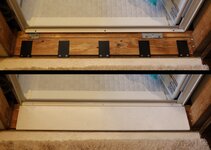
I got a bit Rabbit Holed again. The old trim was for a smaller opening, but it covered all four sides, so given that the floor section is accommodated with the solid surface sill plate I have just enough material to make three sections to finish it.
But, that means a number of invisible **** joints need to be made to stretch the boards out to the required lengths. They will be filled, sanded and painted, but getting the cleanest and precisely square as possible **** joints is important to pull this off. Should I just buy new material? Yes, yes I should.
Anyway, some time ago I bought a Veritas specialty 'shooting' plane that has sat ensconced in its rust prevention paper along with my other rarely touched hand planes. At some point I will be doing some fiddly small scale woodworking and I intend to use these gems, but so far they've been underutilized in what little work I've been up to as of late. A
shooting plane is a big heavy plane designed to run in a tight fitting guideway and the blade is positioned on the side as a right angle to the sliding surface. It is primarily used for trimming and squaring the end grain of boards, theoretically better than my miter saw can do it.
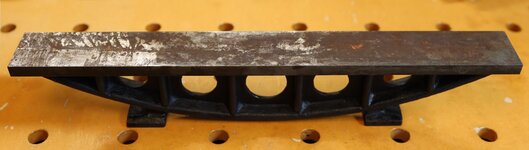
As with most things with me, a lot of the reason the plane went unused is I had grand plans for a custom shooting board that would do everything short of making French toast. The original (rare and luduristly expensive collectors item)
Stanley that this is derived from had a matching cast iron 'board' that is really a lovely thing, and of course I wanted to make something at least as functionally equivalent to the $2000 ancient and unobtainable casting. So it sat. Another case of perfection stomping the life out of good enough in an endless vicious circle.
A while ago I had bought a number of 20x30cm phenolic plates very cheaply to be used for jigs or whatever, and decided to just make a short term solution. My plans were still quite complex, but I was
trying to moderate myself and not overengineer it. I wasn't succeeding though. I had decided early on to leverage my
Incra Miter Gauge as it allowed me to not only set the board up for standard 90° cuts, but also basically dial in any angle needed for doing the Japanese Kumiko work I pictured myself doing (we'll see if that ever happens.) So the design needed a slot for the plane and a parallel slot for the miter gauge. The phenolic I had was 15mm thick, and although it would work great for the plane, the groove depth required for the miter bar would have made it too weak, and unlike the typical use of a miter gauge where it slides in the slot, in this case I needed it to be rigidly fixed in place as it was acting as the backing fence for the material.
Various schemes of bonding aluminum extrusions and epoxying threaded inserts in order to secure everything were pondered, but I couldn't shake the feeling that I was missing something obvious, and when I finally started laying everything out, the solution came into focus. My amalgamation of a Polk table and MFT was the surface this thing was going to be used on, and I realized that by adhering a 2mm thick rubber strip on the back of the aluminum T-slot extrusion, the miter gauge would be at the perfect level for the phenolic. With it at the right height, the need to be permanently affixed to the board may not be as acute. So I first glued two of the phenolic panels together to get a 600mm length and on the router table I carefully planned (joined) the edges clean, then set the best edge as a reference surface and cut the slot for the plane on the router table using that edge as the guide to make sure the two were perfectly parallel.
So full disclosure, Veritas sells an Aluminum extrusion designed to work with this plane that you just screw to some boards. I didn't like the look of it though, and the increase in shipping costs made it seem to be a bad value to me. Their solution has an adjustable stainless steel rail with some PTFE tape on it, that is adjustable so you can constrain the plane in the channel as tightly as needed. I'm a notorious purveyor of, "If you can't make it perfect, make it adjustable!", which I caught myself doing again here. I was identifying how I would make such a rail, how it would be secured and what it would be made out of. I had some UHDPE that would be reenforced by an aluminum angle bar that I'd have to machine to the right height, and again, I stopped myself. This solution was a lot of complexity over my fear that I couldn't just make a precise fitting slot. It's not like I have a variety of these things or cast Iron shrinks over time, one plane, one board, one slot. Just focus on getting that right instead of making an overly complex system that in the best case would be set once and never touched again. And if I couldn't make it perfect or it didn't last, I could always remove more material from that shoulder to implement the more complex version later.
Again the Incra router table pulled its weight, I was able to sneak up on the exact width with the minute adjustments the arm afforded. A couple of strips of durable low friction tape (it honestly didn't need it as far as the friction, the phenolic was already quite slippery) but if wear became an issue it would be easy to replace without worrying about the geometry. Next I chamfered all the corners and edges, the phenolic looked like it could hold a deadly sharp edge. I didn't have any issues working with it, but better safe than sorry, and it reduced the chance of damage. I cut a small section, the height of the planer blade, to act as a sacrificial fence mounted on the Miter Gauge. The remaining piece was drilled and counterbored to attach a pair of 3D printed 'dogs' that fixture it to the table and support the left side of the Miter Gauge. The offset is the same at the festool and 3D printed dogs I use, so it works in conjunction with them.

The aluminum T-slot holding the gauge is then sandwiched between the left fixed support and the right shooting board using standard low profile Festool clamps. The two Festool clamps hold the parts securely to the table, the whole thing is quite rigid and doesn't move at all. I may add a solid pin behind the Incra fence, just to add some support as that is the highest point of force. Since the 3 parts are only joined by the clamping force, they can easily be adjusted relative to each other, which will be important when setting it up for other angles,
I modified an aluminum t-nut on my little mill to clip on and capture the steel tongue on the gauge to allow me to lock it in place. The set screw applies clamping pressure directly on the tongue so the t-slot isn't marred, the fingers just keeps it attached and registered properly when it is loose and moved in the track.
I've got no idea if all this effort will be worth it, I suspect the miter saw that I painstakingly calibrated to be square does just as good of a job, but I never met a side project I didn't want to endlessly agonize over and at least I can cross this off the list for now.

 something to do with setting up both sides maybe? I also need to reread the Incra way of doing it, I recall it being somewhat convoluted as well. I think dovetails are just difficult to route due to the pins, but box and finger joints are pretty too and seem easier to set up on the Incra. Those compound joints in contrasting woods look really good though, quite a challenge.