To avoid these ads, REGISTER NOW!

Below 265 SQ/FT Tiny Tokyo Shop

All workspaces below 265 squarefeet.
OP
B

Bakafish

Well-known member
Joined
Feb 7, 2017
Messages
477
Location
Tokyo
I have the same fence. More proof we are from the same tribe.
Indeed, it is comforting to have kindred spirits. I've got a lot of catching up to do though.

Thanks for the reminder. I need to do some box joints. I was going to do it on my Leigh dovetail jig. But the Incra will be a better choice.
I mounted mine on my cabinet saw for a short time. I found it cumbersome. It also requiredifferent additional space around the saw. That I don't really have.
I have the Porter Cable dovetail jig, which I used for a number of drawers, a bit of a learning curve but I got it to work acceptably with a bit of trial and error. I think the Leigh has more naturally tapered bits and is quite a bit wider which I think actually ends up being more useful than I initially realized. I don't remember why though :LOL: something to do with setting up both sides maybe? I also need to reread the Incra way of doing it, I recall it being somewhat convoluted as well. I think dovetails are just difficult to route due to the pins, but box and finger joints are pretty too and seem easier to set up on the Incra. Those compound joints in contrasting woods look really good though, quite a challenge.
 
To avoid these ads, REGISTER NOW!

LeonardY

Well-known member
Joined
Apr 16, 2011
Messages
5,020
Location
Southern California
I think the Leigh has more naturally tapered bits and is quite a bit wider which I think actually ends up being more useful than I initially realized. I don't remember why though :LOL: something to do with setting up both sides maybe? I also need to reread the Incra way of doing it, I recall it being somewhat convoluted as well. I think dovetails are just difficult to route due to the pins, but box and finger joints are pretty too and seem easier to set up on the Incra.
I hadn't used the Leigh for quite a while when I was making my niece's changing table. Of course being in a rush I didn't read the manual.
I had offset dovetails so the left side and right side were mirror images. I carefully matched the right and left setups. Only to realize after about 1/2 way through that I only needed to setup one side. Then for the other side rotate the template 180 degrees end to end. Which is the beauty of the Leigh. You don't need to use a ruler to set it up. You can do it by eye. Of course you and I would work out a way to use the Haimer to measure. 😂
I need reread the instructions for my Incra as well.
 
OP
B

Bakafish

Well-known member
Joined
Feb 7, 2017
Messages
477
Location
Tokyo
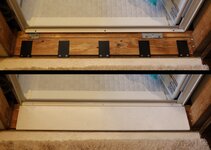
The 3D printed braces were designed to bring the leading edge up to the level of the future tiled floor. I have more of the same natural stone tiles that I used in the toilet documented earlier in the thread. I test fit the panel and jumped on it a bit, trying to get a feel if it needed more support, but it felt solid enough. I mixed up a small amount of the epoxy grout and spread it across a variety of tape samples, I was thinking of taping the back of the panel and using that surface to bond it to the floor. But i opted to just use some 3M VHB double sided tape, as it really didn't feel like it was moving and if it doesn't stay fastened, I've still got the same options for a more permanent fix.

thresh_done.jpeg

The transition to the current vinyl floor is pretty ugly, but I may put a trim strip there once the rest of the door trim is in place and until I replace that floor with the tiles. Next step is trimming out that frame, which isn't straight forward, but shouldn't present too much of a challenge.
 
OP
B

Bakafish

Well-known member
Joined
Feb 7, 2017
Messages
477
Location
Tokyo
So I scavenged through the pile of trim that I kept from the remodeling and located all the original trim pieces from the old doorway. Based on the witness marks my memory was correct, the old bath entrance was raised over 300mm (a foot) above the floor level. I already have a very slight case of bathmophobia (fear of going down stairs not baths) so that was just never going to sit right with me. My wife (who doesn't know the meaning of fear) is constantly running down the stairs, which is always triggering, especially when she slips which she does all the time. Fearless people seem accident prone, and she's injured herself more in the time we've been married than I have in my whole life, and that's with me being in full proactive safety mode. Anyway, I digressed again. The old trim doesn't fit, not that I expected it would. But there's enough of it that I think I can splice together what I need, adding complexity as I am wont to do. Reusing the old stuff will eliminate the need of trying to find clear wood of that uncommon size and trying to get it home, a daunting prospect in itself.

I also wanted to pre-purchase the paint I will need, as the old trim is a kind of translucent dark brown stain/paint that is used throughout the house, but will not go with the remodeled washroom (that I'm optimistically still claiming is a possibility.) I may have mentioned that paint over here seemed odd, in the sense that there wasn't the same sort of variations or custom color matching you see in the US and other first world places. I remember trying to get some touch up paint for my house exterior and bringing a sample to a paint supplier for them to scan and them looking at me like I was insane. They wanted to know the paint 'code' and told me there were only the approved colors, which I assumed meant that exterior paint colors might be regulated to prevent people from painting their house something too unacceptable for society. Being from San Francisco and seeing some cultures paint their homes in 'lucky' colors like brilliant green or yellow, I can understand that, but I don't know the truth of it.

What I do know now is that the paint companies in Japan are all affiliated through an association that chooses and controls the standard set of colors of paint that they all comply with, reevaluating the set every couple of years and rotating in and out new colors for unpopular ones. The palette of general paints (non-automotive) is basically 658, which is a lot to be honest, but still kind of shocking to me recalling how I used to in my youth, page through endless paint swatches, looking at all the cool names (Raven's Gleam!) of the infinite choices of colors I wanted to paint my room in. Here there is no romance to the colors, they are just 'LN-85' and so forth... The other thing that is so typically Japan is that the paint swatch books are only sold to paint association members. The public is **** out of luck. As a consumer you basically have to find a member that will resell one of the limited number of books they are allowed to buy, or pay the membership fee (which isn't listed anywhere, but considering there are only about 200 members, isn't likely very cheap.) Japanse make these choices through the house building company, or maybe the painter they contract to re-paint their home. The need for a normal person to have such a thing is so small it just isn't worth the effort to provide any access to it.

Paint Swatches.jpeg

So having found a swatch book for a small premium over the member price at auction, I'm now armed to choose my trim paints. I have just enough wood to trim the door if I'm careful about splicing the pieces together. I'm a little worried about the joinery, but this is a good exercise in precision. Having taken some provisional measurements everything is pretty square, but not perfect, and I'm a lot closer to the limits of the material size than I would have hoped, so that's what I get for stating above that this was going to be easy.
 
OP
B

Bakafish

Well-known member
Joined
Feb 7, 2017
Messages
477
Location
Tokyo
I got a bit Rabbit Holed again. The old trim was for a smaller opening, but it covered all four sides, so given that the floor section is accommodated with the solid surface sill plate I have just enough material to make three sections to finish it. But, that means a number of invisible **** joints need to be made to stretch the boards out to the required lengths. They will be filled, sanded and painted, but getting the cleanest and precisely square as possible **** joints is important to pull this off. Should I just buy new material? Yes, yes I should.

Anyway, some time ago I bought a Veritas specialty 'shooting' plane that has sat ensconced in its rust prevention paper along with my other rarely touched hand planes. At some point I will be doing some fiddly small scale woodworking and I intend to use these gems, but so far they've been underutilized in what little work I've been up to as of late. A shooting plane is a big heavy plane designed to run in a tight fitting guideway and the blade is positioned on the side as a right angle to the sliding surface. It is primarily used for trimming and squaring the end grain of boards, theoretically better than my miter saw can do it.

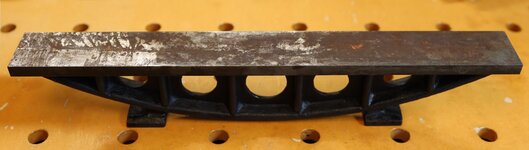
As with most things with me, a lot of the reason the plane went unused is I had grand plans for a custom shooting board that would do everything short of making French toast. The original (rare and luduristly expensive collectors item) Stanley that this is derived from had a matching cast iron 'board' that is really a lovely thing, and of course I wanted to make something at least as functionally equivalent to the $2000 ancient and unobtainable casting. So it sat. Another case of perfection stomping the life out of good enough in an endless vicious circle.

A while ago I had bought a number of 20x30cm phenolic plates very cheaply to be used for jigs or whatever, and decided to just make a short term solution. My plans were still quite complex, but I was trying to moderate myself and not overengineer it. I wasn't succeeding though. I had decided early on to leverage my Incra Miter Gauge as it allowed me to not only set the board up for standard 90° cuts, but also basically dial in any angle needed for doing the Japanese Kumiko work I pictured myself doing (we'll see if that ever happens.) So the design needed a slot for the plane and a parallel slot for the miter gauge. The phenolic I had was 15mm thick, and although it would work great for the plane, the groove depth required for the miter bar would have made it too weak, and unlike the typical use of a miter gauge where it slides in the slot, in this case I needed it to be rigidly fixed in place as it was acting as the backing fence for the material.

Various schemes of bonding aluminum extrusions and epoxying threaded inserts in order to secure everything were pondered, but I couldn't shake the feeling that I was missing something obvious, and when I finally started laying everything out, the solution came into focus. My amalgamation of a Polk table and MFT was the surface this thing was going to be used on, and I realized that by adhering a 2mm thick rubber strip on the back of the aluminum T-slot extrusion, the miter gauge would be at the perfect level for the phenolic. With it at the right height, the need to be permanently affixed to the board may not be as acute. So I first glued two of the phenolic panels together to get a 600mm length and on the router table I carefully planned (joined) the edges clean, then set the best edge as a reference surface and cut the slot for the plane on the router table using that edge as the guide to make sure the two were perfectly parallel.

So full disclosure, Veritas sells an Aluminum extrusion designed to work with this plane that you just screw to some boards. I didn't like the look of it though, and the increase in shipping costs made it seem to be a bad value to me. Their solution has an adjustable stainless steel rail with some PTFE tape on it, that is adjustable so you can constrain the plane in the channel as tightly as needed. I'm a notorious purveyor of, "If you can't make it perfect, make it adjustable!", which I caught myself doing again here. I was identifying how I would make such a rail, how it would be secured and what it would be made out of. I had some UHDPE that would be reenforced by an aluminum angle bar that I'd have to machine to the right height, and again, I stopped myself. This solution was a lot of complexity over my fear that I couldn't just make a precise fitting slot. It's not like I have a variety of these things or cast Iron shrinks over time, one plane, one board, one slot. Just focus on getting that right instead of making an overly complex system that in the best case would be set once and never touched again. And if I couldn't make it perfect or it didn't last, I could always remove more material from that shoulder to implement the more complex version later.

Again the Incra router table pulled its weight, I was able to sneak up on the exact width with the minute adjustments the arm afforded. A couple of strips of durable low friction tape (it honestly didn't need it as far as the friction, the phenolic was already quite slippery) but if wear became an issue it would be easy to replace without worrying about the geometry. Next I chamfered all the corners and edges, the phenolic looked like it could hold a deadly sharp edge. I didn't have any issues working with it, but better safe than sorry, and it reduced the chance of damage. I cut a small section, the height of the planer blade, to act as a sacrificial fence mounted on the Miter Gauge. The remaining piece was drilled and counterbored to attach a pair of 3D printed 'dogs' that fixture it to the table and support the left side of the Miter Gauge. The offset is the same at the festool and 3D printed dogs I use, so it works in conjunction with them.

shoot1.jpeg

The aluminum T-slot holding the gauge is then sandwiched between the left fixed support and the right shooting board using standard low profile Festool clamps. The two Festool clamps hold the parts securely to the table, the whole thing is quite rigid and doesn't move at all. I may add a solid pin behind the Incra fence, just to add some support as that is the highest point of force. Since the 3 parts are only joined by the clamping force, they can easily be adjusted relative to each other, which will be important when setting it up for other angles,

tnut-jpeg.1885081


I modified an aluminum t-nut on my little mill to clip on and capture the steel tongue on the gauge to allow me to lock it in place. The set screw applies clamping pressure directly on the tongue so the t-slot isn't marred, the fingers just keeps it attached and registered properly when it is loose and moved in the track.

I've got no idea if all this effort will be worth it, I suspect the miter saw that I painstakingly calibrated to be square does just as good of a job, but I never met a side project I didn't want to endlessly agonize over and at least I can cross this off the list for now.
 

Attachments

  • tnut.jpeg
    tnut.jpeg
    183.1 KB · Views: 714

LeonardY

Well-known member
Joined
Apr 16, 2011
Messages
5,020
Location
Southern California
The original (rare and luduristly expensive collectors item) Stanley that this is derived from had a matching cast iron 'board' that is really a lovely thing, and of course I wanted to make something at least as functionally equivalent to the $2000 ancient and unobtainable casting.
Pre-blink as I call it. (Pre-pandemic) There was a Stanley 51 and 52 shooting board and plane that was showing up at the tool swap meet in LA. The guy wanted $2400 if I remember correctly. My good friend was looking at it. He is an absolutely expert on Stanley planes. I asked him if he was going to get it. He said no. I asked why. He said, he's asking retail collector price. It's not the swap meet price.

Fast forward a few years. (still pre-blink.) Another good friend calls me and asks if I would come down to San Diego to help him with his dad's tools. His dad passed a few months before. I head down and start looking through the tools. It wasn't the typical barn full of tools. His dad was very wealthy and lived in a very nice area of San Diego. It still was a pile of stuff but it wasn't dusty and dirty. As I went through all the tools sorting and identifying them. My friend says to me, "What the F*** is this?" I look over and see the #51 and #52. Along with the Veritas version that you have. I said "Your dad paid $2400 hundred for that."

His dad hobby was having hobbies. He bought everything both old and new. Used them once to see if they worked, then put them away. The weekend was spent dropping a lot of f-bombs as we opened all the cabinets and boxes. At one point I said, "Your dad found the little known button on the Garret Hack and Lee Valley websites." He said "For what?" I responded "For one of everything."

I've got no idea if all this effort will be worth it, I suspect the miter saw that I painstakingly calibrated to be square does just as good of a job, but I never met a side project I didn't want to endlessly agonize over and at least I can cross this off the list for now.
It's worth it. Just the satisfaction of doing it makes it so.
To quote the Chief in Josey Wales, "Endeavor to persevere."
 
OP
B

Bakafish

Well-known member
Joined
Feb 7, 2017
Messages
477
Location
Tokyo
Pre-blink as I call it. (Pre-pandemic) There was a Stanley 51 and 52 shooting board and plane that was showing up at the tool swap meet in LA. The guy wanted $2400 if I remember correctly. My good friend was looking at it. He is an absolutely expert on Stanley planes. I asked him if he was going to get it. He said no. I asked why. He said, he's asking retail collector price. It's not the swap meet price.

Fast forward a few years. (still pre-blink.) Another good friend calls me and asks if I would come down to San Diego to help him with his dad's tools. His dad passed a few months before. I head down and start looking through the tools. It wasn't the typical barn full of tools. His dad was very wealthy and lived in a very nice area of San Diego. It still was a pile of stuff but it wasn't dusty and dirty. As I went through all the tools sorting and identifying them. My friend says to me, "What the F*** is this?" I look over and see the #51 and #52. Along with the Veritas version that you have. I said "Your dad paid $2400 hundred for that."
Great story! Those originals are really for collectors, too expensive to use (there are claims that they have some weak points around the frog that can cause them to break) but I really love the look of that bed with the scooped divot reliefs. Not saying I wouldn't buy one if I saw a deal on it... I have the same problem as your friend I think.

One of the things I tried to maintain discipline on with this project was to try not worry about the aesthetics, it's already bugging me though, the ugly seam line, dull sanded spots and scratches. Tomorrow I'm going to machine and fasten a 20mm diameter brass support rod as I've convinced myself that there's only upside to having a fixed brace point close to the shear line of the plane blade. I'm thinking to frost the top surface with a sander to give it a more uniform surface finish, and maybe increase the friction a little. The 'speed grooves' of the Stanley were to reduce friction I imagine, but maybe they were for dust management to ensure the board stayed flat. They look really cool but I noticed that lack of friction of the phenolic could cause the workpiece to shift away from the blade during the cut, so a little more stick could help reduce the need to maintain constant hand pressure.
 
OP
B

Bakafish

Well-known member
Joined
Feb 7, 2017
Messages
477
Location
Tokyo
A fairly productive weekend, with zero progress on the actual goal :LOL: I used my new Makita RT-50 trim router (XTR-01 in the US) to plunge a 20mm diameter and 2mm deep recess for the support pin, then drilled and countersunk an M8 clearance hole on the backside so the bolt would sit flush. When my wife opened a bigger office, the system over here is you need to completely strip the old space of virtually everything. Walls, electrical, sinks, air conditioning and toilets. The landlord will sometimes let you leave stuff if he thinks it will be of value to the new tenant, but mostly they want it stripped back to the cement walls and floors. This is quite costly as you can imagine, I suspect very little of this gets reused, Japanese want everything new. We had actually bought the lease and furnishings from a friend who had invested hundreds of thousands on a failed 'beauty clinic', and paid a virtual pittance as she had already lost so much money and would now have to pay to destroy everything. It was a really nice little place. I did move some of the sinks and some specialty equipment to the new clinic, but the timing of switching the location really didn't allow much reuse.

Being formally poor, and currently cheap, I pilfered everything of value to hoard at home. Lots of LED lights, electrical and plumbing hardware. I removed all the 'good' drawer sliders from the furnishings and any stainless hinges and hardware I could find. I also took all the door handles, which in this case were made from long nickel plated solid bronze 20mm rods about 40cm long. They were ridiculously well made, weighed a ton, and cost like $200ea new, which I wouldn't pay because that's crazy, but there were about 20 of them throughout the place. They were perfect for drawer and cabinet handles, some of which will be used on the pantry project, I had already cut some down to a shorter length for the drawers (I will replate the cut surface at a later date and show the results here) and have been using the cutoffs for various things.

So I shortened one of the cutoffs using my Makita 2107FW portable band saw (with base.) I love the saw, got it as 'junk' very cheap, cleaned it, replaced the rubber tires for a few dollars, and it is like new. Cutting metal by hand is really not a great experience IMHO, but I find that cutting small things with this tool is really hard as the vice is set up to clamp very far from the blade and the clearance is really tight and hard to accommodate around the cutting path. I ended up clamping my magnetic chuck and clamping the bar to a v-block, it took me a lot of tries to get it fixtured correctly. The base is a wonderful cast Iron unit, very sturdy and well made, but I'm going to have to modify it to work with smaller materials. It has a flimsy vertical table it came with, but I'll build something better for that as well.

kato.jpeg

Next step was to plug in the lathe and face off the end. The 20mm straight cutter I used on the router doesn't leave a flat bottom, it has a ~10º dish to the bottom cutting edges, so I relieved the center of the pin to make sure the contact was as close to the outside edge as possible and wouldn't be susceptible to rocking. There is potentially a lot of force being transmitted by the plane when it gets caught by the wood, that force is transferred to the fence and the idea is the pin absorbs that force and transfers it back into the shooting board. So the small pocket and sturdy M8 hardware will hopefully stand up to any abuse and keep the Incra Miter Gauge in good health.

As you can see in the picture, I used my Kato power tapping attachment for the first time. I live in fear of breaking taps, and tapping crooked. Hand tapping helps with the former and exacerbates the latter. I have a very useful tapping guide, but it is useless on a tiny target like this and after drilling out the 6.8mm pilot hole dead center with the tail stock, I wanted to make a sweet thread as well. This tapping unit has quick change holders that have preset clutches, I have the full set for this unit from M2 - M12 and pipe taper arbors too. It has about 50mm of damped travel, so once the tap grabs and starts threading it automatically extends allowing you to easily keep up with the progress using the tailstock or a drill press. I bottom tapped it by hand and assembled it, it's super solid, very happy with it. It also makes hanging the plate off one of the side holes of my table very convenient.

brace.jpeg

Tomorrow I need to make a couple more modifications, then I'm going to try and get back to working on that trim. Maybe.
 

RickP

Well-known member
Joined
Jan 15, 2013
Messages
1,547
Location
Annapolis, MD
Nice work, as usual. And your photography skills are great -- beautiful photos!I

It's hard to believe the amount of waste you described when office space is vacated. It's about the same in the States, with only minor re-use of the previous tenant's build-out. But the landlord is usually responsible for demo, so they will sometimes keep some stuff. When we vacated our small office space, I grabbed a couple of fixtures the landlord didn't want. Those bronze door pulls you grabbed sound like they'll be useful for many years of future projects.
 
OP
B

Bakafish

Well-known member
Joined
Feb 7, 2017
Messages
477
Location
Tokyo
Okay, this will be the last posting about the shooting board. It only really deserved a single post, but obsessives gonna obsess. In addition to the backstop pin, I wanted to create a recess on the underside of the main board for a pair of low profile bench dogs to set into. I needed a slot rather than just rigidly mounting a pair of 3D printed dogs as the main plate is the movable side of the sandwich, and needs to be able to apply clamping force on the rail against the fixed plate with the two permanent dogs screwed on it. In truth I could just as easily have butted the top of the main plate against the dogs, but the slot is cleaner looking and I could position it so that the two plates line up better.

Router Template.jpegShoot Slot.jpeg

To make this slot I printed out a quick little insert for my DIY adjustable router template tool, squared it against the reference side, and plunge routed a perfect 5mm deep slot 26mm wide (to make sure it was easy to slip over the dogs) that transfers any of the force of the main plate to the table itself. You can also see the countersunk M8 bolt that fastens the backstop pin.

Shooting Board Underside.jpeg

So the left sub plate has a pair of fixed dogs (sorry the shot only shows one) that fit in the Y axis direction and the right main plate has a slot that rides over a pair of dogs, rigidly bracing it from moving in the Y axis, but freely sliding in the X axis so it can clamp the rail.

Shoot Complete.jpegShoot Backstop.jpeg

The miter gauge is slid backwards between the two plates until the aluminum fence bumps against the backstop pin, which is intended to absorb any potential flex and to take load off the clamping system that sets the angle of the miter gauge. Then a single clamp can just pinch everything together, as solid as can be. The plane is pretty heavy and you can get it chooching along pretty good, when the wood grabs and stops that train, that energy has to go somewhere. Ideally I want it to be absorbed by moving the massive workbench an imperceptible amount.

I've got a couple more mods to do, but none of them functional, just aesthetics, comfort and storage improvements. I'm not going to subject you to those mods, but I will try to 'expose' them in some future project that uses this board for the Eagle Eyed viewers who are interested.
 
OP
B

Bakafish

Well-known member
Joined
Feb 7, 2017
Messages
477
Location
Tokyo
Obviously I don’t mean to get personal, but can you explain that a little.
This thread is pretty long, I've mentioned Furusato a few times.

https://www.garagejournal.com/forum/threads/tiny-tokyo-shop.352738/post-9406035
https://www.garagejournal.com/forum/threads/tiny-tokyo-shop.352738/post-8447723

Basically a system where you can target a portion of your income taxes (~10%) to benefit your hometown or rural areas that have become depopulated and do not have a sufficient tax base. In return local businesses are allowed to support these reallocations by offering gifts, I assume for local tax breaks, and other benefits. The gift offerings can be extremely good products, the exchange value is bad, you could buy the items much cheaper in a store, but you are spending money you've already paid, so basically win win.

You may be able to browse the the sort of offerings (in Japanese) here: https://www.furusato-tax.jp/
 

Old tool guy

Well-known member
Joined
Apr 13, 2023
Messages
3,156
The governmentally controlled colors is unimaginable. I'm voting for 659 and more after that;-).
I was doing a commercial renovation in Williamsburg Va and ran into a similar situation. This was not in the boundaries of Colonial Williamsburg, just in the city limits, but they controlled a lot of things. (Sidebar: i did a new bank branch is CW and they had some really tight requirements. Gutters and downspouts had to be copper, roof could only be slate or wood shakes, windows had to be true divided lite).

So there was an approved palette of paint colors. At first it seemed like a reasonable number of colors, until you realized that only a few were authorized for buildings exteriors. They didn’t control interior colors outside of CW, but the colors were in the deck for if you wanted the interior colors to be correct. The colors have Sherwin Williams code numbers, and SW can mix the paint, but doesn’t have the deck available for reference. You have to go to one or two specific places in town to buy the deck, I think I bought mine from Ace Hardware ... who was not authorized to mix the paint. I think I paid $25 for the fancy box.
 

Attachments

  • IMG_3971.jpeg
    IMG_3971.jpeg
    891.1 KB · Views: 24

LeonardY

Well-known member
Joined
Apr 16, 2011
Messages
5,020
Location
Southern California
Okay, this will be the last posting about the shooting board. It only really deserved a single post, but obsessives gonna obsess. In addition to the backstop pin, I wanted to create a recess on the underside of the main board for a pair of low profile bench dogs to set into. I needed a slot rather than just rigidly mounting a pair of 3D printed dogs as the main plate is the movable side of the sandwich, and needs to be able to apply clamping force on the rail against the fixed plate with the two permanent dogs screwed on it. In truth I could just as easily have butted the top of the main plate against the dogs, but the slot is cleaner looking and I could position it so that the two plates line up better.

Router Template.jpegShoot Slot.jpeg

To make this slot I printed out a quick little insert for my DIY adjustable router template tool, squared it against the reference side, and plunge routed a perfect 5mm deep slot 26mm wide (to make sure it was easy to slip over the dogs) that transfers any of the force of the main plate to the table itself. You can also see the countersunk M8 bolt that fastens the backstop pin.

Shooting Board Underside.jpeg

So the left sub plate has a pair of fixed dogs (sorry the shot only shows one) that fit in the Y axis direction and the right main plate has a slot that rides over a pair of dogs, rigidly bracing it from moving in the Y axis, but freely sliding in the X axis so it can clamp the rail.

Shoot Complete.jpegShoot Backstop.jpeg

The miter gauge is slid backwards between the two plates until the aluminum fence bumps against the backstop pin, which is intended to absorb any potential flex and to take load off the clamping system that sets the angle of the miter gauge. Then a single clamp can just pinch everything together, as solid as can be. The plane is pretty heavy and you can get it chooching along pretty good, when the wood grabs and stops that train, that energy has to go somewhere. Ideally I want it to be absorbed by moving the massive workbench an imperceptible amount.

I've got a couple more mods to do, but none of them functional, just aesthetics, comfort and storage improvements. I'm not going to subject you to those mods, but I will try to 'expose' them in some future project that uses this board for the Eagle Eyed viewers who are interested.
Excellent job. I need to jump back into the garage and shop. The yard demands and keeping the Lady of the Garden happy has been all consuming. But it's worth it.
I have an up coming project that could benefit from a shooting board. But I could also accomplish it with a fixture and my Hitachi PR12A
I don't have a shooting plane and I would end up using my #6 plane. Which was my godfather's.
I'm in a strange place right now. I want to finish so many projects but each one requires another set of projects to get there. I have a feeling you might know what I mean.
BTW. I have the same miter gauge. ( i know your'e not surprised.)
 
OP
B

Bakafish

Well-known member
Joined
Feb 7, 2017
Messages
477
Location
Tokyo
The governmentally controlled colors is unimaginable. I'm voting for 659 and more after that;-).
Forgive me for being pedantic, but this isn't governmental, it is a consortium of companies that have decided to compete on product and not color. It's a very Japanese way of doing things, and would be frowned upon in the states even though the color choices are in theory being outsourced to an outside organization. I'm not defending it, I still have nightmares about the Websafe Color Cube and earlier restrictions on my computers, going from the crazy color logic of the Apple II to a B&W Mac was actually a step forward, but when color finally came with the Mac II I could only afford the 256 color card (I needed a bank loan to buy that good boy.) Anyway, the idea is interesting in the sense that I can give the color code of my house to any paint company and they will be able to mix me the paint. These days with sophisticated color matching and mixing tools, you will likely get a better result as it will match the paint in the current state using the sample you provide, but this system has been in place since forever so it both proceed and forestalled the need for those costly and space-taking color match systems here.

I have an up coming project that could benefit from a shooting board. But I could also accomplish it with a fixture and my Hitachi PR12A
I don't have a shooting plane and I would end up using my #6 plane. Which was my godfather's.
The shooting board works well enough, but to be honest the Hitachi miter saw I have with the premium carbide tipped finishing blade was likely good enough, maybe better. My form of procrastination has some reward in that I get more ways to do a job to avoid what really needs to get done, so I can spend time debating which way to do something rather than doing it. Not all dependencies are mission critical, I am really bad at culling the herd.

I want to finish so many projects but each one requires another set of projects to get there.
Clever of you to quote the words of the song of our people. :p

BTW. I have the same miter gauge. ( i know your'e not surprised.)
I brought back a ton of Festool, Veritas and Incra gear from my trip to Australia, in the before times, as it was cheaper than shipping the stuff here from the states. I got it for the router table, but the fence does most of the work by itself so it isn't used much. I've been meaning to make an insert for the router table to mount a circular saw and make a small table saw, but the rail saw still does what I need well enough and I have concerns about the safety of table saws in general. They are not at all popular over here, so a good domestic unit isn't really in the offering. There are a lot of jobs where they are really the best choice, and I'll eventually have to succumb to the convenience.
 
OP
B

Bakafish

Well-known member
Joined
Feb 7, 2017
Messages
477
Location
Tokyo
When I converted the spindle shaft of my Proxxon mini-mill to an ER-16 collet instead of whatever non-standard chuck it had on it, I also upgraded the drill chucks by getting a couple of smaller Albrecht keyless chucks. The limiting factor is of course that ER-16 tops out at 10mm, so finding arbors that small was a challenge. Most are 12-16mm, but I was able to find Globe, a domestically made precision chuck manufacturer that makes 10mm diameter arbors, but the length is 100mm which uses up all the Z height. Obviously, cutting down the shank, a Short Shank Redemption in other words, was the correct way to deal with this, but even with care the cutoff end looked like *** and bothered me every time I used them.
shank_1.jpeg

So I dug through my pile of extraordinary toys and pulled out my Harig #1 whirlijig or Grind-All spin-fixture. This old gal needed a lot of work, it was well used when I got it, and my guess is mine is from the 50's, but careful cleaning of everything and re-greasing the bearings and journals (which looked pristine) got it back into what I hoped was useful condition. They are intended to work with a surface grinder, which I most certainly do not have, but I was able to clamp it on one pf my little Mass Blocks and bring the centerline up to the middle of my bench grinders wheel.

The jig is a pretty simple device, it has a V-Block on the face that can be adjusted up and down with a little worm drive gear which allows you to center or offset the item you are grinding in relation to the axis of rotation. There are various adjustable stop blocks and 12 detent positions on the unit so you can grind partial rotational features or facets like a hex for example. There's a 360 degree protractor on the handle side, so you can position it wherever you need. I wasn't using any of that, I just wanted to rotate the shaft cleanly as I brought it up against the wheel, a drill and a V-block would have likely worked as well, but what's the point of toys if you don't play with them?

shank_3.jpeg

This didn't need to be precision, I just wanted a cleaner, more symmetrical end that had a nice burr free chamfer on it. I was really happy when I was dialing in the shanks to see that the unit had zero discernable runout using one of my micron accurate digital dial indicators. I have more accurate ones I can test it with, but that's a side project for another time. This grind will look like a horror show to anyone who actually grinds things, the bench grinder is on soft rubber feet and there was no rigid coupling between the jig and the grinder, everything about this was wrong, but I have one less thing (two I guess) bugging me now...

shank_2.jpeg

Oh, and because I keep forgetting to mention it, if you are like me and have an OCD around center punching accurately, I strongly recommend you find the classic (out of production I think) Veritas or the more available Grizzly Optical Punch set. It's a game changer. I no longer have to spend a lot of time trying to pick up my scribe lines and trying to get accurate punch marks.
 
Last edited:
To avoid these ads, REGISTER NOW!
OP
B

Bakafish

Well-known member
Joined
Feb 7, 2017
Messages
477
Location
Tokyo
It's been hot for sure! But I've been relatively (highly qualified as I did nothing for so long) productive. The door frame was an order of magnitude more difficult than I initially told myself it would be. Mostly because I made it so, and did far too many superfluous side-projects. But the domino joins worked well for puzzling together the old materials, sanding, filler and an acceptable tone of paint (it needs to bridge and match both the unit bath trim and the washroom wallpaper.) I just ran upstairs and removed the toilet door to get back far enough to frame the frame and give you a progress shot.

door_frame.jpeg

I see I edited the photos documenting some of this, I think I just thought about what I would say enough that I thought I had actually posted it already.

frame_2.jpegrouter_frame.jpeg

I wanted the door surround to fit flush with the Aluminum trim, and that required a 3mm recess, but since the wood was recycled, and I wasn't as fanatical as I should have been about setting the door perfectly plumb (more of an inferior tools issue, the level I used at the time was a little more forgiving than I needed it to be.) Anyway, it meant that the rabbit I needed to cut was at an angle to the stitched together boards I had made. Fortunately I had tracksaw rails and the Makita router sled, and the 4th router in my growing collection (needed an 8mm shank compatible collet for the Festool 32 kit, the Ryobi only handled 1/4".)

Then it was a matter of fitting everything up, lots of shimming to the frame to get it supported, making backing plates since some of the fastening holes couldn't reach solid wood since the recycled boards were about a centimeter narrower than optimal. Just a pain in the *** all around. The dark finish of the boards was deep enough to not really be sanded off, so that meant many layers of paint. Anyway, that part is done.

Next is finishing all the drywall work and building the small insert shelving, and preparing the final (also recycled) surround trim. For that trim, due to the complex profile I am potentially going to try using one of my spray guns, either the airless Graco unit (which is an overpowered monster) or the Iwata G5 (that I fear will be too fine.) Anyway, that set me off tracking down the slow leak in the Jun-Air which turned out to be a hairline crack in the last possible fitting joint, so it took me days of isolating to find (although I'm super happy I can just leave it on now and have air when I need it.)

I crossed a ton of little tedious items off my todo list as well, making a lot of specialized cables for various projects like an RS485 cable for the Wyler Clinotronic PLUS (it uses an incredibly expensive 8 pin aircraft connector, but it was still way cheaper to build my own.) A 6pin DIN fitting for the thermal probe my Iko mag-stirrer and a complex reverse engineering of an Oriental Motor closed loop stepper driver interface cable. Making your own cables saves money, except for all the time and specialized tools, I'm pretty sure I'm in the hole on all this... but nice to have them done.

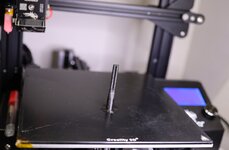
Oh, I made cables and an adaptor for some NSK handpieces I had, these are the older DC brushed motors that do not work with my EVO, one is a 35k RPM unit, the other is a high torque motor for use with things like the Luster (adjustable reciprocating hand tool) I bought. I needed to make a whole endpiece with interface pins and strain relief, and the 3D printer just did a fantastic job. I printed all the strain relievers out of TPU, which is astonishingly tough stuff, but more impressive was my machine printed a missing and unobtainable end piece for the silver one with a 22x0.5 superfine thread, and it ****** worked like a charm!

luster.jpegNSK Handpieces.jpeg

I added another JAM vise to my collection as well (and a bunch of Kanetec/Kanetsu magnetic chucks and V-blocks.)

JAM_CSV100.jpegKanetec_F1A.jpeg

The vise has dual sine plates integrated into it, so it can be precisely tilted in a compound angle, they are crazy expensive new and having disassembled it for cleaning I can understand why. So many machined facets and precision surfaces and hinges, it's a wonderful little object. The big Mag chuck has independant magnets on the top and bottom, so you can just slap it down on a bed. Kind of a silly trick, but in practice it actually has a super fine pole magnet on one side and a large pole on the other, so you can optimally clamp different materials by flipping it over. All this stuff will be highly useful if I ever get a surface grinder, but the odds of that are astonishingly small, so who knows what my reasoning is... other than Magnets!
 
OP
B

Bakafish

Well-known member
Joined
Feb 7, 2017
Messages
477
Location
Tokyo
I realize I didn't show the finished product.


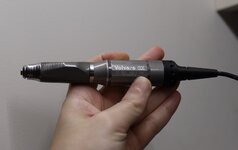
Volvare.jpegEndplate crossection.jpeg

The replacement end cap has radial vents since the motor uses an internal fan that partially exits from the rear. There is an internal piece that holds two pins that plug into the brush holders, I made the center section and the retaining cap out of CF-PLA and the pins out of 1mm brass wire. The cable is secured in the center bore and the two wires exit two holes in the base of the bore and are soldered to the pins which were then pressed into the two holes. Then the end cap is threaded on retaining them in place with a shoulder section and the TPU strain relief was threaded onto the center shaft. I know this kind of looks over engineered, but it really only took me a few hours to design and print all this, and being able to replace a cord assembly that is no longer made and make a tool useful again is pure joy to me.

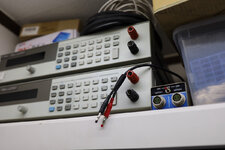
Because the older handpieces just use DC brushed motors, and I have enough clutter, instead of buying a used controller (~$150 for a good one, I could likely get one cheaper) I instead repurposed a splitter box that came with the torque motor, and rewired it to terminate to banana jacks. The 95A shore hardness TPU, despite being flexible, still will print quite well in this orientation, making it really handy for the wire strain relief. You 3D nerds keep this in mind, the stuff is really strong too. The box plugs into either of my DC lab power supplies and runs the motors every bit as well as the factory unit, I can vary the speed with voltage and make sure the motor can't overload and is not straining.

wire boot 2.jpegwire boot.jpeg
 

LeonardY

Well-known member
Joined
Apr 16, 2011
Messages
5,020
Location
Southern California
I have a roll of TPU but haven't tried it yet. I guess I'm going to need to. I have some parts that were rubber on my nail guns that need fixing.
Thanks for the info.
 
OP
B

Bakafish

Well-known member
Joined
Feb 7, 2017
Messages
477
Location
Tokyo
I have a roll of TPU but haven't tried it yet. I guess I'm going to need to. I have some parts that were rubber on my nail guns that need fixing.
Thanks for the info.
Make sure you dry it before use, even if it is still sealed. Print slooooow and hot.
 
OP
B

Bakafish

Well-known member
Joined
Feb 7, 2017
Messages
477
Location
Tokyo
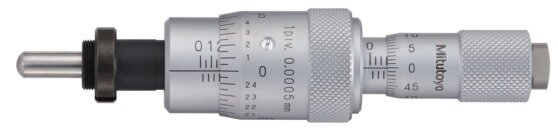
On today's endeavour into the arcane I want to show you an unusual mechanism, the Differential Screw (in the form of a Micrometer in this case.) I have a large number of Micrometer heads, which are a simple calibrated screw that is used to measure or displace things in a precise way. They are one of those things that seem extremely handy for something, but in practice end up in a drawer somewhere waiting to be used. Because of this, they are sold very cheaply on the used market, and I being who I am, buy them when they are too cheap to pass up.

mics.jpeg

Most (metric) analogue micrometer heads use a 1/2mm thread pitch and are typically marked to read down to 10 micron increments. There are precision variants that add a vernier and a higher grade of screw to read down to 1 or 2 microns, or that have a finer 0.25 or 0.1mm pitch thread for more precise work, and of course there are digital versions that can offer even higher precision. Some of these micrometers can be so tiny that they are pencil thin. There are chubby ones too, that trade compactness for a lot more surface area for graduations making them easier to read. These micrometer heads are typically fixtured by the front collar and can have a variety of different tip styles, rounded, flat and non-rotating. Many have a carbide face or ball to reduce wear or friction.

110-502-10.jpeg

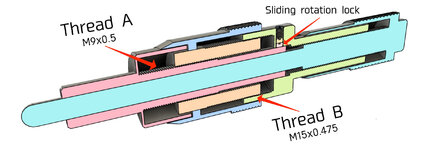
Amongst all the different choices, there is a rare type the differential screw micrometer. These units are actually two separate micrometers lashed together to give a coarse and a fine adjustment. But the fine adjust mechanism is the interesting part as it uses the differential screw. A differential screw is basically a screw that uses two different threads at the same time. These threads are different pitches, and that difference between the pitches is what makes the screw able to transit very small distances per rotation. I've made a cutaway to better visualize this.

Differential Cutaway.jpeg

The fine adjustment thimble (light blue) is attached to the differential nut (orange) with a couple of set screws. When it is rotated clockwise it screws into the mounting collar thread (pink), and out of the rear housing (green) that the coarse micrometer spindle (turquoise) is threaded into. So one rotation is pulling the nut and rear housing 0.5mm forward using the Thread A, while simultaneously unscrewing Thread B which pushes the rear housing and coarse spindle the opposite direction 0.475mm meaning the tip of the micrometer is only moving a tiny 25 microns per rotation of the fine barrel. Since even a 0.1mm (100 micron) pitch thread is considered an achievement due to the tiny size of the features, this differential screw is essentially a quarter the pitch and uses much more robust screw profiles. The front and rear sections are kept in alignment as they move towards and away from each other with a lock screw that rides in a v groove machined into the front section.

Dif Exploded.jpeg

The main disadvantage of this solution is that the half micron resolution is only as good as the error of the entire device. The coarse thread only indicates in 10 micron increments, so the fine adjust + the coarse adjust is only accurate to a few microns, far less than the half micron accuracy one would expect. But these are used in systems that typically have some other point of reference, like a microscope where you use the coarse feed to align a feature to the reticle, then only adjust the fine feed, isolating it from the error of the coarse adjust. Or in optics where you might be moving a mirror, you get the beam close with the coarse adjust, then tweak it with the fine.
 
Last edited:
OP
B

Bakafish

Well-known member
Joined
Feb 7, 2017
Messages
477
Location
Tokyo
Last year I picked up my first BIAX power scraper, and along with the restored diamond carbide blade sharpener and a mix of home made blades and some factory ones, I started practicing on one of my smaller 'mass blocks' I had bought cheaply with a larger one I needed for the CNC. I cleaned up a couple of faces, but didn't attempt the more advanced work of making sure all the faces were parallel and perpendicular. That requires careful measurement and correction using step scraping, and I already have several reference grade angle plates already, so I didn't need to make it perfect.

scrape_2.jpeg

I need to get good at just scraping things flat before doing the more advanced angle stuff anyway. At some point last year, I got my hands on a second BIAX that was a little beat up and missing some parts and got it working well again. I've been keeping my eye out for cheap 'rescue' projects, and this poor little Obishi Keiki 500mm camelback straight edge showed up for $50. Another addition to the menagerie.

500SE Before.jpeg

No idea how old it might be, it had been crudely repainted black at some point, and there was significant rusting everywhere, but fortunately no really deep pitting or other damage. It doesn't have the cool "Eagle" logo of the larger 750mm one I restored before (but didn't scrape) which I think makes this a newer unit, and despite being 2/3 the length of the bigger one, it feels like 1/4 the weight, a good thing. I stripped it, derusted everything as carefully as possible, primered it and gave it the same silver mica paint treatment as its big brother. I then power scraped it relatively flat, removing virtually all of the rust damage caused by the prior neglect.

500SE After.jpeg

I didn't try to get it ultra flat, as I want more basic experience and I will need to reposition my good surface plate (really no fun to move) closer to the work area to make printing between scrape cycles more convenient. I also want to attempt to do some micro scraping using my Nakanishi Luster reciprocating tool. No idea if it will work, but worth a try.

luster.jpeg

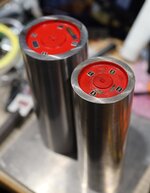
I also picked up some Obishi Keiki cylindrical squares. These have some interesting 'self proving' qualities and are considered to be true reference surfaces, and I've wanted one for a while, so I got two :rolleyes:

OK Squares.jpeg
 

cycle61

Well-known member
Joined
Apr 5, 2020
Messages
500
Location
Middle of Oregon
I learn about a new kind of tool almost every time I open this thread. Fortunately, my hobby of choice is woodwork so I can mostly avoid the temptation of the ultra-precision technica obscura.
 

Old tool guy

Well-known member
Joined
Apr 13, 2023
Messages
3,156
I learn about a new kind of tool almost every time I open this thread. Fortunately, my hobby of choice is woodwork so I can mostly avoid the temptation of the ultra-precision technica obscura.
What … you don’t flatten your workbench top and hone your chisels to scary sharp every day?
 
OP
B

Bakafish

Well-known member
Joined
Feb 7, 2017
Messages
477
Location
Tokyo
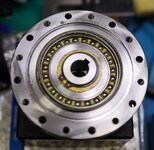
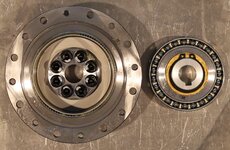
This is something I think a fair few of you will already know about, but it is no less fascinating despite being a little more ubiquitous than some of the other things I've covered. For those unfamiliar, you are looking at the input side of a small Harmonic Drive.

HD.jpeg

Its purpose is to act as a motor gear reduction and has some unique qualities that make it ideal for robotics and other related usage. So how does it work? The magic is in the thin walled cup (seen just outside of the outer bearing race) that has tiny gear teeth machined into the outer surface. It fits snugly into an outer housing that has similar gear teeth that the inner cup meshes with, but the outer shell has exactly 2 more teeth than the inner cup. Due to this mismatch, and the precise dimensional differences of the two sets of gear faces, the inner one forms an oval shape rather than the round profile of the thick outer housing. This makes the gear teeth engage along opposite faces, but there are 2 similar areas where the teeth do not engage, and this along with the tooth count difference allows the inner cup to be driven by a 'wave generator' as seen removed in the picture below.

HD Disassembled.jpeg

If you look carefully at the wave generator on the right side in that photo, you should be able to see that it is a slight oval shape. The inner race of the bearing is not round, and the outer race is thin and able to flex to follow the oval distortion caused by this inner race being rotated. This distortion precesses around the ring, like the wave in a big stadium, pushing the inner gear to engage at two opposing points and allowing it to disengage and inchworm its way to the next set of teeth.

HarmonicDriveAni.gif

With the outer flange held fixed, and the wave generator being driven, the cup slowly rotates and becomes a highly reduced output drive that is accessed from the other side. The cup output side is supported by a relatively large crossed roller bearing (a lovely bit of kit in itself), making it extremely rigid and strong. So that's super neat, but overly complicated right? Why would anyone bother to do it this way and spend so much?

Three main reasons:
  1. Backdrive
  2. Backlash
  3. Size
Backdrive is something that almost every gear train experiences, and is not always a bad thing. It means that applying torque to the output will transfer that force back to the input side, like regenerative braking on an electric car. The problem arises when the output shaft of some critical equipment is under load and needs to stay in position (think a winch or lift) and you suddenly disconnect power. Similarly, a robotic arm that is has the power cut off suddenly collapsing would result in serious damage or injury. The most common gearing solution to this issue is a worm gear. But for robotics the size, efficiency, gear ratio and backlash all make this type of gear less suitable, and although brakes that engage when power is removed are common, to make them strong enough to hold a heavy arm in place takes a lot of space and wastes power. It may come as no surprise at this point that I will state the Harmonic Drive is considered 'self-locking' and doesn't backdrive.

Backlash is an insidious villain that most people go through their lives never having to confront. It seems innocuous, it is just the slop in a gear train, or other motion system. For a lot of things it is so low impact, you likely experience it with zero realization. That small dead zone when changing the direction you turned the steering wheel of some old car you once drove. Maybe the manual focus of your camera, or changing the attachment on your KitchenAid Stand Mixer, the slop in the gear train is just something you never even think about. You subconsciously work around it with ease. But for a precision machine, the motion needs to be controlled exactly, and slop, even when predictable and known, can cause massive issues. I will go into depth on this at some point, it is a long subject in itself, as the dangers it presents are non-obvious and complex, but suffice it to say that Harmonic Drives have zero backlash and this simplifies things enormously.

Size offering 50:1 or 100:1 gear reduction ratios in such a simple and compact package, and not requiring a brake to hold position, you can see why most robot arms are leveraging these units.

I bought a pair of these, not to build a robot, but to use them to make a 4th and 5th axis for my long planned CNC project. The same advantages outlined above makes them especially suited for 4th and 5th axis applications.

There are a few other notable gear systems that are related that I feel I should mention, the first is the darling of 3D printed robots as it offers some similarities to Harmonic drives but is much easier to fabricate at home, and that's the Cycloidal Drive. They have very low backlash, and due to the high gear ratios they can achieve are harder to backdrive than a similarly sized solution. They also have a very cool looking way of operating and are surprisingly easy to make yourself with a printer and a box full of skateboard bearings.

The other one is more of a warning. Harmonic Drive is both the object and the name of the company that makes them, and as a company they have a marketing department and management. The result is exploitation of their success by using product naming that might confuse the layperson into thinking something is a "Harmonic Drive" when it in fact is not. Specifically they market a whole product line of Harmonic Planetary gears that although they are excellent and unique, are not actually Harmonic Drives. I didn't suffer from this confusion, but it was close, so I note it here to save someone else from spending a lot of money and getting something very different than what they were expecting. These Harmonic Planetary gearboxes actually use a deformable ring gear in their final stage, which is novel and reduces backlash, but again they are not working on the same principle as the system explained above and are not suitable substitutes for the same applications.
 
OP
B

Bakafish

Well-known member
Joined
Feb 7, 2017
Messages
477
Location
Tokyo
How does the cup … the flexible ring … attach to the output shaft?
You can see the inside of the cup exposed on the right side of the second photo. It is sandwiched between that ring with the 8 cap head screws and a large round output plate on the opposite side that is essentially the inner race of the 60mm crossed roller bearing that secures it in place. That plate has a rubber lip seal to keep the cross bearing clean and a lot of threaded holes for you to attach a pulley or shaft coupling to. This 107mm diameter unit is a 50:1 reduction ratio and has a start/stop torque rating of ~100Nm (73 foot-pounds) with continuous output at about half of that and a maximum almost double. So despite the output being driven by a thin walled flexible spline, the materials used and the geometry are extremely strong.
 
OP
B

Bakafish

Well-known member
Joined
Feb 7, 2017
Messages
477
Location
Tokyo
stages.jpeg

I've been threatening to cover Motion Stages for a while, I've been picking them up whenever I see an obvious 'deal.' Motion stages are (usually) small devices used to position objects, often optical elements, measurement equipment or other instrumentation. They are one of those items that my sense of utility evaluates as far more useful than what they are likely to provide me. They are also sold secondhand at fractions of their shockingly high retail prices, which triggers my hoarding instincts, so I've collected a fair number of them with the so far unfulfilled and semi-delusional hopes that I would one day find a good use for them. These motion stages go hand in hand with the micrometer heads I've collected, as I suffer from the same lack of valuation and they are often used on the stages in place of an adjustment screw to move them precisely and be able to read the travel.


toolmakers_scope.jpeg

The most common and basic form of stage is the XY linear stage. These are widely used in microscopy as seen here on my recently obtained Mitutoyo Toolmakers Microscope. This type of arrangement makes it possible to take very accurate dimensional measurements of an object by aligning the crosshair reticle of the microscope on a point (I have yet to get the adaptors needed to take a good photo through the scope for you), noting the readings or zeroing the micrometers, then moving to the next point using the micrometer screws and reading the travel values.

Angles can be measured on the scope by rotating either the reticule wheel near the eye piece that rotates the internal crosshair or rotating the optional rotary table you can see attached to the top of the XY table. Both of which use vernier scales marked in degrees/minutes (more on that later.) If you've never learned how to read a vernier, or never known what those extra lines were for (see below), it is a fascinating subject in itself. By using the Z travel of the focus rack adjustment, combined with the shallow focal plane of the scope's optics, it is also able to make relatively rough Z axis measurements (±75 microns with the standard 30X magnification) by comparing the distance between two focal points with the help of an optional dial indicator mounted on top.

yaw_stage.jpeg

As I briefly covered in a prior post, worm gears have the useful attributes of self-locking and low gear ratios, and thus they are commonly utilized by the rotational or radial stages. However the self locking prevents them from being micro-adjusted using a micrometer head as it isn't able to move the stage, so a secondary travel is sometimes provided using a stiff spring in opposition to a micrometer head as seen on this Yaw stage. This vernier indicates in tenths of a degree rather than directly in minutes like the scope.

Just as the X, Y and rotational stages (Yaw) allow angular measurements and motion as seen on the scope and stage above, other less common stages enable movement in the other basic axes of freedom. Dedicated Z stages that can control height, along with Pitch and Roll tilt stages (often called Goniometer stages) which can be really useful with optical experiments where you are trying to align a laser or mirror.

Motion stages use all the common forms of bering methods, plain dovetail bearings, caged ball bearings in various raceways, recirculating ball bearings like with linear rails and at the high end, crossed roller bearings and air bearings. But they also use some less conventional methods as loading is often a secondary concern. Some of the first ones created were for the lightly loaded duties of microscopy, and back then making a precision hardened raceway was a challenge, so easier to manufacture wire race bearings were invented which consist of 4 hardened wires constrained into a matched pair of simple slots with the ball bearings preloading them in place. This was a lot easier to construct than a precision hardened V way or groove and allows the frame to be made of a relatively softer material and still have excellent wear characteristics. They are also still used to make complex curved races as seen below, but hopefully you can understand the basic construction.


4-point-wire-race-bearing.png

I learned the downside of this design with the first XY stage I bought. It seemed like a great deal, but when it arrived I noticed there were significant detents in the travel when it should have been smooth across the entire range. Not knowing anything about this type of design, I disassembled it I discovered the wires and how it worked and I could see that the ball bearings had dented the wires in a couple locations. The problem of this design is that too much load or an impact can easily create a permanent depression (often called a Brinell mark) in the wire as all that force is concentrated on a single point of contact between the spherical bearing and cylindrical wire. My unit was clearly used beyond its capabilities. Fortunately it occurred to me that simply rotating the wires 180° along their axis to present a fresh, unblemished surface to the bearings put it back in working order, but from that point on I've tried to buy the more robust cross roller or dovetail types and keep away from wire stages.
So i had this ever growing pile of various stages, it was time to do something with them. And as I often do, I decided the best way to justify my investment in a bunch of things I really didn't need was to buy more expensive things I didn't really need to better justify my prescient acquisitions. So in the spirit of the buried lede, and starring role of my next post where I will start to tie these threads together, I introduce to you my Nikon 6B bright-field Autocollimator. A device I've been looking for for a long time as it is one of the ideal methods of measuring certain aspects of machine assemblies. More to come soon, ladling this out in more palatable portions...

Nikon_6B.jpeg
 
To avoid these ads, REGISTER NOW!
Top Bottom