To avoid these ads, REGISTER NOW!

Below 265 SQ/FT Tiny Tokyo Shop

All workspaces below 265 squarefeet.

kaymccampbell

Well-known member
Joined
Feb 27, 2015
Messages
29,410
Location
Upstate New York
LOL, I have a Rockwell Retro Encabulator App on my iPhone. Can you believe they needed such a giant machine to encabulate back then?
iPhone? You're behind the times. The latest Virtual Pseudo-Sinusoidal Encabulator is half the size of a business card and encabulates over WiFi, Bluetooth, LoRa, and satellite. And it's already out of date.
 
To avoid these ads, REGISTER NOW!
OP
B

Bakafish

Well-known member
Joined
Feb 7, 2017
Messages
477
Location
Tokyo
Quick trip on the Shinkansen this weekend to visit Kyoto. I love how frictionless and efficient it is to get around over here, high speed trains are the best.

Kyoto.jpegKyoto2.jpeg

A lot of tourists, which is a good thing to see post-pandemic. My favorite thing about Kyoto is exploring the cool, shaded and unmappable stone alleyways crisscrossing it. They support a shockingly numerous variety of tiny restaurants, bars and other traditional shops and makes one feel as if you have been teleported back in time more than anywhere else here in Japan.

Anyway, I was last discussing my new Autocollimator.

range_2.jpeg


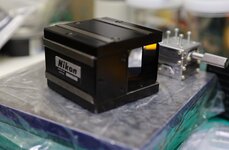
The Nikon 6B has been manufactured since 1963 and other than a retrofitted LED light substituting for the bulky transformer and incandescent lamps that mine came with, it is virtually unchanged. An Autocollimator uses some basic optical principles to project a collimated beam of light to a precision reflector, and then measures the angle of deflection which can be used to calculate very small distances. This point needs emphasis, it can only detect angular changes, it is unaffected by change of distance, vertical or horizontal translation of the reflector, as long as it stays within the narrow observable view of the scope. So carefully moving the reflector from 10 inches away to 10 feet, it would show the same exact reading as long as the surface was parallel. The crosshair only responds if you tilt or rotate the reflector, it can only see angular changes. I was tempted to make a lot of diagrams and stuff, but this is well explained here, so check these videos out if you are interested.

You might wonder why measuring the relative angle of something is at all useful, why measure angles in the first place? We'll get to that in a moment. As a quick aside since these instruments use it and since my highly science educated wife didn't seem to remember the somewhat archaic minutes/seconds notation of dividing degrees, I wanted to cover that here. Just as 360 degrees (°) divide a full circle, in this notation each degree is subdivided into 60 minutes (') and each minute is further subdivided into 60 seconds (") in decimal notation if required. This notation (e.g. 102° 15' 22") is (was?) used heavily in surveying, where the long distances measured can greatly magnify any rounding errors of valuable property lines, although in the modern age of calculators a simple decimal equivalent (102.256°) is often easier to work with. My trusty TI-92 allows entry in both notations, which along with some simple programming, made 'closing the loop' in my civil engineering classes a lot easier.

The smallest angular change that the Nikon 6B can measure using the small micrometer knob on the side, is half an arc second (0.000139°). So it can detect very tiny changes, but to be useful it needs to have a large enough measurement range that large changes remain observable. Having a tape measure that is accurate to 1/64th of an inch is useful, but if it is only 3 inches long, that can really limit the utility. The Nikon can measure a half a degree of change over the full observable range, which although is pretty small, it works out to be well suited for the machine work it is intended for. There are even more precise optical autocollimators out there, but higher magnification trades improved resolution for less range of measurement. So you might be able to discern a smaller angle any larger deviations are more likely to go outside of the viewable measurement range and moving an autocollimator during a series of measurements to keep the reflection in view is problematic at best.

I implied that measuring the angular change is actually useful, and it is! Thanks to basic Trigonometry we can derive real length measurements from these angular readings. What we are really trying to find, is the height (h) of the imaginary right triangle we create with the reflector mounting stand (sled) as it moves across the surface. So for example, if we want to know how flat a straight edge is, we can take a series of angular measurements and with the magic of math, convert those angular changes into to a surface height map.

Heron_Autocollimator.jpeg


Feel free to skip the following mathematical details:

As you may remember, we can fully define all the unknown lengths and angles of a right triangle by knowing just the length of one side (a, the fixed base length of our reflector stand) and two known angles, the 90° that makes this a right angle, and the θ° that we measured with the Autocollimator. Solving these variables gives us the side lengths, and from these we can calculate the Area of the triangle using Heron's formula. And by knowing the area of the triangle and the length of the hypotenuse (c) we can then solve for the height of the triangle (h), using the equation:
Height = 2(Area/Base)
Since the base length of the reflector stand is fixed, we can solve for this ratio of angle to height once, and then just directly convert the arc seconds we observe into a height value as the ratio is a constant. To measure the flatness of things we establish a starting point that we set to zero on our graticule, then record the relative change in angle along the increments of a path divided into the base length of our sled. We can then convert these relative distances into a unified height map. Many target sleds I've seen use a 100mm of base length as it happens to result in a close enough approximation of one arc second ≅ half a micron. This means the half an arc second of resolution on the micrometer knob allows us to resolve as little as a quarter of a micron (0.00025mm) of height change over a total observable range of close to a millimeter with such a sled.
tldr; The autocollimator can see very small hight variations across a planar surface. "Weren't you telling us about all your precision spirit levels that did the same thing?", you might ask. It's true I bought a bunch of extremely precise levels (0.01mm/M per division) that can essentially do a similar thing, and that I intended to use for this purpose. But there was a lot I didn't know. Even my most sensitive levels are still only a quarter as accurate as the autocollimator, although I can certainly live with that level of accuracy. More critically, it takes a long time for a spirit levels' bubble to settle between measurements, and the range of such a sensitive vial is extremely small meaning deviations of more than 10-20 microns will require precision shims or a micrometer adjustment to keep the bubble within readable range, which slows things down even more.

levels.jpeg

The biggest drawback with using spirit levels for this purpose though, is unless everything is bolted to a meter thick layer of concrete or you can hover like a hummingbird, the shifting of your body weight on the floor as you lean to read or position the level (or even the weight of the level itself!) is enough to move the object under test enough to affect your measurements. That's why the professional electric level measurement systems use two linked levels to differentially compensate for the workpiece movement. One is statically placed and just keeps track of the measured object as it bobs like a boat on the ocean, while the other is used to take the measurements and the difference between their readings is the actual deviation with any shifts in position cancelling out. The Autocollimator can be placed directly on or otherwise fastened to the object being measured, and being directly coupled is therefore not usually affected by this type of error.

"So math, optics, birds, levels, autocollimator, bla bla bla, where do the f'ing stages come into all this?" I need them because although I got quite a deal on this autocollimator, it was a basic model and wasn't supplied with the factory adjustable stand or reflector and sled. In order for this to be at all useful, I need some way to securely hold and aim the AC and a highly accurate reflector to take measurements. While not the ideal solution, these stages I've been collecting should be able to be cobbled together to fulfill these roles. Surely I won't need to buy any more, surely...

TBC
 

Old tool guy

Well-known member
Joined
Apr 13, 2023
Messages
3,155
Fascinating. And a nice clear diagram. A sled length of 100 mm is 4”. That seems large, wouldn’t that tend to span across peaks & valleys?
 
OP
B

Bakafish

Well-known member
Joined
Feb 7, 2017
Messages
477
Location
Tokyo
Fascinating. And a nice clear diagram. A sled length of 100 mm is 4”. That seems large, wouldn’t that tend to span across peaks & valleys?
Most manufacturers specifications and industry standards use these intervals. For most machine/metrology measurements that 100mm span is more than enough to clearly define any serious deflections of a bearing surface. Even a worn or damaged surface is likely to be relatively flat compared to most things. If you were adjusting a linear rail for example, it might have screws every 60mm and it is unlikely to have any major localized discontinuities just due to the overall manufacturing precision of being a precision ground lump of high grade steel. You would have a very hard time making a meaningful localized deviation of even a small rail over a shorter interval than this can measure (without causing easily visible damage anyway), if that makes sense. 100mm intervals are going to catch the fundamental character of these rigid and robust elements. So this type of incremental measurement (electric levels included) allows validation that a machine is in spec, or where closer attention is needed.

For problems that might not be seen with this test, something like hand scraped machine ways were one could mistakenly 'dig a hole' or localized wear, we have other ways of identifying it. More localized flatness can then be marked for correction by 'printing' the surface with a straight edge (like this 500mm example) that might only span a few of these intervals. The straight edge is calibrated flat to a lapped plate and you use pigment to transfer and indicate the localized flatness of the device under test. Without the aid of the macro testing with an autocollimator or level, a shorter straight edge will get you in trouble fast. Direct flatness testing without prior mapping always requires your tool to span the entire surface. If it doesn't span the whole surface, there are a number of ways the limited length can be blind to, or even induce curvature to that surface. Although they exist and are the ideal method, giant surface plates and straight edges that can cover an entire machine ways of a normal to large machine are rare, cumbersome (unable to fit in tight confines), expensive and unwieldy (they get super heavy so you need to have a gantry crane.) And again, if you are just validating that your machines are healthy, a small easy to operate tool is better than completely disassembling a machine and craning in a giant straight edge :cool:

One of the more famous devices for localized flatness checking is a Rahn repeat-O-meter and there are other similar ways of doing so, like my Spherometer. But even with these tools the span of measurement is often 4-5" (although the contact point it is measuring is much smaller.) These type of devices are typically only used to validate surface plates though, which are the shop's standard of flatness that everything else derives its accuracy from. How these are made flat is a fascinating chicken and egg question that I think I went into previously.
 

kaymccampbell

Well-known member
Joined
Feb 27, 2015
Messages
29,410
Location
Upstate New York
Quick trip on the Shinkansen this weekend to visit Kyoto. I love how frictionless and efficient it is to get around over here, high speed trains are the best.
When I was in Tokyo, I had a planned few days between flights. The one fun thing I wanted to do was ride the bullet train. My contact dragged me out waiting for 5 days. So, no train ride. Never got back to Japan.
 
OP
B

Bakafish

Well-known member
Joined
Feb 7, 2017
Messages
477
Location
Tokyo
When I was in Tokyo, I had a planned few days between flights. The one fun thing I wanted to do was ride the bullet train. My contact dragged me out waiting for 5 days. So, no train ride. Never got back to Japan.
That's too bad, hope you get another chance. The tracks are quite scenic, and take you closely past Mt. Fuji and the seaside which are easy to take in through the large windows. The trains themselves are stable and feel well planted despite the speeds, and even the normal seats are ridiculously spacious compared to an airplane. The 'green seats' my wife spoils me with are downright luxurious, with footrests and all that stuff. Train bento is also fun, the stations sell bento boxes of all kinds, and cold beer, snacks and drinks are sold from little carts on board. As a tourist, getting a JR rail pass prior to coming is maybe one of the best deals out there, providing unlimited travel for a flat fee, you can save hundreds of dollars and it provides motivation to see more places.

The big advantage of trains over planes is they take you directly to the heart of the city, no baggage claim, no security checks, just walk on walk off. The actual time it takes to get from my house to my hotel is the same with a lot less BS and more relaxed comfort enjoying the ride. Another thing that tourists don't really get to take advantage of is that it is cheap and efficient to ship your baggage back home after your trip. Most larger hotels have direct pickup or you can drop off your bags at the station (airport), you get your bags the next day in perfect condition (carefully wrapped in plastic) since Japanese shipping companies treat all packages with incredible care. Returning home empty handed after a draining trip is fantastic.
 

LeonardY

Well-known member
Joined
Apr 16, 2011
Messages
5,020
Location
Southern California
That's too bad, hope you get another chance. The tracks are quite scenic, and take you closely past Mt. Fuji and the seaside which are easy to take in through the large windows. The trains themselves are stable and feel well planted despite the speeds, and even the normal seats are ridiculously spacious compared to an airplane. The 'green seats' my wife spoils me with are downright luxurious, with footrests and all that stuff. Train bento is also fun, the stations sell bento boxes of all kinds, and cold beer, snacks and drinks are sold from little carts on board. As a tourist, getting a JR rail pass prior to coming is maybe one of the best deals out there, providing unlimited travel for a flat fee, you can save hundreds of dollars and it provides motivation to see more places.

The big advantage of trains over planes is they take you directly to the heart of the city, no baggage claim, no security checks, just walk on walk off. The actual time it takes to get from my house to my hotel is the same with a lot less BS and more relaxed comfort enjoying the ride. Another thing that tourists don't really get to take advantage of is that it is cheap and efficient to ship your baggage back home after your trip. Most larger hotels have direct pickup or you can drop off your bags at the station (airport), you get your bags the next day in perfect condition (carefully wrapped in plastic) since Japanese shipping companies treat all packages with incredible care. Returning home empty handed after a draining trip is fantastic.
I went to a very nice onsen by bullet train. What a great weekend. The train ride was amazing.
On our way back, after eating some of the finest sushi all weekend. We had to get meal at the station going back to Tokyo. Two of my friend's stopped at the vending machine and bought ramen cups. The ones that are like a grenade. Pull the pin and they heat the contents. I couldn't do it. My girlfriend said that she was hungry which meant I was too. I caught a familiar smell and got up and motioned to her to follow. Our other two friends were staring at the cup of ramen. One had pulled the pin. The other must have caught the same familiar smell.
She looked up and said,"You two are not going to do that." I said yes we were. She tossed the Ramen cup to our other friend. Then we all headed to McDonlad's. A fish burger, fries, apple pie and a coke for each. All my other friend said to us was, "You guys ****."

I miss delivery. I would go shopping in Tokyo and everything would just be delivered. I used the luggage service all the time, It's so great.
I think that's why I no longer like to travel here in the states. You get very spoiled by the conveniences in Japan.

I know there are other things that would freak people out here. Like having to walk your trash out to a street corner and put under nets so the crows don't get it.

Have you seen this?

i actually like the idea.
 

Old tool guy

Well-known member
Joined
Apr 13, 2023
Messages
3,155
Another thing that tourists don't really get to take advantage of is that it is cheap and efficient to ship your baggage back home after your trip. Most larger hotels have direct pickup or you can drop off your bags at the station (airport), you get your bags the next day in perfect condition (carefully wrapped in plastic) since Japanese shipping companies treat all packages with incredible care. Returning home empty handed after a draining trip is fantastic.
Almost germane ...
neighbor guy is married to a Philippine national, and after several years in the states they have decided to sell everything and move back to her hometown, a small town on the north shore of Mindanao. He showed me a shipping service run by a Phillippine woman, you pack medium size boxes (about 2x2x3 ft) with whatever you can, and it gets delivered to your address in the PI for $37. It goes by boat, so it’s slow, but weight is not a factor.
 
OP
B

Bakafish

Well-known member
Joined
Feb 7, 2017
Messages
477
Location
Tokyo
AC Stand.jpeg

Nikon's solution to position the autocollimator consists of a heavy cast iron and steel stand with a height and shift (horizontal) adjustment, and the ability to pitch and yaw the device, both with micro adjustments. This is a pretty effective and flexible setup, even allowing it to point straight down at the base platform, but is quite bulky, almost doubling the size of the already fairly large instrument, and costs far more than I paid for the AC (I'm going to abbreviate autocollimator from now on, I'm tired of typing all that) itself. I'll keep an eye out for a used one, but I doubt it is something I can find independent of another AC, and at a reasonable cost. For simple measurements, a matched pair of V blocks as I showed in the first post is sufficient to hold the unit, but I want to make a minimal solution that is a little more flexible by providing some basic adjustability.

Another significant showstopper is that the AC needs a reflector to return the light it projects from the lens in order to work. The reflector can be any highly polished surface, but for best operation the reflector should be flat and ideally some type of 'first surface' mirror. First surface means that the reflective material is coated on the front side of the glass substrate instead of coating the backside of the glass like ordinary mirrors. Light going through the glass of a conventional mirror will both reflect off the glass and refract when passing through it, causing secondary reflections and refraction effects that reduce the fidelity of the measurement and cause spurious indication marks.

This Nikon autocollimator is a little unusual in that it can compensate for a reflector with a small amount of spherical aberration. It implements a corrective focus ring on the front that allows you to recolumate light that has been affected by a slightly spherical reflector. This curvature (concave or convex) can be quantified by percentage with the objective correction ring, in order to make measurements, to validate the curvature of a simple lens for example, but for angular measurements you want a mirror as flat as possible (previously covered a bit in a my post about my optical flats and monochrome light sources.) Nikon makes quite a variety of such mirrors, but unfortunately my AC didn't include a reflector. (I've no idea what the original Plane Mirror A might have been, it isn't documented anywhere, but there used to be an E type with an adjustable length base for flatness measurements.)

Nikon Mirrors.jpeg

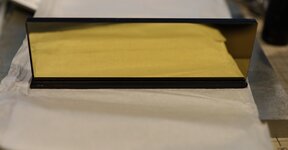
Like optical flats, these super flat first surface mirrors are pretty uncommon outside of scientific use and hard for me to find on the second hand market over here. I had previously picked up a large 150x50mm gold plated first surface mirror pretty cheaply a while back, but I don't have its specifications and in initial testing it didn't really perform as well with the AC as I hoped. It uses gold coating which improves the reflectivity in the infrared spectrum, but it isn't ideal for full spectrum visible light or the green filter used by the lamp assembly. Green light was chosen because our eyes are most sensitive to that color and it makes it easier for us to align the crosshair with a poor reflection.

gold_mirror.jpeg

Traditionally silver was the ideal layer for mirrors being highly reflective across a very broad spectrum, but it is very susceptible to oxidation and has mostly been replaced by aluminum in mirror making. Modern optical coatings can help stabilize these metallic reflective layers, making oxidation less of a factor, but these first surface mirrors remain quite fragile and susceptible to damage since the front layer is essentially unprotected.

There is another method of making reflectors, a dielectric mirror, where extremely thin and transparent layers are deposited in a carefully constructed stack on the flat glass substrate. The complex interaction of these layers with the incoming light causes it to be reflected, often with much better reflectivity than even the finest metallic mirror can achieve, even though the layers themselves are transparent. These mirrors are often tuned (limited) to specific narrow frequencies of light so they are indeed transparent, but still able to reflect a specific frequency of light almost perfectly. There are also broadband dielectric mirrors that work well with the visible light frequencies, achieving over 99% reflectivity (compared to about 90% for a good aluminum mirror.) This improved reflectivity can make a noticeable improvement to the clarity of the crosshairs, especially with smaller mirrors and at greater distances.

retroreflectors.jpeg

Another reflector aside, you may also be familiar with retroreflector prisms which (in addition to being hard to photograph) are used to reflect lasers in surveying and for other useful purposes. These clever little lumps of glass reflect light back towards the source completely parallel, even when positioned at pretty high angles of incidence. Well made ones do not even need a reflective surface to work, offering extreme amounts of reflectivity just relying on a quirk of geometry and physics called 'total internal reflection.' Retroreflectors were famously left on the Moon so lasers from Earth can make very precise distance measurements, and are often mounted to satellites for the same reason. However, despite all their utility, they are wholly unsuitable for use with an autocollimator since they automatically compensate for any angular error, which is exactly what we need for the AC to work.

But prisms can still be useful to an AC, one of Nikon's early cameras, the Nikon F brought the use of a Pentaprism in the viewfinder to the mass market. This 5 sided prism has the ability to flip and reorient an image reflected by the SLR camera's mirror, providing a rear mounted viewfinder that also provided the natural upright orientation of the image through the lens we all come to expect with a modern camera. Before the pentaprism, an SLR's viewfinder was on the top of the camera and required one to look at the image from above where the image was also reversed.

Pentaprisim.jpeg

A pentaprism of high enough accuracy can be used as an optical square, turning light precisely 90 degrees and allowing an easier way to measure the squareness between two perpendicular surfaces. Nikon manufactures just such a unit for use with their autocollimators, the 2 arc seconds of precision equates to roughly 1 micron out of square for our purposes, making something like this one of the squarest squares that ever squared.

For a lot of machine measurements, and just ease of use, it is often required to have more than one reflector as well. An unmounted mirror isn't particularly useful without a proper base (although that Nikon Type C mirror is extremely clever in having a flat ground on the base allowing it to be used without a stand.) Being able to reposition the tilt of the mirror to zero it to the center of the autocollimator's graticule is important for most measurements. So some form of mirror mount or optical stage is required, and due to the sensitivity of aligning these things, this is where those differential micrometers can really shine. In order to efficiently micro-adjust a stage the fine movements provided by the differential screws really help. So that's where these stages and micrometer heads come into play, we finally seem to be getting back to the point. Alas, I'm going to veer off again...

TBC
 

Old tool guy

Well-known member
Joined
Apr 13, 2023
Messages
3,155
What is the weight of your AC? In the picture of it mounted on the stand, it would seem to have a pretty large moment force.
 
OP
B

Bakafish

Well-known member
Joined
Feb 7, 2017
Messages
477
Location
Tokyo
What is the weight of your AC? In the picture of it mounted on the stand, it would seem to have a pretty large moment force.
The main body is 3.5kg. The factory stand weighs close to 30kg though, like I said cast iron and steel. It is made to stay put.
 
OP
B

Bakafish

Well-known member
Joined
Feb 7, 2017
Messages
477
Location
Tokyo
So in the last update for the AC I mentioned it would be nice to have a yaw and pitch adjustment, the factory mount (I finally got a price list, the stand sells separately for $2200, the AC is $4500) also has height and cross shift adjustments, although because of the way the AC works I'm not sure why horizontal shifting is really needed for my application. Translations in the X axis shouldn't have any effect, but maybe the way the factory stand is offset from the vertical post, side to side is useful. Or it could be for when the AC is pointed down at the base plate. There are differential measurements you can do, so sideways movement might help get things centered.

Since the AC was originally designed and built by the Industrial Instruments department with parts presumably shared by the lens division, one of the side effects of the construction is that it shares a lot of key dimensions with popular big boy Nikon camera lenses. This meant I could buy a couple off the shelf 68mm tripod mounts to secure the barrel and a 77mm lens cap although I ended up 3D printing sturdy ones out of TPE for long term storage.

For the mirrors, I actually had all the stages required to make a couple of mirror positioners, but I did a ton of searches for a factory made unit. Not just Nikon either, just any good mirror sled, but had no luck at all. The semi-sentient suggestion algorithm did suggest a pair of very interesting stages that I ended up buying though. So yeah, I bought an expensive thing to have an excuse to use other things I've been collecting, then instead of using what I had, I bought some more.

Newports.jpeg

Folks, some real talk. I wasn't always like this, I bought things as I needed them, I didn't do this kind of crazy packrattery. I guess it's just getting old and figuring why the **** not? This story gets worse... it gets better too. Just understand I am holding out on you, but all will be revealed in the next post... so let's just persevere and look past my questionable decisions, we'll get through this. Anyway, the special stages I bought are cool, let's deep dive them a little.

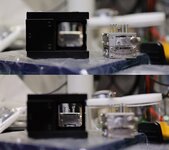
What we have above are two stages that are built specifically for lens and mirror holding. The smaller one on the right is a Newport LP-1A, 5-axis 1" lens positioner. As a general purpose lens holder it has way more axes of adjustability than required for my needs, I really just need the pan and tilt. It is designed for lenses that need the up, down, left, right and in and out movements, but it costed so little, a few extra knobs doesn't hurt anything and the extra axes may come in handy for some other optical tinkering someday.

100tpi.jpeg

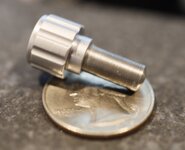
Speaking of the knobs, I commented about the difficulty of making high thread count screw threads in the differential micrometer post. This stage uses 4 different 100tpi screws which are the equivalent of a metric 0.25mm thread. Fine enough that I didn't even realize the threads were exposed at first, they looked like they were smooth. This lead me to look up what the limits really are, and I came across these (which now I must have!) This is madness, but I love it!

I did a full teardown of the lens positioner to clean and re-lubricate the unit, and was really impressed by the complexity and attention to detail of the internals, no corners were cut. Eight tiny (~1mm) spring loaded teflon balls at key internal contact areas, spring loaded plungers, and the adjustment screws each had a different specialized contact point optimized for their specific axis motion. These things may be ridiculously expensive new, but I had a deeper understanding as to why after the teardown. I'll add that it is nice to see an American company that can still be obsessive about making the best, I just wish they were metric.

The larger unit, a Newport 605-2, is a 2 axis gimbal mount, designed specifically for 1" or 2" mirrors, and has a full 360° of rotation on both axes. This gimbaling will allow it to work great as a 'turning' mirror, which allows a second target mirror to be positioned outside the AC's line of sight. That way the AC can stay in a single position and still measure different runs on across a surface.

This unit came with a Sony asset tag, and was configured with a chubby pair of Kohzu FPP03-13 fine adjust micrometers, which at ~$350ea. extra are still a third less expensive than the Mitutoyo's differential thread type I showed you before. But despite the lower cost, they still can offer a similar sub-micron fine adjustability. They use some sort of novel method with the threaded end cap acting on a central plunger that converts 7.5mm of cap travel to a mere 0.3mm at the anvil end. I will open one up at some point to see exactly how it is done, I expect some sort of helical sleeve or lever system, but I chased enough tiny springs and balls for one day and it requires a custom cylindrical spanner to open.

Also, as is often the case, the pictures and description of the auction item didn't describe the additional items that I could see were not part of the device advertised (as the seller likely didn't understand they were not originally part of the main unit.) I knew there was an additional X stage, which turned out to be a really nice heavy duty Newport M-UMR8.25 dual-row ball bearing unit. But the real surprise was that there was already a 405nm UV frequency dielectric mirror installed. I had no idea it would be included as it is essentially transparent to visible light and therefore didn't show up in any of the seller's photos. Not useful for this project, but still a bonus!

~$4000 worth of kit for about $100 is a good deal, so hopefully you can understand why I bought these instead of cobbling together the other parts I already had. Honestly I'm not sure which is more aggravating, a person with too much money to spend on frivolities, or someone who crows about the insane deals he got. I'm well aware I have one foot firmly planted in each category, so feel free to post which aspect you dislike more.

So what's left to do? A single new 1" wide-band dielectric mirror arrived this morning and was installed in the in the adaptor of the gimbal mount. I may spring for a larger 2" mirror it is designed to hold, but it doubles the price and I'm not paying the pennies on the dollar that I'm used to with these. I'm looking at it now from across the room, and it is pretty impressive what a bright reflection it provides. That extra 10% of reflectivity is no joke, you can see it. I need to make a base for the AC so it can be panned and tilted, hopefully without buying any more stages. And I need to make a base for the mirror mounts that provide the 100mm standard contact span.

TBC
 
Last edited:

zanyad

ALLIANCE MEMBER
Joined
Apr 26, 2018
Messages
2,755
Location
NE Ohio
Folks, some real talk. I wasn't always like this, I bought things as I needed them, I didn't do this kind of crazy packrattery. I guess it's just getting old and figuring why the **** not? This story gets worse... it gets better too. Just understand I am holding out on you, but all will be revealed in the next post... so let's just persevere and look past my questionable decisions, we'll get through this.
I await the next installment with bated breath!
 

RickP

Well-known member
Joined
Jan 15, 2013
Messages
1,547
Location
Annapolis, MD
Honestly I'm not sure which is more aggravating, a person with too much money to spend on frivolities, or someone who crows about the insane deals he got. I'm well aware I have one foot firmly planted in each category, so feel free to post which aspect you dislike more.
I dislike neither!

Please keep the detailed descriptions coming -- I love reading about how all the $$$ bits work, even if I barely understand half of it!

~$4000 worth of kit for about $100 is a good deal,
You ****!!!
 
OP
B

Bakafish

Well-known member
Joined
Feb 7, 2017
Messages
477
Location
Tokyo
I'm sure it won't come as a shock to any of you that I spend an inordinate amount of time scrolling through auction and marketplace sites looking for deals and curious stuff that I don't know about. There's a lot of strange things out there, and my overwhelming compulsion to understand how everything works (and desire to possess the most appealing of those things) drives me to wade through hundreds of items a day. My eye has developed quite good involuntary pattern recognition, and it always seems like some new object of desire seen elsewhere leads to discovering some example at the marketplace. I'm not sure if this is serendipity or a newfound object awareness, but often learning about some obscure thing inevitably leads to coming across one (or more) of them as if they were being populated out of the blue. "Of course they are, because you are looking for them!", you quite logically say. But the thing is, I don't believe there is any way I would pass by the same object prior to my knowledge of it, just because of my curiosity and how obviously interesting they are to me without prior knowledge. So I wonder if this stuff is really just flying under my radar, and I'm not as keen of a technological archeologist as I think I am, or if something else is going on and the simulation is real (I don't really think that, but these things popping up demanding to be bought can be spooky at times.)

As far as luck is concerned, I never felt or operated on the premise that I am at all lucky, but looking back it would be insane tho refute that I have been exceptionally so. Luck is a scary thing to me as, if it can be said to exist, it always seems like it must be a finite resource, so 'getting lucky' always felt a little disconcerting to me as I worried about the cosmic balance. I'd rather row on calm seas than invite a favorable wind that may become a tempest.

Anyway, remember that pentaprism based optical square that I mentioned a couple posts back? Yeah, about that. The chance of coming across one of those felt unlikely to put it mildly, but these AC accessories were all well embedded in my search cortex. These prisms aren't something that the small subset of people who use autocollimators commonly use, none of my YouTube peeps have one, I've never seen one used before, and a properly adjusted gimbaled turning mirror can do almost the same job with a bit of careful setup. But just a short while after I picked up my AC, the algorithm inserts a picture from a buy-it-now auction in my results that had the number one trigger for my attention, a felt lined wooden box. There are few bigger triggers of my pattern recognition, and none more likely to connate value as all my best things came in such boxes.

This particular box held a couple objects wrapped in anti-corrosion paper and plastic bags, one with the corner torn open partially revealing what looked like some machined surfaces. I'm including the actual untouched image of what I saw, I will tell you that the hairs on the back of my neck stood up when I saw this. Something was familiar about the shape of that 'N'.

pentaprisim box.jpeg

Now, to be fair, when I clicked through to the auction itself and enabled the translation, things became clearer and I got even more excited. Although this box of objects wasn't mentioned or itemized in any way, the main item being sold was another Nikon 6B for Pete's sake! 😑 I sure as hell didn't need another one of those... but if there was really an optical square in that extra box, it was likely worth the price of the collection by itself. The price for the whole thing was low enough that I could convert the extra AC into a thermos for all it mattered, if that box contained what I thought it contained.

I desperately searched for anything else it might be, or pictures of how it was packaged and what it came with for comparison, but the only thing I could find was that they used to sell a spacer kit for some of the mirrors, and that could be what I was seeing, although it would be a little strange to put those in such a fancy box. I stared at the picture, the ground surfaces were similar to the image of the prism in the catalogue, but the spacing was different. It would have to be of an unpictured side or a design change, I was confounded. Surely the seller would mention something about this box of objects in the sale description? Alas it was beneath mention.

You might wonder why I didn't just ask the seller about it, but if it was an expensive item that wasn't on the person's radar, the last thing you want to do is start asking questions that might prompt them to do the research or alert them to the value. It was also made clear in the description that the person didn't understand the equipment, it was handed down to them, so trying to describe a pentaprism optical square to some plebe in Japanese isn't something I thought I could pull off successfully without creating a large amount of drama. Asking questions in this culture creates more chaos than one would expect, and the chance would be high that the offer would be pulled if the person got uncomfortable that they were selling something controversial enough to draw questions. This was a buy-it-now type of offer as well, with no bidding, so it was a ticking clock. It could be sold at any moment.

The bundle did come with a saving grace. Despite the seller indicating and showing photos that the lenses of the AC appeared to have fungal growth (something I wasn't really that familiar with but from some preliminary searches seemed bad) it also included what looked to be the best factory model of mirror sled. The type B with a 70mm dual sided mirror on a 100mm base and a detachable switched magnet. I didn't want a second AC, and if it was bad and unresellable (who am I kidding? I will hoard it anyway) that made it even less desirable, but there was enough perceivable value there that it almost made sense.

The mirror alone in good condition was probably technically worth the entire price, but it was still more than I wanted to pay for that single item. I planned to make my own sled anyway, and I already had all of parts to do so with a new mirror ordered and on the way. It all came down to if that mystery box was really a prism or not, and all I had was that picture to go on. No other examples to compare the picture to, no documentation if other parts were actually included with it, no YouTube of one in use or being unboxed. I didn't even have an idea what it would be worth. I expected it to be insanely expensive new, but I hadn't deep dived these things at all. Even if it was a pentaprism, modern manufacturing could be spitting out similar ones for peanuts these days or a repurposed camera viewfinder prism might offer similar precision for a few bucks. I just didn't know, WTF could I be thinking?


I couldn't even find pricing on an equivalent item from another autocollimator manufacturer. I could find optics grade pentaprisms, but nothing with better than 5 minutes of accuracy, and they were naked and unmounted. The Nikon unit is less than 2 arc seconds and secured in a metal box that has machined surfaces that are calibrated to be parallel with the optical paths. Getting pricing from Nikon isn't easy, but I immediately applied for an account with Nikon industrial here in Japan and requested an official quote. But the bundle was likely going to sell at any moment, waiting days for a reply and hoping they disclose the price without a formal quote request wasn't going to help.

That lack of information cuts both ways of course, with no model or part number on these accessories and little knowledge about them, it would be hard for a normie to properly valuate these things. The seller appeared to be underpricing the collection, but it all could be junk as well, the few photos they provided were not definitive and showed clear problems with the AC lens. The mirror seemed to have spots as well. Was it suffering from oxidation due to age or scratches on the fragile surfaces?

Lastly, I didn't like the idea of getting another AC, even if the other items completely covered the cost. I couldn't shake the feeling that I would be happier to spend the same amount if the AC wasn't included as counterintuitive as that sounds, if only because I wouldn't feel like such a **** to have two of the stupid things.


I'll admit, I got as far as hovering over the complete transaction button more than a few times, but it just felt like I was pushing my luck and that everything could go wrong and I'd be stuck with even more useless stuff, an additional and broken AC and a box of expensive spacer blocks I didn't really need. So I bookmarked it, knowing that the rapidly increasing "favorite" count showed it had a lot of traction and that the item could be snapped up at any moment. I knew I could make my own mirror sled, I knew I could use my AC and granite square to set the gimbal to 45° and roughly replicate the operation of the prism. Let's stay cool and keep this project sane.

My main hesitation was I didn't like how the explanation of, "Why did you buy this?", sounded in my head. A rational person (e.g. my wife) would just give a placating look as I explained my reasoning, while thinking,
"So he saw some box he'd never seen before, with some things in it, completely obscured by paper and plastic, with no description and just assumed it was this unobtainable thing that was really expensive and does this thing... reflects? Something something square? I don't even know why he needs it or what it is for, but he already had another way of doing that thing, and still spent all this money anyway? And it turned out to be these mundane little bits of metal? Why am I listening to this drivel, am I supposed to feel sorry for him?"​

So I decided to sleep on it hoping for some clarity, but conceding it would be sold before I woke up.

I slept like ****, and woke feeling defeated.

My gut kept telling me to roll those dice, and I had walked away from the table and was now - in the bleary hours of morning - regretting it. I grabbed my bedside iPad fully expecting to find it gone, and was both relieved and once again anxious to find it still available, and just bought it before I put myself into another indecisive spiral. It's just money and I don't like to spit in Fate's face. it had survived the night and I figured worst case I might enjoy cleaning up the lens issues and making it work again. My rationalizations were all pounding down the doubts, and now there was just the waiting game to see what would actually arrive. Worst case, a nice spacer block kit wouldn't be bad to have. The mirror might be in good enough shape to still be useful. I knew I was rationalizing and being a little delusional, but I was still harboring a little hope.

I mentioned the shipping here in Japan is really good, it is also really fast. The shipping was included in the price. It was dropped off at the shipper that night in the south western part of Japan and arrived the next morning, a 15kg box delivered overnight is just normal freight here, nothing special. Not some super expensive red label express overnight that costs more than the item being shipped.

So when it arrived I pulled everything out of the well packed cardboard box and dove straight for the little mystery box. It indeed had 3 heavy block shaped items inside, 2 were still factory sealed in the old rust inhibiting paper and plastic just like the picture showed. The medium sized block was torn open a bit as you could see in the photo, but looked like it too had never been formally removed from the wrappings. I guessed if this box was going to hold a prism, that the medium sized one would be it. It looked like it was the right size (based on the published dimensions) with the other ones being way too small and a little too big. So I carefully removed the paper, Charlie and the Chocolate Factory style, and to my great disappointment, sure enough, it turned out to be just a really nice spacer block. Damn. 😓

I felt dumb, why would you buy an expensive bit of kit and not open it up, right? A box of blocks you would leave wrapped until you might need them, but if you got some fancy thing, you'd at least look at it. When I realized that the medium block hadn't really been opened, just pawed at, I lost all hope. The other two factory sealed blocks felt solid and equally dense in their tight wrapping, with 'Do not open until needed.' helpfully printed on the paper. I put the box aside for a moment and checked on the mirror box. It wasn't still factory sealed, but still had a heavy layer of the original rust inhibitor congealed all over it. It had light spidery fungal patterns on both mirror surfaces, but no sign of any oxidation or significant scratches, and a bit of minor surface rust on the machined contact surfaces, but otherwise looked in perfect shape. At least that looked like a win.

type_b_mirror1.jpeg

I went back to the blocks, and decided to disregard the instructions of the clearly expired paper and open them to remove the old inhibitor and recoat them in Boeshield and fresh anti-rust paper. The small one was a thin, well machined little spacer plate, but I wasn't really sure what I was going to use these for to be honest. There wasn't any hardware, holes or slots in them to fixture them to anything, they were just oddly sized parallel blocks. I opened the largest one in the set, and let out an actual gasp. It was a ******* prism. No ****. Factory sealed, unopened for decades. The guy never even saw what it was. "Just a bunch of blocks.", he must have thought.

Prism1.jpegPrism2.jpeg

I promise this wasn't a windup, until that very moment I had no idea what I was going to get. From there it was all frosting. It didn't really matter how f'ed up the other AC might be, so I opened up the big box to take a look. I expected I would have to disassemble the lenses to gain access to the fungal growth and pre-ordered the special tools, a lens spanner wrench and some rubber friction rings to do so. Fungus releases acids to break down the materials it uses for energy, and the side effect of this is it plays hell on lens coatings and can even etch the glass itself. It is astonishing to me that dust, a little humidity and microscopic airborne spores are all that is required to have this happen, it seems like a pretty common issue with older lenses though, although it isn't always fatal.

The first thing I noticed is that the paint finish was much more glossy, less textured and a slightly different shade than the other one I have. The lamp power supply, unlike the first one, seemed to have a date code indicating it was made in 1974, which seemed about right. The lamp power supply seems to be the most viable method to date these things as I've seen a wide variety of designs. There was the manual and a vinyl cover in the box, a full complement of lamps (the surest sign of all that it was little used) and the barrel (much smoother than the first which has fine lathe marks) was still wrapped in factory paper. I'm almost positive it is the newer of the two I have, but I need to collect more evidence.

The mold on the lens was not as bad as it looked in the photo. The angle of the picture made it look like the mold was deep inside the lens stack which would have required disassembly and would have been an indication of deep moisture and dust intrusion, but it was just internal reflections off of the inner lenses that made it look like that. The only discernible issues seemed to be on the surface itself.

As a basic first attempt to deal with it, I just applied some lens cleaner and a lens wipe, and it removed all traces completely. Pristine lens, like new... no sign that anything had ever been there. A 3 for 3 hat trick. The lens cleaner similarly cleaned up the minor marks on mirror as well. I think I've mentioned how much I love that Japanese don't **** with things in the hopes of getting more money. They just are like, 'Here it is, this is what I want for it.' Well made stuff cleans up really nicely, and I'm so happy that I'm the one getting to do it.

So accounting time, the price sheets from Nikon were finally provided and my intuition about the costs were pretty close, with the Pentaprism (P#: ECW02100) costing almost as much (491,000¥ ≅ $3,300) as the AC itself (680,000¥ ≅ $4,550 without the stand, light or case. About $10k as a full set.) The big "Type B" mirror (P#: ECW01100) is less than I expected, but still the princely sum of 289,000¥ ≅ $1950, and in the states these all are likely less as the market there is so much different, discounts on such items are unknown over here.

Mirror_buddies.jpeg

Suffice to say I paid a very small fraction of that, although I have also spent hundreds on various gee-jaws and doodads to accessorize them. This is still far more invested than the likely utility they will provide, but I still hope I can utilize them better than I expect. I still haven't covered any of the steps taken to build my own sleds or the AC mount, or showed you any of it in actual use. Now that you are up to speed on the state of things, I'll try to get back on point... lol.
 

Grant Gunderson

Well-known member
Joined
May 17, 2013
Messages
2,312
Location
Bellingham, WA
. Despite the seller indicating and showing photos that the lenses of the AC appeared to have fungal growth (something I wasn't really that familiar with but from some preliminary searches seemed bad)
The optical coatings that Nikon, Canon, Minolta and Pentax all used to use turned out to be a perfect Petri dish for growing fungus. When vintage optics are stored away and not actually brought out and used in a regular basis Fungus tends to start growing in the coatings. The problem is once it’s established you can’t just clean it off. It will actually etch the glass and will cloud it making it useless. Back in the days when I used to do a lot of camera repair work I saw thousands and thousands of dollars worth of high end glass ruined by fungus.

Best way to inspect for it is to back light the glass with a flash light. I’ve found denatured alcohol does a good job of cleaning it if it has t etched the glass yet followed by using “ROR” lense cleaner.
 
Last edited:
To avoid these ads, REGISTER NOW!

Old tool guy

Well-known member
Joined
Apr 13, 2023
Messages
3,155
Baka ... I was reading that epistle and about half way through I was mumbling “just buy it!”

So is the new one better than the first? Will you resell duplicate items?
 
OP
B

Bakafish

Well-known member
Joined
Feb 7, 2017
Messages
477
Location
Tokyo
Baka ... I was reading that epistle and about half way through I was mumbling “just buy it!”

I'm usually not that indecisive, this was just one of the most extreme risk/reward opportunities I've had to face.

So is the new one better than the first? Will you resell duplicate items?

They are both essentially unused. The older one had a scattering of tiny rust spots that had affected the chrome plated barrel and had some very tenacious stains. I have already carefully cleaned it though, and it cleaned up perfectly. The rear of the device has a bisected spherical section where the lamp assembly and the eyepiece and micrometer are mounted. It has detents and rotates so that the eyepiece can be oriented either inline or perpendicular to the device, which is quite handy. The first one's detents are not as crisp, and it is leaking a trace of nasty grease from that seam, and so I need to service it. But it seems to be attached by a large slotted screw that is painted, so I am loathe to unfasten it and create obvious signs of intrusion. It is working fine, and when I only had one of these it seemed safest to leave it alone. The new addition changes the risk equation a bit, but I will leave it alone for a while so I can cross check the two unmolested units in case something is wonky with one that I haven't noticed. The alignment of that joint is critical.

As far as selling one of them, that's the obvious thing to do. The problem is that I like things more than money, and once I have them they become dear to me. I also like redundancy and fear scarcity, and end up with multiples of such items (e.g. my pair of Biax scrapers.) So I'm not in a hurry to sell it, although I clearly should. If not for the storage space alone.

Lastly, there are some things that you can measure that require two of these silly things. Oddly enough, one such procedure is validating the trueness of an optical square, which would be the ultimate in completely unnecessary make-work, buying a bunch of stuff to just check itself. You will notice a lot of hobbyist effort is eating one's own tail, making parts and buying machines to service and improve the fleet of machines one already has. I haven't even really started building my CNC and I'm off in the reeds in so many directions...
 

Firstram

Well-known member
Joined
May 16, 2017
Messages
1,390
I enjoy the cool stuff you find but, be careful. If you get the pair of ACs lined up just so they could generate a laser beam and you'll shoot your eye out kid!
 
OP
B

Bakafish

Well-known member
Joined
Feb 7, 2017
Messages
477
Location
Tokyo
I needed a couple of things completed before I could put the Autocollimator stuff mentally to bed. The AC needed a stand, ideally one that could adjust the Z height along with the yaw and pitch, since the big mirror sled is a fixed angle and the AC needs to be positioned relative to that mirror unlike the gimbaled mirror stand which can adjust itself to the AC position. In my experimenting, I quickly realized that getting the mirror pointing straight back at the AC was tedious and fiddly, so I wanted a solution for that. I wanted to have an LED light source to replace the bulky incandescent setup. And lastly I needed to make a sled for the gimbal so it had a 100mm bearing distance. That's a whole lot of stuff for something that I will likely use only a few times at best, but this was really all in service of fiddling around with motion stages, so on with the show!

As nice as the factory stand is, I didn't think being able to position the AC in a vertical orientation was particularly useful for my needs. They enable that so that you can determine the angle of prisms, deflection and relative height differences of items.

AC-vert.png

There's a lot of interesting setups, but I just don't see myself doing any of that at the moment, I'll cross that bridge if I ever come to it. So the Z (height) adjustment stage I had was way to scrawny to support the AC, I happened across a beefy lab jack that was designed for precision use. Lab jacks are useful adjustable platforms that help you to align the height of equipment, positioning a heater under some glassware for example. This unit has dual scissor elements to ensure it stays parallel and has a solid brass construction, very heavy with the top plate offering a matrix of tapped holes for direct mounting of standard stages. To this I added a large rotational stage and a single tilt stage, giving me the three primary axes of rotation I expect I will need.

AC Lab Stand.jpegAC Stages.jpeg

As I mentioned before, the AC itself uses camera industry standard barrel dimensions, so I could use off the shelf Nikon lens mounts and a Slik mounting plate. This made it easy to slide the AC forward and back and position the center of balance over the pitch axis of the Goniometer stage. The Slik plate also made it easy to attach a 3D printed iPhone holder, but we'll get to that later.

The next item on the list was an LED light source. To keep things cheap and simple I just ordered a little high output flashlight off of Amazon. I got one that used a green LED though as the AC uses a green filter anyway, there's no point in losing efficiency to pump phosphors that are just getting filtered out anyway. I created a threaded barrel that replaced the flashlights front bezel and had a very fine pitched 0.5mm thread on the other side for the AC. It was very confusing to me, but it seems like a lot of camera and optical gear use imperial diameters with metric pitches, so you get 1" diameter with 0.75mm pitch threads and such. It has been so long that I've been using metric that it took me a while to realize that they were doing this, the threads were clearly metric as my thread gauges were showing me, but I was having a ton of trouble getting the diameter to match until I realized it wasn't metric.

Anyway, for the sake of over engineering it, I used a parabolic profile to minimize internal reflections. There is likely no need for it, but it printed great and this is all practice for making something of more importance someday. The idea is any light hitting the wall hits a parabolic shape that reflects it back out of the entrance. NASA uses it on certain space telescopes, there are serious formulas and surface finishes required for this to work which I most certainly didn't use.

light_adaptor.jpeg

I'm still impressed that my Ender can print stuff like that tiny 0.5mm pitch internal thread. The Bambu Labs printers have been tempting, but I have so much sunk into this machine (and the fact it is still chugging along) that it is really hard to put it out to pasture. I'm going to need it to die, or a little more disruption before I can pull the trigger to replace it. The light works great, nice and bright, no issues as far as I can detect.

The next thing I wanted was some kind of alignment tool for the mirrors. The AC projects a bright circular image with the crosshairs superimposed through the center of it. When the mirror is properly positioned that circle fills the entire viewport, but the AC's field of view is just the size of that circle, so getting it aligned is really a pain in the ***. The projected image is too faint to really see it if you held up a sheet of white paper in front, unless you are in a pitch black room. So it requires a lot of back and forth fiddling until you can see some partial sliver of the bright circle, at which point you can more easily pull it into view. I noticed in my research that another optical company, Trioptics had a clever solution for this issue. They made a robust assembly that rests on the barrel of the AC and has an extension that holds a laser pointer concentric to the device. This allows you to quickly adjust everything so the laser spot reflects back upon itself, which when the unit is removed will result in the mirror being properly positioned.

As I'm not some industrial laboratory I don't need a big cast metal device, so I ordered a tiny little green spot laser assembly, designed a simple flexure and lens cap, and hooked it to a little LiPo rechargeable battery with a charging port and a toggle switch.

AC Laser Alignment Cap v4.pngLaser Alignment Tool.jpeg

It has three 3mm ground pins that register against the edge of the AC for good repeatability, and the two adjustment knobs only need to be calibrated once. I probably could have just printed it with no adjustment, I suspect the print is accurate enough and it just would have worked, but again, over engineerings my game. So to do the first calibration, I needed to manually get a mirror aligned and zeroed. Then I placed on the cap, turned on the laser, and adjusted the two knobs until the spot reflected back on the laser itself. Now when I need to get everything set up, I can just put on the cap, turn on the laser and position the mirror easily as the spot is clearly visible in the brightest environments.

Okay, we're almost done for this post. The last item on the list was the sled for the Gimbaled mirror. As you may recall, to convert the angular measurement to an actual height it is critical that our base is of a known length. The factory mirror (and industry standard) is 100mm as that provides a good balance of accuracy and granularity. It is important that the base of the sled is relieved so that it doesn't accidentally contact the measured surface at some other point, so there needs to be feet or some contact area that is centered on that 100mm span.

As it happens the industry has a device called a sine bar that is used to very accurately define angles, basically doing the reverse of the calculation we use to measure the height deviation of the sled. By placing a known height stack of gauge blocks under one side, you can establish a specific angle. The good ones are made of hardened tool steel, use cylindrical contact points that maintain the distance between them regardless of the angle, and are quite sturdy. The only downside for my application is they are not very wide, and would be a very expensive solution, if they weren't given away on auction sites.

My favorite brand of machine vises, as you know from past posts, is JAM and as I was putting all this together a pair of their 100mm sine bars came up for purchase for about $20. Ignoring the fact that these are about $700ea new, the reality is that manual machining is rapidly on its way out and everything is computer controlled these days. A lot of these parts are sold on the used market for a handful of yen. The way they are constructed, the ground cylindrical foot is screwed on by a pair of cap head screws. And by removing and repositioning one of the feet to span the two I was able to siamese them into a single wider unit with the highly desirable 3 contact points. At the rear they have a removable lip plate that keeps the work from sliding off when they are angled, I removed those and used the screw holes to attach a 3D printed carriage that the gimble can screw into. All of this is reversible, no modification or alteration was done, just some relocation of parts and a 3D print and I have a sturdy and high precision sled for the gimbal unit.

Gimbal Sled2.jpegGimbal Sled1.jpeg

The 3D printed plastic part is designed so it isn't involved in the geometry in any way, all the contact surfaces are metal to metal, so despite the gimbal being screwed into the plastic girdle, it is actually held in direct contact with the top surface of the sine bars. Again, it likely doesn't really matter, but that's the proper way to do it. In my next post I intend to document some actual measurements I'm going to take with all these parts, and we'll be able to test the accuracy and see if all this is really useful or not.
 

Old tool guy

Well-known member
Joined
Apr 13, 2023
Messages
3,155
What are the 3 points of contact? Looks like you have 2 lines of contact.
 

Attachments

  • IMG_4581.jpeg
    IMG_4581.jpeg
    329.3 KB · Views: 9
OP
B

Bakafish

Well-known member
Joined
Feb 7, 2017
Messages
477
Location
Tokyo
What are the 3 points of contact? Looks like you have 2 lines of contact.
I used points loosely, "three lines of contact" isn't how one would define a plane, and so it required further explanation that I thought might not be interesting. I worried it might be confusing, so I'm glad you brought it up.

Actual 'points' could potentially fall into local minimums, blunt or quickly wear (changing the height across measurements) or damage the surface being measured. For these reasons, most surface related tools try to average out contact over a larger area. In this specific application, larger contact patches like circular pads could span a shorter or longer than 100mm distance depending on where they actually touched which would introduce some error, so the three cylindrical feet with a line contact are a good compromise. Keep in mind we are talking about errors that are far below the resolution of the instruments I'm using, this is orders of magnitude of overkill, but just explaining the thinking behind this approach.

Nishimura Jig Square.jpeg

I have a transfer square (above) that uses a similar arrangement of cylindrical contacts, but it uses a long and short ceramic rod, so I think your argument that there are two lines (not three) isn't necessarily wrong, but having had to align those two rear feet I assure you they are separate. My ultimate goal was to have a stable, accurate sled that was still narrow enough to fit on my straight edges. Repurposing the sine bars was a really easy way to achieve that, and gave them some purpose in an age where they are more often left to rust in boxes.
 

Jagmandave

Well-known member
Joined
Nov 6, 2011
Messages
6,299
Location
Overland Park, Ks.
So, I read about the collimators, so I went back to the beginning and spent my whole Sunday reading your entire thread from your first post and I still don't know what you're going to use them for!!!!!

(tho I have an idea)

Still, a fun way to spend some time on GJ..... :cool: (y)
 
OP
B

Bakafish

Well-known member
Joined
Feb 7, 2017
Messages
477
Location
Tokyo
So, I read about the collimators, so I went back to the beginning and spent my whole Sunday reading your entire thread from your first post and I still don't know what you're going to use them for!!!!!

(tho I have an idea)

Still, a fun way to spend some time on GJ..... :cool: (y)
Thank you for putting yourself through all that :p As with most of the things I have, the reasons I got these are better described as self-delusional justifications to buy old and interesting junk/treasures than any actual need. I expect that buying old stuff and fixing it will continue, and between the CNC I should have already built but is still just a pile of parts, and my scraping, my intention for the autocollimator was to measure just how bad I am at all of this. Clearly I enjoy the process more than the results though... and it is hard to motivate myself to even do that.

A lot of this churn is just doing things that feel right, and hoping to stumble upon an actual plan as to what I will do with my time once my days in the digital salt mine are over. I know I want to make things, but what, and how to be successful at it are completely unclear. As lazy as it sounds, most of my life the opportunities just fell out of the sky and I pounced on them. I'm more of a Monkfish than a Saba I guess, but doing what I enjoy and building useful skills like prototyping with Fusion360 and the Ender, learning how to machine and build things, understanding the electrical stuff, all seem like they will come into play once whatever it is I will be doing becomes clear. And if nothing else I'm keeping myself entertained and avoiding real work :D:cautious::cry:
 
OP
B

Bakafish

Well-known member
Joined
Feb 7, 2017
Messages
477
Location
Tokyo
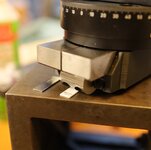
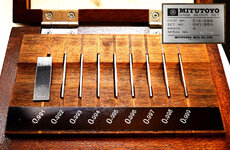
Sunday was a bit frustrating. After having built all the stands, sleds and laser aids it was time to validate if this setup could actually measure things at the micron level consistently and accurately. Since the gimbal sled was based on sine bars, it seemed to me that it would be ideal for testing as I could slip gauge blocks of different thicknesses under the front foot and directly read the angular change.

AC Cal 1.jpegMitu Microns.jpeg

In addition to my basic ceramic blocks, I had a special set of gauge blocks that allow for micron level steps, so I could really push the setup. But after aligning the mirror and zeroing out the AC, I found that trying to substitute the blocks without blowing up the alignment was much more difficult than I had hoped. I had placed a couple of magnets on the cast block for the rear feet of the sled to brace against so it would be constrained from shifting around, but they clearly were moving so I replaced them with a parallel block clamped in place. That worked better, but the crosshairs were still all over the place and I wasn't getting repeatable measurements at all. Even just gently lifting and placing the sled on the same block wasn't giving the same reading. I wasn't sure if this was an issue with the gimbal, or the setup or a combination of both. Switching over to the factory sled didn't really help, and it wasn't suited for this kind of measurement anyway. So it was likely just bad setup, but I abandoned the experiment pretty dejected.

It was clear to me that the setup would have to be a lot more constrained, and I was worried that measuring these small values may end up being a lot more difficult than I had imagined it to be. The target was shifting around 10 microns or more, and that's a lot more than the accuracy I was hoping to measure. On the good side, the stand for the AC seemed to work well. The pitch adjustment wasn't as fine as I want, but it was close and was certainly good enough to get the AC zeroed, although I'd like a fine adjust. The Yaw adjuster was perfect and the X stand is rock solid. It held position really well, so a win there at least.

So this morning my intention was to get the gimbal sled set up so the rear feet would be seated in some v-blocks to keep them constrained, and do some sort of adjustable parallels for the front foot. I was thinking about how to keep it all in line and how best to substitute the gauge blocks with as little disturbance as possible. Then it occured to me, I have a ton of really expensive gear that basically does all that. Enter stage left, the JAM SP150 precision sine plate ($2500 new/$250 used.)

AC Cal 2A.jpeg AC Cal 2B.jpeg

A sine plate works just like a sine bar but with a fixed base and the pivot being a tightly lapped hinge. I could use the switchable magnet in the big Nikon mirror sled to keep it positioned against the removable fences of the plate, and then using the threaded jack it has, gently lift it to place the different gauge blocks between the lapped surface and the rear cylindrical foot designed for that purpose. If you look carefully, there is a second area provided to place gauge blocks that is 1mm lower, so you can use a 1.1mm block to raise the plate 0.1mm rather than having to fiddle with really thin shims.

This worked really well! I was able to easily and repeatedly measure down to the micron. I still need to investigate the issues I was having with the gimbal unit, it may have been just the crappy setup, or there is movement in the sled. It also may be the gimbal itself is moving, as there are no locks, just spring pressure against the micrometer heads, and the movement of the sled may be enough to knock things around. I am going to defer on that a bit so I can think about it.

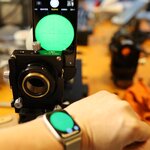
So that brings me to the last bit of jiggery-pokery, the iPhone mount. In reality what I really would like is a high resolution USB camera hooked up to this thing, but being designed in the 60's and made virtually unchanged since then, there is no built in support like a standard microscope style removable eyepiece for such a thing. They make a special optical adaptor that replaces the eyepiece and the front of the micrometer assembly and allows mounting a C mount camera, but it is $2500 for just the adaptor, which is not going to happen. What I did find is that if I positioned the iPhone camera just right I could get it to take a pretty decent shot. But it was maddeningly difficult, as the way the optics and light worked unless you were exactly positioned it was more like the psychedelic displays at a Dead concert than any kind of useful image.

AC iPhone Stand 1.jpegAC iPhone Stand 2.jpeg

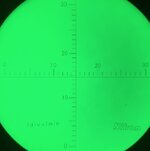
But the Slik camera plate has threaded accessory fixtures on the bottom, so I made an extension plate that encapsulated an X stage and the 5 axis lens holder to it. A 3D printed holder that threaded into the positioner held the iPhone camera concentric, and allowed me to easily align the camera to the eyepiece so that it could focus and get an even exposure. This also meant I could remotely view and take photos with the Apple Watch 'Remote Photo' app, which will come in handy when actually taking measurements on a machine or plate as I can just position the mirror and shoot. The resolution is high enough that I can calculate the changes from the photos without having to use the AC's micrometer.

AC_Crosshairs2.jpeg

So until I have a better understanding of optics and can make my own C mount adaptor plate, the iPhone will suffice.
 
Last edited:

Grant Gunderson

Well-known member
Joined
May 17, 2013
Messages
2,312
Location
Bellingham, WA
Sunday was a bit frustrating. After having built all the stands, sleds and laser aids it was time to validate if this setup could actually measure things at the micron level consistently and accurately. Since the gimbal sled was based on sine bars, it seemed to me that it would be ideal for testing as I could slip gauge blocks of different thicknesses under the front foot and directly read the angular change.

AC Cal 1.jpegMitu Microns.jpeg

In addition to my basic ceramic blocks, I had a special set of gauge blocks that allow for micron level steps, so I could really push the setup. But after aligning the mirror and zeroing out the AC, I found that trying to substitute the blocks without blowing up the alignment was much more difficult than I had hoped. I had placed a couple of magnets on the cast block for the rear feet of the sled to brace against so it would be constrained from shifting around, but they clearly were moving so I replaced them with a parallel block clamped in place. That worked better, but the crosshairs were still all over the place and I wasn't getting repeatable measurements at all. Even just gently lifting and placing the sled on the same block wasn't giving the same reading. I wasn't sure if this was an issue with the gimbal, or the setup or a combination of both. Switching over to the factory sled didn't really help, and it wasn't suited for this kind of measurement anyway. So it was likely just bad setup, but I abandoned the experiment pretty dejected.

It was clear to me that the setup would have to be a lot more constrained, and I was worried that measuring these small values may end up being a lot more difficult than I had imagined it to be. The target was shifting around 10 microns or more, and that's a lot more than the accuracy I was hoping to measure. On the good side, the stand for the AC seemed to work well. The pitch adjustment wasn't as fine as I want, but it was close and was certainly good enough to get the AC zeroed, although I'd like a fine adjust. The Yaw adjuster was perfect and the X stand is rock solid. It held position really well, so a win there at least.

So this morning my intention was to get the gimbal sled set up so the rear feet would be seated in some v-blocks to keep them constrained, and do some sort of adjustable parallels for the front foot. I was thinking about how to keep it all in line and how best to substitute the gauge blocks with as little disturbance as possible. Then it occured to me, I have a ton of really expensive gear that basically does all that. Enter stage left, the JAM SP150 precision sine plate ($2500 new/$250 used.)

AC Cal 2A.jpeg AC Cal 2B.jpeg

A sine plate works just like a sine bar but with a fixed base and the pivot being a tightly lapped hinge. I could use the switchable magnet in the big Nikon mirror sled to keep it positioned against the removable fences of the plate, and then using the threaded jack it has, gently lift it to place the different gauge blocks between the lapped surface and the rear cylindrical foot designed for that purpose. If you look carefully, there is a second area provided to place gauge blocks that is 1mm lower, so you can use a 1.1mm block to raise the plate 0.1mm rather than having to fiddle with really thin shims.

This worked really well! I was able to easily and repeatedly measure down to the micron. I still need to investigate the issues I was having with the gimbal unit, it may have been just the crappy setup, or there is movement in the sled. It also may be the gimbal itself is moving, as there are no locks, just spring pressure against the micrometer heads, and the movement of the sled may be enough to knock things around. I am going to defer on that a bit so I can think about it.

So that brings me to the last bit of jiggery-pokery, the iPhone mount. In reality what I really would like is a high resolution USB camera hooked up to this thing, but being designed in the 60's and made virtually unchanged since then, there is no built in support like a standard microscope style removable eyepiece for such a thing. They make a special optical adaptor that replaces the eyepiece and the front of the micrometer assembly and allows mounting a C mount camera, but it is $2500 for just the adaptor, which is not going to happen. What I did find is that if I positioned the iPhone camera just right I could get it to take a pretty decent shot. But it was maddeningly difficult, as the way the optics and light worked unless you were exactly positioned it was more like the psychedelic displays at a Dead concert than any kind of useful image.

AC iPhone Stand 1.jpegAC iPhone Stand 2.jpeg

But the Slik camera plate has threaded accessory fixtures on the bottom, so I made an extension plate that encapsulated an X stage and the 5 axis lens holder to it. A 3D printed holder that threaded into the positioner held the iPhone camera concentric, and allowed me to easily align the camera to the eyepiece so that it could focus and get an even exposure. This also meant I could remotely view and take photos with the Apple Watch 'Remote Photo' app, which will come in handy when actually taking measurements on a machine or plate as I can just position the mirror and shoot. The resolution is high enough that I can calculate the changes from the photos without having to use the AC's micrometer.

AC_Crosshairs2.jpeg

So until I have a better understanding of optics and can make my own C mount adaptor plate, the iPhone will suffice.
Cmount and optical thread adapters used to be a dime a dozen in the film days. BIC camera , yodabashi or the like might have something.
 
OP
B

Bakafish

Well-known member
Joined
Feb 7, 2017
Messages
477
Location
Tokyo
Cmount and optical thread adapters used to be a dime a dozen in the film days. BIC camera , yodabashi or the like might have something.
Well, there's a reason that Nikon charges over $2000 for the adaptor. Basically if you look at the photo I took with the iPhone above, that was done through the fixed eyepiece. What may not be obvious is there is a significant amount of distortion, which doesn't matter if we are using the built in micrometer to do the measurements, but is a problem if we are making measurements from the captured images as the distortion is non-linear. The good part is that the graticule allows us to characterize it, and I believe I can apply a corrective lens distortion filter that will account for this distortion, but the Nikon part would presumably do all of this with precision optics.

The Nikon part replaces the entire eyepiece by the way, so they are basically building a new optical path from the focal plane at the graticule. Any adapter I would make would best emulate that approach as it eliminates the diopter adjustment and distortion in the eyepiece, that again isn't an issue if you are using the micrometer. Let me explain how the micrometer works, so that can be better understood.

Keen observers may notice that there is only a single knob, yet the graticule and crosshairs clearly imply it measures in both X and Y. The way they go about this is very clever. The AC projects out an image of the crosshairs which is reflected back and falls on the graticule. The micrometer knob moves the entire graticule so you can get the lines to fall between the doubled tick marks. But it does this by moving the entire graticule at a 45° angle to the crosshairs! So it is designed to move a little more than the distance between one set of tick marks, which as you can see from the key in the lower left of the image represents 1 arc minute. So you need to adjust the micrometer twice, once for each axis. This is a very clever solution, as you get more precision by having a micrometer thread at an acute angle to the distance being measured, and you have a single mechanism which reduces costs and complexity.

So using the micrometer, both the crosshairs and the graticule are equally distorted by the eyepiece as they are at the same focal plane and it is self correcting. You are just moving the graticule a tiny amount to get the line centered, then reading off the knob how many seconds the line moved. An image, at least one taken by an iPhone 8, isn't high enough resolution that you could calculate the distances without a lot of error due to the lens distortion. If the item you were measuring didn't vary a lot, and basically stayed in a tight area around the center you could get away without compensating, but the field of view is already tiny and the whole point of adding a digital camera is to ease operation and improve accuracy.

So as far as C mount adaptors are concerned, there are a lot of them out there, and it shouldn't come as a surprise that I own several :) I have one mounted to my toolmakers microscope, and was able to adjust its lenses so that it worked with the factory graticule, which was a bit of a challenge as most microscopes don't use one and so the fit was a bit of an issue.

microscope_scale.jpeg

This is an image taken from the scope of a Mitutoyo 182-511-10 glass scale, which is graduated in 0.1mm increments. You can see that the dashed crosshairs* are (mostly, it is a cheap adaptor) in focus. But even that was achievable only because microscopes have somewhat standardized eyepiece dimensions and focal planes. My complaint that the AC's eyepiece was non-removable and didn't follow this practice refers to that, meaning one of these C mount adaptors, even with the eyepiece removed, doesn't have the right projection from the focal plane of the AC to work. I'll add that the focal plane of the AC that includes the micrometer graticule itself is pretty big in microscope context, about 30-35mm in diameter. Whereas the above image shows clear distortion around the edges and is optically cropped by the 0.5x magnification factor, and that is projecting a tiny area of less than 10mm, maybe as small as 5mm, so these cheap optics would distort the hell out of the AC's image to the point of uselessness.

I admit I find all of this highly fascinating, and the difficulty of creating a solution makes me want to solve it, but I will need to learn a lot more about optics and I know that it is a really deep and dangerous rabbit hole with very little reward, as the iPhone and Fiji is likely all I would ever require to get a "good enough" result.

* These crosshairs are connected to a large ring on the top of the scope and can be rotated to measure angles in the image, if I had not been able to refocus the adaptor they would have been invisible and it would have been a small loss of functionality. The angles can be easily measured in software of course, but by getting the adaptor to focus on them it also means the there is no need to refocus when swapping from the optical eyepiece to the camera as they now both have the same focus points.
 

Old tool guy

Well-known member
Joined
Apr 13, 2023
Messages
3,155
Can you please explain why there are double-line marks on the scale, and what is considered 1 div

1698161419999.jpeg
 
OP
B

Bakafish

Well-known member
Joined
Feb 7, 2017
Messages
477
Location
Tokyo
Can you please explain why there are double-line marks on the scale, and what is considered 1 div

Sure! I explained the Degrees, Minutes, Seconds notation back in this post. If you look at that graticule scale, it goes from 0 - 30 minutes horizontally and vertically. The distance between one pair of tick marks and the next is 1 minute of angular change. The reason these tick marks are doubled is so you can frame the line accurately in between them, something the human eye can do with a pretty astonishing amount of precision. With a good reflection the line is much thinner than the two ticks, but it is still easy to get it centered. If you tried to overlay the line on another line of a different thickness (if it only had single ticks*) it is actually harder than centering it in a gap. Something that would only be obvious if you were to try the two operations.

There are three ways to move the crosshair lines, changing the angle of the autocollimator or the mirror, or using the micrometer to move the graticule itself. The micrometer is able to move the graticule about 80 seconds. The knob itself is marked from 0 to 60 seconds with about 10 extra seconds on either side. But initially you set it to 0 seconds and you physically align the mirror and AC to the starting location, the zero point, which is at 15 minutes vertical and horizontal. They laid it out that way so you aren't dealing with negative numbers, the mirror is just as likely to move in either direction and these measurements are all relative to each other so just start in the middle. The center of the optics is the most accurate area, so this actually works out better than it might seem compared to having the center marked as 0 and going from -15 to +15 minutes which invite sign errors. If you know that you will only be tilting in one direction, and you need to cover a large range you can do the initial alignment at the edge of the ticks, but typically the center is best.

So by careful alignment of the mirror and the pitch and yaw adjustments of the autocollimator stages I mounted to the stand (this is where that laser pointer comes in handy as you can quickly get it within a minute of dead center) you get the crosshair to land in between the double tick marks of the 15 minute vertical and horizontal. And that is your starting, zero, point. Then you move the mirror sled and that will cause the cross hairs to move to show the angular change of the mirror. The lines are very unlikely to land exactly between a pair of tick marks, so you turn the micrometer knob which moves the scale in a 45° direction. It can only move a short distance, but the line will always be between two sets of tick marks, so you will always be able to get it centered. So lets say it is in between the 17 and 18 minute marks, you turn the micrometer knob until the 17 minute ticks frame the line and read the value on the knob, for example 35.5 seconds, and you know the line moved to 17' 35.5". That's your reading for that axis, you repeat the procedure for the other axis, moving the micrometer back to 0 seconds, noting where the line for that axis falls, then moving the micrometer to indicate the number of seconds.

An animation or video would communicate this better, but hopefully this will suffice for now.

* The Nikon 6D version of this AC (D for darkfield, B for brightfield) usies single tick marks because instead of projecting a bright disk with dark crosshair lines, it only projects just a bright crosshair, hence a darkfield. In this case it is much easier to obscure the bright line with a single tick than it would be to attempt to center it between two dark lines on a dark background. Darkfield types work better with low reflectivity subjects and smaller mirrors, but are more sensitive to environmental light.
 

Grant Gunderson

Well-known member
Joined
May 17, 2013
Messages
2,312
Location
Bellingham, WA
Well, there's a reason that Nikon charges over $2000 for the adaptor. Basically if you look at the photo I took with the iPhone above, that was done through the fixed eyepiece. What may not be obvious is there is a significant amount of distortion, which doesn't matter if we are using the built in micrometer to do the measurements, but is a problem if we are making measurements from the captured images as the distortion is non-linear. The good part is that the graticule allows us to characterize it, and I believe I can apply a corrective lens distortion filter that will account for this distortion, but the Nikon part would presumably do all of this with precision optics.

The Nikon part replaces the entire eyepiece by the way, so they are basically building a new optical path from the focal plane at the graticule. Any adapter I would make would best emulate that approach as it eliminates the diopter adjustment and distortion in the eyepiece, that again isn't an issue if you are using the micrometer. Let me explain how the micrometer works, so that can be better understood.

Keen observers may notice that there is only a single knob, yet the graticule and crosshairs clearly imply it measures in both X and Y. The way they go about this is very clever. The AC projects out an image of the crosshairs which is reflected back and falls on the graticule. The micrometer knob moves the entire graticule so you can get the lines to fall between the doubled tick marks. But it does this by moving the entire graticule at a 45° angle to the crosshairs! So it is designed to move a little more than the distance between one set of tick marks, which as you can see from the key in the lower left of the image represents 1 arc minute. So you need to adjust the micrometer twice, once for each axis. This is a very clever solution, as you get more precision by having a micrometer thread at an acute angle to the distance being measured, and you have a single mechanism which reduces costs and complexity.

So using the micrometer, both the crosshairs and the graticule are equally distorted by the eyepiece as they are at the same focal plane and it is self correcting. You are just moving the graticule a tiny amount to get the line centered, then reading off the knob how many seconds the line moved. An image, at least one taken by an iPhone 8, isn't high enough resolution that you could calculate the distances without a lot of error due to the lens distortion. If the item you were measuring didn't vary a lot, and basically stayed in a tight area around the center you could get away without compensating, but the field of view is already tiny and the whole point of adding a digital camera is to ease operation and improve accuracy.

So as far as C mount adaptors are concerned, there are a lot of them out there, and it shouldn't come as a surprise that I own several :) I have one mounted to my toolmakers microscope, and was able to adjust its lenses so that it worked with the factory graticule, which was a bit of a challenge as most microscopes don't use one and so the fit was a bit of an issue.

microscope_scale.jpeg

This is an image taken from the scope of a Mitutoyo 182-511-10 glass scale, which is graduated in 0.1mm increments. You can see that the dashed crosshairs* are (mostly, it is a cheap adaptor) in focus. But even that was achievable only because microscopes have somewhat standardized eyepiece dimensions and focal planes. My complaint that the AC's eyepiece was non-removable and didn't follow this practice refers to that, meaning one of these C mount adaptors, even with the eyepiece removed, doesn't have the right projection from the focal plane of the AC to work. I'll add that the focal plane of the AC that includes the micrometer graticule itself is pretty big in microscope context, about 30-35mm in diameter. Whereas the above image shows clear distortion around the edges and is optically cropped by the 0.5x magnification factor, and that is projecting a tiny area of less than 10mm, maybe as small as 5mm, so these cheap optics would distort the hell out of the AC's image to the point of uselessness.

I admit I find all of this highly fascinating, and the difficulty of creating a solution makes me want to solve it, but I will need to learn a lot more about optics and I know that it is a really deep and dangerous rabbit hole with very little reward, as the iPhone and Fiji is likely all I would ever require to get a "good enough" result.

* These crosshairs are connected to a large ring on the top of the scope and can be rotated to measure angles in the image, if I had not been able to refocus the adaptor they would have been invisible and it would have been a small loss of functionality. The angles can be easily measured in software of course, but by getting the adaptor to focus on them it also means the there is no need to refocus when swapping from the optical eyepiece to the camera as they now both have the same focus points.
I’m having trouble understanding the eye piece situation it’s self. Do you have a photo of it? From what I can tell, it reminds me of a project I did years ago in the camera repair shop. A guy brought in a really high end telescope and wanted to put a cold camera on it. The solution we came up with then was to use a thread adapter from the eye piece adapter to a Nikon standard 52mm front filter thread. That allowed us to attach a dedicated macro lens to it and be able to adjust the focus and then the cold camera could be attached and interchanged with a standard SLR too.

I miss working in that shop. I had left as my photography business had exploded, the owner had a stroke all at the same time Digital totally took over. The guy ended up loosing the business. It was the largest used camera shop on the west coast and the amount of high end gear and especially optics we had in there was mind blowing. In the back of the shop they had accumulated or made damn near any adapter imaginable and as a young engineering student it was a blast to get to play with it all and custom build whatever was needed. Sadly I bet all of it ended up in a dumpster.
 
To avoid these ads, REGISTER NOW!
Top Bottom