To avoid these ads, REGISTER NOW!

Below 265 SQ/FT Tiny Tokyo Shop

All workspaces below 265 squarefeet.
OP
B

Bakafish

Well-known member
Joined
Feb 7, 2017
Messages
477
Location
Tokyo
I've shown the incredible TOTO ceramic stuff I picked up before, and the other day I was just scanning through my favorite online market and another master square appeared before my eyes. Incredibly it was being sold for less than $20!

Toto Squares1.jpegToto Squares2.jpeg

It's a slightly different vintage and design, but the same super accuracy and stability. I checked them against each other, and they both mated perfectly, kind of a self proof. They actually made my cylinder square look kind of shabby as far as light gap testing.

feeling lucky, some additional searches turned up a really nice little Fujita ceramic straightedge. This is a 'Special' grade unit, within a micron of straightness and parallelism. I paid more than I normally would, it was at the edge of the "I don't need it, but it's cool" price spectrum, but like most top class metrology gear over here it originally sold for many thousands. Plus, ceramic...

Fujita Straightedge.jpeg

It came in a really overbuilt aluminum case with rubber isolated Corian supports. You may see the thin lines on the straight edge which I believe are marking the support locations for minimum sag, but may be Airy or Bessel points. I will carefully measure them when I get a chance and figure out exactly what they chose to mark.

PFGStones.jpeg

A friend enabled me to trade my superfluous 3rd Nikon autocollimator for a couple sets of PFG Stones precision ground flat stones. For those who don't know of them, they are a bench stone that has been diamond ground to be as flat as possible. Popularized by the masterful Robin Renzetti, they will remove only the smallest of burrs without damaging or scratching the surface itself. Given the number of needy machine tools I get, I figured they will come in handy for my refurbishment work.
 
To avoid these ads, REGISTER NOW!
OP
B

Bakafish

Well-known member
Joined
Feb 7, 2017
Messages
477
Location
Tokyo
So I measured the scribed lines (showing the two points where the straight edge should be supported for the most accuracy) and it looks like they are very close to the Bessel points, but I think that's misleading and length preservation is obviously not a useful goal for this tool. I believe these points are for minimum deflection, but with a small bias. This (if my theory is correct) is due to these top grade standards being longer than their working length. What I mean by that is that this '300mm' straight edge is actually almost 345mm long. Gravity messes with everything, so the solution for all the highest grade straight edges is to just make them longer and only use the tasty center section. For example, Obishi Keiki says on their precision straight edges to not use the outer 20mm. So the points, which are about 380 microns from the calculated minimum deflection points (if we were trying to use the entire surface), I believe the difference is used to essentially push the error off towards the ends in order to improve the 'useable' area accuracy.

That's my theory anyway. I will really have to visit them to have any chance of knowing for sure.
 
OP
B

Bakafish

Well-known member
Joined
Feb 7, 2017
Messages
477
Location
Tokyo
Metrological indicators are typically clockwork devices, using tiny gear trains and preloading hairsprings to magnify the small movements to a dial where the value can be read. I have units that are accurate to ½ a micron of resolution, so they are quite capable. The convenience of digital indicators for some tasks make them desirable, but for measuring changes like reducing the runout of a workpiece held in a 4 jaw chuck, trying to do that with a digital indicator is a lot less effective. The analogue sweep of the needle in response to the changes make them very intuitive to use. At the highest accuracies though, tenths of a micron, you pretty much are in the realm of electrical indicators, it is just too hard to deal with thermal and other issues to get reliable accuracy through physical means. The most classic designs of these electronic style use a moving coil arrangement, quite similar to a record player cartridge (to greatly simplify things.) But there are more modern units that use internal scales similar to that used by DRO's (digital read outs on machine tools) and these can be optical, inductive or magnetic based scales, although most of those are limited to around a micron of resolution.

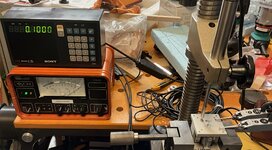
I recently picked up a Sony (Magnescale) type of digital indicator as it was cheap and had a nice looking stand. When it arrived it was twice as big as I had imagined, one of the risks of buying old stuff through pictures without a scale of reference.

Sony probe 1.jpegSony probe 2.jpeg

Despite the size, it was in good shape, with an expansive and pristine ceramic surface plate. It has 50mm of travel, but using the magnetic scale technology is limited to ½ a micron like my analogue Mahr and optical scale Mitutoyo. A fantastic deal, but when chasing zeros one must keep delving deeper.

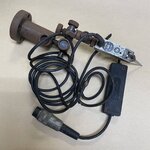
A few weeks ago I picked up a Tesa (also marketed under Browne and Sharp) indicator probe that was sold for the cost of postage, about $3. The seller didn't know what it was, or if it worked, but wanted it to be used as it was their grandfathers. Without the electronics it is useless, so I started looking for a suitable meter, settling on a nicer one than I wanted to risk buying in support of an unknown probe, but that's the way things tend to snowball with me. Buying something I don't really need 'ultra cheap' somehow justifies spending more to get it working or accessorized.

Tesa_Meter1.jpeg

Fortunately it all works. This Tesa system is able to resolve tenths of a micron or more, and with two probes is able to combine their inputs to pull off some very tricky measurements that are otherwise quite difficult.

Tesa_Probe1.jpegTesa_set.jpeg

The unit is the most lovely hammertone orange finish. And I found another cheap probe, but it looks like complete junk and will require a miracle rescue to have any hope of working, and I'll likely have to spend big money to get a working second probe. There's a cautionary tale somewhere in this story, but I'm enjoying my new toys too much to identify it.
 
OP
B

Bakafish

Well-known member
Joined
Feb 7, 2017
Messages
477
Location
Tokyo
I've posted several times about the specialized swiss Biax power scrapers and flakers, and how elusive they are over here. I basically check all my regular auction/used tool sites for them on a daily basis, and have managed to pick up several at pretty discounted prices, although a lot of cleanup and servicing was required on some of them due to age and neglect.

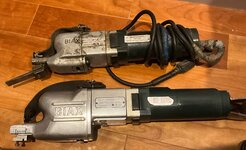
Recently there was a really clapped out looking unit at auction, and I took a chance on it as they are really quite valuable if they work, and probably could be parted out if it was a real basket case. This is how the unit was offered:

Biax BL10 Auction.jpeg

Not super promising, but this is a BL-10 model, a smaller and lighter unit than the BL40's that I have. I camped the auction and bid against a few rivals, but managed to win it for about $350 which is pretty cheap even despite the rough appearance. This is how it showed up, and the size in comparison to the larger BL40/HM2 frame.

Biax BL10.jpeg

It had a crudely made blade and ridiculously spliced power cord, but after a careful clean and disassembly, the extremely well built machine internally looked really good. I replaced the power cable, removed the badly leaking radio filtering capacitor (I don't bother replacing these as radio interference really isn't much of a thing anymore.) The motor brushes were only lightly worn, pretty clear that most of the hours of this unit were banging around in some filthy drawer or box, not actual usage. All the bearings felt good and were quiet. The nasty factory grease was replaced with fresh lithium soap and molybdenum stuff, and while I had it open I pulled out a few plastic parts to reverse model in Fusion 360 as someone was hoping to replace them on one of his units and could use the models I made to 3D print.

Biax BL10 worn plates.jpeg Biax BL10 lapped plates.jpeg

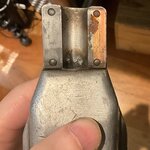
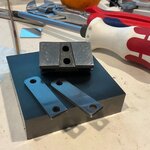
One of the critical areas for these power scrapers is the shoe and wear plates, as contamination, misadjustment or lack of lubrication will cause heavy wear with these hard to replace parts. There was a small area of corrosion and pitting on one of the plates and similar damage on the side of the shoe that rode against it. Fortunately it wasn't deep, and the very minimal wear on the shoe once again indicated to me that this wasn't really used much. I carefully lapped all of them flat, using ascending grits of sandpaper and lapping films backed by a block of tungsten carbide I use as a little toolmakers plate. I then made shims that fit underneath the plates until the gap between them and the shoe was the factory indicated 0.02mm, quite a tight fit.

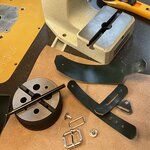
All the parts were degreased, cleaned and reassembled. The leather hand strap was beyond saving, having worn through in several places and with badly corroded hardware. So yesterday I went to the historic leatherworking district in Tokyo, Asakusabashi where I found all the punches, rivets, leather and hardware required to make my best effort at a replacement. I got several different scraps of leather in the original brown, but couldn't help myself and chose to color match the body with a non-standard green.

Biax Strap.jpeg Biax BL10 clean 2.jpeg

Overall it cleaned up nicely I think, and runs well. I will continue to try and get more of these tools if they show up cheaply enough, but will start thinking about moving some of them to new homes as the redundancy gets out of hand.
 

RickP

Well-known member
Joined
Jan 15, 2013
Messages
1,547
Location
Annapolis, MD
After your cleaning and repair work, that Bias power scraper looks like it just left the factory! (better, actually, with the color-matched hand strap) Your selection of metrology equipment continues to amaze me.
 
OP
B

Bakafish

Well-known member
Joined
Feb 7, 2017
Messages
477
Location
Tokyo
After your cleaning and repair work, that Bias power scraper looks like it just left the factory! Your selection of metrology equipment continues to amaze me.
Thank you. I actually don't do a real restoration though, it still looks pretty rough. I could have the aluminum casings bead blasted and sand all the scuffs, stains and scratches out of the plastics, but I like the look and character of a well used tool. As long as it's safe, clean and properly lubricated I'm happy.
 
OP
B

Bakafish

Well-known member
Joined
Feb 7, 2017
Messages
477
Location
Tokyo
You said $350 is cheap … what do you think the true market value is?
A new BL-10 is about $4000 in the US, and about $6000 here in Japan. The new ones use a slightly different motor and hypoid gear and can be identified by using a black body, rather than the dark green Metabo sourced motor used by the units I have. There are some people who prefer the older motors, and say they have more power. I've never had a black body unit, I suspect they are similar, I certainly wouldn't pass on one at the right price. Many of the mechanical parts are interchangeable across the generations (there are even older blue body and white body generations, I wouldn't pay a lot for those as the age and parts and design make them risky, but many people are still using them out there) but the Metabo motor parts are really hard to find as they stopped production long ago. The result of this is the old tools that Metabo made that used the same motor are valued very high as replacement parts for broken Biax scrapers. You can see old jigsaws sold for $300-500 because they have good 'Biax' motors or speed control circuits :cool:

Having said all that, the actual value of a used machine is what the market will bear, and obviously the market over here is different than over there (although I'm not so stupid that I would sell my scrapers at the sub-market prices here in Japan.) $350 felt risky to me based on the picture, which showed obvious neglect and potentially a non-repairable unit. But the potential upside was a fully working machine, and worst case any good parts could cover the cost I paid. Selling a BL-10 or BL-40 in good condition (and I think this one is a 4 out of 5, mechanically and functionally quite good, very low wear, lots of scratches and discoloration though and non-stock leather handle) is about half of a new one. It didn't have any blades, and it didn't come with the distinctive steel box. Figure about $2000, although at auction it could go for more, again the new unit that is functionally identical (but with a warranty and presumably more replacement parts available [at similar crazy prices]) is twice that price. I have an essentially new BL-40 in the original case, with blades and original tools that I suspect I could get $3000 for on a good day, but I didn't buy these for speculation purposes.

The bottom line is I think if this had been sold the same way at a US/EU auction, despite the poor condition in the pictures, it would have gone for closer to $1000, which was why I was saying $350 seemed reasonable. I could be full of it though as I don't participate in those markets. A quick visit to eBay could give you a good ballpark of the value though.

I'll bet a couple grand. I think they're out of production.
Still in production and sold in the US by DARPA, but in a slightly revised form as the motor supplier changed (as documented above.)
 
OP
B

Bakafish

Well-known member
Joined
Feb 7, 2017
Messages
477
Location
Tokyo
Their website is not regularly updated. Mr. King is semi-retired although he still runs a few teaching sessions per year. The Practical Machinist Machine Reconditioning, Scraping and Inspection forum is where you can find dates and contact information, and many people find the lessons helpful. He also sells a DVD/USB Stick training video (that I have not seen, but people seem to like it.)

Having said all that, there is more than enough information out there to learn best practices if you have the time and desire to look for it. Having the knowledge doesn't always mean you have the ability to communicate it, and I've found that people like Stefan Gotteswinter and Robin Renzetti are both incredibly good at providing clear instruction of the process via YouTube.

Like anything, practice and careful analysis of your work is always required for success. But a lot of people have achieved very good results with simple hand tools, and all the mystique and dogma around it should be couched by the fact that it's a process that was perfected in the earliest days of the machine age. It's a dying art that I believe needs to be perpetuated, but some people can get very wrapped up in it, and at the end of the day it's just scratching a piece of metal.
 

Old tool guy

Well-known member
Joined
Apr 13, 2023
Messages
3,157
Slight thread drift. I happened upon this youtube video, found it to be very informative and fascinating. The author is quick to point out that it was gross overkill.
 
OP
B

Bakafish

Well-known member
Joined
Feb 7, 2017
Messages
477
Location
Tokyo
Slight thread drift. I happened upon this youtube video, found it to be very informative and fascinating. The author is quick to point out that it was gross overkill.
Yeah, we had some discussion on Discord when this came out. Seems like a legit usage of scraping, and should actually reduce friction without wax. The scraping (quality?) itself wasn't to everyone's liking, but that's mostly an aesthetic call, and everyone has their opinions. As long as it's flat...
 

Old tool guy

Well-known member
Joined
Apr 13, 2023
Messages
3,157
Thanks for linking the videos, i watched the first two. Fascinating machine. I learned that the inventor started in the 1930’s and finished the design in Buchenwald concentration camp.
 

Luntz

Well-known member
Joined
Jul 13, 2020
Messages
212
Location
Franklin TN
Just what I need, another fascinating mechanical numerical rabbit hole to dive into. I'll need a Scuba tank for this one.
Great thread, mind boggling at times. So interesting to hear about the cultural everyday differences.
Keep on keepin' on!
 
OP
B

Bakafish

Well-known member
Joined
Feb 7, 2017
Messages
477
Location
Tokyo
Prior to convincing myself to buy the new (but heavily discounted) Tesa lever probe, I found a very damaged unit at auction very cheap. From the pictures it was clearly a basket case, I honestly thought it was only going to be useful to post an autopsy here about how they actually work.

Bad Probe 1.jpgcorroded tesa probe.jpegcorroded tesa probe 3.jpeg

It arrived in even worse shape as most of the cable insulation was falling off, it had extensive corrosion that had penetrated the thick nickel plating and the silicon carbide ball at the probe lever tip was missing. The damage seemed to me to be exposure to acid fumes, which as bad as it looked actually was better than this level of corrosion from long exposure to liquids. I did some electrical sanity testing with a bench multimeter and there wasn't any internal shorts and it seemed safe enough to plug into the Tesa meter to see if it was responsive to movement, and I was pleasantly surprised when it moved the needle.

From there I did a deep clean, carefully abrading and scraping as much rust off of the body as I could. Replacing the cable wasn't an option as it is part of the probe calibration and using a slightly different length or type of cable would change the behavior of the unit, and I had no way to calibrate it. So it was necessary to to re-sleeve the cable, and that meant desoldering the inline compensation module and carefully peeling off all the old cladding. I ordered a roll of flexible Polyolefin shrink tubing, a 2mm precision ruby ball and some Loctite gel cyanoacetate from Amazon which showed up the next morning.

Tesa lever IG.jpegTesa lever 2 IG.jpeg

Gluing the tiny ruby to the probe tip was stressful, but helped by the recess provided where the original carbide ball sat. My desk isn't level (I've been too lazy to adjust the legs) so I used a little Obishi-Keiki bubble level to get a vise properly positioned, then with a tiny drop of CA I mounted the ruby to the lever. While I waited for that to cure I cleaned the exposed copper shielding of the flayed cable of oxidation and carefully threaded it into the shrink tubing and applied heat with a heat gun.

I resoldered the calibration board back in and replaced the rusted screws that held the plastic enclosure together and reassembled the lever onto the probe head. The cleaning and manipulation had the lever at least feeling like it was working, but there is a very easy way to test if it actually was accurate.

corroded tesa probe 2 wide.jpeg

I mentioned that the Tesa controller has two inputs and that these can be used for doing more advanced measurements. One way it can be used is to combine the readings of both probes*, but you can also change the probe polarity independently, so I configured it so similar movement would cancel each other out. If the new, known good probe and ol' corrody both recorded the same measurement in this setup, the sum of the differential settings would be zero and the needle wouldn't move as the pair moved together.

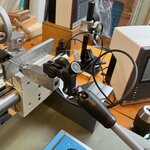
Tessa Differential 2.jpegTessa Differential.jpeg

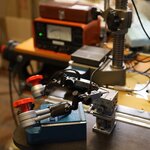
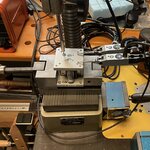
The two probes are positioned here on a little stage that has a Z axis that allows me to raise and lower the surface they are touching. The two probes are first zeroed out independently using the adjusters on the Nikken indicator stands and the fine adjust on the meter, then they are set to opposite polarity and the Z tage raised and lowered. Because this was a quick and dirty setup, (and to be honest I wanted a win after all the work) I only tested at the lowest resolution, but the needle didn't waver. So initially it looks like a successful rescue.


*This is useful if, for example, you were trying to measure the thickness variation of something. Think about trying to get the accurate measurement of the thickness of a rod along its length to check the taper or roundness. If you used a single probe and placed the rod on a flat surface or some V-blocks you could get a measurement of one side, but that's not necessarily telling you the true thickness at that point as the opposite side may not be in contact with the reference surface at all. If the rod was bent like a banana, when you made readings in the middle, depending on its orientation (and if it was held between centers, in v-blocks, the angle of the V of the blocks or if it was resting on a flat surface) you would get all kinds of different readings. It might be perfectly round in cross section, but the bend would lead you to believe it wasn't and the exact source of the error may be hard to determine. But if you use two sensors on opposite sides, this sort of bend will just add displacement to one probe but simultaneously subtract the same amount from the other side and all you are left with is a reading of the thickness variation itself. The bend is canceled out of the measurement so you can read just the thickness at that point, and by rotating it, the roundness at that position. The curve may or may not be important, but you can measure it much more accurately if you know the rod is round and not shaped like a snake eating an elephant :) While this is a simplistic example, there are certain kinds of errors that just can't be easily seen with a single probe, that easily jump out with this kind of differential probing, and I hope to have some 'real world' applications I can show at some point.
 
To avoid these ads, REGISTER NOW!

RickP

Well-known member
Joined
Jan 15, 2013
Messages
1,547
Location
Annapolis, MD
Nice save of the corroded probe!

Your tool repair skills are incredible. If you ever move back to California (not), you should open a Tool Rescue shop. ;-)
 
OP
B

Bakafish

Well-known member
Joined
Feb 7, 2017
Messages
477
Location
Tokyo
Nice save of the corroded probe!

Your tool repair skills are incredible. If you ever move back to California (not), you should open a Tool Rescue shop. ;-)
Well it wasn't much of a repair, more of a mild patch up. If I had a disassembly guide or less common sense I would have taken it completely apart, sanded off the rust, and painted or replated the body, etc... I will try to do more tests this weekend to see if I can actually depend on the thing for any accuracy. I've always loved fixing things, but as I've gotten older, I've come to the realization that this recent compulsion is me of trying to restore value and meaning to things that are nearing (or long past) the end of their usefulness, just as I am.

As far as moving back, I have the papers here in an envelope to send to my parents handing over the deed to my little Alameda cottage. I really loved it over there, but life outside the US changes your perspective and coming home distills the differences for me more clearly every time. Every subsequent visit was more stressful and fraught, I just don't feel safe there at all, and the things you never noticed or were inured to, assault your senses and constantly vie for your attention. My wife, having lived her life here in Japan, is unaware of these things for completely different reasons, coming at them from the other direction so to speak. Whereas I over time learned to ignore them, she never learned to recognize them in the first place.

So I'm pretty sure I won't return home to CA again. It's too far, too stressful, too dangerous and I've grown distant from the people and things that once kept me there. I'll miss the burritos though.
 

LeonardY

Well-known member
Joined
Apr 16, 2011
Messages
5,020
Location
Southern California
Well it wasn't much of a repair, more of a mild patch up. If I had a disassembly guide or less common sense I would have taken it completely apart, sanded off the rust, and painted or replated the body, etc... I will try to do more tests this weekend to see if I can actually depend on the thing for any accuracy. I've always loved fixing things, but as I've gotten older, I've come to the realization that this recent compulsion is me of trying to restore value and meaning to things that are nearing (or long past) the end of their usefulness, just as I am.

As far as moving back, I have the papers here in an envelope to send to my parents handing over the deed to my little Alameda cottage. I really loved it over there, but life outside the US changes your perspective and coming home distills the differences for me more clearly every time. Every subsequent visit was more stressful and fraught, I just don't feel safe there at all, and the things you never noticed or were inured to, assault your senses and constantly vie for your attention. My wife, having lived her life here in Japan, is unaware of these things for completely different reasons, coming at them from the other direction so to speak. Whereas I over time learned to ignore them, she never learned to recognize them in the first place.

So I'm pretty sure I won't return home to CA again. It's too far, too stressful, too dangerous and I've grown distant from the people and things that once kept me there. I'll miss the burritos though.
I completely understand. When I relocated to Japan, i was told my transition back to the United States would be much more difficult than the transition to Japan.
It wasn't just me but pretty much the entire team that had moved there. A lot of my coworker's kids had a really difficult time. It seemed to be the hardest on the ones that were middle and high school aged ones.

I'll miss the burritos though.

We had a tortilla suitcase that traveled back and forth between the CA and Tokyo. Whenever someone was traveling back, it would return with them and come back full of tortillas.
 
OP
B

Bakafish

Well-known member
Joined
Feb 7, 2017
Messages
477
Location
Tokyo
Quick follow up for anyone who wanted to know if the corroded probe is still usable. I finally did a little more stable setup to compare the two probes at high resolution.

Probe_check_1.jpeg

I used a small grinding vise to hold the Z stage so it wouldn't wiggle around so much when I adjusted the micrometer head. I also used my Sony as a sanity check since if the two probes agree in this setup the needle doesn't move, so it's nice to be able to have some feedback when I'm adjusting up or down.

Probe_check_2.jpeg

In this photo I'm making sure the two systems agree in a 0.1mm, (100µm (micons)) displacement. At the higher sensitivity settings the needle gives so much better feedback to movement than the digital one, which jumps in .0005 steps. At the highest setting, the full sweep of the needle is a mere ±3µm but the analogue nature of it is super smooth and granular even at that sensitivity. It was so sensitive it was picking up the sounds/vibrations from the episode of The Flophouse I was listening to, it's really an amazing bit of kit.
 
OP
B

Bakafish

Well-known member
Joined
Feb 7, 2017
Messages
477
Location
Tokyo
I've been on an extensive goose chase trying to leverage my Autocollimator and accessories to validate and calibrate several of my items. I buy almost everything used, and so even when I'm lucky enough to get the factory paperwork, there's no telling if things have changed due to wear or corrosion. Professional shops revalidate their metrological gear regularly, there are companies dedicated to doing that, but obviously that's not a cost that would make much sense in my case (likely exceeding the price I paid for the item itself.)

This is one of the reasons I'm so fond of ceramic and granite gear, the hardness prevents a lot of the wear issues and they don't rust either. There are downsides as they can chip or break easier, but if properly handled and cared for they will stay in tolerance indefinitely.

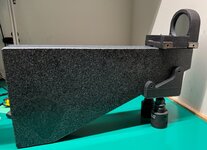
One of my prized tools is an optical square, which is made of special glass and again is ridiculously stable, and so I wanted to check the big granite Mitutoyo square I have, and so I needed to do some gymnastics to actually do that, as the optical square requires a mirror sled placed on the measured surface, and although the big Nikon sled has a powerful switchable magnet, granite isn't very magnetic (at all.)

So I 3D printed a retainer to hold the expensive mirror precariously over the even more expensive square and tool a baseline reading. The idea being you first zero the mirror and AC on the base surface (my granite surface plate, one of the few new items I have as I wanted a known baseline.) Then the mirror is moved to the square's perpendicular face, and the deviation is noted. The difference is the angular error of the optical square (2 arc seconds or less) and the square itself at the position of the mirror. As flat as that face was intended to be, there's always the chance that the deviation seen is local to that specific location, so making measurements along the entire face (like the straight edge checks I've shown previously) is required. But as that would be difficult due to the lack of a magnetic bond, I let gravity assist the measurement by reorienting the square on its back on a 3D printed stand. This allowed it to be leveled (not required, but makes things easier) and the mirror to just be slid from position to position.

Mitutoyo Square Baseline.jpegMitutoyo Square angle.jpeg

Mitutoyo Square flatness.jpeg

You will note that some of this was taking place on a rubber mat and this messed up my numbers more than I had hoped, the repeatability was poor and it was clear that stuff was moving, but the basic mechanics of the method seems viable. I will revisit it and relocate everything to the workbench which is far far sturdier.

What was clear was that I had a whole lot of potentially good squares, the pair of ceramic Toto's, the granite Mitutoyo squares, the precision ground JAM angle plates and the pair of Obishi-Keiki cylindrical squares. Most of which either had no validating documentation, or had age/wear to call them into question. I was hoping the big Mitutoyo would be 'the standard' but the numbers I was seeing weren't good enough, and even if they were perfect, I still couldn't really trust them as just because the numbers agree with you expectations, it doesn't make them correct.

If there's an ancient god of measurement, he looked down upon my plight, and through one of his minions [Yahous Auctionaris], offered me something special.

OK Stone Cylinder Square Close.jpegOK Stone Cylinder Square.jpeg

This is a special 'Black Gabbro' granite cylindrical square made by our friends at Obishi-Keiki. It is in like-new condition and included the factory calibration papers. While not up to the highest possible accuracy of an ultra precision standard which is certified to 1 micron, this one is made to be 3 microns or less from square at any point.

Using a round shape to make a square may seem like a really odd thing to do, but there is a good reason for it. By grinding a very cylindrical surface, something relatively easy to do thanks to turning, this shape takes advantage of a self-proving quality. The surface touching the reference plane {bottom and in some cases the top as well) is the hard part to make, it is 'side' ground at the same time the cylindrical surface is done, but any error on this part will lead to the cylinder to lean just a little bit, throwing off the squareness. But not everywhere, that's its trick! A plane intersecting a cylinder at any angle will still have two opposing points (lines actually) that are perfectly perpendicular to the surface. Finding those points with a basic squareness comparator is trivial, as it will give the same exact reading on opposite sides. So even if they get the tricky bottom wrong (and the best ones don't, but there's still dust and other reasons why it can drift) you can find a self proving point that is very square and can be used to check other tools.

I have a lot more on this, new tools to introduce and experiments I need to do, but thought I'd drop this here as it's been a while. Feel free to ask if I didn't explain anything clearly enough.
 
Last edited:
OP
B

Bakafish

Well-known member
Joined
Feb 7, 2017
Messages
477
Location
Tokyo
So just closing the loop on the whole calibration adventure. (I know you all have been on tenterhooks! :p) The main item I was trying to get aligned is this Mahr Rectamar squareness gauge. It is made from a cast iron outer column which sits on three lapped carbide feet, inside it is a precision rod about 30mm in diameter with two opposing bearing races along its length. It is mounted at the bottom with a ball joint allowing it to pivot freely around that point, and at the top it has two perpendicular slots machined into it where eccentric bolts constrain the rotation, front-and-back and side-to-side tilt.

Mahr_Rectimar.jpeg

A large aluminum carriage rides on this shaft, and uses two sets of recirculating bearings under a great deal of preload to locate it on the opposed races ground into the rod. A pair of long springs help counter the weight of the carriage (and any indicator attached) and a clever little lock screw on the side allows you to stop the carriage at any point of its travel, and has an internal clutch concealed in the thumbwheel to prevent overtightening. The idea behind this kind of tool is that once the internal shaft is aligned to be square to the surface, it is able to sweep an object and show how out of square the surface might be. The internal rod and ball bearing carriage are designed to very tight tolerances, they claim less than 3 microns deviation across the roughly 250mm of travel, but my testing shows it is much less than that.

TOTO Sanity Check 2.jpeg

So this all started because initial sanity checking of the tool showed it was ~30 microns out of square compared to the various squares I had on hand, but none of my menagerie were currently certified to be square. This is a case where having more squares, even if they agree, doesn't actually help. I strongly suspected that the Toto ceramic squares were accurate, they checked against each other and 'nested' together which is a form of self proof, but I always would have some doubts if I used them as a standard without more evidence that they were true. The cylindrical squares are self-proving and included their factory reports, but the corrosion damage was enough to not want to trust them as my true reference. The granite cylinder square had enough documentation, and condition for me to satisfy my incredulous nature and just accept it as square (well, the most accurate side based on the report anyway.)

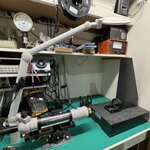
As I mentioned before, my original plan was to use the optical square. You can see the mirror glued to the detachable arm in the photo above. The idea being I could zero the arm out on the surface plate, relocate it to the carriage, and then using the optical square just adjust it to zero.

carriage.jpegMirror mounted.jpegMeasuring with Optical Square.jpeg

The problem was, I had assumed the shiny surface above was a reference surface, parallel with the inner rod and the motion of travel. This was a mistaken assumption, it was not, and the readings I got from it made this obvious as it was more than 13 arc-minutes from square. Now in Mahr's defense, the way this tool works is to sweep a surface with an indicator, which is a single point contact. The angle of this surface and it's parallelism to the travel has zero effect on the measurement. So to use this method, I had to first measure the error of this surface in relation to the travel, and the only way to do that effectively was to remove the sliding assembly from the body, place it on a pair of reference V-blocks or parallels. Sweep the ground surfaces of the ball bearing raceway to make sure it was parallel to the plate, then using the carriage travel itself, to sweep the shiny surface (using a parallel to ease access) and determine the angle of it in respect to the rod.

Mahr Square sweeping the carriage.jpegOK_AA_Vblocks1.jpeg

I'm gratuitously using my pair of Obishi-Keiki carbide faced AA grade V-blocks that I recently won at auction for a pittance, these babies sell for more than $10,000 new (I mean they include a nice box, but my lord!) And I was able to confirm the error of that surface was exactly in the ballpark of my expectation, 12' 39.37674" (the 30 microns of error I had expected to see in the first measurements would have been a few arc-seconds not the 13 minutes I had seen.)

Mahr Rectamar calib.jpeg

This is the final calibration showing the deviation of the sweep from bottom to top of 0.7µ, the total deviation of the entire sweep was under a micron, so I'm really happy with it. I locked the adjustable eccentrics with the lock screws, removed the mirror and boxed it safely for future use (I've got a lot of squares I need to check on some rainy day.)
 
Last edited:

gba2331

Well-known member
Joined
Sep 22, 2021
Messages
759
So exactly what are these instruments used for? I can imagine optical applications (eg cameras) but are there others?
 
OP
B

Bakafish

Well-known member
Joined
Feb 7, 2017
Messages
477
Location
Tokyo
So exactly what are these instruments used for? I can imagine optical applications (eg cameras) but are there others?
Metrology equipment is used extensively in manufacturing, engineering and scientific fields. Beyond the basic appeal to me, most of my equipment was bought with machine building and restoration in mind. CNC machines can achieve incredible amounts of precision, but in order to do so they must be similarly constructed and maintained. One misaligned axis can result in ruined parts, and lost money. It is surprisingly hard to identify the root cause of such issues, and to be able to fix them, and know they are fixed.

So things like Autocollimators can validate and measure that a linear guide rail is both straight and flat, and adding an optical square provides the ability to measure perpendicularity with the other axis. The cylindrical square and Mahr Rectimar are both used to validate that parts are properly manufactured (important if they are custom made or used and possibly damaged.) So someone like me, who hopes to be able to build my own machine, needs to not only design the parts in CAD and buy surplus items on the second hand market, I also have to measure everything, confirm the geometry, and resolve discrepancies.

You were vague about the equipment you were questioning , I've showed other unusual things like the Biax power scraper, which is designed to correct surfaces with micron accuracy, a very critical job as I'm repurposing old cast iron parts for my projects. Again, the metrological equipment guides these corrective processes, as it is critical to be able to know when you've achieved the flatness or geometry required.

H&W AutoC Cleaned 2.jpegH&W AutoC Close 2.jpeg

Speaking of Autocollimators, I picked up another one, admittedly not out of any real need for it, but it was cheap and looked like it needed some attention after years of neglect on some sun baked laboratory shelf. It cleaned up well and is fully functional and pretty darned accurate. I will make a few minor repairs and replacements, but I was already able to validate its operation, again using the tools I've accrued over time.
 
OP
B

Bakafish

Well-known member
Joined
Feb 7, 2017
Messages
477
Location
Tokyo
I've aggregated the parts to build a small gantry type CNC machine. I've mentioned it over the years in previous posts, it's an ongoing work in progress in my head. Hopefully I get to it before too long.
 

Sherk

Active member
Joined
Jun 18, 2016
Messages
43
Location
Southwest MI
@Bakafish Any progress reports to make? I have been reading the entire thread over the past week or so after having seen a post about the Festool LR 32 Makita mods. I have a Milwaukee router that I want to get working with a Festool FS32 which is what I originally searched for.

I'm also interested in your progress on your Japanese home and anything you make in your shop.
 

zanyad

ALLIANCE MEMBER
Joined
Apr 26, 2018
Messages
2,755
Location
NE Ohio
I, too, miss your posts. Gave you a follow on Insta.

Happy New Year!


nicholam77

Well-known member
Joined
Dec 18, 2016
Messages
2,655
Location
Minneapolis, MN
I have been reading the entire thread over the past week or so after having seen a post about the Festool LR 32 Makita mods. I have a Milwaukee router that I want to get working with a Festool FS32 which is what I originally searched for.

Which Makita router? If you want to use the Festool system, the most cost-effective route is to get a Festool holey rail, and the base LR-32 kit that comes with the router base + end rail stops. The parallel guides that come with the full systainer kit are not 100% necessary can be worked around in a variety of ways. There are quite a few 3d printed adapters for various routers to fit the LR32 baseplate these days. Smaller plunge router works best, but I successfully got my DeWalt 618 to fit with a custom 3d printed adapter plate I made.

There are other 3d printed baseplate options that don't use the Festool LR32 plate, but still rely on a spring pin system to index the holes, but if you really want to use the 32mm system I would just go for the Festool one, otherwise you're going to struggle with tolerances most likely.

Even with your own router and the minimum kit, it's not cheap.

Another much cheaper router-based option is this homemade one from Dan Pattison. I made it and it worked pretty well and allowed use of a router, but in the end I wanted the real thing.

There's a few others out there but I know you said you wanted to use the LR32 so I'll leave it at that!
 
OP
B

Bakafish

Well-known member
Joined
Feb 7, 2017
Messages
477
Location
Tokyo
This seems the right place to post about this. Some of you may know about Tuksedo Studio from the excellent video posted by Hagerty or on Instagram.

Exterior.jpeg

In the middle of nowhere, in the heart of Bali Indonesia, a boutique coachbuilder has a team of hands on trained employees making the most authentic appearance reproductions of the elite of classic cars. Made from hand formed aluminum panels over Chrome-Moly tube frames and modern crate motors and brakes, these cars are fanatically reproduced to be authentic looking down to the smallest buttons and knobs.

Currently they have bucks for the Porsche 356 Speedster, Coup and the 550A Spyder. The Mercedes 300SL "Gullwing." Aston Martin DB5. And they even make their version of the rare Toyota 2000GT!

Speedster Exterior.jpeg2000GT.jpeg
MB Exterior.jpeg

One of the wonderful things is how much training they do and leveraging of local talent. We dropped in unannounced and were welcomed graciously, the entire staff was there as they were preparing for a party celebrating the return after a local holliday. We were surprised that there was a luxurious Cafe on site, we had wonderful Cappuccinos and then were escorted by a knowledgeable guide and had full access to all areas of the shop.

MB profile.jpegMB Parts.jpegMB Dash.jpeg

They let my wife sit in several of the cars for photos, which made her very happy. The interiors were just as meticulous as the outsides.

MB Interior.jpeg
2000GT Interior.jpeg
Speedster Interior.jpeg

Anyway, if you are ever in Bali I'd highly recommend a visit. Taxis are cheap over there and it's worth the drive (and it's not far out of the way from the Ubud region that has lots of interesting activities, and the cafe is nice enough to park the Wife if she's not keen.)
 
To avoid these ads, REGISTER NOW!
Top Bottom