All this talk of rust and cars is why I now have a 150k mile cutoff for how long I'll keep a vehicle. I'm okay doing the first round of maintenance items (suspension, hubs, etc) you often see around the 75-100k mile mark. While you may run into a few issues with frozen hardware, it usually isn't terrible. Add in another 5+ seasons of driving on calcium chloride caked midwest roads and the second time around is exponentially worse. I've nursed a few vehicles out to 180-190k, but it was not fun. I would love nothing more than to just buy a vehicle and know that I'm going to be able to drive it for as long as I keep up with the maintenance, or get bored with it.

You are using an out of date browser. It may not display this or other websites correctly.
You should upgrade or use an alternative browser.
You should upgrade or use an alternative browser.
Between 485 & 705 SQ/FT Tom's Neighborhood Workshop
- Thread starter wreckdiver1321
- Start date
Workspaces between 485 and 705 squarefeet.
OP
wreckdiver1321
Well-known member
That's not a bad policy Brad, especially given your locale.All this talk of rust and cars is why I now have a 150k mile cutoff for how long I'll keep a vehicle. I'm okay doing the first round of maintenance items (suspension, hubs, etc) you often see around the 75-100k mile mark. While you may run into a few issues with frozen hardware, it usually isn't terrible. Add in another 5+ seasons of driving on calcium chloride caked midwest roads and the second time around is exponentially worse. I've nursed a few vehicles out to 180-190k, but it was not fun. I would love nothing more than to just buy a vehicle and know that I'm going to be able to drive it for as long as I keep up with the maintenance, or get bored with it.
In my case, Montana is a pretty rust-less state, and I'm pretty committed to the offroad/overland builds I do. Since the 4x4 rigs I like tend to be extremely reliable, I'm okay being with them for the long haul, plus the amount of work and modification I put into them means I'll likely never get all my money back out of them. I don't mind doing a lot of that maintenance and repair myself. Sandy's rust is challenging me, but whether I sell it or keep it I will be driving a Land Cruiser regardless. Their longevity is unbelievable. I know of several 500k+ trucks driving around.
But then, I'm a little nuts.
But then, I'm a little nuts.
Me too. That's probably why we get along.
gearhead1960
ALLIANCE MEMBER
I would consider all of us "gearheads" in some shape or form because we love our vehicles no matter the form, condition or use. I don't have to deal with rust, but love to do stuff to my "Mini Clubman ALL4". I just flashed the computer from 200hp to 300hp. Is it practicle or efficient? Only if I keep my foot out of it, but that's what makes it a blast to drive. We're all a little nutz....
OP
wreckdiver1321
Well-known member
Excellent point Mark. We all like, or at least can appreciate, that sort of thing here. I really enjoy all car stuff, from my Land Cruiser to my wife's Crosstrek. I'd really like to get into more fun cars like that Mini, but for right now I'm more focused on the 4x4 and daily driver world. I'd love my daily to be something more interesting than my Subaru: Volvo V70 or XC90, VW Golf GTI, Mini Cooper, etc. My pipe dream car would be something like a Lancia Delta Integrale or a Ford ****** RS Cosworth.I would consider all of us "gearheads" in some shape or form because we love our vehicles no matter the form, condition or use. I don't have to deal with rust, but love to do stuff to my "Mini Clubman ALL4". I just flashed the computer from 200hp to 300hp. Is it practicle or efficient? Only if I keep my foot out of it, but that's what makes it a blast to drive. We're all a little nutz....
But then I also would love a Series II Land Rover. My taste in cars is strange...
gearhead1960
ALLIANCE MEMBER
Taste is all relative. I learned how to drive on a 1972 Audi 100LS. My dad drove Audis and BMWs before they were status cars. I would love nothing more than to find an old one and do a suspension and engine swap with a more modern "wrecked" donor car. One of a thousand projects I have stored in my head. I could go on for days....Excellent point Mark. We all like, or at least can appreciate, that sort of thing here. I really enjoy all car stuff, from my Land Cruiser to my wife's Crosstrek. I'd really like to get into more fun cars like that Mini, but for right now I'm more focused on the 4x4 and daily driver world. I'd love my daily to be something more interesting than my Subaru: Volvo V70 or XC90, VW Golf GTI, Mini Cooper, etc. My pipe dream car would be something like a Lancia Delta Integrale or a Ford ****** RS Cosworth.
But then I also would love a Series II Land Rover. My taste in cars is strange...
 Oh, and I would swap the Integrale and Land Rover for a Stratos and a Rover P6....
I don't have to deal with rust, but love to do stuff to my "Mini Clubman ALL4". I just flashed the computer from 200hp to 300hp. Is it practicle or efficient? Only if I keep my foot out of it, but that's what makes it a blast to drive. We're all a little nutz....
300hp????? Talk about a sleeper car!
gearhead1960
ALLIANCE MEMBER
I was pleasantly surprised how quick this car now obtains lock me up speeds....300hp????? Talk about a sleeper car!
I bet! That's like a perfect big city car too...plenty zippy for in and out of traffic while being easy to park and still able to carry some stuffI was pleasantly surprised how quick this car now obtains lock me up speeds....
Don't tell @XJSuperman...he might need to look into this as a salve for his recent mini related headaches!
gearhead1960
ALLIANCE MEMBER
Love to hear....link?I bet! That's like a perfect big city car too...plenty zippy for in and out of traffic while being easy to park and still able to carry some stuff
Don't tell @XJSuperman...he might need to look into this as a salve for his recent mini related headaches!
Love to hear....link?
He's documented some of his recent issues in his thread, think the Mini related woes started back on a Xmas/New Years trip
https://www.garagejournal.com/forum...arage-the-projects-inside.468403/post-9554694
XJSuperman
Well-known member
You rang? lol.
300hp in a Mini would be awesome. After I break mine again there are garage rumors of an engine swap. I've got offroad stuff, maybe i need a "racecar".
Yes my Mini is getting tired. And Im tired of taking it to the shop. But after the life I've given it, at 214,000 miles, I can't say Im surprised.
Gearhead, you'll have to dig through the toyota and gmc stuff to find the Mini updates.
300hp in a Mini would be awesome. After I break mine again there are garage rumors of an engine swap. I've got offroad stuff, maybe i need a "racecar".
Yes my Mini is getting tired. And Im tired of taking it to the shop. But after the life I've given it, at 214,000 miles, I can't say Im surprised.
Gearhead, you'll have to dig through the toyota and gmc stuff to find the Mini updates.
jbrentd
Well-known member
I can relate to the highlighted section of the quote above. In the middle of all that now. The biggest PITA is when you have to go hunting on eBay.de to find some part from Europe. The wife and I are taking a road trip next month to NC to pick up a windshield that came in from Finland with about 6 other from a group purchase.Taste is all relative. I learned how to drive on a 1972 Audi 100LS. My dad drove Audis and BMWs before they were status cars. I would love nothing more than to find an old one and do a suspension and engine swap with a more modern "wrecked" donor car. One of a thousand projects I have stored in my head. I could go on for days....
OP
wreckdiver1321
Well-known member
See, I started out my gearhead life in high school when my dad bought me a 1990 Suburban. Perfect camping rig, and I tried off-roading it a bunch. It wasn't too bad but I broke it a lot. I went through another squarebody Chevy 4x4 before I pulled my head out and started buying more practical and reliable stuff, so of course I bought a 2001 Land Rover Discovery II.Taste is all relative. I learned how to drive on a 1972 Audi 100LS. My dad drove Audis and BMWs before they were status cars. I would love nothing more than to find an old one and do a suspension and engine swap with a more modern "wrecked" donor car. One of a thousand projects I have stored in my head. I could go on for days....
I did a bunch of road trips in it, doubled my investment, and sold it for $1,000 less than I paid for it. BUT it really got me into the overland thing as it was getting kicked off in the US. Being a Land Rover fan, I got into the Camel Trophy and all that. Then I discovered TopGear a year or two later and that completely changed what kind of vehicles I was interested in. I became an Anglophile and a lover of European cars. Not a great change financially haha!
Before long I got into Nissans for reliability, as my pursuits were still mostly overland-oriented. I eventually got into my Frontier and that took me all over and did it really well. Then I fell in love with Toyota Land Cruisers and here I am.
I'd like to have more fun with non-offroad cars soon though. Just need to get the Cruiser more squared away and I can start looking at that.
My buddy had a truck like that while we were in high school. 650hp out of a small block Chevy in a stripped-out squarebody 2wd. He eventually had to sell the motor to pay for a speeding ticket...I was pleasantly surprised how quick this car now obtains lock me up speeds....

Dude... that sounds awesome. This is a fun exercise. In my dream garage...(In my dream garage)
Excuse me while I park my CT6 Blackwing between the Unimog 406 and the Pantera, I need to make room so I can get the Series III out.
- Toyota FJ60 Land Cruiser
- 100 or 200 Series Land Cruiser
- Original Austin Mini
- Either an E-Type or F-Type Jaguar
- Lancia Delta Integrale
- BMW 1M
- Saab 900 Turbo
- Land Rover Series II
- Golf GTI
- Royal Enfield Himalayan
- Cessna 185 Skywagon
I feel for you, I saw a lot of that in my Land Rover days. Every guy with a LR110/90 needed to source parts from the UK. Or the 70 Series Land Cruiser guys who have to hunt for them in Japan.I can relate to the highlighted section of the quote above. In the middle of all that now. The biggest PITA is when you have to go hunting on eBay.de to find some part from Europe. The wife and I are taking a road trip next month to NC to pick up a windshield that came in from Finland with about 6 other from a group purchase.
Still, I feel like being a USDM car guy would be a little boring.
gearhead1960
ALLIANCE MEMBER
I'm not sure if we hijacked your thread with this gearhead conversation or not.....
Here's some of my dream/hopeful project car garage (in no particular order):
-1960 Chevy Nomad with LSX/6 speed restomod.
-Classic Mini Cooper Clubman/Traveler with K20/B16 AWD conversion....see VTECMini
-Lamborghini Muira SV (no hope ever on this one....$$$$$$$$$$$$$$)
-1972 Audi 100LS restomod
-1976-1978 or 1970-1970 Toyota Corolla SW or coupe with 2TG (JDM) motor.
-Mid 60's Chevy II Wagon restomod
-1964/65 Ford Falcon Sprint (Holman and Moody clone)
-VW Karman Ghia convertible (not sure year yet)
-Porsche 914 (not out of price range yet) or 912 (might soon be out of price range)
-Emory/Outlaw Porsche 356 (definitely out of my price range)
-Singer Porsche 911 (never was or ever will be in my price range)
-BMW 2002Tii or Ti
-Saab 95/96 Wagon
-Lancia Stratos
I could keep going.....
Here's some of my dream/hopeful project car garage (in no particular order):
-1960 Chevy Nomad with LSX/6 speed restomod.
-Classic Mini Cooper Clubman/Traveler with K20/B16 AWD conversion....see VTECMini
-Lamborghini Muira SV (no hope ever on this one....$$$$$$$$$$$$$$)
-1972 Audi 100LS restomod
-1976-1978 or 1970-1970 Toyota Corolla SW or coupe with 2TG (JDM) motor.
-Mid 60's Chevy II Wagon restomod
-1964/65 Ford Falcon Sprint (Holman and Moody clone)
-VW Karman Ghia convertible (not sure year yet)
-Porsche 914 (not out of price range yet) or 912 (might soon be out of price range)
-Emory/Outlaw Porsche 356 (definitely out of my price range)
-Singer Porsche 911 (never was or ever will be in my price range)
-BMW 2002Tii or Ti
-Saab 95/96 Wagon
-Lancia Stratos
I could keep going.....
OP
wreckdiver1321
Well-known member
@gearhead1960 I wouldn't worry about any type of hijacking. Let's call it a gearhead safe space. 
I love the eclectic nature of your list there. Plenty of US iron, Japanese performance, and European exotics. Love that. My dad is Porsche guy too, he'd love an 80's 911 convertible. I never got into them as much but I have a lot of love for other fast Teutonic machines.
I love the eclectic nature of your list there. Plenty of US iron, Japanese performance, and European exotics. Love that. My dad is Porsche guy too, he'd love an 80's 911 convertible. I never got into them as much but I have a lot of love for other fast Teutonic machines.
gearhead1960
ALLIANCE MEMBER
I will have to say one reason I’ve enjoyed the Mini Clubman S ALL4 is it was designed by BMW but built in the UK. On another note, with the increase in HP combined with AWD, power is distributed to the wheel(s) with traction if it detects slippage. It has the 2.0 BMW motor which is far more reliable and trouble free than @XJSuperman mini. The Clubman shares chassis and mechanicals with X1 and X2.
qwerty18
Well-known member
Make sure the Nissan driver applies fluid film liberally on the entire clean underside once a year at least.
OP
wreckdiver1321
Well-known member
So the last few updates to the workshop have really made it come together I think.
First thing I worked on was getting my jackstands off the floor or a shelf. And keeping them out of a cabinet when those are finally built. My thought originally was to paint a 1x12 the same color as the cabinets and run J-hooks through that and into the wall, but by the time I got home with the 1x12 and J-hooks, my ambition to paint anything had evaporated completely. So I just hung up the hooks and ran with it. I actually think it looks really nice this way.

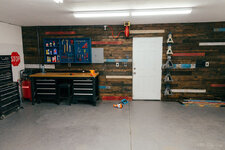
I opted for setting them up on the right side of the door as this is largely unused space, and with the stands upright like this they don't just out into the room much.

No, I don't know why I have three big jackstands instead of four, and two little ones. Been that way since high school and never needed more, so I just have a ragtag assembly of stands. It is what it is.
The next thing I had on my list was getting my shop TV up and running. I'm not ready for the seating area yet obviously, but having it available to play music without using my phone is a really nice update. I bought a pretty simple wall mount from Amazon, and as you can see my first attempt at placement was wrong.
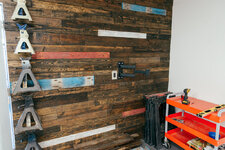
This new placement is almost exactly centered between the jackstands and the south wall. Almost. It's hard to notice it unless you're really looking.
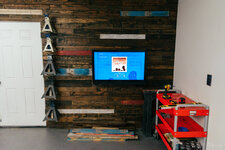
The wall space on either side of the TV got my vintage Land Cruiser ads, so they have a home now. With the additions to that wall, the workshop is really starting to look like I'd envisioned it when we bought the place. I'm pretty stoked with how it's turning out.

With that fun project done, I turned back to utility. While working on Graham's truck, I noticed my bench wasn't as stable as I'd like it to be. When trying to bend something or use the vise heavily, the front of the bench would lift or it would be shoved around. That was really bugging me, so I went for a low-tech solution: lag bolts into the wall. As the walls aren't square with the floor, the upper bolts needed a spacer arrangement, but this actually works out pretty well.
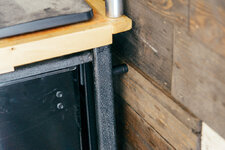
The bottom was just anchored straight to the wall on both sides.

Nice and stable now!
But I had one more fun project up my sleeve. Over the course of last week, I had been slowly gathering the necessary parts to sort out another problem I noticed while we were working on Graham's truck: lighting.
While we were working on pulling things apart or assembling them on the bench, I noticed that the workshop had become much darker, especially near the bench, largely thanks to the dark pallet wood wall. I'd have to shift every so often to see better because it was a little too dim. Well, I've had plans to improve that situation for a while, so this just gave me the excuse I was looking for to remedy the problem. It was time to make the workshop a little bit brighter.
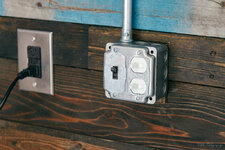
Step one was addressing the switches. As you can see, I've got two just inside the door of the shop. One controls the overhead tubes, the other controls the motion-activated light above the man door. While I was paneling the wall, I cut an opening around the switches like I would be going back to a set of switches within a box inside the wall. While that would have been a bit more low-profile, my new plan was to pull them into surface-mount wiring for two reasons:
1. It would make what I wanted to do much easier.
2. I really love the look of surface mount wiring.
So I killed the main breaker to the shop and disconnected the switches before using my oscillating tool to make a couple of precise cuts in the wall box, which enabled me to collapse it and pull it out of the wall. I cut the Romex free and set about filling the hole in the wall, as it was too big to cover with the new 2-gang surface mount box I bought.
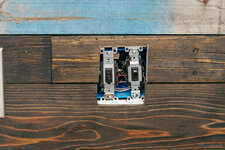
This was a simple fix. I found a stained off-cut from my toss pile that was the right size, then used a 1" bit to drill a hole through the center. With a little gentle persuasion from a hammer, the plug was a perfect friction fit into the hole in the wall with the wires passing through the hole in the plug.
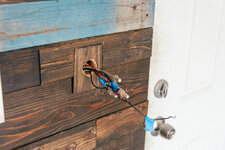
I set to work rewiring the switches, replacing one with a double switch. Unfortunately I discovered two things: the switch controlling the overhead tube lights is a 3-way switch (I had purchased a stacked single-pole switch), and Home Depot did not have any black or brown double stack switches in stock. So I improvised and moved the outdoor light to the same switch as the new bench lights, with the intention of getting a 3-way/single pole stack switch in the correct color via Amazon. For now though, I just wanted to make sure everything was working.
The next step was building the conduit and wire boxes. This process was dead simple. I started with the light boxes as they were the simplest. I marked the center of the right and left sections of my wall cabinet, then cut the conduit to length with a tubing cutter before attaching them together, marking the height I wanted, making sure they were level, and securing them to the wall. I then mounted the box over the breaker panel, using the hole I drilled in the pallet wood earlier, and used a conduit bender to get the 90-degree angle between that box and the switch box.
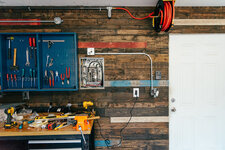
I connected the breaker panel box to the first light fixture box, and now I've got a full system in place.

I ran the Romex through next, starting at the end light fixture box and working my way back to the switch.

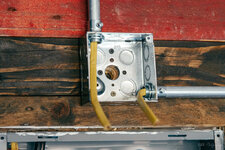
With the Romex in place, I started making my connections, again starting from the far light fixture and working my way back to the switch. I connected the wires to the fixture, then secured the fixture to the wall box before moving on to the next fixture. I did have to use a few washers I had on hand to reinforce the fixtures a bit, as Amazon's special gooseneck fixture is a touch flimsy. Who knew?

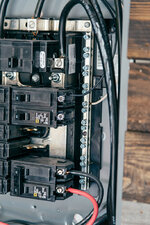
With both fixtures in place, I hooked up the switch and secured the cover to the box before punching out the top center knockout on my breaker box. I ran a short section of Romex through the breaker box up to the surface mount box above it, then hooked up the new wiring to an empty 20A breaker.


I then made the connections between the fixtures, the supply line, and the switch and closed everything up. Aesthetically, it looks great!
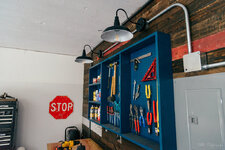
I cautiously flipped the main breaker back on and what do you know, it works!
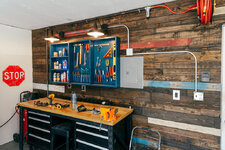
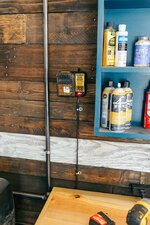
While I was admiring the new progress, I also took the time to hang up my battery charging station. I'm not sure if this will be the permanent home, but it's a good spot for how I have everything set up for now.
Now is probably a good time to mention I have never done any AC wiring before outside of replacing a switch, outlet, or light fixture, so I was really pleased that everything seemed to go off without a hitch. That is, until the breaker popped. A little inspection revealed a problem. Turning on the bench lights also turned on the motion light outside. Turning on both switches popped the breaker. Flummoxed, I disconnected the main breaker and rechecked all of my wiring from the fixtures to the switch. Everything looked good. I inspected the new stacked switch and realized that both circuits were getting power at the same time from their respective sources, but when I turned on the bench lights the power would also be fed to the motion light. Turning on both tried to feed power to both fixture sets with both power sources, popping the breaker.
Damn it. To fix the problem and have the use of the bench lights for now, I disconnected the motion light and capped the wires, causing the double switch to only operate the bench lights. I ordered a three-gang box expecting to add another single switch and just deal with the problem that way. It was about that time I came on here and told of my dilemma with double switches. @Bob Heine so helpfully then told me about the tab to separate the circuits. Thanks for that Bob!
Having ordered both a new stacked double switch (with one three-way and one single pole switch) and a 3-gang box, I waited for everything to arrive before trying to solve the problem, thinking there would be at least one solution in there somewhere. Either I'd have a three-gang box or I'd get the double switch working.
Well last night I went into the shop to do a bit of fiddling. I opened the new double switch, broke off the separating tab, then wired both the overhead lights and bench lights to that switch. What do you know, they worked! Independently of each other! Hot damn!
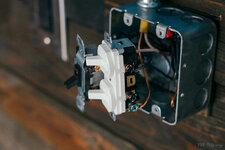


I then used the leftover single pole switch to operate the motion light and closed everything up again. Now it all functions as it should, and I have some extra illumination over the bench! Huzzah!


The extra light is great because it lights up the bench area as well as the cabinet, so it makes everything a lot easier to see. Since the bulbs are only partially shaded, they throw light in other places too, which is a nice plus.
I should note, I used 12/2 Romex on a 20A circuit because the lights over the bench are not the only new fixtures I have planned. More to come on that front. But for now, it's looking pretty nice, and my supervisors are happy with the outcome.


Onward!
First thing I worked on was getting my jackstands off the floor or a shelf. And keeping them out of a cabinet when those are finally built. My thought originally was to paint a 1x12 the same color as the cabinets and run J-hooks through that and into the wall, but by the time I got home with the 1x12 and J-hooks, my ambition to paint anything had evaporated completely. So I just hung up the hooks and ran with it. I actually think it looks really nice this way.
I opted for setting them up on the right side of the door as this is largely unused space, and with the stands upright like this they don't just out into the room much.
No, I don't know why I have three big jackstands instead of four, and two little ones. Been that way since high school and never needed more, so I just have a ragtag assembly of stands. It is what it is.
The next thing I had on my list was getting my shop TV up and running. I'm not ready for the seating area yet obviously, but having it available to play music without using my phone is a really nice update. I bought a pretty simple wall mount from Amazon, and as you can see my first attempt at placement was wrong.
This new placement is almost exactly centered between the jackstands and the south wall. Almost. It's hard to notice it unless you're really looking.
The wall space on either side of the TV got my vintage Land Cruiser ads, so they have a home now. With the additions to that wall, the workshop is really starting to look like I'd envisioned it when we bought the place. I'm pretty stoked with how it's turning out.
With that fun project done, I turned back to utility. While working on Graham's truck, I noticed my bench wasn't as stable as I'd like it to be. When trying to bend something or use the vise heavily, the front of the bench would lift or it would be shoved around. That was really bugging me, so I went for a low-tech solution: lag bolts into the wall. As the walls aren't square with the floor, the upper bolts needed a spacer arrangement, but this actually works out pretty well.
The bottom was just anchored straight to the wall on both sides.
Nice and stable now!
But I had one more fun project up my sleeve. Over the course of last week, I had been slowly gathering the necessary parts to sort out another problem I noticed while we were working on Graham's truck: lighting.
While we were working on pulling things apart or assembling them on the bench, I noticed that the workshop had become much darker, especially near the bench, largely thanks to the dark pallet wood wall. I'd have to shift every so often to see better because it was a little too dim. Well, I've had plans to improve that situation for a while, so this just gave me the excuse I was looking for to remedy the problem. It was time to make the workshop a little bit brighter.
Step one was addressing the switches. As you can see, I've got two just inside the door of the shop. One controls the overhead tubes, the other controls the motion-activated light above the man door. While I was paneling the wall, I cut an opening around the switches like I would be going back to a set of switches within a box inside the wall. While that would have been a bit more low-profile, my new plan was to pull them into surface-mount wiring for two reasons:
1. It would make what I wanted to do much easier.
2. I really love the look of surface mount wiring.
So I killed the main breaker to the shop and disconnected the switches before using my oscillating tool to make a couple of precise cuts in the wall box, which enabled me to collapse it and pull it out of the wall. I cut the Romex free and set about filling the hole in the wall, as it was too big to cover with the new 2-gang surface mount box I bought.
This was a simple fix. I found a stained off-cut from my toss pile that was the right size, then used a 1" bit to drill a hole through the center. With a little gentle persuasion from a hammer, the plug was a perfect friction fit into the hole in the wall with the wires passing through the hole in the plug.
I set to work rewiring the switches, replacing one with a double switch. Unfortunately I discovered two things: the switch controlling the overhead tube lights is a 3-way switch (I had purchased a stacked single-pole switch), and Home Depot did not have any black or brown double stack switches in stock. So I improvised and moved the outdoor light to the same switch as the new bench lights, with the intention of getting a 3-way/single pole stack switch in the correct color via Amazon. For now though, I just wanted to make sure everything was working.
The next step was building the conduit and wire boxes. This process was dead simple. I started with the light boxes as they were the simplest. I marked the center of the right and left sections of my wall cabinet, then cut the conduit to length with a tubing cutter before attaching them together, marking the height I wanted, making sure they were level, and securing them to the wall. I then mounted the box over the breaker panel, using the hole I drilled in the pallet wood earlier, and used a conduit bender to get the 90-degree angle between that box and the switch box.
I connected the breaker panel box to the first light fixture box, and now I've got a full system in place.
I ran the Romex through next, starting at the end light fixture box and working my way back to the switch.
With the Romex in place, I started making my connections, again starting from the far light fixture and working my way back to the switch. I connected the wires to the fixture, then secured the fixture to the wall box before moving on to the next fixture. I did have to use a few washers I had on hand to reinforce the fixtures a bit, as Amazon's special gooseneck fixture is a touch flimsy. Who knew?
With both fixtures in place, I hooked up the switch and secured the cover to the box before punching out the top center knockout on my breaker box. I ran a short section of Romex through the breaker box up to the surface mount box above it, then hooked up the new wiring to an empty 20A breaker.
I then made the connections between the fixtures, the supply line, and the switch and closed everything up. Aesthetically, it looks great!
I cautiously flipped the main breaker back on and what do you know, it works!
While I was admiring the new progress, I also took the time to hang up my battery charging station. I'm not sure if this will be the permanent home, but it's a good spot for how I have everything set up for now.
Now is probably a good time to mention I have never done any AC wiring before outside of replacing a switch, outlet, or light fixture, so I was really pleased that everything seemed to go off without a hitch. That is, until the breaker popped. A little inspection revealed a problem. Turning on the bench lights also turned on the motion light outside. Turning on both switches popped the breaker. Flummoxed, I disconnected the main breaker and rechecked all of my wiring from the fixtures to the switch. Everything looked good. I inspected the new stacked switch and realized that both circuits were getting power at the same time from their respective sources, but when I turned on the bench lights the power would also be fed to the motion light. Turning on both tried to feed power to both fixture sets with both power sources, popping the breaker.
Damn it. To fix the problem and have the use of the bench lights for now, I disconnected the motion light and capped the wires, causing the double switch to only operate the bench lights. I ordered a three-gang box expecting to add another single switch and just deal with the problem that way. It was about that time I came on here and told of my dilemma with double switches. @Bob Heine so helpfully then told me about the tab to separate the circuits. Thanks for that Bob!
Having ordered both a new stacked double switch (with one three-way and one single pole switch) and a 3-gang box, I waited for everything to arrive before trying to solve the problem, thinking there would be at least one solution in there somewhere. Either I'd have a three-gang box or I'd get the double switch working.
Well last night I went into the shop to do a bit of fiddling. I opened the new double switch, broke off the separating tab, then wired both the overhead lights and bench lights to that switch. What do you know, they worked! Independently of each other! Hot damn!
I then used the leftover single pole switch to operate the motion light and closed everything up again. Now it all functions as it should, and I have some extra illumination over the bench! Huzzah!
The extra light is great because it lights up the bench area as well as the cabinet, so it makes everything a lot easier to see. Since the bulbs are only partially shaded, they throw light in other places too, which is a nice plus.
I should note, I used 12/2 Romex on a 20A circuit because the lights over the bench are not the only new fixtures I have planned. More to come on that front. But for now, it's looking pretty nice, and my supervisors are happy with the outcome.
Onward!
OP
wreckdiver1321
Well-known member
We do have a plan to knock a lot of the rust off and get fresh paint on it. Montana is a super dry state, so once painted it's really unlikely to corrode any further. That being said, there's no guarantee we can get all of the rust, so I did instruct him to go at it with Fluid Film for that reason.Make sure the Nissan driver applies fluid film liberally on the entire clean underside once a year at least.
OutlawDrifter
Well-known member
Tom, I like the jackstand storage idea (even if the odd number messes with my OCD), and really like the light fixtures. The Edison bulbs really are the icing on the cake!
Nice work my friend!
Nice work my friend!
Looking really good sir! May want to consider a door stop on that walk door, I may have missed it but looks like the door could swing into the jack stands and dent the door or maybe knock a stand off the hook if jarred hard enough? Probably low risk on it falling off but may be something to look at.
XJSuperman
Well-known member
You've done a swell job of making it into a nice usable space. Im not sure I would have gone with the more decorative bulbs but it looks really nice that way!
rzims
Well-known member
your shop looks really cool! Love the pallet wood idea and the lights over the workbench came out really nice. I also ordered the amazon gooseneck fixtures....you're right, they're a little "flexy"
Nice work!
Nice work!
OP
wreckdiver1321
Well-known member
Thanks Marc!Tom, I like the jackstand storage idea (even if the odd number messes with my OCD), and really like the light fixtures. The Edison bulbs really are the icing on the cake!
Nice work my friend!
Great point Logan. My kids have tested your theory extensively, and while the stands don't seem to be in danger of falling off, they do shift to an annoying angle and scratch the door. I am going to install one of those hinge-mount 90-degree door stops on that door for just that reason.Looking really good sir! May want to consider a door stop on that walk door, I may have missed it but looks like the door could swing into the jack stands and dent the door or maybe knock a stand off the hook if jarred hard enough? Probably low risk on it falling off but may be something to look at.
Thanks XJ! I'll be honest, the decorative bulbs were what I had lying around. I have a bunch of them in use in my house and several spares. So that's what got used.You've done a swell job of making it into a nice usable space. Im not sure I would have gone with the more decorative bulbs but it looks really nice that way!
Thanks rzims! It's starting to really come together, and I'm super happy with how it's turning out.your shop looks really cool! Love the pallet wood idea and the lights over the workbench came out really nice. I also ordered the amazon gooseneck fixtures....you're right, they're a little "flexy"
Nice work!
By the way, a couple fender washers inside the base of the light where the gooseneck attaches really helps stiffen them up.
jbrentd
Well-known member
Nice work on the pallet wall! Good job on the conduit work...it fits right in with the look. You are reminding me that I need to mount my TV.
OP
wreckdiver1321
Well-known member
Thanks Brent!Nice work on the pallet wall! Good job on the conduit work...it fits right in with the look. You are reminding me that I need to mount my TV.
Trapps
ALLIANCE MEMBER
Turned out great!!! The wall is so cool and the bench lights really work well!
Perhaps consider raising the TV, or envision it in the corner angled into the space? It might provide a larger viewing angle should more people be able to enjoy a beverage in the space. I also hit on @loganb 's jack stands to door proximity concern - your solution will solve that.

Perhaps consider raising the TV, or envision it in the corner angled into the space? It might provide a larger viewing angle should more people be able to enjoy a beverage in the space. I also hit on @loganb 's jack stands to door proximity concern - your solution will solve that.
OP
wreckdiver1321
Well-known member
Thanks Trapps! I love the way it's coming together.Turned out great!!! The wall is so cool and the bench lights really work well!
Perhaps consider raising the TV, or envision it in the corner angled into the space? It might provide a larger viewing angle should more people be able to enjoy a beverage in the space. I also hit on @loganb 's jack stands to door proximity concern - your solution will solve that.
I may end up moving the TV up, you make a good point on that. I think I'm going to reserve judgement on that until I get the seating area squared away. Right now it's mostly used for music, so I'll mess with it more later. But yeah, it's something I'm thinking about.
Next up though is probably the trim work on the walls, then some more fun with conduit.
OP
wreckdiver1321
Well-known member
Now it's high time I did something in the workshop vs. doing work on the workshop, isn't it?
Yeah, I think so too. So how about some work on the Land Cruiser?!?
I scheduled Saturday with my neighbor to get as much body work as possible knocked out. We started in at 10am, with me pulling Sandy back into the workshop and getting all the tools organized. He was gracious enough to bring a bunch of his personal tools over to help work on everything. While I was getting ready, he was eyeing the shop. He told me I needed to go do up his. I said, "not if it involves pallet wood."
Prior to working on the truck, I knew I had one important task to attend to. Since my oldest would be home while we were working and coming in and out of the shop like Kramer having a bad day, it was of vital importance that I get this installed.

Okay, with the difficult job done for the day, it was time to move on the easy part.
Yeah, right.
We pulled Sandy into the workshop and came up with a game plan. Since that driver's side dogleg was the most complex and "scary" part of the repair, I decided we needed to start with that.

It was a symphony of measuring, taping, cutting, and grinding. We had to finish the preliminary cuts that my brother-in-law and I started. We also had to measure out the upper section and cut it to length properly. After that, it was a lot of making minor cuts and small adjustments to get everything as close to perfectly lined up as possible.


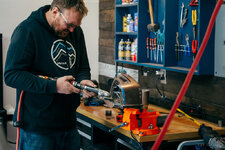

Since my neighbor works in a body shop, he's used to and very proficient with the air tools he brought over. It was a bit of a test of my air system, which seemed to handle everything really well despite being on constantly. Good news is I know now that the filter does in fact take out a bunch of water!

Oh and remember our shop buddy I mentioned? Well, my son Dirk was in the shop most of the time, and he loved it. He knows to keep his safety glasses on so he doesn't get hurt.

With the air compressor chugging away at maximum volume, I gave him some ear protection too. He loved playing with some of the tools and asking a bunch of questions. If he wasn't doing that, he was playing with his monster trucks.


It was finally time to drag out the welder and go to town. We taught Dirk that he couldn't look at the bright light or it would hurt his eyes, even make him go blind. He was really good about looking away or squeezing his eyes shut, and most of the time he was on the opposite side of the workshop.
Our first welding had to be done on the patch panel. Now I know that your expectation of me is that all the parts we cut were absolutely clean and perfect with no mistakes. Well, I'm sorry to say they... weren't quite as nice as that. We needed to fix a couple of over-exuberant cuts before moving the panel into it's final position.

I found out while I was setting up the welder that my 220 extension cable fits perfectly between the top of the bench and the power strip I installed, meaning the cable doesn't interfere with the bench top much at all. Yeah, I absolutely meant to do that. Definitely.

With that cleaned up, we took a lot of extra time lining everything up as well as we could. There was a lot of tapping and pushing and pulling.

Eventually, it was the moment of truth and time to start making sparks.


While he was working on that side, I started making the repair panels for the rear corner. I cut down a piece of sheet steel to the right shape, then waited for my neighbor to take a break and tacked it in.

He gave me some pointers on welding sheet metal that really helped my skills, and he even took the time to watch me and offer tutelage while I was stitching the panel on. The basic idea was higher heat and wire speed, with a very short arc time. Basically build spot welds into a continuous weld, alternating different sides of the work piece to avoid warping.
I'm getting dangerously close to looking like I know what I'm doing.
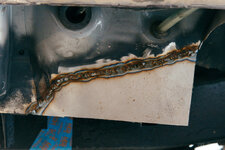
Once that was done, I was able to cut the piece my brother-in-law was working on to length and get it tacked into place.

On the bottom I just plug-welded some holes I drilled and will go over the whole thing with seam-sealer later on. Overall I'm extremely pleased with how this patch came together. Especially considering no one will ever see it.

He then had me come over and do a bunch of welding on the dogleg section, giving me a little more instruction. I did most of the back side and a good chunk of the visible side. It's looking really nice now with that panel replaced and holding itself in!

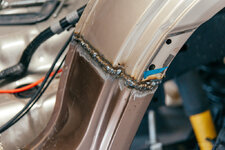

We did a little grinding to clean it all up and before we knew it, it was time to call it a night. Holy **** what a marathon day. It was a lot of work, a lot of fiddling, and a lot of welding, but this is a massive leap forward compared to where we were last week. It's also given me more confidence to tackle another section of the body repair (driver's side rear corner) myself. I have the tools and thanks to working at home, I have the time. Maybe there's hope for this project yet...
Yeah, I think so too. So how about some work on the Land Cruiser?!?
I scheduled Saturday with my neighbor to get as much body work as possible knocked out. We started in at 10am, with me pulling Sandy back into the workshop and getting all the tools organized. He was gracious enough to bring a bunch of his personal tools over to help work on everything. While I was getting ready, he was eyeing the shop. He told me I needed to go do up his. I said, "not if it involves pallet wood."
Prior to working on the truck, I knew I had one important task to attend to. Since my oldest would be home while we were working and coming in and out of the shop like Kramer having a bad day, it was of vital importance that I get this installed.
Okay, with the difficult job done for the day, it was time to move on the easy part.
Yeah, right.
We pulled Sandy into the workshop and came up with a game plan. Since that driver's side dogleg was the most complex and "scary" part of the repair, I decided we needed to start with that.
It was a symphony of measuring, taping, cutting, and grinding. We had to finish the preliminary cuts that my brother-in-law and I started. We also had to measure out the upper section and cut it to length properly. After that, it was a lot of making minor cuts and small adjustments to get everything as close to perfectly lined up as possible.
Since my neighbor works in a body shop, he's used to and very proficient with the air tools he brought over. It was a bit of a test of my air system, which seemed to handle everything really well despite being on constantly. Good news is I know now that the filter does in fact take out a bunch of water!
Oh and remember our shop buddy I mentioned? Well, my son Dirk was in the shop most of the time, and he loved it. He knows to keep his safety glasses on so he doesn't get hurt.
With the air compressor chugging away at maximum volume, I gave him some ear protection too. He loved playing with some of the tools and asking a bunch of questions. If he wasn't doing that, he was playing with his monster trucks.
It was finally time to drag out the welder and go to town. We taught Dirk that he couldn't look at the bright light or it would hurt his eyes, even make him go blind. He was really good about looking away or squeezing his eyes shut, and most of the time he was on the opposite side of the workshop.
Our first welding had to be done on the patch panel. Now I know that your expectation of me is that all the parts we cut were absolutely clean and perfect with no mistakes. Well, I'm sorry to say they... weren't quite as nice as that. We needed to fix a couple of over-exuberant cuts before moving the panel into it's final position.
I found out while I was setting up the welder that my 220 extension cable fits perfectly between the top of the bench and the power strip I installed, meaning the cable doesn't interfere with the bench top much at all. Yeah, I absolutely meant to do that. Definitely.
With that cleaned up, we took a lot of extra time lining everything up as well as we could. There was a lot of tapping and pushing and pulling.
Eventually, it was the moment of truth and time to start making sparks.
While he was working on that side, I started making the repair panels for the rear corner. I cut down a piece of sheet steel to the right shape, then waited for my neighbor to take a break and tacked it in.
He gave me some pointers on welding sheet metal that really helped my skills, and he even took the time to watch me and offer tutelage while I was stitching the panel on. The basic idea was higher heat and wire speed, with a very short arc time. Basically build spot welds into a continuous weld, alternating different sides of the work piece to avoid warping.
I'm getting dangerously close to looking like I know what I'm doing.
Once that was done, I was able to cut the piece my brother-in-law was working on to length and get it tacked into place.
On the bottom I just plug-welded some holes I drilled and will go over the whole thing with seam-sealer later on. Overall I'm extremely pleased with how this patch came together. Especially considering no one will ever see it.
He then had me come over and do a bunch of welding on the dogleg section, giving me a little more instruction. I did most of the back side and a good chunk of the visible side. It's looking really nice now with that panel replaced and holding itself in!
We did a little grinding to clean it all up and before we knew it, it was time to call it a night. Holy **** what a marathon day. It was a lot of work, a lot of fiddling, and a lot of welding, but this is a massive leap forward compared to where we were last week. It's also given me more confidence to tackle another section of the body repair (driver's side rear corner) myself. I have the tools and thanks to working at home, I have the time. Maybe there's hope for this project yet...
OutlawDrifter
Well-known member
Nice work Tom! 90% of a new task is getting over the mental part. The rest is just fundamentals and finding your groove.
OP
wreckdiver1321
Well-known member
Thanks Marc! I absolutely agree, you often have to get over the scary factor first, then figure it out as you go. I'm getting better about that the older I get and more confidence I gain in my abilities. Funny how experience does that to you. I'm still worried about messing something up when I get into new stuff, but I know almost everything is fixable. So I might as well give it a try.Nice work Tom! 90% of a new task is getting over the mental part. The rest is just fundamentals and finding your groove.
"In order to become an expert, one must first be willing to look like a fool."
rattle_snake
Well-known member
Nice work on the sheet metal repair. You know, now would be the time to do more extensive sheet metal mods to fit 40s under there. They will fit with additional trimming.
OP
wreckdiver1321
Well-known member
Haha! I do know for a fact that the drivetrain will hold up to 38's. A guy here in town had one of these with 38's on it and never had any problems.Nice work on the sheet metal repair. You know, now would be the time to do more extensive sheet metal mods to fit 40s under there. They will fit with additional trimming.
Not in the cards for my build though. I'd be shocked if I even went up to 33's. I've got more ground clearance than I know what to do with on this rig.
XJSuperman
Well-known member
Slap it together, come to Iowa. I'll not only show you what to do with that ground clearance, but I'll show you that you need more!
Then return home to trim as per Rattle_snake's advice.
Then return home to trim as per Rattle_snake's advice.
jbrentd
Well-known member
Weren't you almost at your limit as far a door clearance goes, as is?
OP
wreckdiver1321
Well-known member
Thanks, but I like two things: scenery and not breaking stuff.Slap it together, come to Iowa. I'll not only show you what to do with that ground clearance, but I'll show you that you need more!
Then return home to trim as per Rattle_snake's advice.
You make an excellent point! I really can't go any taller and still fit in the shop. I might be able to get away with a little more because the suspension will squat a bit under full weight. But I'm plenty happy with the tire size I have.Weren't you almost at your limit as far a door clearance goes, as is?
OP
wreckdiver1321
Well-known member
Ladies and gentleman, grab your popcorn and find your seats! Rust Bucket Suspension Rescue Round II is coming this weekend only!
My buddy Graham is coming into town again tomorrow night to finish up the absolute mess that was working on his Nissan. All we have left to do is put in some add-a-leafs in the rear suspension. That's all. We'll see how much of an ***-kicking I take from it. I'm hoping not, but after the last bout I'm not holding my breath. I've advised him to hose everything down with penetrating oil today in order to hopefully make things easier for us.
My buddy Graham is coming into town again tomorrow night to finish up the absolute mess that was working on his Nissan. All we have left to do is put in some add-a-leafs in the rear suspension. That's all. We'll see how much of an ***-kicking I take from it. I'm hoping not, but after the last bout I'm not holding my breath. I've advised him to hose everything down with penetrating oil today in order to hopefully make things easier for us.
jbrentd
Well-known member
Stock up on some butane bottles and good luck!