To avoid these ads, REGISTER NOW!

Tool or technique for seating larger diameter PVC pipe and fittings

stokefire7

Well-known member
Joined
Oct 5, 2011
Messages
616
Ok all, pictures, or it didn't happen

IMG_3242.jpg

IMG_3225.jpg
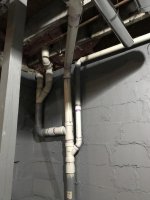
My starting point. Up until here it all went together very well. It was just working overhead with the full length pieces I had trouble pulling the joints together. So, once again thanks for all the helpful suggestions and tool recomendations.

IMG_3241.jpg

IMG_3239.jpg

You can see my coupling of the new 3" connection to the original stack. All of this was pretty straight forward.


...thanks for the pics by the way.
 
To avoid these ads, REGISTER NOW!
OP
G

gahrajmahal

Well-known member
Joined
Dec 12, 2008
Messages
2,546
Location
Cincinnati, Ohio
Well stoke, I used steel strapping, the kind with continuous holes in it. 4 screws per strap at every joint and halfway between one ten foot length. The hvac install used those pvc straps. I didn’t like the looks of those. They had to span the whole length of the basement. My job looks as good or better than what they did as I at least got the slope right.

I don’t think we will have to worry about settling as there will be a second floor laundry exiting down that pipe too.
 

johnm123

New member
Joined
Aug 8, 2023
Messages
1
I'm having a similar problem,but 4 inch pipe in a ditch, so even harder to access.
 

Crazyjake8493

Well-known member
Joined
Sep 26, 2014
Messages
3,977
Location
Upstate NY
Slow setting glue and ratchet straps to pull sections together. Our high efficiency boilers at work have large PVC air intake (12" I believe) and that's how the guys installed it.
 

flat350

Well-known member
Joined
Jan 1, 2009
Messages
1,006
Location
illinois
It's PVC pipe, prime it, glue it, push it home, hold for a second, move on to the next joint.
 

welder4956

Well-known member
Joined
Apr 8, 2010
Messages
3,084
Location
Birmingham, AL USA
I'll second the ratchet straps on the big pipe. We had to glue some 10" and 12" PVC pipe on a project and used 2 ratchet straps 180 degrees apart to get an even pull. Had to wrap the end of the strap a couple of turns around the pipe to get a choke hold on it and hook the other end to another strap wrapped around the building frame. The glue actually tries to push the pipe back out and the larger pipe seems to push out with more force than the 2" and less. There is a tool for pulling the pipe together, but we didn't have time to wait for it: https://weldon.com/joining-tools/
 

housewolf

Well-known member
Joined
Feb 3, 2021
Messages
1,144
Location
East Texas
Piping looks pretty good OP.

YouTube and advice on forums is great. As long as we can follow some simple directions many of us can DIY just about anything but there is no substitute for experience.

When I hear “large diameter”, I’m thinking >8”

We rarely have problems making up PVC joints below 6” and even then only in extremely hot weather. The cement is setting up quicker than we can push it together.

Primer the fitting & pipe, hub first, while the primer is wet, do same with cement. Don’t drag your feet, push it together ASAP

Somewhere around 10” we usually start beveling the pipe. It’s never a bad idea to put a little bevel on it. Always at least knock all the burr off of it

If you had used something like clevis hangers your pipe would have slid easier probably making assembly easier. Alignment is key.

Dry-fitting is counterproductive. Use a level to leave it in the proper orientation

In general quicker setting cement is thinner it might have made it easier to assemble but you’d have less time. If available I like Weld-on 711 (might be because it peels off my hands easiest). Post Covid, we use what we can find.

Full lengths of 3” overhead is a pretty hefty task for a one man crew, but all in all… it’s just something that takes a little practice to become proficient with. I’m 67 years old and feel pretty comfortable running up to 4” by myself but I’ve done it a time or two. Yours looks good OP.
 
Last edited:

rayra

Well-known member
Joined
Dec 1, 2014
Messages
4,724
Location
Escaped from Los Angeles
skip the dry fitting and the attempted exactitude of bottoming out the pipe to the step in the coupling. Completely unnecessary. And part of your self-inflicted fitting difficulties.

Use more glue. Use a SLOWER glue. Get the excess off the swab, wet inside the coupler, re-dip and slop it around the outside of the pipe, twist as you insert and hold until enough of a set occurs to prevent backing. Excess glue ought to be running / dripping off the pipe, at the mouth of the coupling. NOT inside the coupling.
Set a pipe segment / run that is slightly longer than necessary. When figuring the placement / alignment of the fitting on the other end, that's when you cut the pipe to final length.
For a 2" or 3" pipe, you'll need to be better at pre-cutting the length to accommodate NOT fully seating the couplings.
 
To avoid these ads, REGISTER NOW!

Spencer Was Here

Well-known member
Joined
Jan 2, 2006
Messages
327
Location
Western Michigan
To anse4 the OP's main question, yes there are tools available to help pull pipes together. Just Google "Pipe Puller" or "Pipe Joiner".

Here is one example:
https://www.reedmfgco.com/en/products/general-pipe-working-tools/multi-purpose-pipe-joiner/

When I worked with 4" PVC for the addition on my house, I used two of these, one on each piece being fitted together.

IRWIN VISE-GRIP Original Chain Clamp, Locking, 9-Inch (27ZR)​

https://www.amazon.com/gp/product/B00004SBCB/?tag=atomicindus08-20

The chain clamps give you a much easier grip to hold on to and I also used a Quick-Grip type clamp placed against each chain clamp to help squeeze the sections together and keep them tight together while the solvent did it's work.
 

ycgoat

Well-known member
Joined
Mar 28, 2020
Messages
971
Location
S.E. Va
For long runs in a trench we used 2 people (1) guides the pipe in and (1) either shoves with their back to the joint or uses a sledge hammer and 2x4.


For shorter runs by myself I will use a 2x4 as a pry bar to apply leverage to push in and hold it in while the glue sets.
 

deminimis

Well-known member
Joined
Nov 10, 2015
Messages
58
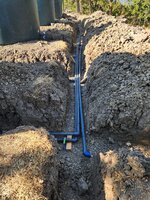
Old post, but whatever. I came looking for a reasonably priced tool to do what I need. They make expensive ones for large diameter pipe, but, not surprisingly, I'm not finding much for small diameter pipe. Oh well. I've been thinking of using a ratchet strap to set and hold a long run of 2" sch 80 PVC together. I'm about to start two 180'-200'-ish downhill sections (one for filling from our water trailer below, the second (not shown here) for the fire dept to draw from if/when needed). Not much room in the trench and I'm doing it solo. Because of the lay of the land, it makes more sense to bench build the line (well, field build), insert the works in the trench (making gravity my friend). The plan is to ratchet it back up into place and to keep it tight while the slow glue sets. I'm thinking I'll drive a t-post into the ground to use as an anchor/attachment point for the upper strap end and to hold the existing pipe in place while I insert the downhill line into it. For down the line, perhaps an exhaust clamp (or a series of hose clamps) to secure the other end of the strap to the straight pipe section (only a couple feet down the line from where they will insert into their respective 90s). I think that will work well. We are talking nearly 200# for each line, so I may change up this plan a bit. We shall see.
 

Attachments

  • 20250824_092027.jpg
    20250824_092027.jpg
    1.7 MB · Views: 7

deminimis

Well-known member
Joined
Nov 10, 2015
Messages
58
^ Chop saw. Perfect cuts, perfect fit, every time. I'm using a genny to power my chop saw on this current project as juice is unavailable at the site.
 

deminimis

Well-known member
Joined
Nov 10, 2015
Messages
58
I treat the chop saw I use for things like this like I hate it for stealing my girlfriend back in high school. It was left behind by a buddy using my shop to build out a van in 2010 (he returned to Sweden, leaving the saw). I didn't need it has I have a nice DW sliding compound miter with a long stand.... or so I thought. He found the wood blade cut alumn just fine and was a cheap work-around for a metal chop saw. I had a ton of T-6 to cut last Summer for a project, so I dug it out and did just that. Despite the gross mis-use of this cheapie saw (Ryobi throwaway garbage), and absolutely vile treatment of that blade, it makes flawless cuts through PVC (and 6061 square aluminum tubing for that matter). Point being, it doesn't take much of a cash outlay to get perfect fitting PVC plumbing.
 
To avoid these ads, REGISTER NOW!
Top Bottom