OP
Private Lugnutz
Well-known member
When I said I would check the 1943 catalog, I wasn't referring to only the 4000W Socketchest page, which I sent you a scan of several weeks ago, I wasn't referring to color at all (you asked about finish, didn't you?), or artwork, I was referring to descriptions.
Descriptions can be very helpful. I have studied all the wartime catalogs extensively, especially from the WPB Limitation Order L-216 perspective, and I am well aware that the frontispiece in the 1943 SK catalog states that the illustrations are from peacetime catalogs. As Don alludes to. Note that it does not say anything about descriptions being peacetime.
Having said that, some of the text, especially parts lists, are also implied to be peacetime artifacts, because items are redlined, marked SUSPENDED at the end of the redline, with footnotes added at the bottom referencing L-216, or, when more convenient than individual redlines, a whole section is just stamped SUSPENDED. Those are all mark-ups, made on top of the original printing.
Most of the text is not marked-up. It is not possible to determine if the text describing the many toolboxes is peacetime or original, but I really don't understand how the difference is germane to begin with. I find peacetime catalogs to be very useful for wartime preservation efforts. In many cases there were no changes at all except availability (redundancy was the main goal of L-216, to preserve steel), alternatives to plating, and in the case of boxes, to color. Edit: In some cases, markings on tools.
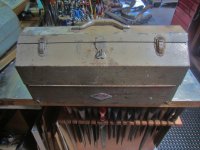
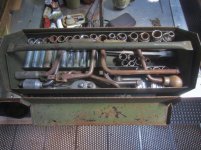
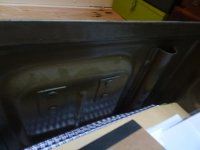
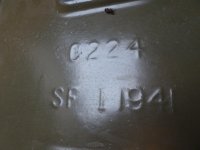
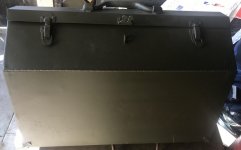
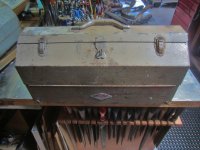
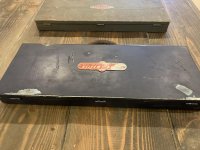
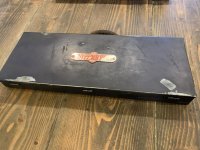
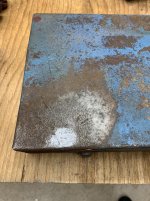
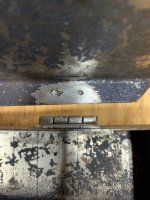
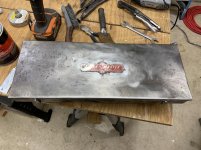
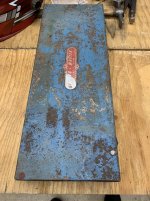
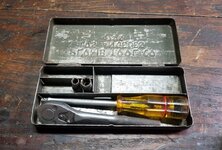
On top of all that suggesting you rethink how much credence you give to the idea of dismissing peacetime artifacts, including artwork, I wasn't aware you knew exactly when your box was made. It had the remains of a logo found on pre-war and wartime boxes, did it not? In my opinion, the 1943 catalog gives collectors good insight into both eras, and I wasn't aware you decided your box would be strictly wartime.
FINDINGS
Unfortunately, unlike Plomb, Snap-on, Blackhawk and other OEMs, SK was less directly forthcoming in the 1943 catalog about stating or implying how much shine their box finishes had.
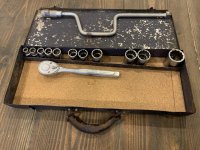
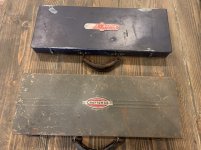
If you've read the 4000C Socketchest description on the page 13 scan I sent you, you've seen it called a "baked enamel finish." For your information, all the smaller socket set boxes on page 8 through 12 have the same exact description.
The Toolwagon on page 14, 15, and 16 had a "red and black wrinkle finish."
The larger Socketchest (4010C) on page 17 had an "attractive green baked enamel" finish, as did the heavy duty machinists' chests on page 20.
The Carb-O-Mang boxes on page 24 were "finished in Crystalline."
My read?
If it was originally shiny, it might say Crystalline. If it was originally wrinkled, it would say wrinkled. (I'm not even sure it's possible to bake on an enamel finish with wrinkles.)
I would probably use semi-gloss. I have even used matte and brought the shine up with polish rather than dulling down an overly glossy finish.
But just my $.02.
Descriptions can be very helpful. I have studied all the wartime catalogs extensively, especially from the WPB Limitation Order L-216 perspective, and I am well aware that the frontispiece in the 1943 SK catalog states that the illustrations are from peacetime catalogs. As Don alludes to. Note that it does not say anything about descriptions being peacetime.
Having said that, some of the text, especially parts lists, are also implied to be peacetime artifacts, because items are redlined, marked SUSPENDED at the end of the redline, with footnotes added at the bottom referencing L-216, or, when more convenient than individual redlines, a whole section is just stamped SUSPENDED. Those are all mark-ups, made on top of the original printing.
Most of the text is not marked-up. It is not possible to determine if the text describing the many toolboxes is peacetime or original, but I really don't understand how the difference is germane to begin with. I find peacetime catalogs to be very useful for wartime preservation efforts. In many cases there were no changes at all except availability (redundancy was the main goal of L-216, to preserve steel), alternatives to plating, and in the case of boxes, to color. Edit: In some cases, markings on tools.
On top of all that suggesting you rethink how much credence you give to the idea of dismissing peacetime artifacts, including artwork, I wasn't aware you knew exactly when your box was made. It had the remains of a logo found on pre-war and wartime boxes, did it not? In my opinion, the 1943 catalog gives collectors good insight into both eras, and I wasn't aware you decided your box would be strictly wartime.
FINDINGS
Unfortunately, unlike Plomb, Snap-on, Blackhawk and other OEMs, SK was less directly forthcoming in the 1943 catalog about stating or implying how much shine their box finishes had.
If you've read the 4000C Socketchest description on the page 13 scan I sent you, you've seen it called a "baked enamel finish." For your information, all the smaller socket set boxes on page 8 through 12 have the same exact description.
The Toolwagon on page 14, 15, and 16 had a "red and black wrinkle finish."
The larger Socketchest (4010C) on page 17 had an "attractive green baked enamel" finish, as did the heavy duty machinists' chests on page 20.
The Carb-O-Mang boxes on page 24 were "finished in Crystalline."
My read?
If it was originally shiny, it might say Crystalline. If it was originally wrinkled, it would say wrinkled. (I'm not even sure it's possible to bake on an enamel finish with wrinkles.)
I would probably use semi-gloss. I have even used matte and brought the shine up with polish rather than dulling down an overly glossy finish.
But just my $.02.
Last edited: