To avoid these ads, REGISTER NOW!

Tooling (Re)Organization

kspwski

Well-known member
Joined
Dec 22, 2011
Messages
56
Location
Central Iowa
We've had success using a single dovetail to hold two pieces together to make something that didn't fit on the printer bed. Took a little trial and error, but ultimately worked well.
 
To avoid these ads, REGISTER NOW!

zr52002

Well-known member
Joined
Jan 5, 2007
Messages
82
No big deal...right. ;)

Sent from my iPhone using Tapatalk Pro

The print time isn't, anyway. Actually drawing these isn't very hard either - they are simple shapes. I draw everything in OpenSCAD. I'm working on some software add-ons for it that will make it a lot more approachable, and make things like this VERY easy.


We've had success using a single dovetail to hold two pieces together to make something that didn't fit on the printer bed. Took a little trial and error, but ultimately worked well.

Yes - this does work well once you have the dovetail geometry worked out for your printer, and you're smart enough to put them in the right places. If you hit the sizing just right, the layer lines in the print actually lock the joints together, it's pretty cool. I've had really good luck making joints that way with a sort of "puzzle piece" shape. Same idea but they end up stronger due to not having sharp corners.

For these drawers I wasn't ready to commit to a standard size tool tray, nor was I prepared to keep track of dimensions well enough to place the dovetails between different sized pieces. I figure once I get the drawer full I will print some small bins to take up any extra space around the edges to keep things from shifting.

I suppose you could compromise on the design - if you built your trays in increments of a standard size piece - like 2x2 inches - you could fit connectors on the center of that 2" size.
 
OP
L

lilscorpion

Well-known member
Joined
Mar 15, 2010
Messages
3,599
Location
Colorado
zr52002 said:
The print time isn't, anyway. Actually drawing these isn't very hard either - they are simple shapes. I draw everything in OpenSCAD. I'm working on some software add-ons for it that will make it a lot more approachable, and make things like this VERY easy.


I suppose you could compromise on the design - if you built your trays in increments of a standard size piece - like 2x2 inches - you could fit connectors on the center of that 2" size.


Thanks for the tip, I’ll check out OpenSCAD.

Interesting idea. Would be cool if one could design a whole drawer in cad and then break it down into 2-inch (or printable sized) blocks similar to how a jigsaw puzzle works. Obviously it would be better for the pieces to be modules so, if you replaces a ‘set’ of something you could just reprint that module to fit the new ‘set’.

I’m thinking a 3D printer is in my future.


Sent from my iPhone using Tapatalk Pro
 

zr52002

Well-known member
Joined
Jan 5, 2007
Messages
82
I maybe wasn't clear on prior message - I meant multiple of 2x2 inch size. So you could mix 2x2, 2x4, 4x4, 6x6, 8x8, 4x6, 2x8, etc. Think of your drawer gridded out like a checkerboard and you can make a module to fit as many squares as you want, but it needs to cover hole squares for the system to work.

What exactly the base grid size should be, 2", 1.5", or something else - I'm not sure. It has to be big enough to fit connectors in a single-square unit, so 1" square is probably too small.

If you modeled it well in OpenSCAD, it'd be easy enough to even use a different base module size for different people (or different drawers). I'll have to draw something up and pass it around.
 
OP
L

lilscorpion

Well-known member
Joined
Mar 15, 2010
Messages
3,599
Location
Colorado
I maybe wasn't clear on prior message - I meant multiple of 2x2 inch size. So you could mix 2x2, 2x4, 4x4, 6x6, 8x8, 4x6, 2x8, etc. Think of your drawer gridded out like a checkerboard and you can make a module to fit as many squares as you want, but it needs to cover hole squares for the system to work.

What exactly the base grid size should be, 2", 1.5", or something else - I'm not sure. It has to be big enough to fit connectors in a single-square unit, so 1" square is probably too small.

If you modeled it well in OpenSCAD, it'd be easy enough to even use a different base module size for different people (or different drawers). I'll have to draw something up and pass it around.

No you explained it well, I got it. Breaking the drawer down on printable sized pieces would work well. I was having a follow-on thought - if you could break down the drawer in such a way as to not interrupt sets then, if you were to delete that set from your drawer, you’d only have to reprint for what replaces it. Maybe it wouldn’t matter if the pieces were small enough.

What kind of printer do you have? I’ve been looking for the past few days and it’s really difficult to tell in just a few days research without taking some guys word off of YouTube. Thus far it seems like Anycube 13 gets good reviews. Budget, I’d like to be under $1k if I get one. Don’t have space for a huge machine..


Sent from my iPhone using Tapatalk Pro
 

Cruzan80

Well-known member
Joined
Jul 22, 2015
Messages
4,155
Location
Denver, CO
I have two different flash-forges at work (Tech Teacher at K-8 School). Following this thread, and re-reading the older one for ideas. A good two-color, enclosed printer is about $750, a decent basic model is right around $300. I have some tips/tricks that have worked very well for getting results out of the printer, less so on the design aspect (need to brush up on CAD work). Plan on printing most of my stuff that you milled (only have router and drill press, can set up RAS as overhead router if needed).
 

zr52002

Well-known member
Joined
Jan 5, 2007
Messages
82
I have a genuine Prusa i3mk2. If I needed another one today, would not hesitate to buy the i3 MK3. I might buy one anyway - there is a lot of tech in that printer that is ahead of what everyone else is doing at this point.
 
Last edited:
OP
L

lilscorpion

Well-known member
Joined
Mar 15, 2010
Messages
3,599
Location
Colorado
New Workbench Build

In the past 4 years I’ve learned a thing or two about building cabinets. Even though melamine has been good to me (meaning it hasn’t yet failed me), It’s not the strongest for cabinet assemblies. The previous bench utilized unfinished baltic birch for the face frames and the drawers. To finish, it took me about a month to apply 3 coats of poly (spray, scuff, spray, stuff, spray) on both sides of the drawers and a single side of the face frame spraying sometimes 2-3 times per day and many times per day on the weekends.

This go around I'm going to apply what I've learned and build the boxes out of pre-finished baltic birch. This pre-finished material comes from the supplier with a fairly durable UV stable clear coat that has a much nicer finish that what I'm able to spray myself in the garage and it only costs $10-$20 more per sheet depending on where you get it and if you get a break on quantity. I've only been able to find 2 places that sell it in town but they regularly have on hand so there's no need to order it in advance. The only downside to using it is it requires careful handling during machining (or it looks like junk when you're done). For the price difference, I have no issue slowing down to go MUCH faster.

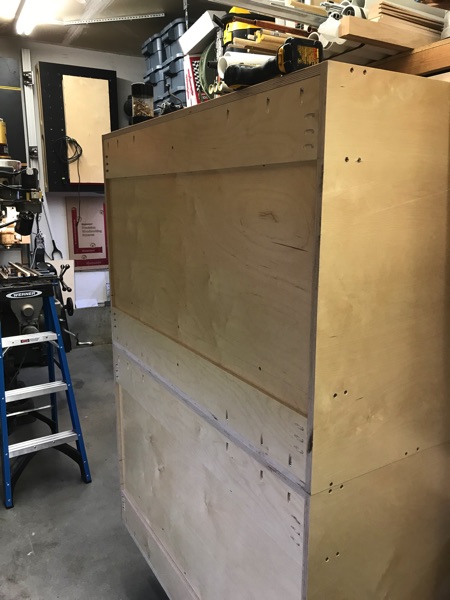
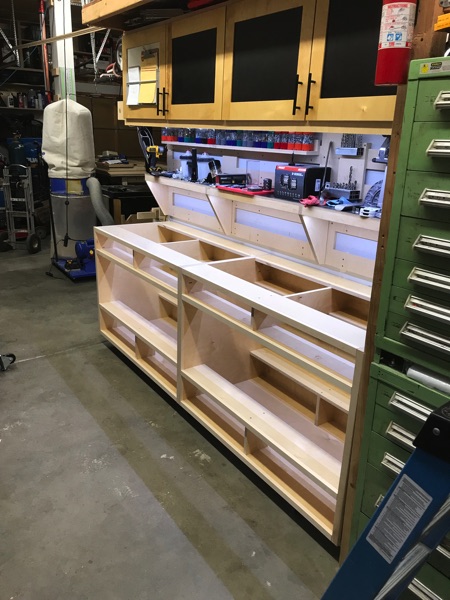
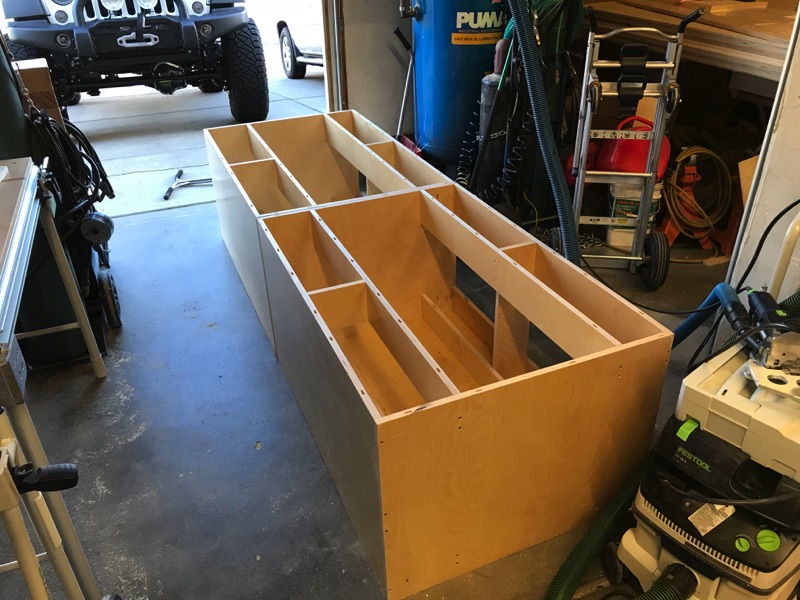
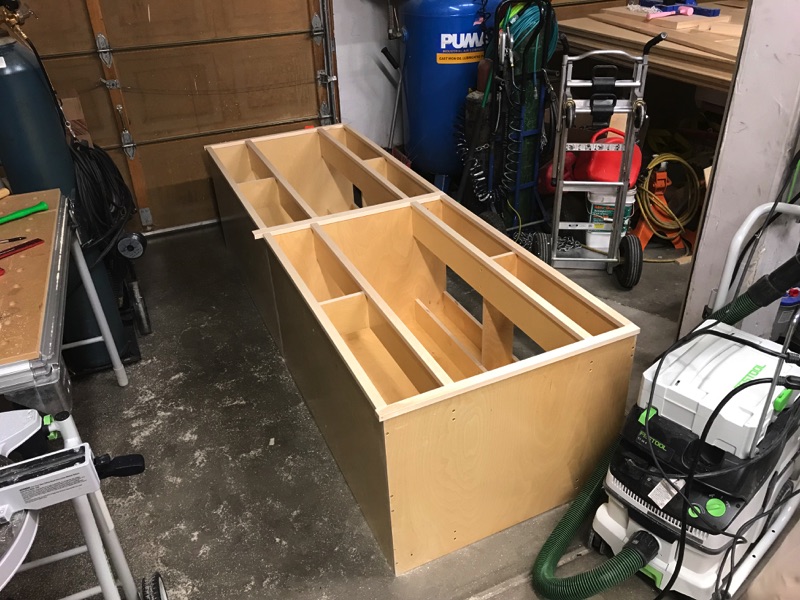
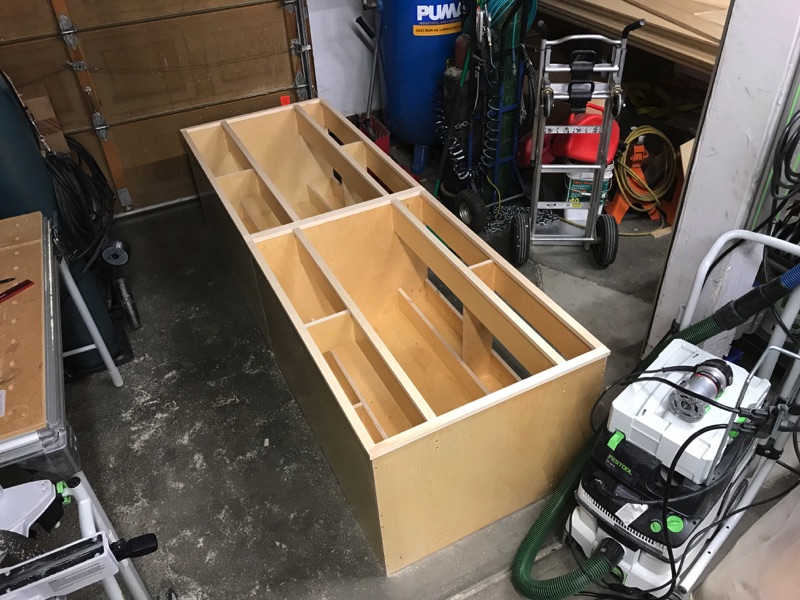
I really really wanted to get the main boxes built this weekend so I didn't slow down to take pictures until I had the main assemblies pieced together. I apologize however I promise that once you've seen me break down a sheet of ply, you've seen it...fast forward...the two boxes, a total of 8'2" long, are laying on their back machined and ready for the face frames.

IMG_2046.JPG


Orientation-wise, you can see the bottom in this picture. These assemblies are designed to have some fairly wide drawers so they can hold tools that I never had a dream of storing in my old bench (e.g. 36" long impact extensions).

On the old bench I used remnant pieces of the baltic birch cut into thin strips for the face frames and attached them using brad nails. This cause me to spend time patching holes and sanding before I could finish. Since I have a few dozen feet of white maple left over from the kids closet builds I decided I'd use that up. It being hardwood makes it a better choice for shop cabinets anyway because it can take more abuse.

The face frames are hall hand fitted pieces. I cut the verticals so they run a little long top and bottom and then hand fit the rest by measuring and cutting the smaller pieces one at a time. I'll do a more comprehensive breakdown when I feel like I have more time, like when I build the uppers.

IMG_2050.JPG


Once i have everything fit, I mark and trim the verticals to be flush top and bottom. I do it this way because it allows me to hide slight imperfections in the boards (like if one is 1/16th narrower) by cutting them point to point instead of 90* to length...if that makes sense.

IMG_2051.JPG


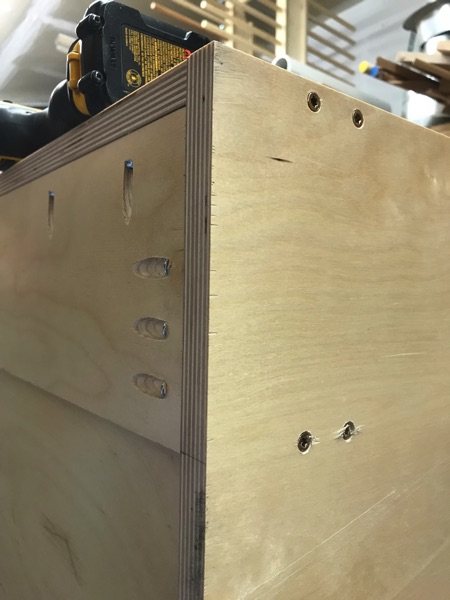
The conventional face frame would be held together as a single assembly using pocket screws which would require me to mark all of the intersections and pocket hole screw the thing together on a large assembly table. I did that for my first two cabinets but, since then, have done it a little differently. I, instead, leave all individual pieces floating so I can remove them, refinish them, and/or replace them later individually if necessary. Then I attach each one using pocket screws which, along with the dominos, prevents it from moving. This allows me to color change or repair my cabinets easily down the road. The cabinetmaker probably cringes...I’ve had no issues to date so no evidence that the face frames actually need to be one assembly. Again I'll go into better detail when I build the uppers.

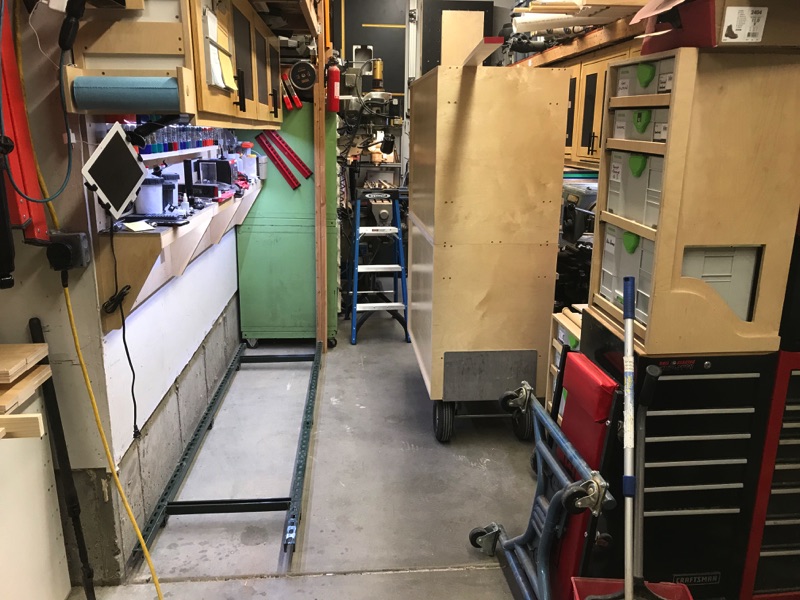
With the face frames complete, I then moved the cabinet assemblies over to the new location in preparation for install using this conversion hand truck/dolly.

IMG_2214.JPG


Before installing them, I need to add rear nailer boards. Here’s another notable difference in these cabinets over the old ones. The back have a 1/4-inch thick back panel and I add 5 1/2-inch wide nailers to the top and the bottom. When attached with pocket screws, these nailers serve three purposes - (1) they add a substantial amount of strength to the cabinet. (2) They provide a strong way to attach the cabinet to the wall. (3) they push the back panel forward solidly into the groove so, from the inside, the panel appears to have zero reveal.

IMG_2216.JPG


IMG_2217.JPG


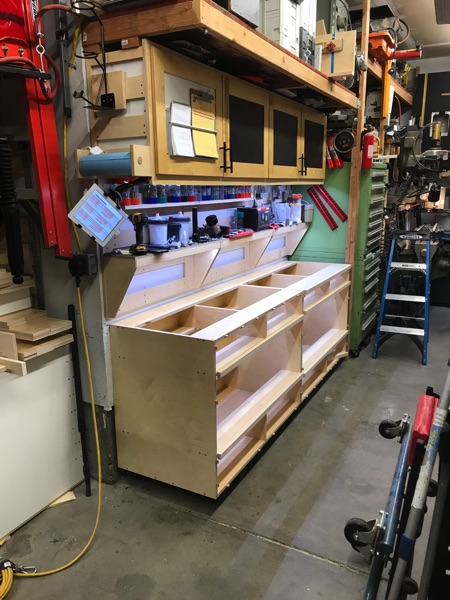
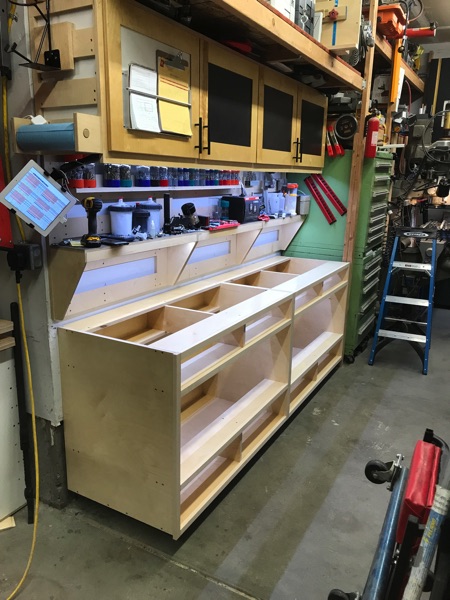
Took me all weekend to get to this point...dropping them in place.

IMG_2221.JPG


It's fun to see a pile of ply turn into something like this in a weekend and to think that all of the flat surfaces already have clear coat on them! I'd bet I build this one in 10th the time. Kinda wished I'd timed myself on the previous one.

IMG_2223.JPG


IMG_2224.JPG
 

FTWingRiders

Well-known member
Joined
Mar 21, 2012
Messages
1,558
Location
Central Ma
Very inspiring!! Now I want to go out and organize my shop, (maybe someday...)! Looks great, can't wait to see how you plan on loading them up. Watching along with everyone else! Thanks for sharing!
 
OP
L

lilscorpion

Well-known member
Joined
Mar 15, 2010
Messages
3,599
Location
Colorado
EOC_Jason said:
Looks super nice! You can come build out cabinets in my garage any time! :lol:

What did you do with the old ones?


Thanks. The old ones? They’re sitting in the garage half holding stuff in such a disorganized way it’s painful. I can almost find a tool when I need it. I’m still trying to sell them even though I’ve never posted an ad. 🤣


Sent from my iPhone using Tapatalk Pro
 

BoilermakerFan

Well-known member
Joined
Apr 17, 2006
Messages
2,188
Location
Indianapolis, Indiana
I have a genuine Prusa i3mk2. If I needed another one today, would not hesitate to buy the i3 MK3. I might buy one anyway - there is a lot of tech in that printer that is ahead of what everyone else is doing at this point.

Did you buy the MK2 as the DIY Kit or as an assembled and tested printer?
 

bj383ss

Well-known member
Joined
Sep 29, 2011
Messages
3,166
Location
TX
Those new cabinets look great. I build all my base cabinets modular with 2x stock. It is time consuming to build but I am to rearrange the sections however. The are all 30" so you can add as many together as you want. I currenty have 3 sets that are 4 sections.

My last set of uppers I built out of pre finished plywood and as you said big time saver. Just annoying to have to be careful with them during the milling process.

Looking forward to how you build the drawers. I have become obsessed with box joints on all my drawers makes them super strong but is very time consuming. I like it because it requires no fasteners.

Bret
 

tjpavlov

Well-known member
Joined
May 18, 2012
Messages
1,276
Location
Providence, RI
Everything looks amazing. Just a question for you about your cabinet boxes....

Why do you have the flat, horizontal pieces running through the boxes? I assume those are used to help support the drawers. Most plans that I have seen just have the drawer slides hang off of the face frames. So are your added supports to just help with really heavy drawers, or are they needed because the boxes are so wide?

And on another note, I really need to find someone who sells prefinished ply in my area....

Amazing work!
 
OP
L

lilscorpion

Well-known member
Joined
Mar 15, 2010
Messages
3,599
Location
Colorado
Everything looks amazing. Just a question for you about your cabinet boxes....

Why do you have the flat, horizontal pieces running through the boxes? I assume those are used to help support the drawers. Most plans that I have seen just have the drawer slides hang off of the face frames. So are your added supports to just help with really heavy drawers, or are they needed because the boxes are so wide?

And on another note, I really need to find someone who sells prefinished ply in my area....

Amazing work!

Thank you!

The cabinets have extremely wide drawers (mid-section) which reduces the load they can support. That vertical board you’re referring to runs the full depth of the cabinet and is screwed through the back panel and upper nailer as well as the top cabinet spreaders and lower drawer spreaders.

Translated - it will hopefully help support the countertop.


Sent from my iPhone using Tapatalk Pro
 
OP
L

lilscorpion

Well-known member
Joined
Mar 15, 2010
Messages
3,599
Location
Colorado
bj383ss said:
Those new cabinets look great. I build all my base cabinets modular with 2x stock. It is time consuming to build but I am to rearrange the sections however. The are all 30" so you can add as many together as you want. I currenty have 3 sets that are 4 sections.

My last set of uppers I built out of pre finished plywood and as you said big time saver. Just annoying to have to be careful with them during the milling process.

Looking forward to how you build the drawers. I have become obsessed with box joints on all my drawers makes them super strong but is very time consuming. I like it because it requires no fasteners.

Bret


Box joints look really nice and are very strong but I don’t have the patience. I’ll probably go with Domino’s (mortise and tenon) because I’ve gotten fairly efficient I using them. Feels like cheating but getting across the finish line sooner enables me to get on with things.


Sent from my iPhone using Tapatalk Pro
 

zr52002

Well-known member
Joined
Jan 5, 2007
Messages
82
Did you buy the MK2 as the DIY Kit or as an assembled and tested printer?

I bought the kit. It probably took close to 3 hours to put together, but not my first 3d printer.

I highly recommend going the kit route - sooner or later you're going to need to work on it, and it's a lot less scary if you put it together yourself.
 

BoilermakerFan

Well-known member
Joined
Apr 17, 2006
Messages
2,188
Location
Indianapolis, Indiana
I bought the kit. It probably took close to 3 hours to put together, but not my first 3d printer.

I highly recommend going the kit route - sooner or later you're going to need to work on it, and it's a lot less scary if you put it together yourself.

The MK3 is sweet! I hadn't really looked at that model, nor had I really looked at any 3D printers too closely, but my son loves using the one at his STEM middle school and I could certainly make prototype parts for my motorcycle builds before committing to milling in aluminum or steel. I'd add the 4 station multi-filament a little later too. I figured the DIY kit was worth the savings even if there were a couple setup hiccups. Looks like the main issue is getting it dialed in so it will calibrate.
 
To avoid these ads, REGISTER NOW!

Sawdustmaker

Well-known member
Joined
Jan 15, 2017
Messages
928
Location
Placentia, Orange Co., California
Nice work on the cabinets. I might have missed something while reading. Did you use 3/4" baltic birch for the cabinet sides and bottom. I do my faceframes almost the same way you do. Can't believe you did all that in a weekend, you must not have many distractions (like grandkids, neighbors, etc). I'm impressed and subscribed. Hope to learn something new and pick up a few tips. Getting ready to build a 10 drawer cabinet myself, as soon as I finish the kitchen redo. Love your original concept of drawers inside drawers.
Thank you for sharing your build.
 
OP
L

lilscorpion

Well-known member
Joined
Mar 15, 2010
Messages
3,599
Location
Colorado
zr52002 said:
I bought the kit. It probably took close to 3 hours to put together, but not my first 3d printer.


I highly recommend going the kit route - sooner or later you're going to need to work on it, and it's a lot less scary if you put it together yourself.


When you say “work on it”, what kind of things have you had to do? Replacing parts, tightening it up, or other?


Sent from my iPhone using Tapatalk Pro
 
OP
L

lilscorpion

Well-known member
Joined
Mar 15, 2010
Messages
3,599
Location
Colorado
Nice work on the cabinets. I might have missed something while reading. Did you use 3/4" baltic birch for the cabinet sides and bottom. I do my faceframes almost the same way you do. Can't believe you did all that in a weekend, you must not have many distractions (like grandkids, neighbors, etc). I'm impressed and subscribed. Hope to learn something new and pick up a few tips. Getting ready to build a 10 drawer cabinet myself, as soon as I finish the kitchen redo. Love your original concept of drawers inside drawers.
Thank you for sharing your build.


Yes, 3/4 pre-finished baltic birch. I probably could use something thinner to save on weight and money however using 3/4 makes the math easy when designing on paper. It actually measures at ~11/16 which doubled (like cabinet sides) equals 1 3/8. Second reason is it’s much easier to sink a 1 5/8-inch screw into the end of a 3/4 sheet and not have it separate than something thinner.

You got me, not really all in one weekend. Drawings were done a couple weeks in advance. I picked up the sheet goods the weekend before. I worked through dimensions and created cut-list in an excel worksheet every night after work while on the couch. Friday I got home early and fed the sheets through the table saw. Saturday morning I wrapped up the machining and started assembling. So...more or less, a substantial amount of the actual work was done before the weekend.

Regarding distractions - the primary (and maybe a goal I failed to share) for the garage (re)organization is to get my wife in the garage which enables her to buy that new car she’s been wanting. At the moment there’s lots of push to get me out there and knock it out. Kids are busy with sports and my part ends up being shuttle driver which is an easy part.


Sent from my iPhone using Tapatalk Pro
 

zr52002

Well-known member
Joined
Jan 5, 2007
Messages
82
When you say “work on it”, what kind of things have you had to do? Replacing parts, tightening it up, or other?

Sent from my iPhone using Tapatalk Pro

Knock on wood, but I haven't had to work on my i3mk2 yet - not even a clogged nozzle.
I've had it for about a year and ran several spools of filament through it.

The printer I had before, a printrbot simple metal, I had all kinds of problems with it and had to replace hot ends, install the heated bed upgrade myself, etc.

As somebody else mentioned - I would like to get the multi-material upgrade at some point so I could print the inset text in my tool trays in a contrasting color. That's, hopefully, the next time I need to take a wrench to this printer.
 

Samh

Well-known member
Joined
Aug 16, 2006
Messages
482
Location
Canton GA
After further contemplation, moisture wouldn’t be an issue if the wood was sealed. I’m now considering this as an option. It would be, I believe, the fastest way to build the trays and likely the cheapest.


Sent from my iPhone using Tapatalk Pro

Maybe I am wrong, but I'd think it would be better to use wood that isn't sealed, as it should wick away the moisture. I thought a reason for having a gerstner oak tool chest was because the would would keep the tools dry and rust free.
 
OP
L

lilscorpion

Well-known member
Joined
Mar 15, 2010
Messages
3,599
Location
Colorado
Maybe I am wrong, but I'd think it would be better to use wood that isn't sealed, as it should wick away the moisture. I thought a reason for having a gerstner oak tool chest was because the would would keep the tools dry and rust free.


You’re right, most machinist chests are wood but I thought they were finished/sealed. Those tool chests had felt liners too I thought. Hmm...don’t honestly know but I’ll research. Wood would be the easiest to make holders out of.


Sent from my iPhone using Tapatalk Pro
 

Prometheus

Well-known member
Joined
May 17, 2006
Messages
104
I think your cabinets turned out great! Maybe I missed it, but what was the reason for the face frames? Your cabinets have plenty of structural rigidity without them and obviously the frames take a decent amount it time to make. Seems like you could have skipped them entirely without sacrificing structure and saving time. Was it asethetics or something else?
 
OP
L

lilscorpion

Well-known member
Joined
Mar 15, 2010
Messages
3,599
Location
Colorado
Prometheus said:
I think your cabinets turned out great! Maybe I missed it, but what was the reason for the face frames? Your cabinets have plenty of structural rigidity without them and obviously the frames take a decent amount it time to make. Seems like you could have skipped them entirely without sacrificing structure and saving time. Was it asethetics or something else?


Just aesthetics really but I used pre-finished ply for the same reasons. At this point I feel that if I’m going to spend as much time as I do building stuff for the garage, and the cost and time investment isn’t much more, I might as well make them nice.

You’re right, the face frames don’t add to the strength.


Sent from my iPhone using Tapatalk Pro
 

Prometheus

Well-known member
Joined
May 17, 2006
Messages
104
Just aesthetics really but I used pre-finished ply for the same reasons. At this point I feel that if I’m going to spend as much time as I do building stuff for the garage, and the cost and time investment isn’t much more, I might as well make them nice.

You’re right, the face frames don’t add to the strength.


Sent from my iPhone using Tapatalk Pro


Totally fair, I was just wondering if I was missing something ('cause that's never happened before....)
 

Sawdustmaker

Well-known member
Joined
Jan 15, 2017
Messages
928
Location
Placentia, Orange Co., California
Forgot to mention that I like your method of attaching the back to your cabinets. I think you said it was 1/2 " baltic birch. My dad, who was a carpenter/finish carpenter/cabinet & furniture maker was an advocate of putting a rabbet to recieve the back of a cabinet. I always found it time consuming and an extra set up on the table saw (dad did not use a router), but did it anyway. New technique learned! Thanks.:thumbup:
 
OP
L

lilscorpion

Well-known member
Joined
Mar 15, 2010
Messages
3,599
Location
Colorado
Forgot to mention that I like your method of attaching the back to your cabinets. I think you said it was 1/2 " baltic birch. My dad, who was a carpenter/finish carpenter/cabinet & furniture maker was an advocate of putting a rabbet to recieve the back of a cabinet. I always found it time consuming and an extra set up on the table saw (dad did not use a router), but did it anyway. New technique learned! Thanks.:thumbup:


I do cut a 1/4-inch dado in the back inset a half inch on top, bottom, and sides. The back panel is 1/4-inch Baltic birch that floats in that dado’d slot. The “nailers” (as I call them) are half inch which end up sitting flush to the back of the cabinet because that back panel is inset the half inch.

A rabbet back and bottom seems to be extremely common for drawer and cabinet construction. It’s a super clean finish and, as long as the panel is square and a snug fit, would ensure squareness. Sitting here thinking about it, it might just be easier than how I do it now...hmm. That’s something to noodle over.


Sent from my iPhone using Tapatalk Pro
 

Sawdustmaker

Well-known member
Joined
Jan 15, 2017
Messages
928
Location
Placentia, Orange Co., California
I do cut a 1/4-inch dado in the back inset a half inch on top, bottom, and sides. The back panel is 1/4-inch Baltic birch that floats in that dado’d slot. The “nailers” (as I call them) are half inch which end up sitting flush to the back of the cabinet because that back panel is inset the half inch.

A rabbet back and bottom seems to be extremely common for drawer and cabinet construction. It’s a super clean finish and, as long as the panel is square and a snug fit, would ensure squareness. Sitting here thinking about it, it might just be easier than how I do it now...hmm. That’s something to noodle over.

OK, I think I might have misread your post. I understood that the "Nailers" were attached to the cabinet top, sides and bottom in a 1/4" from the edge and the back attached to the "nailers" without a rabbet. Got to go back and read that again. It was late, I was tired..........:confused:

On drawer construction; I built a set for kitchen pullouts using 5/8" baltic birch using pocket holes to attach front and back with a 1/4" MDF thick bottoms. That was on the "heavy" pantry drawers. On the under cabinet pullouts used the same construction, but with 1/8" thick hardboard for bottoms. Turned out nice, wife happy. Got the 5/8" baltic birch at Rockler during a sale. Planning on using 1/2" baltic birch on the new kitchen drawers. Not sure how baltic birch machines for drawer lock joints. Never used it before. Have watched several videos and looks doable. One article I read said to use 1/2" maple or poplar for drawer sides. Can't find that here locally(I don't have a planner...yet). The lumber supplier I use has pre-made drawer sides of various widths, prefinished with the dado already cut for a 1/4" drawer bottom. Not sure of the material. Going to go there next week to check it out.
Update (2-10-18): Went to check on drawer side material at the local lumber supplier. 1/2" prefinished baltic birch. Top edge is rounded and finished, bottom edge is left bare so it can be cut to width. Comes in various widths and are 8' long. Still have to rout/dado the groove for the drawer bottom, but not a big deal.

You mentioned crown staples for garage drawer assembly. What kine of pneumatic crown stapler do you have? Looked at HD today. Porter-Cable $90; DeWalt $110, both made in China. Rigid $100, Made in Taiwan. I'm thinking the Rigid? For the kitchen drawers I will do dovetail or box in the front, staple the back. Thanks.
 
Last edited:
OP
L

lilscorpion

Well-known member
Joined
Mar 15, 2010
Messages
3,599
Location
Colorado
You mentioned crown staples for garage drawer assembly. What kine of pneumatic crown stapler do you have? Looked at HD today. Porter-Cable $90; DeWalt $110, both made in China. Rigid $100, Made in Taiwan. I'm thinking the Rigid? For the kitchen drawers I will do dovetail or box in the front, staple the back. Thanks.

I have an older version of this Porter-Cable (think before it was Chinese) - NS150C. I think mine is the NS150A. It's been a good gun. Honestly, maybe I've oiled it twice and i've run thousands of staples though it. Great gun.

FYI - Dewalt and Portercable are the same unit with different lipstick. They'll change the angle of the gun so you can't tell but it's fundamentally the same gun. That goes for most Dewalt/Porter Cable tools now. Same company.

If I bought a new NCS today I'd probably get this Hitachi - Hitachi N3804AB3. I don't personally own a Hitachi yet but some guys I know swear by them and they consistently get good reviews.

Re: your drawer construction - are you doing dovetails in the front because you like the way you look? Dovetails are a much stronger joint than staples but if you mix joinery, you're drawers will only be as strong as your weakest method which, in this case, would be the staples. If you're gonna staple the back, I'd also staple the front...unless you like they way dovetails look when the drawer is open. :thumbup:
 
OP
L

lilscorpion

Well-known member
Joined
Mar 15, 2010
Messages
3,599
Location
Colorado
Update (2-10-18): Went to check on drawer side material at the local lumber supplier. 1/2" prefinished baltic birch. Top edge is rounded and finished, bottom edge is left bare so it can be cut to width. Comes in various widths and are 8' long. Still have to rout/dado the groove for the drawer bottom, but not a big deal.

I missed it at first. You referenced one of the edges being rounded. Are you saying that the lumber supplier sells pre-cut drawer sides? Can you get pre-finished in 5'x5' or 4'x8'? I'd expect that it would be a lot less expensive. Would be easy work to get it machined to where they have it..
 

Sawdustmaker

Well-known member
Joined
Jan 15, 2017
Messages
928
Location
Placentia, Orange Co., California
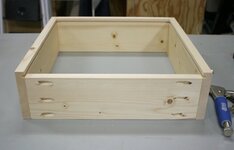
Yes, it is 1/2" baltic birch, prefinished on one edge and bothsides. The prefinished edge is slightly rounded. Comes in 8' lengths.

Thanks for the tip on the Hitachi crown nailer. I have a PC finish nailer that I picked up before they went Chinese. A real workhorse.

Dovetails in front of drawers for strength. Was told that staples in back are OK as there isn't as much stress there. Watch Norm Abrams make a set that way once on TV. He actually used a finish nailer and glue on the back.If it's good enough for him, then I'm OK with it.
 
OP
L

lilscorpion

Well-known member
Joined
Mar 15, 2010
Messages
3,599
Location
Colorado
Sawdustmaker said:
Dovetails in front of drawers for strength. Was told that staples in back are OK as there isn't as much stress there. Watch Norm Abrams make a set that way once on TV. He actually used a finish nailer and glue on the back.If it's good enough for him, then I'm OK with it.


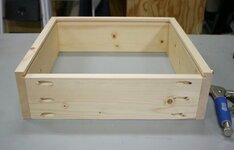
Was this how the rear of the drawer looked? The bottom gets inserted form the rear and them stapled flush to the back?

347200e7a52cc8f14aee0e72e73f2dcd.jpg
 

Attachments

  • 347200e7a52cc8f14aee0e72e73f2dcd.jpg
    347200e7a52cc8f14aee0e72e73f2dcd.jpg
    41.8 KB · Views: 6

Sawdustmaker

Well-known member
Joined
Jan 15, 2017
Messages
928
Location
Placentia, Orange Co., California
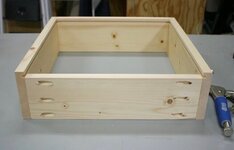
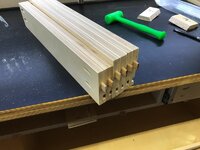
Was this how the rear of the drawer looked? The bottom gets inserted form the rear and them stapled flush to the back?
347200e7a52cc8f14aee0e72e73f2dcd.jpg

Yup, that's how he did it. What I've done in the past (using pocket holes) is install the back so that it also captures the bottom of the drawer, and install screws from the side. When I built my pullouts in the kitchen my pocket holes were on the sides. Screws went into front and back. The holes do show, but the slide pretty much covers them, so nobody has noticed. Built them 8 years ago. Three of them are carrying quite a bit of weight and are holding up well. Used 100 lb full extension slides for the pantry and the lighter weight Blum slides for the others (pots & pans, etc).
If I get a chance later today, I'll get a pic and attach. Busy around the house today. On a short break right now.:)
 

Attachments

  • 347200e7a52cc8f14aee0e72e73f2dcd.jpg
    347200e7a52cc8f14aee0e72e73f2dcd.jpg
    22 KB · Views: 3

Sawdustmaker

Well-known member
Joined
Jan 15, 2017
Messages
928
Location
Placentia, Orange Co., California
Was this how the rear of the drawer looked? The bottom gets inserted form the rear and them stapled flush to the back?

347200e7a52cc8f14aee0e72e73f2dcd.jpg

Got a chance to snap some pics. The material is 5/8" baltic birch. Drawer bottom in the pantry is 1/4" ply, drawer bottom for pots & pans is 1/4" hardboard. Yes, I know they are unfinished and probably should have put the pocket holes on the inside. This was my first project with pocket holes (10 years ago now that I recall). I was under the gun with the wife "urging" me on and with a daughter's wedding coming up (in Hawaii). When I installed them my wife even commented, "They aren't finished". I said, "I'll do it later". Well later is now, so another facet to the kitched project. Doors are done, now drawers, then paint and finish.
 

Attachments

  • IMG_1987.jpg
    IMG_1987.jpg
    133.8 KB · Views: 318
  • IMG_1985.jpg
    IMG_1985.jpg
    134.8 KB · Views: 312
  • IMG_1984.jpg
    IMG_1984.jpg
    138.1 KB · Views: 360
  • 347200e7a52cc8f14aee0e72e73f2dcd.jpg
    347200e7a52cc8f14aee0e72e73f2dcd.jpg
    22 KB · Views: 10
OP
L

lilscorpion

Well-known member
Joined
Mar 15, 2010
Messages
3,599
Location
Colorado
Drawers for the New Bench

With the main bench box assembly completed, it’s time to move on to the drawers but first I slide the top back on the cabinets so I can use the space for assembly. The drawers take much longer to machine and assemble than the main cabinet boxes. The drawers are multi-process and, in many cases, I have to switch between setups to build a complete one. As a result, it’s fairly easy for me to screw up by simply referencing of the wrong edge on one of the operations thus making a bunch of firewood quickly.

Here’s my process for building drawers: Rip sheets to width on the table saw, Machine the dado for the drawer bottom, cut them to length on the miter saw, cut domino (mortise and tenons to aid in assembly), cut the pocket hole screws, rip the bottom on the table saw, cut the bottom to final length with the track saw, and then assemble. Once all the machines are setup, the process goes fairly quickly. Here’s some of the drawer fronts and the backs.

IMG_2233.jpg

The trick is to not get things backwards between operations. After a few screw ups I decided to make some fixtures to help make sure that I have reference marks to help me keep things straight.

IMG_2231.jpg

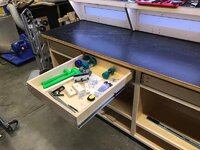
First drawer sometimes requires a little tweaking to get all of the parts to fit right but after all of the measurements are dialed in, all can be slammed together, drawer slides installed in the bases, and drawers loaded in place. This gives you an idea of what a 24-inch deep drawer projects like into the shop.

IMG_2238.jpg

Now l have a place to keep my tools during the remainder of the build process. It’s nice being able to put things away in between operations.

IMG_2236.jpg

4 drawers down and what feels like 100 to go. This is how I decided to leave it Saturday night. Felt kinda deflated but it was nice to have a few drawers that are actually usable. Before I went inside I rummaged through my cabinet materials and found a couple more sets of slides but that leaves me about 15 pairs short for this cabinet. Guess Installation will have to wait until next week.

IMG_2239.jpg

IMG_2242.jpg

Sunday was a rough day. I knew I had a mess of drawers to build and it's really cold here right now so I feel kinda slow (my hands especially). Yesterday I was only able to build 4 drawers and pre-cut another few. I stood there looking at the mountain before me without interest until the coffee kicked in. It was then that I noticed something I hadn't seen before in the drawing or all of the times I've walked past the cabinet since it was installed. I realized that if I had full width drawers on the left side of the base I’d have to build complex dividers in the drawers themselves to enable the kind of organization that I wanted to have. Since many of my organizers were coming from a 26x18 craftsman box, I realized I had an opportunity to make things easy on myself if I were to make drawers that were close in size so the organizers could damn near be a drop-in fit. After pulling the tape on the craftsman boxes I realized that the insides of the drawers were nearly exactly the same width-wise as the drawers I was building depth-wise. That mean that I needed to add a divider to the mid-section of this box that allowed me to have drawers that were ~16 1/2-inches wide (inside dimensions). If the internal dimensions need to be 16 1/2 inches then, to figure the width of the hole I need to add to that 2 x the drawer slides and 2 x the drawer sides.

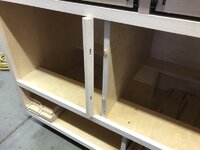
Adding a divider is extremely easy given how I construct my boxes and I happen to have access above and below which will allow me to screw the divider in place. After sliding in a dimensionally correct piece, I machine in the dominos to retain the face frame and trim down some maple to fit.

IMG_2259.jpg

And you press it on and get a snug fit. More or less, glue almost isn’t necessary after the drawer slides are installed (the outer screw goes into the face frame).

IMG_2260.jpg

Just to give you an idea of the accuracy capabilities of this construction process, I used my laser to grab a measurement from one face-frame the other (top and bottom). The height difference between both sides of the opening is about the same (remember I’m a machinist so “about” is relative) - 15 11/6 and 15 21/32

IMG_2262.jpg

And width dimensions top and bottom of the opening - 19 1/8 and 19 5/32.

IMG_2264.jpg

In both dimensions the “hole” is within 1/32. After seeing both sides are off by 1/32 I actually paused in an attempt to figure out where my variance is. I suspect that it could be coming from two places - It’s possible that I’m not getting a perfect cut on the table saw when I cut the face frame material to the final width OR it could be that I’m not getting the domino perfectly flat on the material as I cut the domino mortise OR a combination of both. Worrying about it is a waste of time though, I should just say sweet and get on with it…so…sweet. Now I can make all the drawers the exact same size.

I have a few final touches I need to make before I can begin drawer-a-thon 2018. There are a few small face frame parts that I needed to install but couldn’t previously because the Domino fence is too big to fit. I instead use a dowel fixture to drill both the cabinet and the face frame piece. What makes this stupid easy is that the dowel fixture is self centering. If you don't have a domino, this is another great way to attach face frames easily and accurately.

IMG_2267.jpg

IMG_2268.jpg

I use a little CA glue to retain the dowels into the box assembly, let it dry, and then press on the face frame piece.

Now I’m ready to get started on building the multitude of drawers. The remainder of Sunday was spent machining all the drawer components. To keep things straight, I cut up the pieces and then stack them within the holes they’ll eventually the installed in. I was able to assemble 4 more drawers before I ran out of time but since I didn't have drawer slides I was only able to stack then their holes. This weekend sure doesn't look like progress.

IMG_2296.jpg
 
To avoid these ads, REGISTER NOW!
Top Bottom