Dave455
Well-known member
Now that you mention it, you might be right!
I was going from memory of pictures I saw, some years back now! In that picture it does look as though the join is where the groove for the ring is!
Now that you mention it, you might be right!
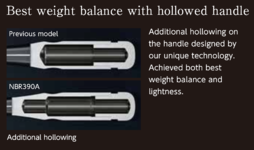
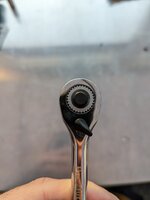
I'm guessing that the rubber ring is also there to hide the seam between the hollowed out handles and the caps on the larger ratchets.
Personally prefer the screws through the head into backplate design because if the threads ever strip you've only ruined the backplate instead of the ratchet body. Considering Nepros ratchets aren't cheap throwaways, they're keepers that you hold on to long term, and the screws on the 1/4" and 3/8" ratchets are tiny it'd be an actual improvement to switch to this design if they're going to bother making changes. As I said though I expect it's a form over function choice. I wouldn't say it's uncommon these days either, all my ratchets are modern fine tooth and most of them screw through the head into the backplate.Not sure why you would expect screw heads on the top cover? I mostly see that on older production, it's fairly uncommon on modern tools.
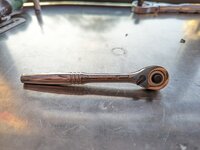
At this end of the spectrum/price I'd rather a band of knurling than a rubber ring on their sockets. If quick identification is what they're going for they could add a painted groove as well similar to Wera sockets. Either way don't see the point of a little rubber ring on their ratchet handles, personally would rather they were finished completely smooth if there isn't a need for a groove for the join.It also gives gripping surface to turn the socket with thumb and finger. Same for the ratchet spinners (which work great).
Personally prefer the screws through the head into backplate design because if the threads ever strip you've only ruined the backplate instead of the ratchet body.
I agree about prefering metal knurling, I have concerns about longevity on the rubber, especially when exposed to fluids. The edges are kind of sharp when you remove the rubber though, I may see if I can bend a brass strip into place or maybe thermo-form plastic as a replacement at some point.At this end of the spectrum/price I'd rather a band of knurling than a rubber ring on their sockets. If quick identification is what they're going for they could add a painted groove as well similar to Wera sockets. Either way don't see the point of a little rubber ring on their ratchet handles, personally would rather they were finished completely smooth if there isn't a need for a groove for the join.
That's fair, as I said before none of this is a big deal, more nitpicking. I just thought as they've bothered to make changes to their 3/8" ratchets it'd be worth changing to the screw through head design as well. I took the fact they hadn't as a form over function choice but as you've outlined there's more to it than that. I've seen people referring to Nepros as heirloom tools, just seems a shame to potentially ruin such nice ratchets because of a little screw versus fitting a new backplate, even though there are disadvantages to the screw into backplate design. As you say ideally people would just take care when rebuilding their ratchet and it wouldn't really matter either way how it's designed but stripping the threads on a ratchet body can and does happen.I see your point, I just don't think of it as a very practical issue unless the rebuilder is particularly careless. There are, however, significant functional advantages to putting the screws through the rear:
Old Proto, Snap-On, Hazet, Stahlwille, Gedore, etc. are all the way that you describe but the newer gen tools from basically everyone have switched to either screws through the bottom or a snap ring/spring clip (my personal preference). It would be inaccurate to call it "form over function", it's a functional evolution the same way that we now have stronger multi-tooth engagement and higher tooth counts.
- Way more thread engagement in the head (not limited by backplate thickness) = stronger connection and less likely to come loose or be accidentally crossthreaded.
- Screws with chamfered seats help align backplate during re-assembly.
- No long unthreaded shank with potential slop/misalignment in the through-hole.
- The head can potentially be a little slimmer without the need to drill a hole all the way through the sides.
Neither are great durability wise, as you say though it's quicker to swap a rubber ring versus reapplying paint. Don't think anything will beat ensuring you buy sockets with stamped sizes and painting them yourself if colour coding/visibility really matters to someone. I get that some people treat Nepros like jewellery and aren't going to want to apply paint to them or anything like that, there's no perfect solution.I get what you are saying about paint but I don't think that would hold up to Nepros durability standards, whereas the rubber can be easily replaced or swapped out for different colors depending upon use/wear.

Beautiful.
Could you provide more info on the Nut Grip? I would like to check that out.Oh, and a shout out to the Ko-Ken breaker bar, and Nut Grip socket. I only have a 10mm but will be adding more at the next opportunity. The Nut Grip has already saved me a couple of times from dropping a nut in a deep, dark place. It's very helpful both for removal and reassembly in tight spots.
https://letmegooglethat.com/?q=Koken+nut+gripCould you provide more info on the Nut Grip? I would like to check that out.
To be fair I would be hesitant to google “nut grip”https://letmegooglethat.com/?q=Koken+nut+grip
Its Ko-Ken's holding function sockets. Two ball bearings squeezed by an outer coil spring.
very close to spitting my beer on the computer screen....To be fair I would be hesitant to google “nut grip”
There's a good cutaway view and description here: https://kokenusa.com/pages/nut-grip-socketsCould you provide more info on the Nut Grip? I would like to check that out.
Reviews seem legit and there's a price history on camelcamelcamel. It looks like it's just a really good time to buy.Anyone know if the Mitutoyo 505-732 150mm Dial Caliper from Amazon is genuine?
Price seems too good... 41% off, "lowest price in 30 days".
Anyone know if the Mitutoyo 505-732 150mm Dial Caliper from Amazon is genuine?
Price seems too good... 41% off, "lowest price in 30 days".
Reviews seem legit and there's a price history on camelcamelcamel. It looks like it's just a really good time to buy.
Too bad the inch model isn't going as cheap.

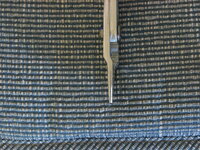
Can expect nothing but quality from Mitutoyo. However, I specifically bought the fake digital calipers off of Aliexpress for my own home needs. I think they were 25-30$ at the time. For that kind of money, probably the best calipers on the market - or at least, way better than the generic chinese digital offerings for 15-20$. At least, they are really "absolute", which is a feature I always missed on cheap digital calipers. If you really take some precise measurements, it's best to have something that's true to size to calibrate them anyway (like, if you measure something around 50mm, calibrate them with a 50mm bearing and you'll have a very exact measurement). But that's something that is needed even with a genuine mitutoyo if you really want to be exact. I have genuine higher end Mitutoyos at work, they're nice for having the carbide tips but overall I'd say the chinese ones at home aren't notably worse. Only thing I noticed is that there's some discrepancy between the ID and OD jaws (I think 0.02mm), but that's definitely the hardest thing to grind accurately and it's fine if you know about it.I just got these calipers in today. They look quality-made as I expected with the exception of the plastic flex hinges on the plastic case, which will eventually crack/break. Oh well, maybe I'll rig up a nice case for these metric calipers and my inch calipers. If I hold the head and bounce the slide a little the needle moves (see the pic), but when I open and close it the needle goes back to zero every time. Just shows the nature of the dial mechanism, and that I'll have to be careful with these calipers.
The youtube vid "17 Warning Signs Your Mitutoyo Calipers Are Fake" by Clough42 at
is about digital calipers, but the points in common with my dial calipers indicate I have a genuine Mitutoyo product. All his points about typograpical and printing minutiae jive, as do the points in common between his digital calipers and my dial calipers and the construction/manufacturing of the cases.
All in all, I am very satisfied!
![]()
Can expect nothing but quality from Mitutoyo. However, I specifically bought the fake digital calipers off of Aliexpress for my own home needs. I think they were 25-30$ at the time. For that kind of money, probably the best calipers on the market - or at least, way better than the generic chinese digital offerings for 15-20$. At least, they are really "absolute", which is a feature I always missed on cheap digital calipers. If you really take some precise measurements, it's best to have something that's true to size to calibrate them anyway (like, if you measure something around 50mm, calibrate them with a 50mm bearing and you'll have a very exact measurement). But that's something that is needed even with a genuine mitutoyo if you really want to be exact. I have genuine higher end Mitutoyos at work, they're nice for having the carbide tips but overall I'd say the chinese ones at home aren't notably worse. Only thing I noticed is that there's some discrepancy between the ID and OD jaws (I think 0.02mm), but that's definitely the hardest thing to grind accurately and it's fine if you know about it.
I really like the digitals for measuring distance differences. Like, if you want to know the difference between two same size holes. You measure the size of one hole, zero the digital caliper, then measure the longest distance between the holes and you directly get the centre distance. Or if you want to know depth differences, like you know something edge is at 25mm, you zero the calipers to 25mm and then you can measure how much higher or lower a different edge is, or how crooked the surface is etc... You can do all this with regular calipers but it requires writing down measurements and calculating, instead of just directly reading it off the calipers.
In terms of accuracy, digital calipers aren't really better. They may make you assume they're more accurate for having a 0.01mm resolution, but if we're reasonable a caliper is not the right tool to use to measure anything below ~0.05mm, it just won't be consistent. Advantage of digital is how easy it is to read and how you can zero it wherever you want, but nothing more. Dial calipers don't need batteries (though digitals last for a long time so it's not really a big issue) but they're also very accurate. Vernier are cool for always being an absolute scale (to be honest, dial too) and very cheap and also just as accurate if well made, but hardest to read (especially in a dimmly lit garage).Thanks. I specifically bought these dial calipers because I do not need the accuracy/etc such as what you need. I just **** around in the garage and knew from using my old inch dial calipers that Mitutoyo dial calipers will always 'out-perform' the capacity I need.
I use an old Starrett case for my Mitutoyo calipers.I just got these calipers in today. They look quality-made as I expected with the exception of the plastic flex hinges on the plastic case, which will eventually crack/break.


Anyone know if the Mitutoyo 505-732 150mm Dial Caliper from Amazon is genuine?
Price seems too good... 41% off, "lowest price in 30 days".


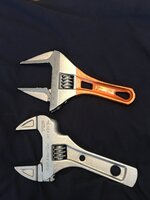
I believe TOP typically designs their wrenches with metal handles first and then offers a dipped grip version as an extra. That way they can use a single forging and if the grip does wear out, you can cut it off and still have a functional handle underneath. A very practical approach.On a side note I was surprised to find Top had there makers mark underneath the blue grip (that I removed).
I’m not really a fan of soft grips because my tools end up getting nasty one way or another. So as soon as I ordered the Fujiyas I just cut the grip off.I believe TOP typically designs their wrenches with metal handles first and then offers a dipped grip version as an extra. That way they can use a single forging and if the grip does wear out, you can cut it off and still have a functional handle underneath. A very practical approach.
That said, I do quite like the colored grips on mine. The are done quite well with no drip marks and the texture is very matte with no sticky or tacky sensation.
In the last 6 months I've had roughly the same experience. Shipping costs for amazon.jp tools used to be 15-20% on an order of, say, a dozen items. Now it's 30-40-50%.Anyone else seen a big price increase in shipping from Amazon.jp?
Used to be reasonable but the last couple times I put some stuff in my cart and checked it was too high to be worth while.
I just had 4 items in my cart for about 80,000 yen (about $80CAD) and the shipping was 75,000 yen.
Used to be around 15,000-20,000 yen for the same amount of stuff or weight.
thought I was the only one seeing an increase. bought some items a few months ago with cheap shipping. Now just yesterday was going to purchase some screwdrivers and the shipping was almost 50%. came out to be 174$ for 80$ ish worth of items.Anyone else seen a big price increase in shipping from Amazon.jp?
Used to be reasonable but the last couple times I put some stuff in my cart and checked it was too high to be worth while.
I just had 4 items in my cart for about 8,000 yen (about $80CAD) and the shipping was 7,500 yen.
Used to be around 1,500-2,000 yen for the same amount of stuff or weight.