Growing up, my dad had pegboard above the sturdy workbench that we had at two houses. It wasn't loaded with tools but it served a purpose.
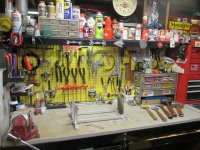
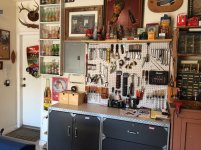
It wasn't until recently that I had a dedicated space for a garage workshop. I chose to use Whirlpool Corp.'s Gladiator track system which mounts to the wall, 6" wide x 4' long w/continuous horizontal channel slots for using a variety of their storage products. The Craftsman Geartrack system is similar, and I've found the dimensions are similar enough that the removable storage brackets are interchangeable. I actually prefer the Craftsman Geartrack brackets because they have a 90* throw locator lever that locks the hanger in-place (top & bottom) more-securely than the Whirlpool Gladiator design.
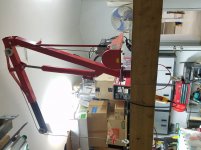
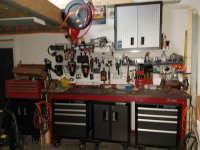
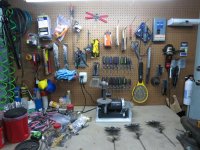
I have an 8 ft workbench frame w/a 1-1/2" solid wood top, and that's topped w/a 3/16" steel sheet, held to the frame w/countersunk 1/4" flathead machine screws. A decent vise mounted to a 2 x 8 scab of wood held in place w/a sturdy c-clamp (removable if I need to), next to that a swiveling magnifying lens, lit by a concentric circular fluorescent lamp, w/an additional movable loupe, and that lamp pivots on its mounting pin drilled into the vise wood piece.
At the other end I have a 6" grinder, one stone, one wire wheel. I had to source a good American wire wheel because the offshore ones would make the grinder jitterbug around because of the crappy balance, or rather the lack of balance, the USA wire wheel was close to $40 but worth it. I also don't end up looking like a porcupine from the shedding bristles of an Asian one.
Underneath I have Craftsman roller cabinets, two are 4-drawer units, two are two-door units. If I needed to I can move them all out from under the workbench in perhaps 90 seconds, which I do periodically to roust the 'daddy longlegs' that appreciate the space for housekeeping.
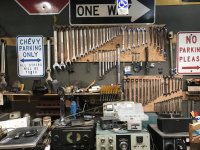
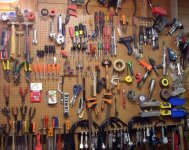
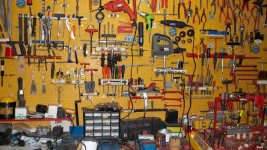
The tool hangers I have on the wall carry a bunch of things, metric and SAE combination wrenches, hung on a Craftsman plastic snap-in tool tote; hanging on two long pins, a blow-molded plastic box for a 1/4" drive socket set; and various brackets for frequently-used hammers, pliers, and screwdrivers; two 19.2 volt battery chargers so I can remove the battery, and just press it 'into' the charger receptacle, and remove it just as-easily, with a firm 'pull,' which keeps the workbench free of charger clutter, and fresh batteries directly in-front of me; a 3' shelf mounted up high, well-above my head, for storing a variety of whatever I need stored, short-term, I use some of my wife's discarded baking pans here, because they come w/snap-on plastic lids to ensure no parts go missing; the front of the shelf I have mounted a US General magnetic strip, where I hang my wire cutters, 1/4", 3/8" and 1/2" 5/16" hex to square drive adapters;back on the wall I have multiple plastic clip-in bins for holding spray cans of WD-40, PB Blaster, Sharpies, pencils, tool receipts until I don't need them, work gloves, some ratcheting strap tie downs, and some kept empty to collect small parts from whatever I'm working upon, until they are retrieved; and some different Vise-Grips for fabrication or clamping. I don't do a lot of welding, but I've got a light duty stick welder, a flux-wire welder, and an acetylene 'trench tank' setup for on the job soldering, and an oxy/acetylene cutting torch stored elsewhere. No welding table yet, not sure I need one for the amount I do. I also hang nut drivers clipped into a plastic carrier; a cloth roll hung from grommets for punches and chisels; and a drill index. I also have a selection of adjustable wrenches on a common pin, and pipe wrenches on a common hanging pin.
Above the wall storage I have a welded steel Gladiator 30" square x 12" deep two-shelf cabinet tapconed to the CMU wall, and underneath it I have a 33" LED light strip. I have three double-duplex 120 V outlets above the workbench, and a 240 V 20 amp service receptacle for saws or welders.
I have a HFT auto-retracting 50 ft. air line from my 240 V compressor above one end of the workbench, plenty of length to reach out into the driveway to air-up tires, or to blow away leaves from the driveway.
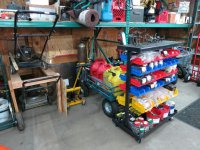
What I have hung on the wall are tools I use frequently, I don't keep a valve-spring compressor there, that's in a toolbox, along with other specialty tools and supplies, and I have several stackable toolboxes that are of-course, roll-arounds. I don't need a 5 ft long box, 5 ft high, to be in the way, space in my shop is at a premium. I can push/roll all my tools into one bay to give me an open 1 car space, if I needed it, but the vehicles stay outside, hey, it's south Florida. The exterior wall opposite the tools and workbench is also Whirlpool Gladiator product but it's pallet-style shelving, originally 18" deep, I cut them down to 13" depth, so they don't protrude into the garage OH door space, as my returns next to the OH garage doors aren't much-more than that. I store smaller portable tools like wood and metal chop saws, gas welding tanks (small ones), a combination belt sander/disc sander, a benchtop scrolling saw, and numerous smaller portable toolboxes holding hand tools and supplies for various types of work. Every three ft. I have a duplex outlet about 46" high, for three sides of the garage, and a double duplex between the two front single OH doors about 16" off the floor, and another at ~7-1/2 ft. for a shop lamp hung below the OH door tracks, between them.
I have a 13' x 20' loft at the rear half of the garage for storage, and a hydraulic 360 degree pivoting 'cherry-picker' to allow me to get heavy, bulky items up or down. It's my 'loft-lift.' I adapted a 120 V electric winch to the 'cherry-picker' and the two pieces are rated at 2,000 lb. for their short length and double line pull, and 1,000 lb. for an extended boom length and a single-line pull. The loft was designed for hundreds of pounds per sq. ft. and it has a front steel box beam of 4" x 8" x 1/2" welded to flitch plates set into the CBS walls on either side, for the loft floor joists to anchor-to at the open end, and a CBS wall for the ledgers on the opposite closed wall. It was all done by an architect and structural engineer. There are no stairs to the loft, and the headroom isn't quite 5 ft at the ridge beam which tapers to about 3 ft at the sides. I would have liked a full second story, but we didn't have the $$$$ and the stairwell to it would have taken a good deal of floor space, and made it a 1 car garage w/less than a 1 car space next to it. Compromises. I have motorcycles as a hobby, and the loft gives me space for secure, dry conditioned storage of parts and other household items. I put shelving above the high-lift OH garage door tracks for light, bulky storage, perfect for Christmas decorations, and long building material, or unused storage containers, nesting in one-another.
For me, the advantage of the wall storage is that tools I use frequently are an arm's-reach away, no drawer to open, and easily replaced. I can inventory the tools at a glance, and see what's still 'out,' and what needs to be replaced. It works for me. If you like a six-foot long Snap-On cabinet five feet high, this isn't for you. My entire tool inventory probably wouldn't buy one of those monsters. But, I've maximized my space, and can easily accommodate shifting things around as I change needs.
I also use the space between the bays of the loft. I used 1/4" masonite fastened to the bottoms of the loft floor joists to provide storage, I chose 12" as a good depth for each bay, the anti-racking reinforcement scabs of wood between the floor joists and the masonite make perfect compartments for HFT plastic bins to fit two-abreast in the compartments. In other loft bays, I installed cast-iron shelving irons to support pipe clamps and longer metal stock. Another couple of bays house my 3 ft and 5 ft levels, hung from exterior-grade screws.
The back wall of one side of the garage holds three 30" square x 12" deep Gladiator welded-steel cabinets. They are mounted ~54" above the slab so the vehicle can comfortably pull forward. The wall is CBS, so they are mounted via tapcons w/flat-washers and a ledger beneath. The Gladiator cabinets have two adjustable shelves and steel pegboard strips on the inside of the doors. I use the pegboard to hang masonry and metal cutting discs, pneumatic power fittings, containers of fasteners, and whatever-else I need stored, and found easily by opening a door, at-a-glance.
I have a pneumatic platform lift for my motorcycles, a Handy Air Lift, and my back thanks me.
My space is constantly evolving, as I think of something I can easily change the layout, and inspiration comes from reading fellow members' posts. As has been said, necessity is the mother of invention.