No doubt. It’s likely too slow for a pro, even in a dead-quiet environment. For the amateur without an angle TW however, it’s a useful trick to know. Never know when it could come in handy …Not in any working shop I've been in. Without a stethoscope anyway.


You are using an out of date browser. It may not display this or other websites correctly.
You should upgrade or use an alternative browser.
You should upgrade or use an alternative browser.
Torque Wrench Ranges
- Thread starter oldschoolcraft
- Start date
joshmodelskidoo
Well-known member
I mess with different stuff and use HF torque wrenchs. I prefer the click style but torque angle is used a lot so I would recommend digital with built in torque angle. I know the torque speck for lug it's on our traverse is 149ft lb so I would recommend the bigger 1/2in wrench
Hohn
Well-known member
Somewhat.Does the use of angle reduce the need to be concerned with whether the fastener is dry or wet?
The variation in straight torque is due to variation in the friction, or K-factor. (T=KDF). By replacing a portion of the bolt's stretch with angular rotation instead of torque, you have confined the friction variable to only that part to where the torque applies.
Unlike torque, rotation is very highly correlated to actual stretch. If I have an M10x1.5mm bolt, one rotation will give darn near 1.5mm of stretch.
So the most precision in a torque+angle spec comes when you set the torque low and the angle high. (say, 10Nm+180° instead of 30nm+90°, for example).
The lower the angle, the closer to straight torque you get. Which means you end up with more of that variation due to friction.
But the k factor is the short end of a VERY long lever. So you can't just pretend that dry vs lubed is irrelevant, because it might be as much as TWICE as much stretch for the same torque lubed. I've tested dry film lubes like Precote 709 and saw a nut factor as low as 0.08 result. Which means that the torque spec developed for an dry manganese phos coated bolt (0.18 nut factor) more the DOUBLED the stretch. Needless to say, we never even got to the nominal torque spec before the bolt yielded badly.
SO yes, the angle does reduce the sensitivity to k-factor variation by confining it to a fraction of the total bolt stretch. But the remaining fraction can still have a lot of variation between "dry or wet" and in my judgment it's something that still must be considered if the joint is to work.
OP
oldschoolcraft
Well-known member
I'm here to learn and maybe make a few friends along the way. Arguing or being defensive is counterproductive to both of those goals.Oldschoolcraft (OP) has a thick skin-- good on him.
OP
oldschoolcraft
Well-known member
Damn that makes a lot of sense but the Proto torque wrenches I'm getting (for now) have no overlaps. I might get a tech angle later, right now I'm pretty distracted by my leaking transmission pan I need to replace ASAP and I dont have a torque wrench that can go below 20 ft pounds so I ordered a Proto in the smaller range.I'm no torque expert, but I don't think that anyone has advised trying to stay out of the bottom 10% of the range of a torque wrench due to inaccuracy. Maybe I missed an earlier comment though. I'll use the bottom 10% in a pinch, but I can usually get into the middle range of a different wrench.
But they have no overlaps, it's basically 3 to 16 foot pounds, then 16 to 80 foot pounds.
You're fine. It's 20% of the scale (max) not the top 80% of the listed range. There is a reason the Proto is sold as 16-80 Lb-Ft. The accurate range is 20% of full scale to 100% of full scale, so 16 lb-ft up to 80 lb-ft.Damn that makes a lot of sense but the Proto torque wrenches I'm getting (for now) have no overlaps. I might get a tech angle later, right now I'm pretty distracted by my leaking transmission pan I need to replace ASAP and I dont have a torque wrench that can go below 20 ft pounds so I ordered a Proto in the smaller range.
But they have no overlaps, it's basically 3 to 16 foot pounds, then 16 to 80 foot pounds.
Also, nice choice on the Proto. I own 3 of them, two being about 20 years old, and they've held calibration in home use this whole time with the last check about a year ago. The high tooth count and wide head is the only potential drawback to them but neither has ever been a problem for me in general automotive use and they're used extensively in aerospace production and MRO environments as well.
Wamsutta
Well-known member
Man this thread has gotten to be complicated as a mother effer. 
OP
oldschoolcraft
Well-known member
I learned a lot, I never heard of torque-angle before. I didn't even know it existed, so there'd have been no way for me to research it before because it was an unknown-unknown. So I'm glad I asked the question!Man this thread has gotten to be complicated as a mother effer.
We’ve had problems with torque at work. I’ve been involved with some of them. Properly applying torque to a mechanical joint is one of the most basic operations we perform when we build or fix things. Yet even pros with the right training and tools:Man this thread has gotten to be complicated as a mother effer.
a) don’t seem to understand it
b) absolutely don’t do it right
up to and including not knowing how to use the wrench.
In automotive, there’s a wide range of consequences from gasket and seal failures, to minor wear or corrosion, to brake rotor warpage.
In this thread, you can see folks not really wanting to go to the trouble to do the job right. One guy thinks torques have +/- 20% tolerances. No data, just his rationalization for why whatever he does or thinks is okay. Believe it or not, we see this same concept in our factories.
It makes me wonder what else might be wrong. I’m fairly convinced folks here on GJ don’t know how hammers work, what happens when you hit a vehicle part with a hammer, or how to select the right hammer for a given task. Some here have admitted to breaking multiple hammers!
This isn’t really a complicated subject. These are basics everyone working on passenger vehicles should know.
Hohn
Well-known member
Agreed completely.
I've come full circle though, going from complete ignorance to understanding torque specs to wanting to be as precise as possible to realizing that "gudenteit" under some conditions is basically as precise as hitting the torque spec.
In addition to the aforementioned k-factor test, I had another situation highlight for me just how illusory can be the "precision" of nailing the torque spec. Here's the story:
IN development testing, we often reuse the HP fuel lines even though we strongly encourage customers to never reuse them. This is because we are constantly swapping injectors and adjusting valves and inspecting overheads-- replacing the lines each time would cost a small fortune.
The steel HP fuel lines on modern diesels generally are ball-on-cone designs where torqueing the nut to spec will plastically deform the ball end to conform to the conical seat-- this generates the sealing pressure needed to keep 2500bar or so where it's supposed to be. This deformation is essentially a near perfect correlation with axial load and yield strength of the tube alloy.
I was called to a test cell where a fuel line was leaking after having been reused a few times, somewhat typical. I asked the tech to show me how he torqued the line nut. He showed me the torque wrench setting was to spec, then showed me exactly what he did. I noticed that when he torqued the line, the nut had barely rotated 45°-60° from snug when the wrench beeped indicating proper torque. Satisfied that he'd installed it properly, I had him replace the line and I looked at the leaking part.
I saw the normal evidence of leakage on the old part (cavitation at the seal surface creates an orange peel like surface texture, sometimes it will even blue from the heat of depressurization) but I didn't see anything else that stood out as wrong.
But then I noticed that the new part going on took nearly 360° of rotation before the same torque wrench beeped indicating correct torque. Hmm. How could that be?
A closer look at the old line showed that the inside of the retaining nut was galling against the line's ferrule when it was disassembled. Some quick impromptu testing showed rather clearly the that same "torque spec" was producing differing axial loads because each time the line was removed, it would gall a bit worse and raise the k-factor higher and higher. Eventually it would get so high that the "spec torque" was producing less than half of the design axial load. And it only took 3 installations of the same part to where you'd lose the statistical confidence that it would seal.
My takeaway from this experience was that a torque spec without a valid k-factor value is like specifying a maximum restriction without specifying the flow rate at which it would be measured, or the fluid properties of the fluid flowing in the line. It's incomplete at best, grossly wrong at worst.
I no longer torque my lug nuts "to spec". Because either the spec is way too high (if I've applied some anti-seize) or it's way too low (because its rusty). If you cannot replicate the k-factor under which the torque spec was validated, then the torque spec is nearly useless. Even small changes in k-factor can easily make the spec off, sometimes by a lot.
It's one thing to torque to spec internal engine bits that have always been bathed in oil and have essentially the exact same k-factor for their entire lives. But it's entirely another thing to torque "to spec" a rusty chassis bolt or suspension component. Heck sometimes even without rust the spec will be way off. (say your bolt is a zinc chromate finish part and you've cleaned it with brake cleaner. The k factor is off because the bolts as installed at the factory will have a thin film of oil on them. Same goes for all black oxide and manganese phosphate coated parts which derive their corrosion resistance *entirely* from the oil the coating retains-- the coating itself offers essentially no corrosion resistance. You blast it with brake cleaner, remove all the oil and you've altered the k-factor as you remove the corrosion resistance).
I believe this is why so many home gamers and less professional shops have been getting away with "gudenteit" for so long-- experience has taught them when torquing "to spec" will result in joint failure when it comes loose.
Generally speaking, a bit too tight is safer than too loose anyway, although as always "it depends."
When using virgin parts or building from new-- by all means FOLLOW THE SPEC, including which lube to apply or not apply.
But in a reuse scenario where you are wrenching on rusty hardware, following the spec might cause everything to be woefully undertightened.
I've come full circle though, going from complete ignorance to understanding torque specs to wanting to be as precise as possible to realizing that "gudenteit" under some conditions is basically as precise as hitting the torque spec.
In addition to the aforementioned k-factor test, I had another situation highlight for me just how illusory can be the "precision" of nailing the torque spec. Here's the story:
IN development testing, we often reuse the HP fuel lines even though we strongly encourage customers to never reuse them. This is because we are constantly swapping injectors and adjusting valves and inspecting overheads-- replacing the lines each time would cost a small fortune.
The steel HP fuel lines on modern diesels generally are ball-on-cone designs where torqueing the nut to spec will plastically deform the ball end to conform to the conical seat-- this generates the sealing pressure needed to keep 2500bar or so where it's supposed to be. This deformation is essentially a near perfect correlation with axial load and yield strength of the tube alloy.
I was called to a test cell where a fuel line was leaking after having been reused a few times, somewhat typical. I asked the tech to show me how he torqued the line nut. He showed me the torque wrench setting was to spec, then showed me exactly what he did. I noticed that when he torqued the line, the nut had barely rotated 45°-60° from snug when the wrench beeped indicating proper torque. Satisfied that he'd installed it properly, I had him replace the line and I looked at the leaking part.
I saw the normal evidence of leakage on the old part (cavitation at the seal surface creates an orange peel like surface texture, sometimes it will even blue from the heat of depressurization) but I didn't see anything else that stood out as wrong.
But then I noticed that the new part going on took nearly 360° of rotation before the same torque wrench beeped indicating correct torque. Hmm. How could that be?
A closer look at the old line showed that the inside of the retaining nut was galling against the line's ferrule when it was disassembled. Some quick impromptu testing showed rather clearly the that same "torque spec" was producing differing axial loads because each time the line was removed, it would gall a bit worse and raise the k-factor higher and higher. Eventually it would get so high that the "spec torque" was producing less than half of the design axial load. And it only took 3 installations of the same part to where you'd lose the statistical confidence that it would seal.
My takeaway from this experience was that a torque spec without a valid k-factor value is like specifying a maximum restriction without specifying the flow rate at which it would be measured, or the fluid properties of the fluid flowing in the line. It's incomplete at best, grossly wrong at worst.
I no longer torque my lug nuts "to spec". Because either the spec is way too high (if I've applied some anti-seize) or it's way too low (because its rusty). If you cannot replicate the k-factor under which the torque spec was validated, then the torque spec is nearly useless. Even small changes in k-factor can easily make the spec off, sometimes by a lot.
It's one thing to torque to spec internal engine bits that have always been bathed in oil and have essentially the exact same k-factor for their entire lives. But it's entirely another thing to torque "to spec" a rusty chassis bolt or suspension component. Heck sometimes even without rust the spec will be way off. (say your bolt is a zinc chromate finish part and you've cleaned it with brake cleaner. The k factor is off because the bolts as installed at the factory will have a thin film of oil on them. Same goes for all black oxide and manganese phosphate coated parts which derive their corrosion resistance *entirely* from the oil the coating retains-- the coating itself offers essentially no corrosion resistance. You blast it with brake cleaner, remove all the oil and you've altered the k-factor as you remove the corrosion resistance).
I believe this is why so many home gamers and less professional shops have been getting away with "gudenteit" for so long-- experience has taught them when torquing "to spec" will result in joint failure when it comes loose.
Generally speaking, a bit too tight is safer than too loose anyway, although as always "it depends."
When using virgin parts or building from new-- by all means FOLLOW THE SPEC, including which lube to apply or not apply.
But in a reuse scenario where you are wrenching on rusty hardware, following the spec might cause everything to be woefully undertightened.
Last edited:
Tynee
Well-known member
OP, to go back to your original question, I've gotten by for a lot of years doing my own wrenching with nothing but click-type torque wrenches. Most of the time I had a 40-150 ft-lb 1/2", then I added a lower range 3/8" because I found it on the side of the road. My most recent purchase was a 1/4" that would get down into the low double-digit inch-lbs because I was working on a Toyota engine that required that in places. I WISH I had sprung for the larger wrench, but I tried to cheap out. I needed it for torquing the cam sprocket bolt on an LS engine to 250 ft-lbs. I tried the "tight enough" method, and it wasn't...
So, If I were in your shoes, knowing what I know now, I'd
So, If I were in your shoes, knowing what I know now, I'd
I've been researching various torque wrenches and it seems like common ranges are:
- 40 to 200 inch pounds / 3 to 16 Foot Pounds in 1/4 and 3/8 drive
- 200 to 1000 inch pounds / 16 to 80 Foot Pounds in 3/8 drive
30 to 150 Foot Pounds in 1/2 drive- 50 to 250 Foot Pounds in 1/2 drive
Good post. Interesting. Bad message tho.Agreed completely.
I've come full circle though, going from complete ignorance to understanding torque specs to wanting to be as precise as possible to realizing that "gudenteit" under some conditions is basically as precise as hitting the torque spec.
To be clear, the goal is preload in the joint, not torque. Torque is one way we can measure an input to predict the desired output (preload). When there’s friction, schmutz, etc, a perfectly torqued bolt may not achieve the required preload. Pretty sure that’s what Hohn wrote above. He’s totally right.
When you spend hours each day for years tightening bolts, you can generate muscle memory that allows you to feel the right amount of torque.
For the rest of us, we really should be cleaning and using our torque wrenches on every fastener that has a torque spec.
- When bolting patterns, groups of fasteners, that hold something, uniformity is essential. If one fastener in an 8 hole pattern has dirty threads, that fastener won’t be pulling its weight, even with perfect uniformly applied torque. So good torque technique also includes cleanliness ( which was kinda @Hohn point.)
- Whenever gaskets or seals are involved, those are always torque situations. Don’t care if your dad told you hand tight plus a quarter turn (isn’t that exactly the same as a torque to angle?) If the manufacturer published a torque spec USE IT.
So my message is: have a torque wrench and learn to use it. ESPECIALLY if you don’t work on things like this every day for years.
BTW, oil filters have seals. I think guys over torque them. Oil pan plugs have gasket washers. Use your torque wrench next oil change to check yourself.
OP
oldschoolcraft
Well-known member
Does a crush washer fall under the gasket/seal scenario of "always torque"? I assume so since you to generate a specific torque to crush the washer.
- When bolting patterns, groups of fasteners, that hold something, uniformity is essential. If one fastener in an 8 hole pattern has dirty threads, that fastener won’t be pulling its weight, even with perfect uniformly applied torque. So good torque technique also includes cleanliness ( which was kinda @Hohn point.)
- Whenever gaskets or seals are involved, those are always torque situations. Don’t care if your dad told you hand tight plus a quarter turn (isn’t that exactly the same as a torque to angle?) If the manufacturer published a torque spec USE IT
I forgot which poster said it, but recently I read someone suggest cleaning EVERY threaded surface with a thread repair kit. If you take 10 bolts out of the water pump and are putting the same bolts in, run the threading cleaning nut over all 10 of them first.
I think that could make a lot of sense. Something that a flat rate mechanic won't do on someone else's car, and probably wouldn't do on their own car because they are tired of working on other people's cars all week to put in extra effort on their own car.
Probably wouldn't make a different 95%+ of the time, but maybe that last 5% of the time it does. Maybe one of your water pump bolts was slightly deformed and using the thread repair die would have allowed it to seat properly, but you didn't take the time to do it, it developed a leak during a road trip, overheated and killed the engine.
Others could answer, but I drove a car with an aluminum block. Water pump bolts went into threads tapped in the aluminum(no helicoils). Had a sort of paper like gasket and low tightening torque. Workshop manual called for blue locktite. You’d better believe you clean or replace those screws or risk doing the job again when the water pump housing leaks.
I think you are correct that many flat rate mechanics don’t do their best. Although my best is far below their best, I think my repairs are better because I try a lot harder.
If you guys watch greasy fingers on you tube, thanks to our host @Ryan posting about it, he removes the fastener, cleans the mating surfaces, touches up the paint finish, cleans the hardware, uses appropriate lubes and final torques. In my mind, that’s good basic maintenance.
Pulling out a greasy part, throwing in a new one and hitting the fasteners with an impact is what we pay for and all we can expect. It’s cheap and gets us down the road. Worked fine when Americans traded in their cars for new ones every 3-5 yrs,
I think you are correct that many flat rate mechanics don’t do their best. Although my best is far below their best, I think my repairs are better because I try a lot harder.
If you guys watch greasy fingers on you tube, thanks to our host @Ryan posting about it, he removes the fastener, cleans the mating surfaces, touches up the paint finish, cleans the hardware, uses appropriate lubes and final torques. In my mind, that’s good basic maintenance.
Pulling out a greasy part, throwing in a new one and hitting the fasteners with an impact is what we pay for and all we can expect. It’s cheap and gets us down the road. Worked fine when Americans traded in their cars for new ones every 3-5 yrs,
richfinn
Well-known member
Does a crush washer fall under the gasket/seal scenario of "always torque"? I assume so since you to generate a specific torque to crush the washer.
I forgot which poster said it, but recently I read someone suggest cleaning EVERY threaded surface with a thread repair kit. If you take 10 bolts out of the water pump and are putting the same bolts in, run the threading cleaning nut over all 10 of them first.
I think that could make a lot of sense. Something that a flat rate mechanic won't do on someone else's car, and probably wouldn't do on their own car because they are tired of working on other people's cars all week to put in extra effort on their own car.
Probably wouldn't make a different 95%+ of the time, but maybe that last 5% of the time it does. Maybe one of your water pump bolts was slightly deformed and using the thread repair die would have allowed it to seat properly, but you didn't take the time to do it, it developed a leak during a road trip, overheated and killed the engine.
Mostly the fasteners with a specified angle, you are supposed to use new bolts anyway as they stretch during final tightening.
Pro mechanics shouldn't be refitting any damaged or TTY hardware!!!!
I would recommend reading the Workshop Manual for your car so you can see exactly which fasteners require special attention during repair and maintenance (it will tell you "use new bolts" if required).
Be careful running thread chasers over every single thread, you need to be 100% sure you are using the correct size/pitch. (clean them and inspect for damage/corrosion before assuming they need remedial action, if they came out OK chances are they will be fine). Replacement is always better than repair on cheap parts like bolts.
Don't overthink it, read the instruction manual first and have the correct parts before you attempt the job.
If you buy good quality components very often they will come with new hardware (brake pads/timing belt kits etc.) even then consult the repair manual!!!
It's easy for guys on GJ to be telling you to spend $$$$$$ on tools without knowing much about you, my advice is take it easy with the tool buying, save the cash until you actually need the tools and focus on getting it right rather than "prepping" for situations you might never encounter.
You could have a spare car with all the stuff you buy "just in case"
BTW Not all mechanics are the "lazy flat rate butchers" types you assume them to be, a lot of us do this job simply because we love cars and despise boring office type work/corporate bullsh*t

OP
oldschoolcraft
Well-known member
I dont mean it in an insulting way. Just that there's different levels of work someone can perform:BTW Not all mechanics are the "lazy flat rate butchers" types you assume them to be, a lot of us do this job simply because we love cars and despise boring office type work/corporate bullsh*t
- Crappy
- Good Enough
- Good
- Excellent
richfinn
Well-known member
I dont mean it in an insulting way. Just that there's different levels of work someone can perform:
And I'd guess most professional techs are doing somewhere between Good and Good Enough. Perhaps running the thread repair over every faster is bad, as you mentioned the risk of using the wrong die, my point is just there might be some things one could do as a hobbyist that might fall under excellent, which would be beyond what a flat rate tech would do, not because they're lazy, but because they aren't being paid to do that.
- Crappy
- Good Enough
- Good
- Excellent
I'm not insulted don't worry, I'm trying to educate you.
Dealer Flat Rate Techs are paid and trained to follow the manufacturers maintenance and repair procedures as specified in the official workshop manual.
The best thing you can do as a hobbyist is invest in the official workshop manual for your vehicle and take your time following it so you don't miss anything (and maybe do some type of technical training) instead of assuming you can just keep buying tools to automatically elevate your mechanic skills to "excellent" without any real world experience.
When we were learning to carry out Automotive repair tasks we always had an experienced mentor on hand to offer technical advice and assistance in real time (and critique our tool buying habits), whereas you are relying on some random blokes on an internet forum to tell you what tools you might need!!!
Real skills are hard won and it takes time (we are all still learning no matter what anybody tells you), the speed and quality comes with experience.

ChevyEFI
Well-known member
I will one day read this thread. Until then, I am in a Pittsburgh state of mind.
Beer and Penguins?I will one day read this thread. Until then, I am in a Pittsburgh state of mind.
OP
oldschoolcraft
Well-known member
Ohh! Sorry I'm a little slow. I had to re-read this a few times and I understand now. I put it in bulletpoints in case anyone else is slow like me comes across this thread:You're fine. It's 20% of the scale (max) not the top 80% of the listed range. There is a reason the Proto is sold as 16-80 Lb-Ft. The accurate range is 20% of full scale to 100% of full scale, so 16 lb-ft up to 80 lb-ft.
- The scale always starts at zero.
- 0 to 80 foot pounds
- The bottom 20% of the range, the tool isn't good for.
- 20% of 80 is 16
- So anything below 16 is not accurate on the tool, so the tool goes from 16 to 80.
- Similarly on the 3 to 16
- 0 to 16 is the range
- 20% of 16 is 3.2
- So it works from ~3 to 16.
Did we ever discuss how to handle putting anti seize or locktite on fasteners?uses appropriate lubes and final torques.
Or fasteners like drain plugs that (I dont think) you can ever get fully dry short of removing the pan and will always have some oil/ATF on them?
In my preliminary research, the K-factor is the calculation here (Which was mentioned earlier in this thread), but it said the K-Factor has to be experimentally determined based on the fastener and substance on the threads.
Do factory specs for bolts that require putting something on the threads list the "wet" torque instead of dry torque?
How about drain plugs for oil and trans pans? The ones I saw were listing dry torque. Maybe there's a trick to keep the constant drip from getting on the threads? I let me car drip drain the trans for an hour and it still keeps going.
whateg01
Well-known member
I have to start torquing my drain plugs??? 
OP
oldschoolcraft
Well-known member
I stripped the transmission pan on my car of undisclosed make/model/year by overtorquing the drain plug.I have to start torquing my drain plugs???
Could also be that I was using the wrong crush washer and I kept going trying to get it to crush, and it didn't.
Wrong crush washer? You supplied your own that wasn't for that application? I don't remember that being mentioned before.I stripped the transmission pan on my car of undisclosed make/model/year by overtorquing the drain plug.
Could also be that I was using the wrong crush washer and I kept going trying to get it to crush, and it didn't.
Metal-Marc
Well-known member
Beer and Penguins?
Both are great on ice.
Metal-Marc
Well-known member
Wrong crush washer? You supplied your own that wasn't for that application? I don't remember that being mentioned before.
We need to discuss crush washer specifications now.
Seriously! How about a little mechanical sympathy. You can't feel a crush washer crush, or at least I can't. Its function is to crush.We need to discuss crush washer specifications now.
Good example (and thanks @oldschoolcraft for sharing it), of why its good practice to use torque wrenches, especially for newbies or part timers like me.
BTW, swapped the throttle body on my 2013 F150 this afternoon. Torque spec to re-install was 10nm + 90degrees. There is a gasket, Ford highly recommends replacing with the throttle body.
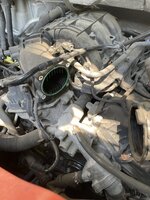
Here’s the gasket.

I probably could have cleaned this to get it working again. The one I pulled out was the original. Truck has done 190k miles.
PS used the techangle for this job. Perfect application. Could not see the lower rear bolt head. Maybe a cell phone, bore scope or inspection mirror would have helped. Everyone who said (essentially) “it’s easy, just mark the bolt head” I would have liked to see them try that here. The bolt had 8mm heads.
Last edited:
OP
oldschoolcraft
Well-known member
Pittsburgh has some good mechanics... well... at least one.I will one day read this thread. Until then, I am in a Pittsburgh state of mind.

OP
oldschoolcraft
Well-known member
It's easy, just put a radioactive marker on the bolt head and use a geiger counter to know when the angle was hitPS used the techangle for this job. Perfect application. Could not see the lower rear bolt head. Maybe a cell phone, bore scope or inspection mirror would have helped. Everyone who said (essentially) “it’s easy, just mark the bolt head” I would have liked to see them try that here. The bolt had 8mm heads.
whateg01
Well-known member
It's easy. Rotate the ratchet from vertical to horizontal. It's just has to seal the joint. It's not a head gasket.Seriously! How about a little mechanical sympathy. You can't feel a crush washer crush, or at least I can't. Its function is to crush.
Good example (and thanks @oldschoolcraft for sharing it), of why its good practice to use torque wrenches, especially for newbies or part timers like me.
BTW, swapped the throttle body on my 2013 F150 this afternoon. Torque spec to re-install was 10nm + 90degrees. There is a gasket, Ford highly recommends replacing with the throttle body.
Here’s the gasket.
I probably could have cleaned this to get it working again. The one I pulled out was the original. Truck has done 190k miles.
PS used the techangle for this job. Perfect application. Could not see the lower rear bolt head. Maybe a cell phone, bore scope or inspection mirror would have helped. Everyone who said (essentially) “it’s easy, just mark the bolt head” I would have liked to see them try that here. The bolt had 8mm heads.
Right. Thank you, Marie! Yeah you got it. That’s the point. The devil is in the details.It's easy. Rotate the ratchet from vertical to horizontal. It's just has to seal the joint. It's not a head gasket.
Upper fasteners could have turned 90. Lower fasteners, I probably had more swing room on the front one but not 90 and the back one more like 30 degrees IIRC. And none could move vertical to horizontal.
Possible alternatives would have involved a couple u joints and wobbles and 20” of extensions. Or I probably could have put witness marks on the socket and a corresponding mark on the vehicle (somewhere - would have been hard to see).
Or I probably would have done fine by feel. But this thread, and my comments in it, encouraged me to put my money where my mouth is and torque per the factory instructions. That TTA spec just isn’t as easy as many folks here have suggested it is (without a TECHANGLE, with it, it was super easy.)
One more thing. That looked like a silicone o ring gasket. The spec was 10nm + 90. That resulting torque felt pretty low to me. I probably would have over tightened this had I not used the spec.
Last edited:
TBH that throttle body would probably be just fine with 3 bolts torqued to spec and the blind one good enough to not fall out.Right. Thank you, Marie! Yeah you got it. That’s the point. The devil is in the details.
Upper fasteners could have turned 90. Lower fasteners, I probably had more swing room on the front one but not 90 and the back one more like 30 degrees IIRC. And none could move vertical to horizontal.
Possible alternatives would have involved a couple u joints and wobbles and 20” of extensions. Or I probably could have put witness marks on the socket and a corresponding mark on the vehicle (somewhere - would have been hard to see).
Or I probably would have done fine by feel. But this thread, and my comments in it, encouraged me to put my money where my mouth is and torque per the factory instructions. That TTA spec just isn’t as easy as many folks here have suggested it is (without a TECHANGLE, with it, it was super easy.)
One more thing. That looked like a silicone o ring gasket. The spec was 10nm + 90. That resulting torque felt pretty low to me. I probably would have over tightened this had I not used the spec.
It's airflow, not liquids.
whateg01
Well-known member
It would be fine with the fasteners just snugged up pretty good. If they were over tightened but not so tight as to pull out the threaded inserts, it would still work.TBH that throttle body would probably be just fine with 3 bolts torqued to spec and the blind one good enough to not fall out.
It's airflow, not liquids.
Yeah I agree with that.It would be fine with the fasteners just snugged up pretty good. If they were over tightened but not so tight as to pull out the threaded inserts, it would still work.
Intake pressures are typically -5psi. So, yeah, not huge.TBH that throttle body would probably be just fine with 3 bolts torqued to spec and the blind one good enough to not fall out.
It's airflow, not liquids.
But: modern vehicles have sensors on either side of the throttle. They measure the throttle plate angle and compare to the mass airflow sensor (MAF) before it, and the manifold absolute pressure (MAP) sensor behind it. If there’s a leak in that path, that’s not great.
I guess the point you guys are both making is similar to @Hohn. Does common sense trump the need to follow torque specs? When are they given because they are critical, vs when do they simply quantify “basic good practice”? Do you really need a torque wrench or is it overkill for most jobs?
There are jobs I feel comfortable with departing from factory specs etc. But I’m growing less and less certain I really know better. I personally feel more comfortable deferring to the factory manual specs.
Last edited:
Hohn
Well-known member
Good post. Interesting. Bad message tho.
To be clear, the goal is preload in the joint, not torque. Torque is one way we can measure an input to predict the desired output (preload). When there’s friction, schmutz, etc, a perfectly torqued bolt may not achieve the required preload. Pretty sure that’s what Hohn wrote above. He’s totally right.
When you spend hours each day for years tightening bolts, you can generate muscle memory that allows you to feel the right amount of torque.
For the rest of us, we really should be cleaning and using our torque wrenches on every fastener that has a torque spec.
Only exceptions would be the sheet metal trim screws into or through plastics that are completely non structural. Those, I would never do with a power tool as a home gamer. Too much risk in stripping the clip nut or breaking the plastic. Out is okay, in is not.
- When bolting patterns, groups of fasteners, that hold something, uniformity is essential. If one fastener in an 8 hole pattern has dirty threads, that fastener won’t be pulling its weight, even with perfect uniformly applied torque. So good torque technique also includes cleanliness ( which was kinda @Hohn point.)
- Whenever gaskets or seals are involved, those are always torque situations. Don’t care if your dad told you hand tight plus a quarter turn (isn’t that exactly the same as a torque to angle?) If the manufacturer published a torque spec USE IT.
So my message is: have a torque wrench and learn to use it. ESPECIALLY if you don’t work on things like this every day for years.
BTW, oil filters have seals. I think guys over torque them. Oil pan plugs have gasket washers. Use your torque wrench next oil change to check yourself.
You misunderstand the point of my post. It's not "clean everything to be sure the torque spec is correct."
Rather there key takeaways of my post are:
-- even a perfect torque spec with all new parts has ± 30% load variation (95% confidence or two sigma) under lab conditions.
-- K factor repeatability can be pretty poor (it drifts as you reuse fasteners) even under lab conditions.
-- In repair and service applications, most hardware will have significantly different k factor and you cannot correct this. NO amount of wire brushing or antiseize will restore the virgin k-factor of unrusted hardware with no antiseize or simply oil. This renders the "correct" torque spec moot. This is true with any threaded fastener, whether it is a gasketed joint or not.
In a repair or fastener reuse situation the reasonable approach should be to err on the side of more torque (higher K-factor), not less. 110% of nominal is a safe target because it's within the nominal load in almost every case.
To be sure, there *are* repair situations where the k-factor will be essentially as new-- anything in an oil bath, for example. Your oil pan drain plug is another one where the k-factor doesn't increase over time (it actually lowers slightly as the threads burnish and the friction reduces).
But the vast majority of fasteners used on a vehicle are exposed to elements that will, over time, alter the k-factor in a unpredictable and irreversible way. As in my post above, this happens even under laboratory conditions. If the fastener has a plating or coating, the k factor is shifting every time it's installed. It is has any oxidation, the k-factor has shifted.
So instead of only getting a torque wrench and learning how to use it, invest some effort in knowing WHEN to use it and have in mind a very real concept of how bolted joints work. Don't fall prey to the smug satisfaction of thinking you are right when you are actually wrong because you made the invalid assumption of constant k-factor.
OP
oldschoolcraft
Well-known member
This is something I've long since assumed and wondered the real world implications.-- even a perfect torque spec with all new parts has ± 30% load variation (95% confidence or two sigma) under lab conditions.
Everything compounds to add more variation. The bolts themselves won't be 100% identical, there will be some metallurgical differences, even if they are 99.99% identical, they aren't 100%. The shape of the bolts won't be 100% correct, they might be 99.9% the same.
A single particle of grit might be on the bolt face. A single drop of oil might get on the threads.
The tool itself is only 2% accurate at best. Where do you grip your hand on the tool, is it exactly dead center? Or are you off by 1/4"?
If the torque wrench is 15" OAL then 1/4" variation in the grip is 0.25/15 = another 2% variation in torque.
Even if you grip exactly dead center of the handle, are your forearm muscles acting equally across the width of your grip or are they asymmetrically acting more towards the thumb?
So if the fastener is supposed to be 20 foot pounds, at what point is too high that you'll strip it? 25 foot pounds? 30 foot pounds?
If it's supposed to be 20 pounds at what point is too low that it won't hold? 15 foot pounds? 10?
I assume there's a distribution curve where anything within a certain range, perhaps 16 to 24 foot pounds is acceptable. Though what makes it interesting is there's a binary outcome. Either you over torque it and strip the bolt, or you over torque it and do not strip the bolt. So then you add in statistical analysis and say at 24 foot pounds there's a 95% chance you dont strip the bolt. At 30 foot pounds there's a 50% chance you strip the bolt. At 35 foot pounds there's an 80% chance you strip the bolt.
Undertorqueing seems to have more variability. In the case of a water pump, if you under torque by a lot, it might immediately leak. If it you under torque by a little, it might have a very very slow leak that is inperceivable. Except over a long period of time when you measure coolant levels and it's low.
It's also possible undertorquing is fine, until it isn't. That the fastener works its way off due to vibrations over time. But over what time? Maybe 15 foot pounds on a 20 foot pound fastener is fine for the first 1,000 miles of driving, or even 10,000 miles, but will start to work itself off.
My point to all of this is that the 30% variation in acceptability seems reasonable and about what I would have estimated as the acceptable range. That doesnt mean it's fine to not use a torque wrench, because there's a lot of factors outside of the torque wrench that impact the tightness of the fastener that are alot harder to control for. So control for the ones you can control.
whateg01
Well-known member
Oh good. You're back.... Where do you grip your hand on the tool, is it exactly dead center? Or are you off by 1/4"?
If the torque wrench is 15" OAL then 1/4" variation in the grip is 0.25/15 = another 2% variation in torque.
Even if you grip exactly dead center of the handle, are your forearm muscles acting equally across the width of your grip or are they asymmetrically acting more towards the thumb?
...

For a clicker type or split beam, it doesn't matter where you grip it.
the best route to start is with 3 micrometer style wrenches 1/4,3/8,1/2I hadn't considered that due to my ignorance of the topic. Based on how @dnschmidt phrased that, does that mean digital torque wrenches handle angle calculations automatically?
I just priced them out, I'd be looking at over $2k for a set of three tech angles. That's more than I'd like to spend at this time. Especially on a digital tool, I dont mind spend as much on traditional tools, they seem to last forever, but anything electronic seems to have a finite life span. The ranges they appear to offer are:
* 1/4" Drive 15 to 300 inch pounds
* 3/8" Drive 5 to 125 foot pounds
* 1/2" Drive 15 to 300 foot pounds
From what I've seen, I'm guessing the 3/8 drive 5 to 125 foot pounds will cover over 90% of anything I'll be torquing on a car. So if I got that single one, then I'd only have to deal with angles manually using old style torque wrenches using whatever other techniques exist?
then add the digital 3/8 that does digital angle. followed by the 1/2 digital. Then you'll be covered
the TechAngle is nice because it can be set to a ton of different scales as well as Torque then Angle. It will indicate with the LEDs on the handle that you are approcing the set Torque value then once you hit that, it will automatically start counting the degrees. when you hit the degree target the LEDs light up. it will then cycle between the final degree and the final torque you hit.
yes they are expensive
2 year warranty on the digital part, lifetime on the ratchet head.
They offer a bench service for 120 dollars that includes shipping both ways, calibration, any parts, screen,housing etc and if they cant fix it they give you a new one.
dnschmidt
Well-known member
Best and cheapest way is buy the HF Quinn 1/2" digital wrench with angle for like $100 with a coupon. This wrench is made by Eclatorq in Taiwan and is one of the best digital torque wrench companies on Earth as I sell their higher end stuff which is identical to the digital torque wrenches sold by MAC, Proto and the rest of SB&D as well as NAPA Carlyle. No, you don't need to spend $2000 on Techangles and angle in any wrench under 1/2 capacity typically is a waste as it doesn't have sufficient range to finish the final angle as that torque value almost always exceeds 100 ft-lb which is the 3/8" drive limit. Tools Tested on YouTube did a review of the Quinn and he was highly impressed with his results.
Hohn
Well-known member
That's not how it works, or rather, should work. In any properly engineered bolted joint, you will fail the fastener (fracture or yield) before you strip any threads.I assume there's a distribution curve where anything within a certain range, perhaps 16 to 24 foot pounds is acceptable. Though what makes it interesting is there's a binary outcome. Either you over torque it and strip the bolt, or you over torque it and do not strip the bolt. So then you add in statistical analysis and say at 24 foot pounds there's a 95% chance you dont strip the bolt. At 30 foot pounds there's a 50% chance you strip the bolt. At 35 foot pounds there's an 80% chance you strip the bolt.
Undertorqueing seems to have more variability. In the case of a water pump, if you under torque by a lot, it might immediately leak. If it you under torque by a little, it might have a very very slow leak that is inperceivable. Except over a long period of time when you measure coolant levels and it's low.
It's also possible undertorquing is fine, until it isn't. That the fastener works its way off due to vibrations over time. But over what time? Maybe 15 foot pounds on a 20 foot pound fastener is fine for the first 1,000 miles of driving, or even 10,000 miles, but will start to work itself off.
My point to all of this is that the 30% variation in acceptability seems reasonable and about what I would have estimated as the acceptable range. That doesnt mean it's fine to not use a torque wrench, because there's a lot of factors outside of the torque wrench that impact the tightness of the fastener that are alot harder to control for. So control for the ones you can control.
Over torqueing is usually slightly safer, but it depends on static vs dynamic loads. If you are hand-tightening, you can feel a bolt going into yield-- the torque rise vs angular relationship changes. Incidentally, production environments using robotic assembly of torque-to-yield bolts do the same thing. The robot measures the change in torque with rotation (usually by measuring the current draw on the DC motors), and when it departs from a linear trend by some threshold, it will stop because it's saying the bolt is "yielded" there. This allows a VERY consistent preload on all the fasteners and minimizes k-factor variation to near zero. At this point, the joint's load variation is due entirely to the bolt metallurgy, which is pretty minimal.
If you slightly overtorque, the risk is that you will sometimes go slightly into yield. While not desirable, it's usually very low risk, because in a properly designed joint ,the failure will be that you permanently stretch the fastener and have to replace it next time.
The exception to the "overtorque is safer" is in situations of high dynamic loading-- think connecting rod bolts or similar. If you take a joint into yield when it's not engineered to have high yield margin, you can create a situation where each load cycle further yields the joint. Which means each increment of yield will further loosen the bolt and then it will fail from fatigue.
There are torque-to-yield bolts used successfully in high dynamic load situations, but they are engineering to have a yield point significantly higher than the highest dynamic load cycle.
Incidentally, undertorquing is not safer in a high dynamic load joint because instead of yielding and then coming loose or fracturing, it will just come loose and then fracture without yielding first.
So my assessment as someone who does this stuff professionally is: if it has little to no vibration, nominal torque to slightly higher is the way to go; err on the side of overtighten rather than undertighten.
But with high dynamic loads, there's no free lunch-- you simply have to have the correct preload because either too high or too low and you'll have a failure either way.