Oldtuleguy
Well-known member
- Joined
- Nov 4, 2017
- Messages
- 10,479
They work fine. Most newer stuff use stretch bolts so you need a torque angle meter, but I still get some use from older foot lb versions for torqueing wheels and such


That bad boy has seen some action. I wonder if the grooves in the handle are for hanging a weight to calibrate.
Be curious if it's reading accurately.
We have an Oregon Bureau of Trade cert scale that goes to 30kg. That should do it--but what about the fact it doesn't return to zero? Can I take the indicator apart to clean and oil it?Or use a scale and make your own with water and jugs...
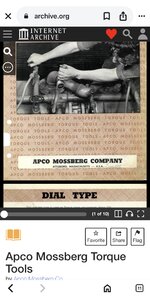
Another Apco Mossberg:
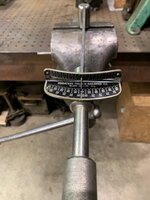
I picked this up as part of a haul today. I can't find any markings other than what's on the dial.
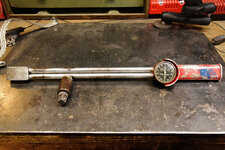

I did some cleaning on this old torque wrench today. I knocked the worst of the dirt and rust off and managed to clean and lube the measuring parts some.
The only parts that come off (with reasonable force) are these:
I was surprised to find that the splined drive is an adapter! I think it'll go in the box with my 1/2" breaker bar--I can see it coming in handy.
The adapter is also roll-embossed with the APCO Mossberg and Battleboro, Mass. With the adapter removed, the wrench just has the fixed 1/2" square post and detente ball.
I removed the screws, which allowed the two beams to slide a ways out of the handle, but they stopped after about 3/4". I chose not to force them, seeing as I have no idea what' going on in there( well, actually, I have a pretty good idea). The beam the screws go into is fixed relative to the handle, but the other beam slides in and out of the handle via a bronze or brass sleeve. Obviously, there is a rack of some kind mounted to that beam that runs a pinon for the dial indicator.
The adjustment of the wrench--and I assume the calibration--is done by rotating the bezel of the dial indicator. I got that broke loose while fiddling with it to see if I could pull it off. I worked some CLP and 30 wt into the sliding beam sleeve before I put the screws back in, which let me slit it back and forth while wiping up the crud that came out. It moves smoothly now and returns to zero.
With everything back together, the worst of the crud dealt with and a very light coat of BLO on the rust-prone parts, it now seems to work pretty damned well. I still need to give it a real test, but hanging my weight off of it produced reasonable results.
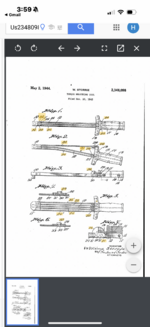
Patent is from 19442348098
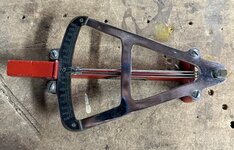
If you look at the diagram, the torque tool is different than the one I posted. Maybe that’s why there is an A in the patent number at the end. Maybe it’s a revised version of mine…
No, almost all the patent numbers online have the A in theIf you look at the diagram, the torque tool is different than the one I posted. Maybe that’s why there is an A in the patent number at the end. Maybe it’s a revised version of mine…
Thanks for your input.
Thanks for the prompt response and your input RTM. This torque tool is a little different than what I’m used to seeing. Most torques have the male socket at the bottom of the tool where this one is on the top. As well it seems to have little legs on the bottom which I’ve never seen b4 but then I’m not as knowledgeable as other people on this site. Thanks again RTMNo, almost all the patent numbers online have the A in the online systems.
The tool doesn't have to look the same for the patent to be applicable. Especially when it's something small that is patented, might be hidden inside the tool. I did not dig deeply, but typically it says your tool should be no older than 1944, and no newer than 1944+17 years, just to help with your searching in catalogs.
Here’s a couple more pictures… I should have measured the length… it’s about 7” long…Thanks for the prompt response and your input RTM. This torque tool is a little different than what I’m used to seeing. Most torques have the male socket at the bottom of the tool where this one is on the top. As well it seems to have little legs on the bottom which I’ve never seen b4 but then I’m not as knowledgeable as other people on this site. Thanks again RTM
Thanks for adding your thoughts Private Lugnutz. It will go nicely into the portable man cave… it will be my first Torque Tool where the head is on the top instead of the bottom of the tool.Only Google adds that "A" suffix, @RTM. Not sure why/what it signifies, because I don't use Google Patents, but it does not appear in the USPTO system.
@Ayrhead - Look at the original patent number on the patent itself (no "A"). I agree with @RTM. That model you have clearly has really wide wings supporting the beam indicator scale, but if you look at how the actual torque is measured, it's the same basic mechanism.
I've never seen this type of torque wrench from APCO-Mossberg or this patent (Storrie). The one I posted in post #7 - 2169223 (Apr 9, 1940 / Montgomery), with a wartime FSN on it, which is a Dial Indicator type, was preceded by Montgomery's 2125945 (Aug 9, 1938). They were busy bees in torque wrench design between 1938 and 1944!
They were apparently fond of that configuration. If you look at the Dial Indicator type model I posted in post #7, page 1, with the wartime FSN, it's configured the same way. Curiously, @Beerhippie found one like mine with no FSN (post #42-50, this page) and the drive stud faces down....it will be my first Torque Tool where the head is on the top instead of the bottom of the tool.
Yes, I just did. Thanks again for your inputThey were apparently fond of that configuration. If you look at the Dial Indicator type model I posted in post #7, page 1, with the wartime FSN, it's configured the same way. Curiously, @Beerhippie found one like mine with no FSN (post #42-50, this page) and the drive stud faces down.
I don't have a single tool like that, and I don't think I have ever seen one before. Pretty cool.
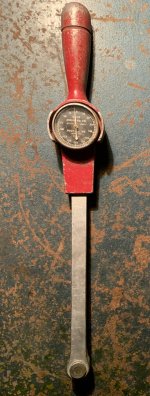

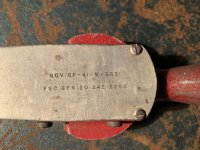


It seems like everyone has the Snap-on U-boat jobbie Torqometers. But there’s probably not too many of this model floating around!