To avoid these ads, REGISTER NOW!

Trailer project

To avoid these ads, REGISTER NOW!

ScottyVetteGuy

Well-known member
Joined
Aug 28, 2013
Messages
122
Location
Philadelphia, PA Western Suburbs
I Agee got to have brakes...


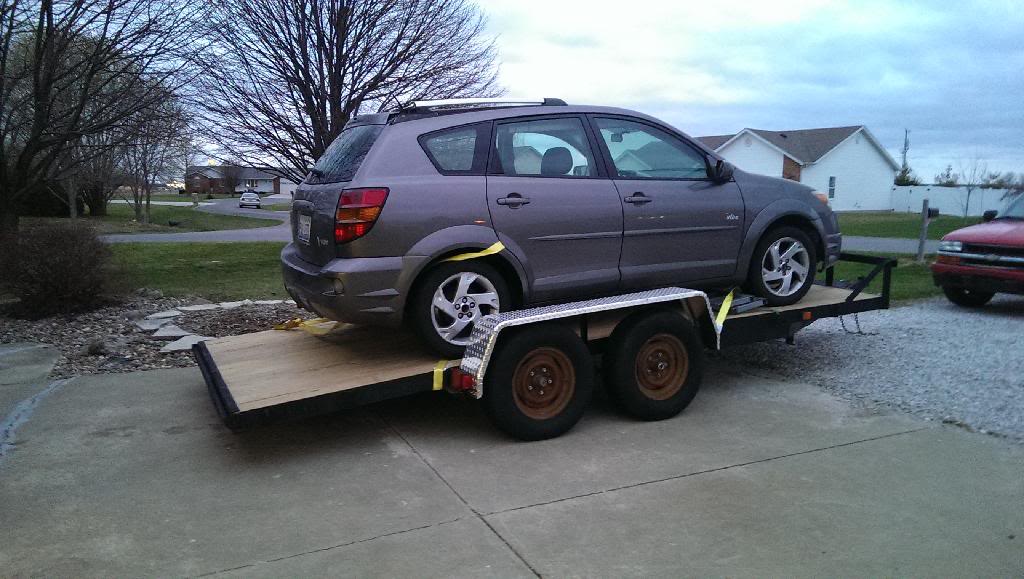
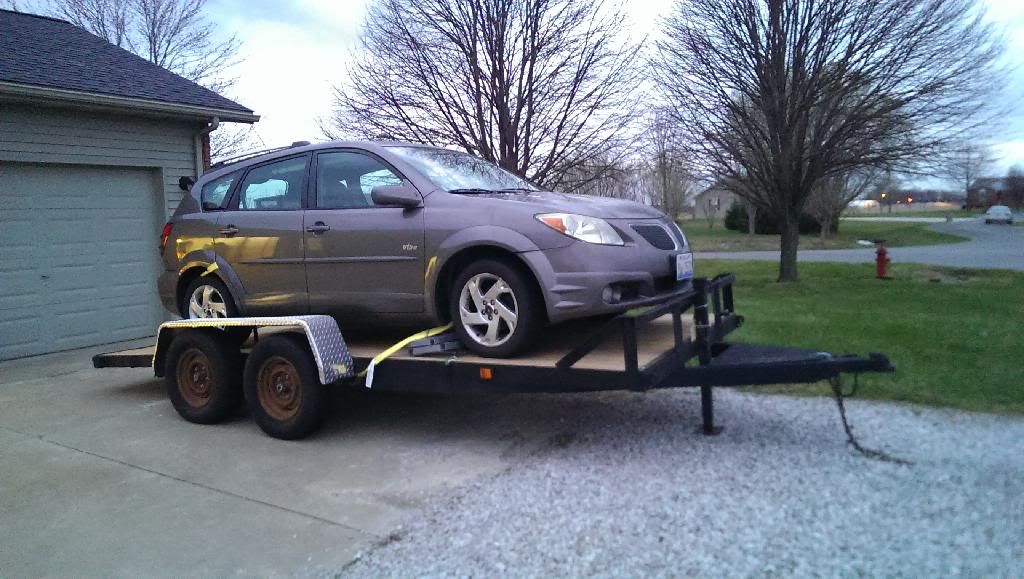
Here is a pic of my car hauler... See the bolts on the fender. I was planing to add a hinge on the front side and wing nuts to make the fender flip up so I could open the door of the car.

 
OP
M

majerus

Well-known member
Joined
Feb 27, 2013
Messages
240
Location
St. Louis Missouri
How did you apply the Hurculiner brush, roller, spray?
Is it a flat, semi gloss, or gloss finish?

Used the rollers that were supplied in the kit, along with the brush for tight areas. I would call it a semi gloss, tomorrow i will ad the uv protectant and see what that does to it.
 

readhead

Well-known member
Joined
Dec 8, 2012
Messages
6,175
Location
Durango, Co.
Yes. That is where we place the tube. Clean everything and use weld through primer everywhere so you minimize rust between the tube and the angle.
 

lmalcomb

Well-known member
Joined
May 5, 2013
Messages
152
Location
Southeastern Indiana
Used the rollers that were supplied in the kit, along with the brush for tight areas. I would call it a semi gloss, tomorrow i will ad the uv protectant and see what that does to it.

That sounds great. After reading up on the kit I still did not see where the uv protection was included. I read some reviews that said it made a big difference as far as preventing fading. Keep us updated.
 
OP
M

majerus

Well-known member
Joined
Feb 27, 2013
Messages
240
Location
St. Louis Missouri

Spareparts

Well-known member
Joined
Mar 12, 2010
Messages
2,042
Location
Lansing Ks.
Tractor Supply has the complete brake kit's for $154.00 here. As far as the sway in the frame put jack stands on the 4 corners and not under the axles and see how much of the sway disappers, a lot of times when they weld the spring hangers on (especiallt if they weld it all the way around with out stopping) it will cause the metal to draw causing that problem. Use a string line down the frame to see where it starts.
 

kerrynzl

Well-known member
Joined
Nov 8, 2013
Messages
5,054
Location
Tauranga, New Zealand
This could be my ignorance, however I was told the trailer was built that way? I thought it was kinda odd, but took the guy for his word.( it does have a slight curve to it) Also I figured anything I put on it should not stress it too bad. Do you have a pic of the thing you do to straighten them?

It would have been like that since it was built. [it wasn't built that way but ended up being like that from new]
It happens when all the x-members and suspension hangers are welded on the bottom of the angle rails.
When all the welds cool, they shrink causing a curve in the rails.

It is very simple to "flame straighten" the rails with a torch at relatively low temperatures

Just leave it as-is ,it doesn't hurt the strength at all. When you put backs behind the fenders you usually cannot see it.
 

gungatim

Well-known member
Joined
Jan 8, 2013
Messages
8,101
Location
west mich
I don't know if this is any benefit or not, but for the underside of the wood, I would get a few cans of spray on rubberized undercoat and just spray the wood (bottom only, not the top). I did that with a new enclosed trailer I bought a while back just thinking the bare wood would hold up longer if water and snow/salt wasn't spraying directly on it. I guess I'll know if it helps in 10 yrs. or so ha ha...but it was cheap and easy enough to spray on.
 

koditten

Well-known member
Joined
Apr 10, 2008
Messages
5,528
Location
Midland, Michigan
Very nice job Majorus! you did a very outstanding referb. I hope you enjoy the trailer for many years.

I've built several trailers in the last couple of years and painted them with the bedliner paint. I've been trying to keep tabs on those trailers and get routien feedback on how well it is holding up. So far those customers are happy.

Keep us posted on how it is holding up.

KO
 

460Rustang

Well-known member
Joined
Oct 9, 2013
Messages
208
Location
Nawlins
I picked up the trailer for 800, the herculiner was just one gallon for about 85, two fenders 65 each, wood will cost 180 after taxes, and i have sealer here left over. The thing that i was a little stunned with price on was 210 for sand blasting. All said in done it will be about 1500 without a winch.

I musta missed that initial $800 cost,......what size is it ? :thumbup:
 

460Rustang

Well-known member
Joined
Oct 9, 2013
Messages
208
Location
Nawlins
Kind of curious why you didn't straighten the frame before you put all this work into it. When we repair this type of trailer we line up the side rails and then put in a piece of tube steel above the axles to stiffen up the frame.

How would you straighten it?
 

kerrynzl

Well-known member
Joined
Nov 8, 2013
Messages
5,054
Location
Tauranga, New Zealand
How would you straighten it?

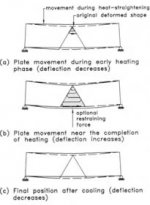
Put a straight edge along it and mark the points where it is under tension causing it to bend downwards.
Then use mild heat to stress relieve it.

Mild heat mean just enough to “blue it” and no more.
When you heat something it lowers it’s density and expands in ALL directions. When it cools it contracts back to it’s original density.

If you heat a piece of steel that is clamped to it cannot expand in that direction , it will expand in other directions instead. [ it will get thicker ]

The technique is to draw a “V” shape with chalk [away from the origin of the bend] and use heat in an “S” shaped pattern.
The wide part of the “V” will expand and thicken more than the base of the “V” ,so when it cools it will pull together.

Flange up Angle is easy to straighten with the basic inverted “V” heating the flange
 

Attachments

  • fig6.jpg
    fig6.jpg
    9.9 KB · Views: 83
To avoid these ads, REGISTER NOW!
OP
M

majerus

Well-known member
Joined
Feb 27, 2013
Messages
240
Location
St. Louis Missouri
Its been a while since I have posted on this project, here is an update. I have the fenders on , wiring is ran. All of it is ran though the frame in wiring mesh to isolate it from abrasion. Side markers, tail lights all work really well. So far I have pulled two cars on it and it pulled really well. I have to get some rims for it yet other then that all buttoned up. I didn't get around to straightening the frame but at this point i figure it is easier to leave it as is.

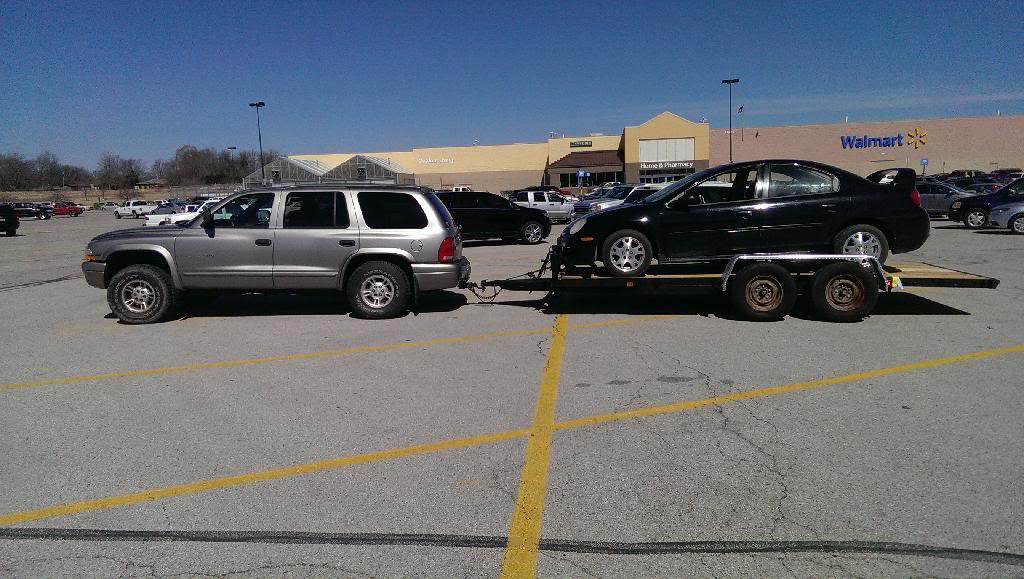
Here is one with a car on it, this was the first time I towed with a two axle trailer. I was told the car should have been centered on the wheels which is why my durango is squatting so bad.

IMAG1026_zpsoxvstdd0.JPG


I pulled this car over for over two hours in the middle of a storm . Drove very straight no sway or anything.

IMAG1056_zpspwedzk3t.JPG


IMAG1057_zpsfzy4kokf.JPG
 
Last edited:

Vegaman_Dan

Well-known member
Joined
Jun 1, 2012
Messages
2,453
Location
Pacific, WA
Things to consider adding would be some side stake pockets to let you drop in some short buckboards to make it an open top cargo trailer for bulk materials.
 

Capt Chrysler

Well-known member
Joined
Mar 6, 2011
Messages
1,160
Location
Middle of nowhere.
Hello,

You will want to close in the back (inboard) side of the fender. You will be amazed at how beat up the side of a load will get in a short ride!

How's the bedliner holding up??


Capt. Chrysler
 
OP
M

majerus

Well-known member
Joined
Feb 27, 2013
Messages
240
Location
St. Louis Missouri
The bed liner still looks good, it sits outside all the time. The grey stuff on the bedliner is mud that got slung up on it when I was pulling it out of the yard. Ill get to work on in closing the side, I should be able to get some diamond plate and just rivet it or screw it in. Thanks for the heads up.
 

koditten

Well-known member
Joined
Apr 10, 2008
Messages
5,528
Location
Midland, Michigan
Hello,

You will want to close in the back (inboard) side of the fender. You will be amazed at how beat up the side of a load will get in a short ride!

How's the bedliner holding up??


Capt. Chrysler

I disagree.

If you close the back of the fenders, the flex of the trailer when loaded with a car will distort the sheet steel. I've done it and the trailers always come back to me. People WILL overload their trailers. Its natural.
 

kerrynzl

Well-known member
Joined
Nov 8, 2013
Messages
5,054
Location
Tauranga, New Zealand
Hello,

You will want to close in the back (inboard) side of the fender. You will be amazed at how beat up the side of a load will get in a short ride!

How's the bedliner holding up??


Capt. Chrysler

Good Suggestion.
I had a car hauler with open backed fenders, And I was forever sweeping gravel off the deck [The **** used to wedge into the sidepipes on my racecar]

Adding backs to the fenders contributes a huge amount to increasing the beaming strength of the trailer [ you have an 8"+ high "blade" at the most stress bearing point of the trailer ]

The biggest mistake in open car trailers [ and biggest cause of stress failures ] is over-springing them.
Some of them are sprung like "tuning forks"
 

koditten

Well-known member
Joined
Apr 10, 2008
Messages
5,528
Location
Midland, Michigan
What are you using for the back of the fenders? Around here, the sheet steel is 18 gauge. Its not adding anything to the strength of the trailer.

If you want to increase the overall strength of the trailer with out much weight, add a top rail. Like what you see in my avitar, but much shorter.

As for over springing, the only time I see this issue is when someone recycles trailer house axles and springs. Those springs won't even start to flex until you get 10k lbs on them. Never a good thing to do unless you have built the entire trailer to haul that much weight.

I agree, the fender backing looks nice, but it doesn't do much, so I never install it and try to talk my customers out of it.
 

V-10 Killer

Well-known member
Joined
Feb 11, 2007
Messages
1,011
Location
Midland, MI
If you do use the fender backing, just make sure you can keep it contained. If you weld it and it flops around, it can rub the back side of your trailer tires. And I have first hand experience of what Koditten was talking about.
 

JHunter

Well-known member
Joined
Jan 27, 2006
Messages
76
Location
DeRidder, LA
I would strongly recommend having D rings welded to the front and back of the trailer - have a professional welder weld on a triangle piece of 1/4" or greater metal to the corners that ties both the front/side back/side rails together, then weld the D ring to that. They way you have the cars secured is very un-secure.
 
OP
M

majerus

Well-known member
Joined
Feb 27, 2013
Messages
240
Location
St. Louis Missouri
Good idea , those straps have a huge metal connecting point and its around the bottom lip of the trailer. I would think the straps wouldnt work with D rings, should I be using chains?
 

kerrynzl

Well-known member
Joined
Nov 8, 2013
Messages
5,054
Location
Tauranga, New Zealand
What are you using for the back of the fenders? Around here, the sheet steel is 18 gauge. Its not adding anything to the strength of the trailer.

If you want to increase the overall strength of the trailer with out much weight, add a top rail. Like what you see in my avitar, but much shorter.

As for over springing, the only time I see this issue is when someone recycles trailer house axles and springs. Those springs won't even start to flex until you get 10k lbs on them. Never a good thing to do unless you have built the entire trailer to haul that much weight.

I agree, the fender backing looks nice, but it doesn't do much, so I never install it and try to talk my customers out of it.


I use 16 gauge [1.6mm] which is the same thickness as the fenders [imported from the USA]

18 gauge would also contribute to the beaming strength also, ONLY IF it was fitted correctly to prevent buckling on the compression side [lower edge]
You need to picture a fender with backs as similar to a piece of angle [ the top of the fender and the back are at 90° to each other ]

The top edge is under tension ,and the lower edge is under compression so either the top will try to stretch or the lower would try to buckle.
If the lower edge had a 90° flange it wont buckle [ so this is where the deck of the trailer comes in handy ]
I literally bond the whole back to the trailer using urethane adhesive and pop rivets every 6” [ the rivets only hold the backs until the urethane cures ]

If you had a spot weld [ 1/4” Rosette weld ] every 2” on a 72” fender, the total area of the 37 welds is 1.81 In² . Spot welds will also allow the backs to buckle between them.

A 3/4” strip x 72” of urethane adhesive has the surface area of 54 In². Now the Deck-Backs-Fender are “Z” shaped.

A common method of adding beaming strength is the cutback tongue [on car haulers] where an upper rail is undesirable.
If I were to add an upper rail on a utility trailer, I would [and do] literally fold up the whole side out of 14 gauge [2mm]

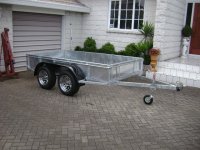
Here is a pic of a car hauler I built for a friend which is grossly overloaded . The trailer was made from 1/8 tube [3mm], The tongue is pivoting to allow it to tilt [so it isn’t welded to the deck ]
The overall weight is 1496 lbs [680kg]. It has not bent or had any buckles in the fender backs.

The other pic is a 10 x 5 utility trailer built from 14 gauge , the visible sides are the actual chassis and are folded into a “U” shaped channel on the upper and lower edges
It is basically a monocoque tub with cantilever posts on the corners [ it is very stiff and lightweight ] The biggest issue I had was getting springs rated low enough

With engineering “Shape is more important than size” , so try not to fall into the Cowshed Engineering trap of adding more and more **** until it looks strong enough
 

Attachments

  • DSC04602.JPG
    DSC04602.JPG
    146.3 KB · Views: 77
  • DSC03783.JPG
    DSC03783.JPG
    138.8 KB · Views: 72
Last edited:

koditten

Well-known member
Joined
Apr 10, 2008
Messages
5,528
Location
Midland, Michigan
Good idea , those straps have a huge metal connecting point and its around the bottom lip of the trailer. I would think the straps wouldnt work with D rings, should I be using chains?

I use both.

I like chains in the front and 4" winch straps in the back. Most of the straps have a hook on the end for latching onto the "D" rings.

You should be using axle straps, wich are just short web straps with hooks on both ends, to connect the straps too.

You should not be tieng down the body of the car, either. Tie down axles and let the springs and shocks of the car "float" the body. You will have a much better ride and you don't have to worry about the straps and chains loosening as the body of the car compresses the suspension going over bumps and dips.
 

koditten

Well-known member
Joined
Apr 10, 2008
Messages
5,528
Location
Midland, Michigan
I use 16 gauge [1.6mm] which is the same thickness as the fenders [imported from the USA]

18 gauge would also contribute to the beaming strength also, ONLY IF it was fitted correctly to prevent buckling on the compression side [lower edge]
You need to picture a fender with backs as similar to a piece of angle [ the top of the fender and the back are at 90° to each other ]

The top edge is under tension ,and the lower edge is under compression so either the top will try to stretch or the lower would try to buckle.
If the lower edge had a 90° flange it wont buckle [ so this is where the deck of the trailer comes in handy ]
I literally bond the whole back to the trailer using urethane adhesive and pop rivets every 6” [ the rivets only hold the backs until the urethane cures ]

If you had a spot weld [ 1/4” Rosette weld ] every 2” on a 72” fender, the total area of the 37 welds is 1.81 In² . Spot welds will also allow the backs to buckle between them.

A 3/4” strip x 72” of urethane adhesive has the surface area of 54 In². Now the Deck-Backs-Fender are “Z” shaped.

A common method of adding beaming strength is the cutback tongue [on car haulers] where an upper rail is undesirable.
If I were to add an upper rail on a utility trailer, I would [and do] literally fold up the whole side out of 14 gauge [2mm]

Here is a pic of a car hauler I built for a friend which is grossly overloaded . The trailer was made from 1/8 tube [3mm], The tongue is pivoting to allow it to tilt [so it isn’t welded to the deck ]
The overall weight is 1496 lbs [680kg]. It has not bent or had any buckles in the fender backs.

The other pic is a 10 x 5 utility trailer built from 14 gauge , the visible sides are the actual chassis and are folded into a “U” shaped channel on the upper and lower edges
It is basically a monocoque tub with cantilever posts on the corners [ it is very stiff and lightweight ] The biggest issue I had was getting springs rated low enough

With engineering “Shape is more important than size” , so try not to fall into the Cowshed Engineering trap of adding more and more **** until it looks strong enough

I'm not buying you math. I don't care if you weld every cm of the perimiter and have brakes at the bottom. If the trailer is overloaded, you will distort the sheet steel or pop the welds. One of the second reasons I don't do the backs is because "call backs" are killers. I can't afford to fix things that I told the customer they would not be happy with. They all want it for free.

I'm only suggesting that I don't want the fender backings. I want, and know a steel car hauling trailer will flex. I expect it and know the flex will not hurt anything. If you want the fender backs, put them on. As for debriese entering from the open backs, yes, it will happen. Around here, your tow vehicle will kick up much more road debries than what will come from the sides. If it that much of a conscern, you should really think about a covered trailer.

Your other trailer designs are very nice. That bent sheet steel will make for a very rigid trailer. I don't have a brake at my disposal, so I'm forced to do frame trailers. I'm sure the cost comes down using your style as well.
 

kerrynzl

Well-known member
Joined
Nov 8, 2013
Messages
5,054
Location
Tauranga, New Zealand
I'm not buying you math. I don't care if you weld every cm of the perimiter and have brakes at the bottom. If the trailer is overloaded, you will distort the sheet steel or pop the welds. One of the second reasons I don't do the backs is because "call backs" are killers. I can't afford to fix things that I told the customer they would not be happy with. They all want it for free.

I'm only suggesting that I don't want the fender backings. I want, and know a steel car hauling trailer will flex. I expect it and know the flex will not hurt anything. If you want the fender backs, put them on. As for debriese entering from the open backs, yes, it will happen. Around here, your tow vehicle will kick up much more road debries than what will come from the sides. If it that much of a conscern, you should really think about a covered trailer.

Your other trailer designs are very nice. That bent sheet steel will make for a very rigid trailer. I don't have a brake at my disposal, so I'm forced to do frame trailers. I'm sure the cost comes down using your style as well.

I built trailers from home in my garage [in a nice residential area] so I need to consider my neighbours
With bending of steel, I outsource it [it is cheaper than owning a press-brake]
The little bit of folding takes care of a huge amount of my personal labour If I built it in more conventional methods.

I would build a car hauler trailer similar to the 10 x 5 I built but there is one major problem
The largest guillotine in a 100mile radius can only cut 4m [13 ft]

Please understand that we have strict weight regulations over here, so I try to build them lightweight.
Every lb added to the trailer is a lb you cannot load on it.

My 1500lb car hauler can carry a 4000lb payload [before all the rules change]
I'm fighting a losing battle with dimensions and weight over here.:D
 
OP
M

majerus

Well-known member
Joined
Feb 27, 2013
Messages
240
Location
St. Louis Missouri
I use both.

I like chains in the front and 4" winch straps in the back. Most of the straps have a hook on the end for latching onto the "D" rings.

You should be using axle straps, wich are just short web straps with hooks on both ends, to connect the straps too.

You should not be tieng down the body of the car, either. Tie down axles and let the springs and shocks of the car "float" the body. You will have a much better ride and you don't have to worry about the straps and chains loosening as the body of the car compresses the suspension going over bumps and dips.
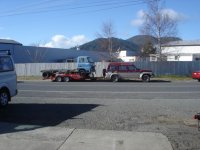
I guess the pictures did not show this very well, but what we did was went around the back axle and the just threw the extra strap (loose stuff in the door) ill get to adding the D rings and buying some actual short straps.
 

JHunter

Well-known member
Joined
Jan 27, 2006
Messages
76
Location
DeRidder, LA
I'd recommend straps like this:
http://www.macscustomtiedowns.com/product/110/TieDowns

And D rings like this:
http://www.tractorsupply.com/en/store/erickson-weld-on-forged-flip-anchor-ring-15000-lb-maximum

The straps with the spring closure will help make sure that as the straps loosen in the first part of the trip (which will happen), they won't have a chance of coming off the anchor point. Good practice is to drive 30 minutes or so, then pull over and check your straps. Using a strap like that (and axle straps like someone else mentioned) will secure your load. The "cheaper" straps with the open mouth are usually not rated real well, and then there's the issue of the open design of the hook. I don't remember the math, but think about a 3k pound car on the trailer and the force of the load on the straps if you get into an accident - you want a strap that is rated well past the weight of the vehicle, and never rely on two straps. Wrapping the strap around the rear axle (even with an axle strap) and hooking the ends of the strap to either side isn't safe because if that one strap breaks, your car is no longer secured. I always go with 4 straps, and X them in the front or rear so you are snugging the car down to the trailer while also stabilizing it side to side.
Hope that helps - I just get a little nervous seeing cars on trailers on the highway so it's something I pay attention to.
 
To avoid these ads, REGISTER NOW!
Top Bottom