NOPE
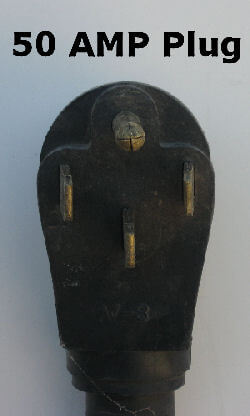
The code articles 550 / 551 Trailers and Trailer Park electrical outlines only 4accepted "Power Supply Assemblies" and 50 amp 120/240 volt is 1 of them.
Doesn't obviate what I said.
OK, there is more to this post but this is what I want to correct.
A 50A 240v, or 120/120V, circuit is not, repeat IS NOT 25A + 25A. It never is. Not even in your marine world.
The problem here is one of semantics.
This whole thing got off-track when the OP "assumed" he needed (and I quote) "a 50 amp 240 volt circuit to plug it into." And from there, almost everybody jumped to the conclusion that his trailer actually
needs 50A @ 240V. While there is a slim outside chance that is actually correct (which I why I asked him to confirm the specs for HIS particular RV), it would be VERY unusual, especially in RVs. Larger and/or newer yachts DO sometimes use 50A @ 250V shore power; but that's a different animal. And as the OP himself also posted, his RV
DOES NOT USE 240V. Hence, the whole "50A" designation is in the context of "at 120V". And since that 50A is effectively split between two (120V) legs, each of those legs is just 25A. If you want to blame this language usage -- which I fully understand would seem somewhat "nonsensical" to land-based electricians -- on the "marketing" reasons from whence it originally sprang, be my guest. But it has been that way for a l-o-o-o-o-n-g time.
I have done 50A shore power pedestals and they are typical 50A 120/240V, 4-wire circuit.
No argument. But that is NOT what I was talking about. As noted above, SOME yachts DO use 50A/240V shore power. And obviously marinas need to accommodate them, as well as those with lower requirements. But the very reason those pedestals are marked with BOTH voltages is because that is NOT always the case.
And besides, this is not about wiring up a generic power pedestal in a marina or RV park. The issue is what
HIS trailer actually needs. And so far, there has been ZERO evidence posted to suggest that really is 50A @ 240V. As noted above, the OP even explicitly stated that his RV does not use 240V at all.
125-250V is just the device rating. They are still for 120/240V circuits and feeders. All devices are are rated this way, not just marine.
Again, no argument. But just because a dual-rated connector CAN be used for 240V application doesn't mean it necessarily MUST be. And in this case, it isn't.
You need to get out of the mentality that marine shore power wiring is somehow it's own special world of electrical wiring.
Not a "special world of electrical wiring"; just different semantics: "50A service" is NOT the same thing as "50A @ 240V service"
If you know of a 50A device that is 25+25A please show a link to it.
Try this...
I would be willing to wager heavily his trailer would be PERFECTLY happy running ALL of his AC electrical stuff to full capacity off two (opposite polarity) 30A/120V sockets on the power pylon, via a Y-adapter similar to this one:
http://www.marinco.com/product/reverse-y-adapter
to feed his single "50A" inlet on the trailer, which probably something like this (or equivalent NEMA SS2-50P):
http://www.marinco.com/product/50-amp-125250-volt-stainless-steel-inlet
(which can indeed "handle" 50A @ 250V, but is rarely called to do so.)
That would simply not be possible if the trailer REALLY needed "50A @ 240V".
[NOTE: Given the RV vs. Marine application, the connector styles MAY be somewhat different; but the underlying principles remain the same, regardless.]
Speedy,,, you get the feeling no one listens to this guy in the real world? I bet they don't let him have tools near or on his person. But the real kicker is it seems someone with such expertise in circuit design would have some concept of how a multi wire actually works.
I'm still waiting for you to come up with that "one credible, verifiable reference which states that the captive wiring on a plug-in device imposes any sort of legal limit on the current capacity of the host circuit."
The way 2manyprojects explained it is exactly the way I was looking at it when I did my original post. Hence my question of is such a large gauge wire really needed.
And the final answer on that still depends on what YOUR particular trailer really needs.
In reality, for > travel trailer use only<, it would work just fine if it was a direct wire into the trailer panel. Codes not withstanding on that.
I don't think "direct wire" vs. "plug & socket" has anything to do with it, really.
Since the trailer has an unbilical cord that plugs into a normal 240 volt 50 amp receptacle that receptacle needs to be wired with wire large enough to handle the rating of the receptacle and breaker to meet code.
This depends on a couple of things. First, is that
REALLY a "normal 240 volt 50 amp receptacle" you need to plug into? That assumption is what started this whole debacle.
This is in case some doofus (like me) comes along and plugs in a high draw device like a welder into it I would be protected. Is this correct guys?
I'm really not certain of the code details here; but even if your shore-power cord does use something like a NEMA 14-50 plug, I don't think this is necessarily a problem. I
think the controlling issue would be that the wire does not need to be matched to the receptacle, as long as said wire is still "adequately" protected by an appropriately rated breaker. Worst-case, if someone comes by and tries to plug in something bigger and more power-hungry than your trailer, the breaker would trip, and that would be the end of the story. No harm, no foul. Also, like the similarly "mismached" welder-outlet situation, labelling may also come into play here.
But this is not really the part I'd be concerned about in your case. As said before, the REAL question is the actual requirements of your trailer. Until and unless we really KNOW that, we're throwing darts in the dark.
All that said, if you WANT to go well into overkill territiry, and set up that receptacle so that it COULD easily supply 50A @ 240V, there's nothing stopping you except your wallet.
The requirements for a welder may be different and the plug isn't the same. This is really a 50A service to the trailer. Most of the big loads are 240 and somewhat samer as an electric range,
I guess you missed the several mentions (including by the OP) that
HIS TRAILER DOES NOT USE 240V.
Have another one:
http://www.groceries-express.com/images/80000\85000\00730\8500000730CF.GIF.

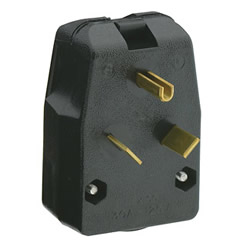

 ).
).