The first purpose of a french drain is to gather water. To that end, you need to make sure all the water you want to divert is funneled to the drain. You don't want perforated pipe to do this as it will disperse in the same location that it collects in.
Use downspouts, sloped hard surfaces and trench drains to get water into your drain(s).
The second purpose is to transfer the water to a different area. To do this, you may want to make at least part of the drain solid, so it doesn't disperse water until you get it where you want it to go. Then you can use part of the drain line to disperse water, even before it gets to the discharge point or gravel filled pit.
The drain itself needs to be sized so as to accommodate the quantity and flow of water that you expect to have.
Slope should be a minimum of 1/8" per foot, but ideally 1/4" per foot.
Don't forget to cover your perforated lines with geotextile socks to prevent silting up of the lines.
All the water you divert needs to go somewhere. If you have a natural ditch or watercourse, then you can send it there. Otherwise you need either enough leeching capability, or retention combined with leeching, to accommodate it.
Leeching can happen in lines or into a covered pit or open air pond.
Investigation of the soil type is important in determining what kind of, and how much area you need to leech the water flow you have.
In cold areas, deeper is better for lines and pits.
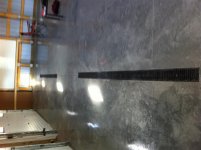
That said, it looks like you just have a couple of inside trench drains that might get a bit of melting snow off some cars. Unless you wash cars in there, or have a river flowing through the building, then what you have will be adequate as long as it slopes properly and has somewhere to go. If you are just draining the interior drains, I would make it solid (Not perforated) until well outside the building, then go perforated. Don't over think it.
Bill (I've designed retention ponds and drainage systems)
PS: You should think of your entire site, and even surrounding sites, as part of one big drainage system. When designing drainage on a site, I look at surrounding terrain, and find all the adjoining land that is higher. This land contributes runoff to my site and must be taken into account. Then all the hard surfaces (Buildings and paving) on my site must be used in calculations to determine the quantity and rate of water to accommodate.
The general rule that jurisdictions require, at least for commercial work, is that you retain water, and only let it flow into storm sewer systems, at the rate it would from your undeveloped site. So ponds are sized to retain the excess flow and their outlets are restricted to that undeveloped flow rate.