To avoid these ads, REGISTER NOW!

Truss Construction – Mending Plate from Scrap Zip Sheathing – Attic Storage – Code Compliance

17w

Member
Joined
Apr 23, 2023
Messages
5
28′ x 28′ garage under construction by a many decades experienced garage builder, and am curious if the construction methods are up to code, or even a good idea.
Specs:
Size: 28′ x 28′
2′ x 6′ walls
2′ x 10′ rafters
Pitch 7/12
Slab on grade
Zip sheathing walls and roof
One large bay with 18′ x 7′ garage door (no columns or supports).
Photos attached

Questions:
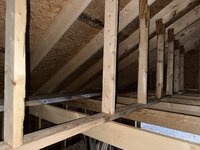
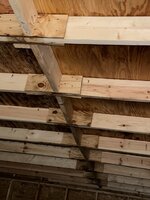
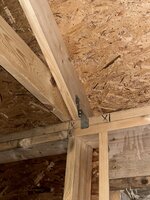
Can one really use scrap pieces of Zip sheathing as ‘mending plates’ I’ve only seen metal plates used.
How about ‘sistering’ those two 14′ boards on the ceiling joist using, again, scrap sheathing? There is no center support pole or post.
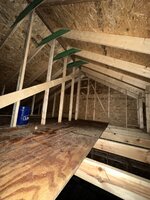
Is one king post in center, and then shorter posts on either side (do not know the term) enough to support weight for storage above the plywood ceiling?
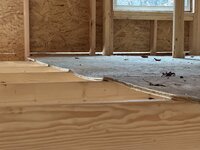
Builder said we could store lightweight items on that plywood floor, add more plywood sheets to make more storage area, and if we wanted to store more weight, he could add two LVLs, but support on garage door end would only be on garage door header, whereas on opposite wall he could install vertical support beams.

Thanks
 

Attachments

  • IMG_0342 Large.jpeg
    IMG_0342 Large.jpeg
    268.5 KB · Views: 342
  • IMG_0338 Large.jpeg
    IMG_0338 Large.jpeg
    327.4 KB · Views: 328
  • IMG_0336 Large.jpeg
    IMG_0336 Large.jpeg
    274.9 KB · Views: 341
  • IMG_0334 Large.jpeg
    IMG_0334 Large.jpeg
    237 KB · Views: 353
  • IMG_0341 Large.jpeg
    IMG_0341 Large.jpeg
    320.1 KB · Views: 364
To avoid these ads, REGISTER NOW!

jack stand

Well-known member
Joined
Feb 29, 2012
Messages
3,335
Location
Lakes Region Maine
under construction by a many decades experienced garage builder,
Looks like it's not going to fall down to me.👍
Unless you're a code worshiper, it's basic framing with simple loads and the only thing that I might do is a lower rafter tie every other or every 3rd rafter.
 

Rusted Nut

Well-known member
Joined
Dec 11, 2022
Messages
1,809
Location
PNW
Do you have construction drawings (plans), if so what do they show? Scabbed together rafters are a bit frightening.
 

Slowboat

Well-known member
Joined
Nov 5, 2010
Messages
599
Location
Green Mountains
In general, if collar ties are needed they should be 1”.

“If collar ties or ridge straps are installed to connect opposing rafters, they must be located in the upper third of the attic space. They must be at least 1 inch by 4 inches (25 mm by 102 mm). They must be spaced no more than 4 feet (1219 mm) apart. They must be properly fastened.”
 
Last edited:

loganb

ALLIANCE MEMBER
Joined
Dec 29, 2011
Messages
5,524
Location
Omaha, NE
Location of build?

As Slowboat just noted, code for collar tie minimum is nominal 1 x 4 solid wood, so 7/16" sheathing doesn't meet those requirements. But it's probably still overbuilt. Collar ties are to help resist negative wind pressures trying to lift the roof
 

gsmith22

Well-known member
Joined
Jul 14, 2015
Messages
337
Location
Central NJ
its hard to tell just from the pictures, but it looks like you have a ridge "board" and not a ridge "beam". a ridge board doesn't span - just serves as a location to transfer compression between opposing rafters. a ridge beam spans (front to back of garage in this example). span looks too long and ridge too small to be a beam so that is why i say the ridge member is functioning as a ridge board. This matters because it tells you how the roof framing structurally behaves. with a ridge board, you get triangular truss action between rafters and ceiling joists. this puts the rafters in compression (looks okay as framed) and the ceiling joists in tension (ceiling joist also acts as a beam when supporting storage load) so that center splice in the ceiling joist (in direct tension) looks like a disaster waiting to happen.
 
OP
1

17w

Member
Joined
Apr 23, 2023
Messages
5
Thanks for comments
No drawings, design lives in builder's mind who has thousands of garages under his belt.
I spoke to another experienced carpenter, who said it is common with site built truss to use wood, vs. metal for offsite built truss.

Here's another photo 'before' the temporary supporting posts for the ceiling joists were removed. I am not a carpenter, but do not understand how this 'king post' functions, given gravity is pulling both it down, and the ceiling joists down. I should probably get up to speed on structural framing.
 

Attachments

  • IMG_0271.jpeg
    IMG_0271.jpeg
    949.8 KB · Views: 338
Last edited:

gsmith22

Well-known member
Joined
Jul 14, 2015
Messages
337
Location
Central NJ
Thanks for comments
No drawings, design lives in builder's mind who has thousands of garages under his belt.
I spoke to another experienced carpenter, who said it is common with site built truss to use wood, vs. metal for offsite built truss.
for wood members in compression, sure wood mending plates are fine becuase they aren't doing alot - members are just bearing against each other and mending plates are keeping things aligned. but tension is a whole different animal. the forces need to be understood and the connections detailed to handle them. i don't think that bottom ceiling joist splice at center span is proper.
 

gsmith22

Well-known member
Joined
Jul 14, 2015
Messages
337
Location
Central NJ
Those are not Trusses. It's stick built with rafters, collar ties and ceiling joists.
whether something is a truss has far more to do with the structural behavior and not where it is built. because of the lack of a ridge beam, and interconnection of the sloped rafters and horizontal ceiling ties, that system will attempt to behave like a trianglar truss spanning side wall to side wall inducing compression in the rafters and tension in the ceiling joists, ie a truss.
 

Innovate1

Well-known member
Joined
Jul 28, 2014
Messages
4,288
Location
Illinois near St. Louis, Missouri
Those aren't trusses any way you look at them. Trusses would consist of all triangles built up of mainly diagonal members. What worries me most is the splice in the center of the bottom cord. What holds that up? I see the vertical pieces to the ridge - the way this is built they don't hold up the ridge - they hold up the floor below and I don't see any connection that would support tension on those members although there may be some metal connector strips I didn't see. As for using OSB for connector plates I don't see it as a problem for the rafter ties as I think the stress there is low (but that's just my opinion and worth what you paid for it). Plywood would make much better tie plates. As a kid I helped my dad build a large pole barn maybe 40 x 50 and the trusses were built to extension plans with large 1/2" plywood gussets on both sides with nails on a 2" grid. It's still standing over 50 years later. Anyway, without more detail I would be very concerned about that floor and especially about putting any load on it. As for LVLs supported by the OHD header - that will put a large load in the center of that header and likely go way over acceptable load unless it is a large LVL header too.
 

Innovate1

Well-known member
Joined
Jul 28, 2014
Messages
4,288
Location
Illinois near St. Louis, Missouri
whether something is a truss has far more to do with the structural behavior and not where it is built. because of the lack of a ridge beam, and interconnection of the sloped rafters and horizontal ceiling ties, that system will attempt to behave like a trianglar truss spanning side wall to side wall inducing compression in the rafters and tension in the ceiling joists, ie a truss.
True trusses can be site built but those aren't trusses. Compression in the rafters and tension in the ceiling joists happens regardless of if it is a truss structure or rafters. This is a rafter design with a couple extra vertical braces thrown in.
 

gsmith22

Well-known member
Joined
Jul 14, 2015
Messages
337
Location
Central NJ
True trusses can be site built but those aren't trusses. Compression in the rafters and tension in the ceiling joists happens regardless of if it is a truss structure or rafters. This is a rafter design with a couple extra vertical braces thrown in.
read my post #7. if you have a ridge beam (something that spans back to front of garage) then you won't get compression in the rafters and the rafters just span from side wall to ridge (so then no tension in ceiling joists either). if the ridge can't span, stiffness dictates the system becomes a truss inducing compression in rafters and tension in ceiling joists. the behavior of the ridge member determines the behavior of everything else in this system. i believe that is a ridge board and not a ridge beam beucase the member is too small/span front to back too large.
 

Innovate1

Well-known member
Joined
Jul 28, 2014
Messages
4,288
Location
Illinois near St. Louis, Missouri
for wood members in compression, sure wood mending plates are fine becuase they aren't doing alot - members are just bearing against each other and mending plates are keeping things aligned. but tension is a whole different animal. the forces need to be understood and the connections detailed to handle them. i don't think that bottom ceiling joist splice at center span is proper.
Those center splices concern me too. I'm surprised it didn't collapse when the temporary support wall was removed. The vertical above should be turned 90 degrees so the plywood gussets can extend up onto the vertical member. Same at the ridge. And they need to be bigger and a lot more nails. Lots of small nails. On the one I mentioned I think they were 8 penny nails. I might be able to dig up some pics of the one they did.
 

Innovate1

Well-known member
Joined
Jul 28, 2014
Messages
4,288
Location
Illinois near St. Louis, Missouri
read my post #7. if you have a ridge beam (something that spans back to front of garage) then you won't get compression in the rafters and the rafters just span from side wall to ridge (so then no tension in ceiling joists either). if the ridge can't span, stiffness dictates the system becomes a truss inducing compression in rafters and tension in ceiling joists. the behavior of the ridge member determines the behavior of everything else in this system. i believe that is a ridge board and not a ridge beam beucase the member is too small/span front to back too large.
I read it. Believe what you want. The forces you mention don't make it a truss.
 

Joemctag

Well-known member
Joined
Aug 11, 2017
Messages
813
Location
Outside raleigh nc
for wood members in compression, sure wood mending plates are fine becuase they aren't doing alot - members are just bearing against each other and mending plates are keeping things aligned. but tension is a whole different animal. the forces need to be understood and the connections detailed to handle them. i don't think that bottom ceiling joist splice at center span is proper.
Those ceiling/attic-floor joist splices are definitely not ok. In fact, I’d putback some temporary support until it’s resolved. Also, don’t store anything in attic right now. Hard to believe they didn’t sag when he removed the supports. Maybe he had them high to begin with, sag to about right. If the “kin posts” were at every joist and tied to them with large enough gussets, I could see them acting as trusses. Not designed/ engineered, though. Those splices, especially at mid-span are not ok at all.
If he doesn’t do anything , then I would shore up under joists,a few at a time, get sag out and sister with with a 12’ to 16’ long board with glue (PL in a caulk tube and a lot of screws. Leave shored a couple days. I’d also consider connecting king posts to joists, moving them if they don’t align .
 

Joemctag

Well-known member
Joined
Aug 11, 2017
Messages
813
Location
Outside raleigh nc
In addition, someone in the future WILL stir a lot of stuff up there. With proper joists, they’ll sag gradually, a LOT, before collapsing. Maybe not the case with those mid-span splices. It would have been better to use a 16’ member in the center with a 6’ one at each end. Splice in mid-span is worst possible location. Pretty sure not to code,anyway.
 

Innovate1

Well-known member
Joined
Jul 28, 2014
Messages
4,288
Location
Illinois near St. Louis, Missouri
I looked at the pictures again and these could be considered king post trusses with just the single upright in the middle IF it is securely fastened at the top and bottom which doesn't appear to be the case. It looks like the center verticals are at ever rafter location as needed and the piece is turned properly so the thin direction is parallel to the rafters and joists so gussets could be applied to both sides.
 

Innovate1

Well-known member
Joined
Jul 28, 2014
Messages
4,288
Location
Illinois near St. Louis, Missouri
In addition, someone in the future WILL stir a lot of stuff up there. With proper joists, they’ll sag gradually, a LOT, before collapsing. Maybe not the case with those mid-span splices. It would have been better to use a 16’ member in the center with a 6’ one at each end. Splice in mid-span is worst possible location. Pretty sure not to code,anyway.
That's a terrible suggestion. The splice in the middle is fine. But it needs to be supported by the tie to the ridge. And the rafter to joist joints and the bottom ends needs to be good to support load transfer between joists and rafters. I now see that the vertical extends to the bottom of the joists so that's good. I would still be concerned about the fasteners holding things together at the joints. Not many nails in those joist splice plates. I would be very leery about putting loads on the floor. Most trusses of that span would have more diagonals that spread the load out.
 
To avoid these ads, REGISTER NOW!

Joemctag

Well-known member
Joined
Aug 11, 2017
Messages
813
Location
Outside raleigh nc
I see now why it’s not sagging: In picture 6, you can see where the “king posts” ARE overlapping the joist splices. No doubt fastened somehow, nails or screws. Nevertheless, even for a self-designed truss, which is what you have, I don’t think the king post-to-joist connection or the joist splices are good enough. I CAN see it possibly not sagging or failing.
I think I’d shore up, remove some plywood floor, and maybe remove existing joist splices and put large plywood gussets at each joist/king post connection. Gusset on each side.
That’s just me. I would not build like that if I was getting paid to build for someone else. Again, not to code because “trusses”. It designed.
Good luck.
 

Joemctag

Well-known member
Joined
Aug 11, 2017
Messages
813
Location
Outside raleigh nc
That's a terrible suggestion. The splice in the middle is fine. But it needs to be supported by the tie to the ridge. And the rafter to joist joints and the bottom ends needs to be good to support load transfer between joists and rafters. I now see that the vertical extends to the bottom of the joists so that's good. I would still be concerned about the fasteners holding things together at the joints. Not many nails in those joist splice plates. I would be very leery about putting loads on the floor. Most trusses of that span would have more diagonals that spread the load out.
Agree. My comment about splice location was considering long 28’ joists with splices, not truss, which is what is really going on with kingposts attached to joists. Agree completely with everthing else you’re saying, as well!
 

duneslider

Well-known member
Joined
Jan 20, 2013
Messages
2,262
Location
Riverton, Utah
These are in NO WAY trusses. This is a stick framed roof and the ceiling joists should NOT be used to store anything the way it is built.

I have seen people use plywood for the collar ties, I am not sure how well it meets code but I suspect it is as strong or stronger than 1x material depending on how many nails are used.

I am not sure how well those purlins do the job vertical the way they are, I was under the impression they needed to be perpendicular to the roof joists to function correctly but those ceiling joists are pretty big and maybe this is just fine.

I hardly think this is going to fall down.

The osb collar ties and the ceiling joists prevent spreading and uplift. I would still want to see hurricane straps to tie the roof to the walls though(or some other method for this).
 

walta

Well-known member
Joined
Jan 13, 2017
Messages
2,311
Location
Dutzow Missouri
The title asks if it is code compliant.

The first step in a code compliant build is submitting a set of plans for approval and The OP says this never happened. SO not compliant.

In most locations if you call something a truss it requires an engineer’s stamp on the plans.

To my eye this garage was built without the benefits of engineering. My guess is what was built is not the prescribed rafter framing that gets approved without a plan stamped by an engineer.

Will the garage collapse under its own weight tonight? My guess is no.

Will the garage collapse under 28 inches of snow when the loft is loaded with auto parts? My guess is yes.


Walta
 
Joined
Feb 4, 2010
Messages
7
17W,
My best recommendation would be a phone call to the building inspector followed by a site visit. He can then advise based on building codes for your particular location.
 

billconner

Well-known member
Joined
Jul 20, 2021
Messages
6,964
Location
Thousand Islands NYS
17W,
My best recommendation would be a phone call to the building inspector followed by a site visit. He can then advise based on building codes for your particular location.
I may have missed it but if there is a building inspector, are building and zoning permits required? Were they obtained? Calling inspector may initiate more problems if no permit.

Everything seems fine except rafter ties, which probably are strong enough to resist the rafter thrust, but certainly can't span 28'. (I don't think any sawn lumber could span 28' - only TJI or other engineered product.) I understand the common sense of supporting rafter ties with a hanger from the ridge, but can find no basis for it in the IRC. Obviously works.

And I don't think the use of the Zip sheathing is a problem. Under ridge not required nor doing much; as a splice where hanger supports rafter ties it's probably stronger than the nails.
 

firebirdparts

Well-known member
Joined
Jun 8, 2016
Messages
10,609
Location
Kingsport, TN
That's truly curious construction. I am not qualified to condemn it, but as cheap as trusses are, I don't see a good reason to do that.

(edit) I guess I should say you would NOT expect to see a floor on that. I would not store anything on it. My real question is not much tension the plywood will tolerate with the fasteners in it.
 

Hank11

Well-known member
Joined
Aug 19, 2019
Messages
1,151
Location
Tennessee
The connection of the center “hangers” is the most suspect part. I’m not seeing how they connect to the spliced member below that they should be firmly attached to. Up top, I’d use 2X material instead of the left over osb and maybe drop it down a little. There is a way to use sheet material like this but I do not like this technique. At the bottom, I can’t tell. Need more pictures.

You’re spending some money on this and I suggest you hire an engineer to assess what you have and determine whether and how it should be corrected. Now is the time, not later.
 

Firebrick43

Well-known member
Joined
May 12, 2015
Messages
14,033
Location
West central Indiana
read my post #7. if you have a ridge beam (something that spans back to front of garage) then you won't get compression in the rafters and the rafters just span from side wall to ridge (so then no tension in ceiling joists either). if the ridge can't span, stiffness dictates the system becomes a truss inducing compression in rafters and tension in ceiling joists. the behavior of the ridge member determines the behavior of everything else in this system. i believe that is a ridge board and not a ridge beam beucase the member is too small/span front to back too large.
I am sorry but rafters in no way need a ridge beam to be rafters. There are hundreds of thousands old barns and houses with neither a ridge beam or ridge board and have rafters. Having a ridge beam that "spans" has nothing to do with the definition of what a rafter is.
 

gsmith22

Well-known member
Joined
Jul 14, 2015
Messages
337
Location
Central NJ
I am sorry but rafters in no way need a ridge beam to be rafters. There are hundreds of thousands old barns and houses with neither a ridge beam or ridge board and have rafters. Having a ridge beam that "spans" has nothing to do with the definition of what a rafter is.
a rafter is simply a sloped beam in a roof much a like a joist is a horizontal beam in a floor. the primary force distribution in any beam (rafter or joist) is bending.

A ridge board is simply a way for a stick framed roof to connect the two slopes of rafters at the ridge - its a convenience but in no way requrired as you indicate with historical examples where no ridge board is present and yet two rafters are connected together at the peak. By the way, if you have no ridge member, then it is clear that all forces will distribute via truss action of the rafters and ceiling joist.

A ridge beam is a structural member that is supports loads, can span, and thus different from the ridge board. The fact that a ridge beam is made from the same materials and looks just like a ridge board confuses most people (this entire thread being a remakable perfect example).

To illustrate my point below, I'll also define a truss - a set of strutural members arragned such that you get primilary axial load (compression and tension) in the members.

When you construct a system that has multiple potential load paths, the forces are distriburted based on stiffness of the load path. In the OP's roof, there is a ridge member (note I didn't say board or beam) runnning front to back. In the perpendicular direction, there are triangles (note I didn't say trusses) formed between the rafters and ceiling/floor members. So gravity loading in the OP's roof has a choice - if the ridge member is stiff enough (ie doesn't deflect to activate a different load path) and its ends supported to carry the load, the ridge member can be a beam, supporting the rafter ends at the peak. In this force distribution, there is only bending in the ridge member, bending in the rafters, and any loads applied to the storage area would induce bending in the floor joists. Alternatively, if the ridge member is not as stiff as the trianglar geometery of the rafters and ceiling joists forming a simple truss, the ridge member won't span at all and load will distribute to the rafters/ceiling joists with truss behavior. In this force distribution, you get all of the bending in the rafters and ceiling joists that you had with a ridge beam but you also get axial forces - compression in the rafters and tension in the ceiling joists.

The vast majority of gable shaped roofs are oriented such that their ridge is the long dimension making it nearly impossible to construct a deep enough/stiff enough ridge member to be stiffer and span relative to the rafter/ceiling joist truss system. The OP's building is square but ultimately has the same issue. He has a ridge board that can't span and all load will be transfered via the trusses created by the rafters/ceiling joists interconnections. Rafters will therefore have combined axial compression (from the truss action) and bending (because it spans between the ridge and ceiling joist connections). The ceiling joists will have combined axial tension (from the truss action) and bending (because it spans between the rafter ends, center vertical hangar, and other rafter end). The rafters will probably be fine but the builder put a splice in the ceiling joist right at maximum bending moment (for a two span member) that also has tension. Wood has like 1/2 to 1/4 capacity in tension compared with compression. I'm not about to go and do a structural anslsyis of all the members, but it is clear that the weak spot in that roof is the center splice in the ceiling joist.
 

billconner

Well-known member
Joined
Jul 20, 2021
Messages
6,964
Location
Thousand Islands NYS
A typical roof in stick frame buildings is supported by either rafters or trusses. They may be the same to you but not to most of the world, not to codes, and not to builders.

It looks to me there are more nails in the splice with plates on both sides of the rafter ties than there are at the ends of the rafter ties. That connection - at the top plate - is likely the weakest point for the tension in the ties, but likely strong enough for the roof loads. And the fasteners will fail before the OSB plates. The attic loads are more concerning because of the nailed joints at each end of the hanger.
 

WisJim

Well-known member
Joined
Dec 20, 2010
Messages
2,280
Location
Menomonie, WI
First thing that came to mind to me (and often does in situations with questionable roof structures) was back in the 1970s, when I worked in engineering, a large building collapsed after a big snow storm The engineer's remark on checking the building that he had designed was something like "my god, the tension members went into compression". A lot of snow sliding off upper roof levels onto lower roofs was part of the problem.
Also, the American Plywood Association used to have numerous publications about building trusses, rigid frames, box beams and other structural pieces with dimension lumber and plywood. The trusses might have nailed or glued plywood gussets, but always with a clearly specified number of nails and size of gusset. The gussets were usually quite large. This structure doesn't look too good to me.
The location of the building (in regards to climate) makes a big difference too.
 
OP
1

17w

Member
Joined
Apr 23, 2023
Messages
5
Thanks to all for these detailed replies.

Here are more photos which hopefully show details that were not in first batch.
The king posts are attached to the ceiling joist in the middle (to the mending plate) with a small piece of 2x4. The king post are not directly above the mending plate, but offset by the width of the 2x4.

The top of these king posts attach to the ridge board and are notched, perhaps so they can be directly under ridge beam, but the beam itself does 'not' rest on the notch in the king post (so I guess there is no support at that location).

The spliced ceiling joists have what I'll call 'blocking' between every joist.

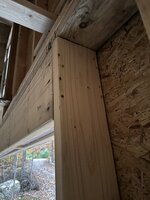
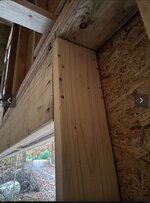
We are using an 18' x 7' garage door, and I noticed the header for the door is not support by a vertical 'stud' on each end, but is sandwiched on each end by wood attached with maybe four nails per end, which I think is relying on the shear strength of the nails, instead of physical support under each end.

I hope you understand that I am not familiar with all the technical terms and am not an engineer, but simply looking at the framing, am concerned about the structural integrity, for which I am paying tens of thousands. I am not opposed to a few ally columns, but completely open would make rearranging vehicles much easier. Maybe is should not worry at all, just not store anything above?

I think my first step should be a conversation with the builder. Maybe when the time comes, it will not pass town inspection ... don't know, as he's built 1000s of permitted garages in all of Maine. I cannot see how one could store anything on those 4x8 sheets above, regardless of weight. As an aside, the crew was not able to apply the zip tape before the rains came, so that whole area was soaked, and the plywood sheets are now delaminating.
 

Attachments

  • IMG_0380.jpeg
    IMG_0380.jpeg
    933.4 KB · Views: 136
  • IMG_0381.jpeg
    IMG_0381.jpeg
    770.9 KB · Views: 115
  • IMG_0383.jpeg
    IMG_0383.jpeg
    676.3 KB · Views: 105
  • IMG_0385.jpeg
    IMG_0385.jpeg
    772.8 KB · Views: 99
  • IMG_0389.jpeg
    IMG_0389.jpeg
    589.3 KB · Views: 93
  • IMG_0399.jpeg
    IMG_0399.jpeg
    629 KB · Views: 92
  • IMG_0400.jpeg
    IMG_0400.jpeg
    582.9 KB · Views: 92
  • IMG_0406.jpeg
    IMG_0406.jpeg
    855.8 KB · Views: 140
Last edited:

Zeke

Well-known member
Joined
Aug 13, 2009
Messages
17,176
Location
Long Beach CA, the sewer by the sea.
^^^Where did you find that pic? No trimmer? I see a mark for one so maybe not installed yet. If those are 2 x 12's they need 6 naiIs each. I suppose you can count the toe nails. What is the filler in the beam? I guess that's a clue as to how this garage 'builder' works.

Lots of different structures have been built in many ways. My experience being hard in the city all my life is mostly tract framing. That building is not like anything I've ever seen. It might work but it doesn't meet any codes that I know about. The center splice is concerning.

Of course I'm in CA where everything is over built by a factor of at least 2x.
 
OP
1

17w

Member
Joined
Apr 23, 2023
Messages
5
^^^Where did you find that pic? No trimmer? I see a mark for one so maybe not installed yet. If those are 2 x 12's they need 6 naiIs each. I suppose you can count the toe nails. What is the filler in the beam? I guess that's a clue as to how this garage 'builder' works.

Lots of different structures have been built in many ways. My experience being hard in the city all my life is mostly tract framing. That building is not like anything I've ever seen. It might work but it doesn't meet any codes that I know about. The center splice is concerning.

Of course I'm in CA where everything is over built by a factor of at least 2x.
The photo is img_0400 which I posted at 1:25pm today, and was enlarged by jar944
Rigid pink foam is sandwiched between the two headers (I think they are called headers)
Not sure what a trimmer is, is it part of the jamb ... probably be installed after the door itself, not sure, thanks
 

jar944

Well-known member
Joined
Jul 26, 2010
Messages
5,917
Location
Northern VA
The photo is img_0400 which I posted at 1:25pm today, and was enlarged by jar944
Rigid pink foam is sandwiched between the two headers (I think they are called headers)
Not sure what a trimmer is, is it part of the jamb ... probably be installed after the door itself, not sure, thanks

Trimmer/jack

Screenshot_20231030_150637_Chrome.jpg
 
To avoid these ads, REGISTER NOW!
Top Bottom