To avoid these ads, REGISTER NOW!

Truss Construction – Mending Plate from Scrap Zip Sheathing – Attic Storage – Code Compliance

To avoid these ads, REGISTER NOW!

gsmith22

Well-known member
Joined
Jul 14, 2015
Messages
337
Location
Central NJ
sure the jacks are missing, but do you really think the 2-2x10's can support the gable wall over an ~19' span (for the 18' garage door)? or how about that ridge member bearing on the gable wall - think that really takes any load? :)
 

Old tool guy

Well-known member
Joined
Apr 13, 2023
Messages
3,258
28 ft is a long long way for 2x10 to span. Needs a load bearing wall somewhere in there.

You claim to be a decade-experienced garage builder. Pictures don’t agree with that.
 

kaymccampbell

Well-known member
Joined
Feb 27, 2015
Messages
29,517
Location
Upstate New York
IMHO, it's a touch sketchy. I'd set a couple 16-18" LVLs on triple 2x6 columns right up against what's already there for the door. Then I'd run a couple LVLs lengthwise under that ceiling joist joint, and call it good.
 

alinc100

Well-known member
Joined
May 26, 2013
Messages
3,027
Location
Dearborn,MI
28 ft is a long long way for 2x10 to span. Needs a load bearing wall somewhere in there.

You claim to be a decade-experienced garage builder. Pictures don’t agree with that.
No the OP does not claim to be the builder. The Op stated "under construction by a many decades experienced garage builder" ,"Builder said we could" I believe the OP is concerned and came here asking for clarity.
 

Hohn

Well-known member
Joined
Aug 25, 2016
Messages
2,642
Location
Diesel Central, Indiana
a rafter is simply a sloped beam in a roof much a like a joist is a horizontal beam in a floor. the primary force distribution in any beam (rafter or joist) is bending.

A ridge board is simply a way for a stick framed roof to connect the two slopes of rafters at the ridge - its a convenience but in no way requrired as you indicate with historical examples where no ridge board is present and yet two rafters are connected together at the peak. By the way, if you have no ridge member, then it is clear that all forces will distribute via truss action of the rafters and ceiling joist.

A ridge beam is a structural member that is supports loads, can span, and thus different from the ridge board. The fact that a ridge beam is made from the same materials and looks just like a ridge board confuses most people (this entire thread being a remakable perfect example).

To illustrate my point below, I'll also define a truss - a set of strutural members arragned such that you get primilary axial load (compression and tension) in the members.

When you construct a system that has multiple potential load paths, the forces are distriburted based on stiffness of the load path. In the OP's roof, there is a ridge member (note I didn't say board or beam) runnning front to back. In the perpendicular direction, there are triangles (note I didn't say trusses) formed between the rafters and ceiling/floor members. So gravity loading in the OP's roof has a choice - if the ridge member is stiff enough (ie doesn't deflect to activate a different load path) and its ends supported to carry the load, the ridge member can be a beam, supporting the rafter ends at the peak. In this force distribution, there is only bending in the ridge member, bending in the rafters, and any loads applied to the storage area would induce bending in the floor joists. Alternatively, if the ridge member is not as stiff as the trianglar geometery of the rafters and ceiling joists forming a simple truss, the ridge member won't span at all and load will distribute to the rafters/ceiling joists with truss behavior. In this force distribution, you get all of the bending in the rafters and ceiling joists that you had with a ridge beam but you also get axial forces - compression in the rafters and tension in the ceiling joists.

The vast majority of gable shaped roofs are oriented such that their ridge is the long dimension making it nearly impossible to construct a deep enough/stiff enough ridge member to be stiffer and span relative to the rafter/ceiling joist truss system. The OP's building is square but ultimately has the same issue. He has a ridge board that can't span and all load will be transfered via the trusses created by the rafters/ceiling joists interconnections. Rafters will therefore have combined axial compression (from the truss action) and bending (because it spans between the ridge and ceiling joist connections). The ceiling joists will have combined axial tension (from the truss action) and bending (because it spans between the rafter ends, center vertical hangar, and other rafter end). The rafters will probably be fine but the builder put a splice in the ceiling joist right at maximum bending moment (for a two span member) that also has tension. Wood has like 1/2 to 1/4 capacity in tension compared with compression. I'm not about to go and do a structural anslsyis of all the members, but it is clear that the weak spot in that roof is the center splice in the ceiling joist.
I'll need to re-read this as I struggle to recall my engineering mechanics class on trusses and load paths. GREAT post, sir.
 

Beemer

Well-known member
Joined
Jun 21, 2020
Messages
1,402
Location
Northeast
a rafter is simply a sloped beam in a roof much a like a joist is a horizontal beam in a floor. the primary force distribution in any beam (rafter or joist) is bending.
Actually. a rafter (with no ridge beam) is a sloped ladder. How that differs from a sloped beam is that a rafter (as noted) has no vertical support at the top. It only has horizontal support from the opposing rafter, much like the ladder is opposed by the wall but not held up at the top by the wall. All of the vertical load is shed at the bottom.
 
To avoid these ads, REGISTER NOW!

Old tool guy

Well-known member
Joined
Apr 13, 2023
Messages
3,258
No the OP does not claim to be the builder. The Op stated "under construction by a many decades experienced garage builder" ,"Builder said we could" I believe the OP is concerned and came here asking for clarity.
Right. Took some careful re-reading. So my comment is correct about the construction details, but should be directed at the bubba builder.
 
OP
1

17w

Member
Joined
Apr 23, 2023
Messages
5
Thanks for all the replies, here's the final follow up.

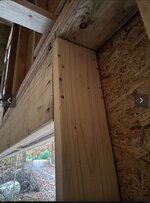
Builder had planned to, and then did install double king studs (I think that is the term) on both sides of garage door (below gable end).

Town code officer said everything was fine, but he would only store Christmas decorations (I will not store anything).

At the time, manufactured trusses had many month lead time, so that is why everything was site built.

I may not have mentioned, but these 'ceiling joists' or whatever you would like to call the horizontal lumber at ceiling height, and have OSB mending plates where they meet, are size 2' x 6'. I guess some of you would think this design, which spans 28', is even more of a not-so-good build.

Apart from adding more 8 penny nails to each mending plate, as suggested, and maybe down the road adding vertical posts, which will make vehicle placement annoying, I am stuck with it, however greatly enjoying the space.
 

6869704X4

Active member
Joined
Jan 18, 2024
Messages
29
Location
Eastern NM
I stick built the roof on my pole barn in NW Florida like that. I used corrugated tin with purlins. The first test was Hurricane Ivan, followed by Dennis. No damage at all.
Keep an eye on it but I think you'll be fine. (I didn't see where you posted a location)
 

rayra

Well-known member
Joined
Dec 1, 2014
Messages
4,724
Location
Escaped from Los Angeles
The title asks if it is code compliant.

The first step in a code compliant build is submitting a set of plans for approval and The OP says this never happened. SO not compliant.

In most locations if you call something a truss it requires an engineer’s stamp on the plans.

To my eye this garage was built without the benefits of engineering. My guess is what was built is not the prescribed rafter framing that gets approved without a plan stamped by an engineer.

Will the garage collapse under its own weight tonight? My guess is no.

Will the garage collapse under 28 inches of snow when the loft is loaded with auto parts? My guess is yes.


Walta


cough 7:12 roof pitch cough


Rafter ties look fine, wood was and has been used like that for decades before the metal nailer plates came along.
But if those are ****-jointed joists tied together, I'm a little leery of plywood in that application.
 

karoc

Well-known member
Joined
Dec 19, 2017
Messages
1,998
Location
Hemphill Tx
I’ll only respond about mending plate. This is what I was told by Allied Trusses. He check with his engineers that I could use 7/16 Zip plus Liq Nail or equivalent and screws on both sides of trusses. So I had do repair’s myself cause they wouldn’t send no one out. A mending plate was never installed, so much for quality control
 

KenC

Well-known member
Joined
Dec 20, 2009
Messages
2,578
Well I'm way to late for my opinion to matter but, the design seems fine to me. The execution however lacks. IMO (and experience) that type of splice in the ceiling joist is fine IF the 'mending plate' is long enough and thick enough with adequate fasteners. I've done similar but used 4ft long plates of 1/2 or 3/4" material on both sides nailed with 2" nails on one side 3" on the other. Shot at an angle so the don't penetrate the other side.

The shop I now have was built in the mid 60s, site built trusses, typical double Fink design, all 2x6 material. 30' long made up of one 14 and one 16' board. The 'mending plates' are 8' long 2x6s on one side only. W members lap fitted on the sides of the other members. Lots of 16d nails handdriven and clinched on the back side. Still standing and with a 4x6 on top of 4 trusses has been used to lift hundreds of engines. It was my Dad's salvage/shop building until '90 when he retired.
 

Bert_

Well-known member
Joined
Dec 24, 2016
Messages
9,720
Location
NW Iowa
The knee walls up in the attic aren't really a good design.

The rest looks fine. The splice in the joists is perfectly fine seeing how it's supported from the ridge above. That's how a truss works
 

WisJim

Well-known member
Joined
Dec 20, 2010
Messages
2,280
Location
Menomonie, WI
I hadn't noticed last year when this was first discussed, but the window in the attic area makes me wonder if it was intended as an occupiable space, not just light storage.
 
To avoid these ads, REGISTER NOW!
Top Bottom