To avoid these ads, REGISTER NOW!

Truss Design

Medeek

Well-known member
Joined
Jan 13, 2013
Messages
550
Location
Copalis Beach, WA
I was really hoping to get my hands on a a good truss software even if I had to shell out the big bucks. I contacted Miitek and Alpine and neither of them are willing to sell or lease their software to an architect or engineer. Something about trusses becoming a commodity. Bottom line is there aren't a whole lot of decent truss calculators/designers out there. If you want a truss design you have to get a truss manufacturer to quote you on a job and generate the engineered plans.

So I purchased a couple of books and starting reading up on trusses and how they are manufactured and designed. I've still got a lot to learn but just today I started into programming a basic truss estimator:

http://design.medeek.com/calculator/calculator.pl
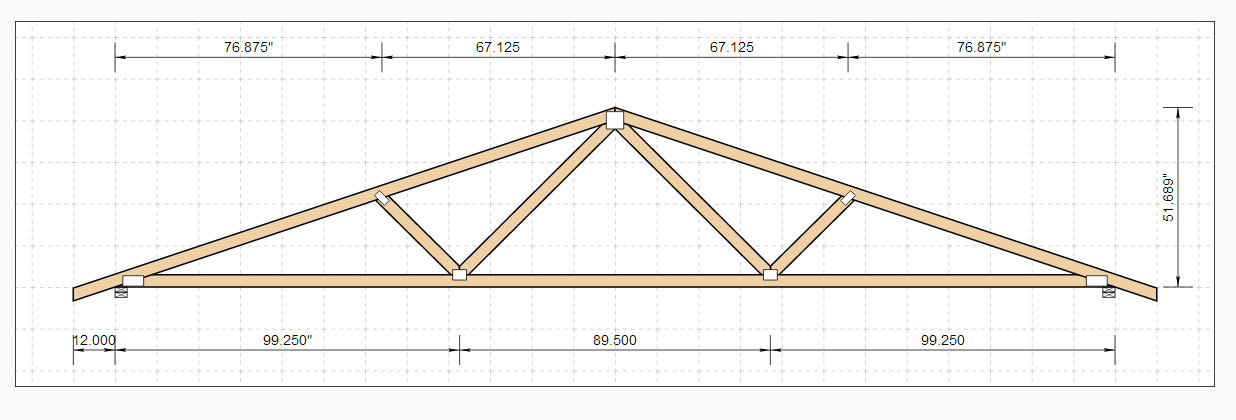
trusscalc24.jpg


It doesn't do a whole lot yet, just produces a picture and some dimensions but I will probably have it calculate loads and axial forces in the truss members. I apologize that Internet Explorer does not currently work with the images, for some reason there is no native SVG support in Microsoft browsers. I would also like it to analyze the plates and calculate those as well.

If anyone has any thougts on what else this sort of thing should do let me know. I'll probably being hacking away at it for the next few weeks in between other stuff so hopefully it can develop into something useful.
 
To avoid these ads, REGISTER NOW!
OP
M

Medeek

Well-known member
Joined
Jan 13, 2013
Messages
550
Location
Copalis Beach, WA
Also added the King Post and Howe type truss. I will probably switch back to ASD analysis and show calculations for combined bending and axial stresses in each member.

Don't try the Queen truss yet, its still a bit broken.

Also found some good material on sizing of the metal plates so as time goes along I will add in the combined stress index for each member and lumber selection based on the values from the 2012 NDS Supplement as well as size each connector plate. The last piece of the puzzle I am missing is the deflections. Still a little unsure on how Mitek and Alpine come up with their deflection numbers. I've ordered a copy of the TPI-2007 to see if it will enlighten me a little.
 
Last edited:
OP
M

Medeek

Well-known member
Joined
Jan 13, 2013
Messages
550
Location
Copalis Beach, WA
When you say commodity, do you think there's not much competition out there?

I don't know what the rep that I spoke to meant exactly by that. I asked if I could purchase or lease the software to use as simply a design tool (not to actually manufacture trusses). His answer was that if they allowed the designers and architects access to their software then trusses would become a commodity and somehow this would be bad for the truss plate manufacturers and the truss plants (BMC West, Stock Lumber etc...). I really don't see how they would sell any less trusses or nailer plates.

Anyhow, I am determined to devise a system whereby architects, engineers, designers and even the general public can easily design a truss and those results be very comparable to the output from the commercially available truss manufacturers software.

The current form is a web based app, and that is my prototyping platform. Once I have the full functionality established I will also package it up into a standalone app that can be downloaded and installed on your desktop.
 

bczygan

Well-known member
Joined
Nov 4, 2009
Messages
22,002
Location
DETROIT! Arsenal of Scrappers
Truss design software is sophisticated. It not only determines the loads, but also considers costs for different varieties of wood and factors in availability, shipping costs and other factors. Typically a truss company will run the software and an engineer somewhere else will stamp or seal the drawings that are generated. These are national systems. They squeeze out every penny from a design based on the local requirements. You can't do better.
 

tymbo

Well-known member
Joined
Apr 6, 2012
Messages
612
Location
West Chicago
If you plan on building a garage with a truss roof, you will still need to have an engineers stamp if you want to get a building permit. Ask me how I know.:lol_hitti So my question is, what is the advantage to reinventing the wheel? As far as I am concerned, the reason for using trusses was to save time/ labor. If you are going to build them yourself, whats the point?
Tim
 
OP
M

Medeek

Well-known member
Joined
Jan 13, 2013
Messages
550
Location
Copalis Beach, WA
I think the previous two responses are missing my point. I am not trying to make trusses myself or even produce the final design and specifications. I am simply trying to create a tool for architects and designers and even DIY'ers who want to use trusses in their design but need a few more details to help them in the design process. Mostly just a quick and dirty on what truss will be used for a certain situation early on in the design process.

Here is an example:

I am designing a 48'x30' 3 car garage with a 5/12 roof. The location is in a high snow load area, lets say 40-50 lbs/sqft. There is ample tools to spec out the rafter size/dimensions using AWC's website or other literature. However, there is nothing out there currently that tells me what top or bottom chord might need to be used (2x4 vs. 2x6) on a manufactured truss for this particular application.

Yes, I know that thing to do is contact a truss company with the specs of the building and have them generate a quote and some engineered drawings. Unfortunately, that is kind of hit or miss. The last time I contacted a couple companies for some trusses for a smaller 24'x16' shed they would only give me the price and no engineered drawings actually showing what the trusses looked like. So I had no clue if my assumption of a 2x4 top chord was correct or not.

I guess the thing I am running into is that there is no tool currently available for designers to use at their discretion in the design phase of a building to help layout and select a proper manufactured truss. On the same note it would be nice to quickly test other configurations, different roof pitches, overhangs, attic truss vs. non-attic truss, raised heels etc... without having to wait on a quote to come back from a truss manufacturer.
 

bczygan

Well-known member
Joined
Nov 4, 2009
Messages
22,002
Location
DETROIT! Arsenal of Scrappers
You shouldn't care whether the top chord is 2x6 or green cheese. As long as they meet the design and load specifications. And sizes will depend on species used for each member. They spec different strength and species for each member, depending on need. Tell them spans and loads and desired slope and what will hang on it and they will give you the truss you need. And no, they won't do the work and share the results til you buy.

As an Architectural designer I never needed OR wanted to do all the work necessary to design a truss. And we always used trusses, partly because designing joist and rafter and the connections was a pain. And the truss mfg., and their engineers take all the liability.

It's like deciding to design and manufacture a pencil, It is complicated and expensive. And it's been done. Just go buy a pack.

Now, if you just want to do it as an exercise, to see if you can, well, kudos to you. It will be fun to watch. When you are finished it would be interesting if a truss engineer could look at it and tell you what he thinks.

We never designed steel structures either. We had an engineer (One guy left in a big office that used to have hundreds), who, because of his experience, could give us just what we needed.

We would bring him a general layout of a building with preliminary sizes, and he would size everything. He saved us, and owners, untold thousands by his knowledge of just what to choose for each member. Sometimes a heavier member was cheaper. Sometimes deeper trusses at a specific spacing saved money overall. I'm sure computers do this now.
 

dirtydogintex

Well-known member
Joined
Sep 28, 2012
Messages
927
Location
inner looper-3rd Div Houston w & n
I think the previous two responses are missing my point. I am not trying to make trusses myself or even produce the final design and specifications. I am simply trying to create a tool for architects and designers and even DIY'ers who want to use trusses in their design but need a few more details to help them in the design process. Mostly just a quick and dirty on what truss will be used for a certain situation early on in the design process.

Here is an example:

I am designing a 48'x30' 3 car garage with a 5/12 roof. The location is in a high snow load area, lets say 40-50 lbs/sqft. There is ample tools to spec out the rafter size/dimensions using AWC's website or other literature. However, there is nothing out there currently that tells me what top or bottom chord might need to be used (2x4 vs. 2x6) on a manufactured truss for this particular application.

Yes, I know that thing to do is contact a truss company with the specs of the building and have them generate a quote and some engineered drawings. Unfortunately, that is kind of hit or miss. The last time I contacted a couple companies for some trusses for a smaller 24'x16' shed they would only give me the price and no engineered drawings actually showing what the trusses looked like. So I had no clue if my assumption of a 2x4 top chord was correct or not.

I guess the thing I am running into is that there is no tool currently available for designers to use at their discretion in the design phase of a building to help layout and select a proper manufactured truss. On the same note it would be nice to quickly test other configurations, different roof pitches, overhangs, attic truss vs. non-attic truss, raised heels etc... without having to wait on a quote to come back from a truss manufacturer.
In addition it'd be nice to have something other than a gut feel to verify the truss folks missed (fouled up) before they actually do.

These types of things are better caught pre-erection, eh?...
 

bczygan

Well-known member
Joined
Nov 4, 2009
Messages
22,002
Location
DETROIT! Arsenal of Scrappers
Typical truss mistakes I've seen are from the guy checking the job and writing it up. Real stupid stuff.

Too few or too many trusses
Wrong pitch
Wrong overhang
No energy truss
No gable end truss

Trusses in many modern homes can be quite complex. Takes a lot of attention to get them right.
 

theoldwizard1

Well-known member
Joined
Feb 22, 2011
Messages
43,100
Location
SE MI
I am simply trying to create a tool for architects and designers and even DIY'ers who want to use trusses in their design but need a few more details to help them in the design process. Mostly just a quick and dirty on what truss will be used for a certain situation early on in the design process.
So when some DYI'er uses your software, ignoring your warnings of "not fit for any purpose" (read some software licenses sometime; they are hilarious)
and the roof collapse. I hope you have good insurance !
 
OP
M

Medeek

Well-known member
Joined
Jan 13, 2013
Messages
550
Location
Copalis Beach, WA
So when some DYI'er uses your software, ignoring your warnings of "not fit for any purpose" (read some software licenses sometime; they are hilarious)
and the roof collapse. I hope you have good insurance !

If my analysis cannot eventually meet or exceed the current software out there then I will accept defeat and take it all down. The problem is not so much really someone using my truss designer to do a preliminary truss design it is more a question of quality control with the manufacture of the truss itself.
 

7th Kahuna

Well-known member
Joined
Aug 4, 2012
Messages
1,704
Location
Los Angeles, CA
I have to say, as a builder, designer, and consumer, I never like to be clueless about a service someone else provides for me. I also like to formalize my own experience to test future results. While I am not sure I would have taken on this project myself, I can see its potential value, even in light of its obvious shortcomings (i.e. no engineer's stamp).

Having worked many years as a construction cost estimator I have developed more than my share of spreadsheets to capture knowledge and enable me to reach certain design conclusions without having to wait for feedback from my vendors. I have also been able to check their work, sometimes catching mistakes, and saving us both time and money. Time consuming sure, but worth it. I look forward to seeing the final product Medeek.
 
Last edited:
OP
M

Medeek

Well-known member
Joined
Jan 13, 2013
Messages
550
Location
Copalis Beach, WA
I have to say, as a builder, designer, and consumer, I never like to be clueless about a service someone else provides for me. I also like to formalize my own experience to test future results. While I am not sure I would have taken on this project myself, I can see its potential value, even in light of its obvious shortcomings (i.e. no engineer's stamp).

Having worked many years as a construction cost estimator I have developed more than my share of spreadsheets to capture knowledge and enable me to reach certain design conclusions without having to wait for feedback from my vendors. I have also been able to check their work, sometimes catching mistakes, and saving us both time and money. Time consuming sure, but worth it. I look forward to seeing the final product Medeek.

I think you have so far summed up what I find most problematic with the current system of truss design. The information is kept behind lock and key by the truss plate manufacturers with their proprietary software when it rightfully should be available to the design professionals who need the tools to estimate, check, adjust and cost their building projects. Maybe I'm wrong but the bulk of the design and engineering of trusses should be done by architects and engineers and not by truss plants and nail plate manufacturers.

I understand they have engineers on staff who seal the truss plans at some level. But the people on the ground, at least anyone I have ever spoken with at a truss plant while requesting a truss quote has never been an engineer. In fact, I had to prod them a number of times when I didn't like the trusses they handed back to me with their "to code" deflections, I tend to be conservative with my designs, no one likes a bouncy attic floor or their furniture all migrating to the center of the room.

With regards to DIY'ers I think it is good for people to have knowledge at their fingertips, if nothing else it keeps us on a level playing field. However, having a design tool at hand in no way removes the requirement for final truss plans that are stamped by a licensed engineer. If they are not they are in violation of the building code and should be written up, dismantled etc...

However, I don't feel that what I am doing will be used much by the layman. My plan is to add in as muchl of the complex analysis as I can, so that it is laid bare for all to see, and the mystery of truss design is removed. This information will be of much more interest to the design professional who can then play with different configurations to acquire the optimal design result. So really this tool will be geared toward the design professional.
 

readhead

Well-known member
Joined
Dec 8, 2012
Messages
6,175
Location
Durango, Co.
What about the shop drawing review? The truss plant has no secrets. You have the opportunity to review and make changes. I see plans quite often where the AOR will draw the basic shape of the truss and then can review the shops for conformity.
 

7th Kahuna

Well-known member
Joined
Aug 4, 2012
Messages
1,704
Location
Los Angeles, CA
Riiiiiiiiiiight...

While there is some unfortunate truth to that, the same can be said about all manner of tools. I don't need any specific training or certificate to change the brakes on my truck. Should I not be able to buy 'Car Repair for Dummies' or for that matter the brakes themselves without having first proven my competence or signing some lawyer's release? Then, even if I end up taking the truck to the mechanic, would there not be some value in understanding what he was going to do?

I once had a 'mechanic' push down hard on my fender and release. When the vehicle bounced back, he told me that my shocks were shot and under California law, he shouldn't let me leave without replacing them. Fortunately I knew better and could confidently tell him just to change the tires (the reason I was there in the first place). Oh, and that brake change; my brother and I did it and it worked out just fine. I think we were 16 and 20.
 
Last edited:
To avoid these ads, REGISTER NOW!
OP
M

Medeek

Well-known member
Joined
Jan 13, 2013
Messages
550
Location
Copalis Beach, WA
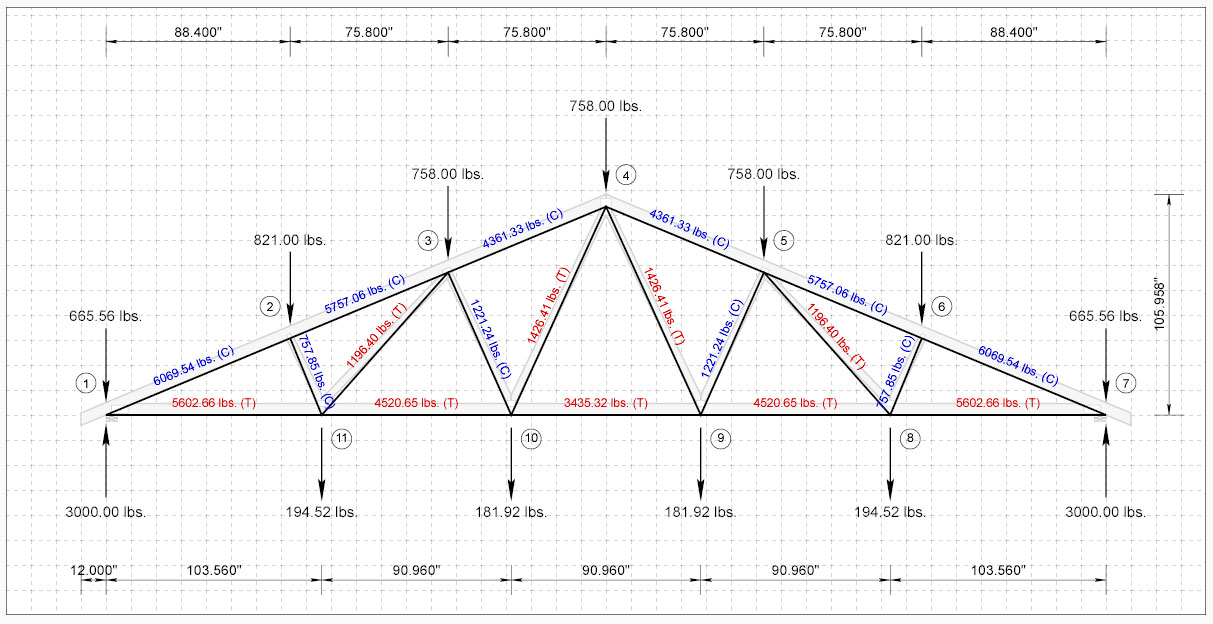
The statics equations for the double fink got really long and sure enough I made a small typo in the code (a misplaced dollar sign in front of one of my variables, perl code). So for about 3 hours I scratched my head trying to figure out why my internal checks were not adding up. Finally I remembered I still had and old 2005 demo version of "Working Model" on an install disk so I mocked up the truss in that with all the correct forces and dimensions as a independent check. Helped lead me right to the typo. Also really cool to see that my equations checked out perfectly. It never fails to amaze me how some simple math and a few carefully placed vectors can model real world systems. Anyhow, the double fink is finally up, that one was fun.

doublefink40.jpg
 
Last edited:

FunkyfullWidth

Well-known member
Joined
Oct 3, 2011
Messages
1,238
Location
Three Rivers, ma
One thing i've been curious about is how much weight I can put upstairs in the garage loft... If I gave you rough dimensions and pictures... is that something you could say. I've been curious if I can safely put a pool table up there, or a hot tub, or whatever else.

I think that would be a beneficial tool for alot of people too. "this is what I have, Can I Put this up there?"
 

readhead

Well-known member
Joined
Dec 8, 2012
Messages
6,175
Location
Durango, Co.
That has been my thought also. This information is out there. How much is your E&O insurance going to increase? Are you going to carry liability insurance? If there is going to be a disclaimer that the user would use this information at their own risk and you are not going to stand behind it why would I trust it?
 

Steinmetz

Well-known member
Joined
Oct 11, 2012
Messages
2,274
Location
Washington State
That has been my thought also. This information is out there. How much is your E&O insurance going to increase? Are you going to carry liability insurance? If there is going to be a disclaimer that the user would use this information at their own risk and you are not going to stand behind it why would I trust it?

I am a Registered Professional Engineer in Washington State, and also an attorney.

The OP is embarking on a perilous course, in my estimation, even if the software is used for his own purposes. He should not be substituting his own professional judgment for that of the truss designer/manufacturer, who has already properly sealed the truss design.
 

kythri

Well-known member
Joined
Jan 3, 2007
Messages
6,330
Location
Lebanon, OR
Everyone, stop trying to learn new things right now! How dare you try to understand the forbidden knowledge?!

Goodness, it's getting deep in here.
 

7th Kahuna

Well-known member
Joined
Aug 4, 2012
Messages
1,704
Location
Los Angeles, CA
Thanks kythri.

Steinmetz, 'even if the software is used for his own purposes'? Are you strictly worried about liability or can you truly not see any value to this? I understand you look at these things through different eyes but your statement seems a bit strong. Perhaps you could suggest a proper disclaimer for Nathaniel to add to his website.
 
OP
M

Medeek

Well-known member
Joined
Jan 13, 2013
Messages
550
Location
Copalis Beach, WA
I am a Registered Professional Engineer in Washington State, and also an attorney.

The OP is embarking on a perilous course, in my estimation, even if the software is used for his own purposes. He should not be substituting his own professional judgment for that of the truss designer/manufacturer, who has already properly sealed the truss design.

If you read the disclaimer at the bottom of my app you will see that I am not substituting my design above that of a truss manufacturer. The intent is to use the tool as a preliminary design tool, the final design and engineered plans would as normal come from the truss manufacturer using their software which has all of the min. requirements of the current ANSI/TPI 1-2007 standard. I would of course then compare their results with my own as an independent check on their results and mine. If there are any major discrepancies I would try to understand why and probably have a separate truss manufacturer quote me out on the job so I can see from a second source where the discrepancies actually exist (Mitek vs. Alpine Software). I actually normally do this anyways when I order trusses, mostly for price comparison but also I like to have a second opinion on the deflections and CSI (combined stress index). I've noticed that some truss plants are willing to shave off a few more bucks by sacrificing on cheaper lumber which gives you higher CSI values for the same design, thereby decreasing your safety factor and pushing the limits of the truss design. The point is that when it comes to trusses a few sanity checks are in order in my opinion, there is too much at stake and the safety factors are so close to the edge that there is no room for error.

I will have to give this more thought perhaps. Maybe putting this knowledge to the general public is perilous on some level. There is always going to be that maverick that sees something like this and thinks he can then make his own set of trusses, but doesn't have the skills and quality control to do it right.

The original intent of the software is for architects and engineers like myself to have an early design tool that can quickly spit out a decent estimate of what type of truss may be needed for an application without having to go through the bother of contacting a truss plant and having them write up an entire truss package, only to change it again two days later.

However, at the same time it would be nice to lay bare the entire truss design process step by step so that the mystery of truss design is removed as much as possible. I've actually had a number of building inspectors who visited my site comment on the usefulness of the software in helping them realize the immense loads in the top and bottom chords. I guess they see a lot of truss modifications that they need to write up. The gravity of cutting a bottom chord really sinks home when you've realized you've got 4000lbs of tension in the one skinny 2x4 with a decent snow load.

I may require registration to use the tool, with the registrant having to supply the current license number with their respective state that I can easily verify on the state boards.
 
OP
M

Medeek

Well-known member
Joined
Jan 13, 2013
Messages
550
Location
Copalis Beach, WA
One thing i've been curious about is how much weight I can put upstairs in the garage loft... If I gave you rough dimensions and pictures... is that something you could say. I've been curious if I can safely put a pool table up there, or a hot tub, or whatever else.

I think that would be a beneficial tool for alot of people too. "this is what I have, Can I Put this up there?"

An app. for that sort of thing would definately have value, but there are a lot of factors to consider, maybe too many to easily program. I would have to give this one some thought. The problem here is your dealing not with a general case but concentrated loading specific to a certain roof. You've got me thinking though.
 
OP
M

Medeek

Well-known member
Joined
Jan 13, 2013
Messages
550
Location
Copalis Beach, WA
That has been my thought also. This information is out there. How much is your E&O insurance going to increase? Are you going to carry liability insurance? If there is going to be a disclaimer that the user would use this information at their own risk and you are not going to stand behind it why would I trust it?

You make a good point. My disclaimer is to let people know that this tool is not designed to replace your truss plants engineered plans, let them do their job. I'm basically reinventing the wheel here because I need a tool that is currently missing on the market. As an engineer I cannot go out and buy or even lease any of the currently commercially available software packages that are used to design trusses. My argument is that the engineer and architect should be more involved in the truss design than many currently are. The blackbox mentality imposed on us by the current system of proprietary software and tight grip held by the truss plate manufacturers is something I would very much like to change. Give us the tools so we can get a better feel for the trusses that are used in our designs. I would like to play with dead and live loads, pitches, overhangs, spans etc... to see how that affects my roof line while all at the same time knowing that my design is actually "buildable". Why should only a truss technician at a truss plant with no formal engineering training have access to a world class piece of design software while I am left in the dark?

My thoughts are that by developing this software I will ultimately force the like of Mitek and company to offer a competitive product that fills this gap. Currently there is no need to since the competition does not exist and why change status quo when they are obviously sitting pretty right where they are at.

So in short this project for me is more of a quest than a commercial venture. A things progress that may change, one can never say for certain but at least for know my main desire is to simply insert some change into our current modus operandi.
 

Charles (in GA)

Well-known member
Joined
Jan 11, 2006
Messages
12,489
Location
50 mi south of Atlanta
Well, someone in the past developed at least two different truss design software programs. Doesn't anyone wonder why after the first program was up and running, that someone would bother to design the second?

Its possible that the OP is on to something here, he might even build a better mousetrap as a result.

As a layman and not an engineer or architect I can certainly understand how one of those professionals might want to be able to run different scenarios themselves and arrive at the "perfect" solution, prior to going to the truss mfg. Otherwise, you take what they suggest and I can see how it becomes a "here is your truss design, now go away and don't bother me again" type of thing.

While many truss manufacturers probably bend over backwards to help and offer all possible suggestions and solutions, I can certainly understand that somewhere out there, there are truss manufacturers that feel they are above all others and really don't want to be bothered with ten different possibilities.

Charles
 

readhead

Well-known member
Joined
Dec 8, 2012
Messages
6,175
Location
Durango, Co.
You are the design guy out there by yourself wanting information. I am the guy who has to put it up and make your design real. I deal with several design professionals every day and I have put your thoughts out there. Not one felt a need for the information. I think it is quite simply supply and demand. There is no supply because there is no demand. As I stated before several designers around here design the truss they want and collaberate with the truss company to comply with the design.
 

kythri

Well-known member
Joined
Jan 3, 2007
Messages
6,330
Location
Lebanon, OR
You are the design guy out there by yourself wanting information. I am the guy who has to put it up and make your design real. I deal with several design professionals every day and I have put your thoughts out there. Not one felt a need for the information. I think it is quite simply supply and demand. There is no supply because there is no demand. As I stated before several designers around here design the truss they want and collaberate with the truss company to comply with the design.

Huh what? :headscrat
 
OP
M

Medeek

Well-known member
Joined
Jan 13, 2013
Messages
550
Location
Copalis Beach, WA
I just tried a google of truss design spreadsheet, lots of hits for free stuff. Start with,

http://www.jhu.edu/virtlab/bridge/truss.htm

more

http://www.cesdb.com/structural-design/roof-truss-design-truss4.html

The first one is an educational toy, no engineering going on there. The other is a software developed by Fine Engineering out of the Czech Republic supporting the following EU design standards:
EN 1995-1-1, CSN 73 1701, STN 73 1701

Notice the absence of the ANSI/TPI 1-2007 standard. This is the standard required in the US and referenced by the IRC and IBC.

I've actually used this software a bit to see if I could utilize it but everything is in metric and non-ANSI standards. I really have no idea what it is doing and if the design values for the lumber calculations are NDS or not.

Find me a truss design software that I can use (money is not an issue) that complies with the national codes and I will put the entire truss app. that I've just started working on into the Recycle Bin.
 

Steinmetz

Well-known member
Joined
Oct 11, 2012
Messages
2,274
Location
Washington State
Thanks kythri.

Steinmetz, 'even if the software is used for his own purposes'? Are you strictly worried about liability or can you truly not see any value to this? I understand you look at these things through different eyes but your statement seems a bit strong. Perhaps you could suggest a proper disclaimer for Nathaniel to add to his website.

Mr. Wilkerson is a litigator's dream come true. I can see he's never been embroiled in a lawsuit. If he had, he wouldn't be providing a public (e.g., discoverable) record of his engineering musings. As far as a disclaimer is concerned, he appears to have a naive belief in their effectiveness.
 

Steinmetz

Well-known member
Joined
Oct 11, 2012
Messages
2,274
Location
Washington State
Everyone, stop trying to learn new things right now! How dare you try to understand the forbidden knowledge?!

Goodness, it's getting deep in here.

No one is discouraging the pursuit of new knowledge. But this isn't new, and planar truss analysis "ain't exactly rocket science".
 

kythri

Well-known member
Joined
Jan 3, 2007
Messages
6,330
Location
Lebanon, OR
Mr. Wilkerson is a litigator's dream come true. I can see he's never been embroiled in a lawsuit. If he had, he wouldn't be providing a public (e.g., discoverable) record of his engineering musings. As far as a disclaimer is concerned, he appears to have a naive belief in their effectiveness.

It's a shame that assault and battery against litigious idiots with zero respect for personal responsibility is itself illegal.

It's getting to the point that I'm surprised that it's even legal to teach arithmetic in public schools these days, for fear that someone might use the maths themselves and sue the textbook publisher when they screw something up.
 
OP
M

Medeek

Well-known member
Joined
Jan 13, 2013
Messages
550
Location
Copalis Beach, WA
Mr. Wilkerson is a litigator's dream come true. I can see he's never been embroiled in a lawsuit. If he had, he wouldn't be providing a public (e.g., discoverable) record of his engineering musings. As far as a disclaimer is concerned, he appears to have a naive belief in their effectiveness.

You're right up until this point I have never had to deal with any form of lawsuit and hopefully never will. I've updated the app. to included a check box and a terms of use which is a bit more extensive than the small disclaimer at the bottom.

http://design.medeek.com/calculator/calculatorterms.html

However, you will probably find this also is not satisfactory for preventing litigation.

I'm really not sure what is wrong with making public ones engineering musings. Other professionals present papers to journals all the time that are then part of the public record, anyone who has a hankering can read those papers and utilize that knowledge. Obviously some matters such as enriching uranium etc... may pose national security risks and those topics are more censored than most. But truss analysis, building design, components ec... do not seem like that hot of a topic to me, just a little bit interesting.
 

CNGsaves

Well-known member
Joined
Sep 26, 2012
Messages
13,233
Location
KS and OK
Steinmetz said:
Mr. Wilkerson is a litigator's dream come true. I can see he's never been embroiled in a lawsuit. If he had, he wouldn't be providing a public (e.g., discoverable) record of his engineering musings. As far as a disclaimer is concerned, he appears to have a naive belief in their effectiveness.


It's a shame that assault and battery against litigious idiots with zero respect for personal responsibility is itself illegal.

It's getting to the point that I'm surprised that it's even legal to teach arithmetic in public schools these days, for fear that someone might use the maths themselves and sue the textbook publisher when they screw something up.

Unless there is some sort of copyright/workmanship against the software code, etc. that MEDEEK is using, then I don't see any problem with his idea to help end users dream up solutions for truss design earlier in the process. In fact, MEDEEK might need to worry the other way that someone will steal his "Rough Truss Draft" idea and use it for commercial gain . . . thus, if MEDEEK develops something that catches on and spreads like wildfire, he may need his own copyright protection for what he just created!!

What STEINMETZ appears to be doing is suppress free thought process, under the Threat of Litigation!!

In the America I know, freedom of thought and speech is STILL FREE !! Also, the pursuit of knowledge and commercial enterprise is also free!!
 
To avoid these ads, REGISTER NOW!
Top Bottom