To avoid these ads, REGISTER NOW!

Truss Modification for Car Lift

RyanEricW

Well-known member
Joined
Jan 14, 2012
Messages
85
Hello,

I'm one of the few lucky people in the world to have acquired a 4 post lift in their garage to finally stop working on the cold concrete!

The only problem is, I am trying to figure out how to modify 3 trusses on my attached garage for extra ceiling height.

Current height from floor to bottom chord is 9'

I've reached out to the only structural engineer in the area and he wanted around $3,000 for blueprints for modification....that seems a bit excessive for this project.

What do you guys think?


Any help would be appreciated
 
Last edited:
To avoid these ads, REGISTER NOW!

ssdave

Banned
Joined
Apr 11, 2015
Messages
2,913
Location
Eastern Oregon
Go to your local lumberyard that sells trusses, and ask for a quote for trusses that can be installed to replace the ones you have and give you the lift you need. They can be installed adjacent to the existing trusses, nailed to marry them at the top boards of the trusses, and then the existing trusses removed. It may be more work than the $3000 worth of engineering, to do it, though.

I don't want to comment on the appropriateness of the fee you've been quoted, and without seeing the scope of work, would have no basis for doing so. However, you may want to talk to other engineers and get a different perspective on what they would do and charge to modify this design. They may see a different scope of work than the first one did.
 

ssdave

Banned
Joined
Apr 11, 2015
Messages
2,913
Location
Eastern Oregon
A footnote to the previous message, and totally different subject.

You really need to put in some appropriate electrical and eliminate the extension chords. They are a recipe for starting a fire and shouldn't be used as they are shown in the trusses.
 
OP
R

RyanEricW

Well-known member
Joined
Jan 14, 2012
Messages
85
Go to your local lumberyard that sells trusses, and ask for a quote for trusses that can be installed to replace the ones you have and give you the lift you need. They can be installed adjacent to the existing trusses, nailed to marry them at the top boards of the trusses, and then the existing trusses removed. It may be more work than the $3000 worth of engineering, to do it, though.

I don't want to comment on the appropriateness of the fee you've been quoted, and without seeing the scope of work, would have no basis for doing so. However, you may want to talk to other engineers and get a different perspective on what they would do and charge to modify this design. They may see a different scope of work than the first one did.

Thank you for the suggestions. The scope of the work would be raising the bottom chord of 3 trusses right in the middle where the car is. The other tricky part is figuring out how to appropriately brace the bottom of the trusses as the current bottom brace needs to be removed.

I could be wrong, but you can see if you cut the truss in 1/3rds. Can't I just add the same thickness wood along the entire span of the bottom chords at the 1/3 marks on EACH side of the existing trusses to remove the center bracing entirely? From what I've read that is there primarily to tie all of the trusses together for something like a dywall ceiling.

See my pic attached to explain what I mean. Imagine I install the support on the left and right sides, then am I able to to remove the center support?
 

Attachments

  • common-truss.jpg
    common-truss.jpg
    37.2 KB · Views: 567

ssdave

Banned
Joined
Apr 11, 2015
Messages
2,913
Location
Eastern Oregon
The bottom chord of the truss is in tension, to hold the whole truss from spreading out and squashing down. You cannot simply remove it. You can get re-designed trusses that have a raised center, to replace the trusses you have now. You may be able to modify the existing trusses in place, one at a time, with a proper design. You need an engineer with the appropriate truss software and a good analysis of your existing conditions to tell you how to mod the trusses. Or a design to replace them.
 

lakeroadster

Well-known member
Joined
Jan 19, 2015
Messages
5,166
Location
Central Colorado
Another option is a couple of heavy duty 2 ply trusses (gable end style) that utilize purlins that locate below the upper chord of the 3 trusses in question.

Once installed those 3 trusses in question could then be removed... except for the top chords.

Lots of options... all of which if done correctly require a knowledgeable truss designer who will stamp his design so you can provide it to the proper jurisdictional authorities.

Good luck in your endeavour!
 
Last edited:

ssdave

Banned
Joined
Apr 11, 2015
Messages
2,913
Location
Eastern Oregon
Lake Roadster is right, you can get appropriately designed trusses to sister with the trusses on each side of the 3 you remove, and then span across them with purlins that support the existing truss top chord that is holding up the roof. If you go to the local lumber yard that sells trusses, they can design and sell you those trusses. The only catch is it is hard to put a truss up into place under an existing roof. The work may be worth more than the fee to design a modified truss to modify the existing 3 you have.

I used this trick in a building I'm just designing to make room for an attic access stair. Easy on new construction, hard to install on existing.
 

K'ledgeBldr

Well-known member
Joined
Aug 22, 2011
Messages
1,925
Location
Johns Creek, GA
REW-

Now, after reading all of these ideas, contraptions, and speculations you should be able to recognize why an engineer charges the fee he does. Besides, it's not just the "change" to be done- it's accepting the responsibility for the proposed change. Don't second guess- your life and the life of others could be at stake.
 

jimbojk

Member
Joined
Jan 1, 2013
Messages
9
I would go to a truss manufacturer and ask for a design for a scissor truss with the same span and roof pitch. You may be able to modify your existing trusses the same way. It would be important to support the roof while your doing the modifications, but if you do one at at a time, it could be accomplished. I am assuming that your existing roof pitch is no less than 6 on 12.
 

ms fowler

Well-known member
Joined
Jun 27, 2012
Messages
450
Location
Littlestown, PA _ 6 miles south of Gettysburg
You could also use a rafter design table and see what size rafter is needed for your span. Sister the rafters to the existing trusses. The rafters will carry the load, and not spread as trusses with the bottom chord cut would do. Local lumber yard might have more grades and sizes available than big box stores.
 

manwithtools

ALLIANCE MEMBER
Joined
Aug 24, 2015
Messages
13,857
Location
Lebanon, TN
You could also use a rafter design table and see what size rafter is needed for your span. Sister the rafters to the existing trusses. The rafters will carry the load, and not spread as trusses with the bottom chord cut would do. Local lumber yard might have more grades and sizes available than big box stores.

You do realize that rafters rely on a ridge beam or ceiling joists to keep them from spreading, correct? You can't just put up a rafter without a means of supporting it.

Modifying an existing roof support structure requires engineering beyond rafter tables.
 

ms fowler

Well-known member
Joined
Jun 27, 2012
Messages
450
Location
Littlestown, PA _ 6 miles south of Gettysburg
Maybe--but then help me see the problem. We are not building a free-standing new roof. The problem is how to modify an existing truss roof system. The roof sheathing is already fixed to the ex. trusses. We are not disturbing that so the lateral loads at the roof line are handled. The loads on the roof are currently carried by the trusses. If we sister an adequately-sized rafter to the ex. trusses the loads are carried to the outside wall. The inner ends of the rafter may bear directly against each other, or you can put a piece of ridge between the ex. trusses and let the rafters bear on that. He is only talking about removing the center third of 4 trusses. The out third at each end remains intact, and either drywall on the ceiling, or extra lateral braces spanning the cut trusses would handle any lateral loads in that area. Rafter ties added about 1/3 of the height of the truss in the area to be cut would control the spread and loads imposed on the walls.

I may be wrong, but I can't see it. If I have made errors, please show me.
 

astroracer

Well-known member
Joined
Jun 22, 2005
Messages
3,001
Location
Mid_Michigan
**** it! I don't need to get somebody killed with this... Obviously I am just a stupid *** for posting it... That won't happen again, believe me.
Mark
 
Last edited:

manwithtools

ALLIANCE MEMBER
Joined
Aug 24, 2015
Messages
13,857
Location
Lebanon, TN
I have posted this a few times...
You can modify some trusses to get a full height lift in there.
This is what I did for my hoist area. it has been like this for 6 years with no issues. :)
.....

If you do something along these lines you should be okay. :)

Mark

Highlighted text says all you need to know about this subject. I can hear the discussion with the insurance adjuster now "I don't know why my garage fell down, a guy on the internet did this and he said I should be okay doing this too"

I see astroracer has all the required information from the OP to make this qualified recommendation about cutting out some silly old roof trusses, he knows the on center spacing of the trusses, the snow and wind loads, the roof structure and how many layers of roofing it has now and in the future. All this will work out just fine.....
:lol_hitti:lol_hitti

In case it's not obvious, I'm being very sarcastic and the OP should NOT listen to the advise to go ahead and cut your trusses and you will "probably" be okay. That is simply bad advise and in the right circumstances could get someone hurt or worse. Don't proceed without some type of engineering or truss manufacturers advise.
 

manwithtools

ALLIANCE MEMBER
Joined
Aug 24, 2015
Messages
13,857
Location
Lebanon, TN
What you have done is take out the tension member, which is the bottom chord of the truss. So, the truss parts that remain and your new helper rafters will be pushing out on the walls. The top plates of the walls may transfer the thrust to the rest of the uncut trusses and keep the garage from failing, or the walls may bow out and the roof sag. In the long term, I'd bet on the latter happening, although the roof may not fail initially and you may think that you've been successful.

If you put in rafter ties, that will help, as they will hold some of the tensile force from the truss action they create. Problem is, without analysis, you won't know how effective they are.

Overall, just a bad idea unless you actually can analyze the forces and know that they will work. Otherwise you're just guessing and hoping.

Typically hope is not an effective strategy.

Well said :thumbup::thumbup::thumbup::thumbup:
 

manwithtools

ALLIANCE MEMBER
Joined
Aug 24, 2015
Messages
13,857
Location
Lebanon, TN
In the interest of full disclosure, I have plans to modify trusses in my shop to provide clearance for a lift as well. I have consulted with a truss engineer and the modifications I will have to do are very involved. My building has the trusses on ten foot centers and I need to remove about 2 feet from the bottom cord to provide an opening for the lift posts to fit in. It's going to be a lot of work and not inexpensive, but at least I will sleep well while I live here and after I sell the place to the next owners.
 

astroracer

Well-known member
Joined
Jun 22, 2005
Messages
3,001
Location
Mid_Michigan
Highlighted text says all you need to know about this subject. I can hear the discussion with the insurance adjuster now "I don't know why my garage fell down, a guy on the internet did this and he said I should be okay doing this too"

I see astroracer has all the required information from the OP to make this qualified recommendation about cutting out some silly old roof trusses, he knows the on center spacing of the trusses, the snow and wind loads, the roof structure and how many layers of roofing it has now and in the future. All this will work out just fine.....
:lol_hitti:lol_hitti

In case it's not obvious, I'm being very sarcastic and the OP should NOT listen to the advise to go ahead and cut your trusses and you will "probably" be okay. That is simply bad advise and in the right circumstances could get someone hurt or worse. Don't proceed without some type of engineering or truss manufacturers advise.

Did you even bother to ask me who designed my truss modifications before making me look like an idiot? No, you didn't... Thanks for that. VERY much appreciated... In case it's not obvious, I took offense to your post. I am NOT an idiot and the truss mods were done with direction from a construction engineer...
I will sleep well tonight also, ya Jack.
Mark the idiot.
 
To avoid these ads, REGISTER NOW!

ms fowler

Well-known member
Joined
Jun 27, 2012
Messages
450
Location
Littlestown, PA _ 6 miles south of Gettysburg
The tensile strength of drywall--or rather a drywall assembly in considerable higher than you assume. I don't have the numbers, and I doubt that they would mean anything, but stick built houses are far stronger after the drywall is installed than before. Screwed and glued to studs and trusses or rafters produces an assembly that is far stronger than the same components by themselves. I know we have all seen drywall screws punch thru the drywall when attaching, and that gives the indication that drywall is weak. Well, in that direction, and unsupported, it is weal. But in shear, when screwed and glued, it produces a great assembly.
 

lakeroadster

Well-known member
Joined
Jan 19, 2015
Messages
5,166
Location
Central Colorado
The tensile strength of drywall--or rather a drywall assembly in considerable higher than you assume. I don't have the numbers, and I doubt that they would mean anything, but stick built houses are far stronger after the drywall is installed than before. Screwed and glued to studs and trusses or rafters produces an assembly that is far stronger than the same components by themselves. I know we have all seen drywall screws punch thru the drywall when attaching, and that gives the indication that drywall is weak. Well, in that direction, and unsupported, it is weal. But in shear, when screwed and glued, it produces a great assembly.

The added strength is negligible ..... You're reaching. And on a ceiling, the weight of drywall is a negative, not a positive.
 
Last edited:
OP
R

RyanEricW

Well-known member
Joined
Jan 14, 2012
Messages
85
Are the pictures not showing up for anyone?

There are like 11 trusses on 2' centers across my garage. I only need to modify the bottom chords of 3 right in the middle and modify the location of the beam running across the bottom chords to the outsides instead of the center.
 
Last edited:

lakeroadster

Well-known member
Joined
Jan 19, 2015
Messages
5,166
Location
Central Colorado
Highlighted text says all you need to know about this subject. I can hear the discussion with the insurance adjuster now "I don't know why my garage fell down, a guy on the internet did this and he said I should be okay doing this too"

I see astroracer has all the required information from the OP to make this qualified recommendation about cutting out some silly old roof trusses, he knows the on center spacing of the trusses, the snow and wind loads, the roof structure and how many layers of roofing it has now and in the future. All this will work out just fine.....
:lol_hitti:lol_hitti

In case it's not obvious, I'm being very sarcastic and the OP should NOT listen to the advise to go ahead and cut your trusses and you will "probably" be okay. That is simply bad advise and in the right circumstances could get someone hurt or worse. Don't proceed without some type of engineering or truss manufacturers advise.

Did you even bother to ask me who designed my truss modifications before making me look like an idiot? No, you didn't... Thanks for that. VERY much appreciated... In case it's not obvious, I took offense to your post. I am NOT an idiot and the truss mods were done with direction from a construction engineer...
I will sleep well tonight also, ya Jack.
Mark the idiot.

Maybe I'm the only one... but all this was quite confusing since there was no link to the modifications that astroracer did to his trusses?

I did some searching and found that astroracer's truss modifications are discussed on post #13 here: http://www.garagejournal.com/forum/showthread.php?t=330774&highlight=truss

Here's his quote:

You can modify some trusses to get a full height lift in there.
This is what I did for my hoist area.
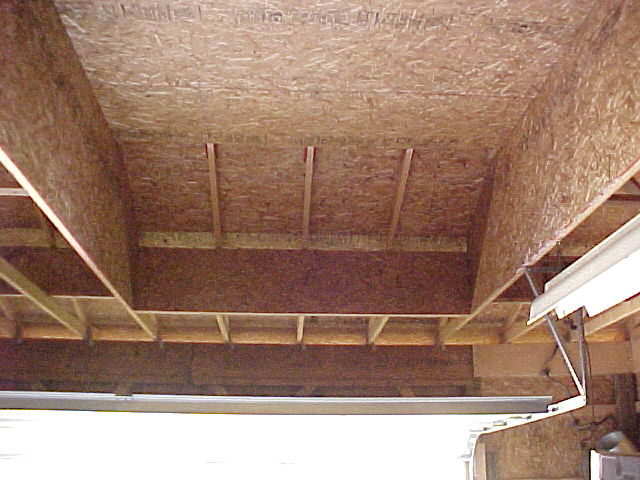
Looking toward the garage door you can see I plated the entire truss on either side of the bay I was opening up with OSB.
MVC004F-vi.jpg

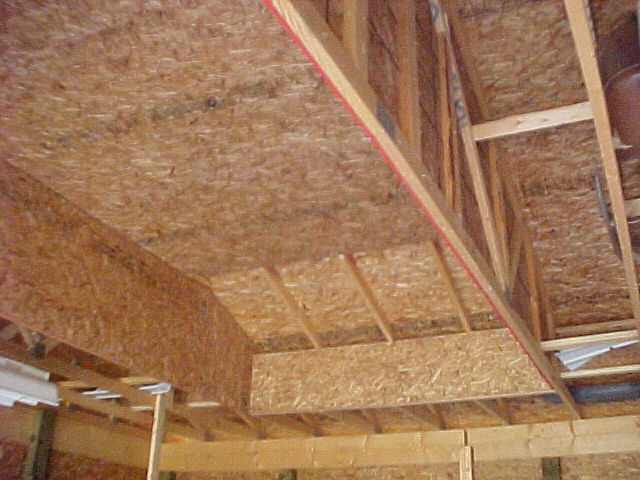
Added collar ties to the three rafters I was cutting out. After the middle of the truss was removed I plated the entire top of the opening with OSB. You can also see the verticles I added to the two end trusses to give the added OSB something to attach to and give it some robustness.
MVC002F-vi.jpg

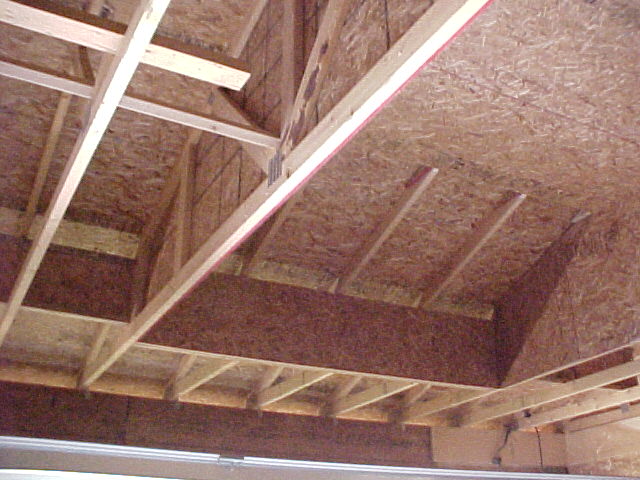
I also added 16" engineered floor joists at both ends of the opening.
MVC006F-vi.jpg

These go thru three sets of trusses on both sides of the new opening.
In this pic you can see where the three trusses were cut of at the engineered floor joist.
MVC009F-vi.jpg

The cut off trusses were tied into the new structure with joist hangers on the back side.
If you do something along these lines you should be okay. :) And it is much less tear up then raising the entire roof.
Mark

Looks like a lot of structure has been added and the installation looks great. :thumbup: All that additional sheathing really helps to strengthen the framing.

Neither I nor anybody else here can say if this will or won't work without knowing more.
 
Last edited:

ssdave

Banned
Joined
Apr 11, 2015
Messages
2,913
Location
Eastern Oregon
Even though you are only cutting 3 of the 11, you are modifying the support for 8 feet of your roof. You may or may not be able to cut out the bottom chords and not have the roof collapse. You may or not be able to modify the trusses to keep the roof from collapsing. The point is, you have to find someone that is competent to analyze those modifications, and modify them correctly. This isn't something that can be done on an internet forum from a few pictures and a plea for help. No-one with the right qualifications will give you advice under these conditions, and those that will give you a design from the limited information are not likely to give you the correct design for your particular situation. The reality of it is that each truss design is a specific to the circumstances of the loads, spans, and truss configuration, and there's no easy way to mod the design without re-calculating the truss.

Kind of beating a dead horse here. To do this safely, you will have to replace the roof support that you are compromising with correctly designed and installed new support. The key item here is "correctly designed". There is no internet table or resource that I know of that has this information available. It has to be designed specifically for your truss and your case.

Usually the easy to do this is to put in the extra trusses next to the spans you are taking out, and purlins in between to support the roof. Or scissor trusses that give additional headroom on the existing bottom chord. The problem is that it will be really hard to get the trusses up under the existing roof and bearing on your walls to do this. You can go in to your local truss seller and see if they can make you a "short truss" that has the tails just long enough to jack up and sister next to the adjacent ones. Then, there will need to be some bracket or other provision to make the short truss bear onto the top plate. All this to accommodate installation under the existing roof. They may also be able to make the trusses in two parts, split vertically down the middle. They will have some kind of design to marry the two halves in the field. Again, you need correct design, and the truss manufacturer is the one to do it. Or an engineer that is qualified in this.

Good luck with your project, and in finding the expertise to help you. Those resources are out there, really depends on where you live and what resources are there.
 
Last edited:

ssdave

Banned
Joined
Apr 11, 2015
Messages
2,913
Location
Eastern Oregon
More posts while I was typing mine.

Astroracers modifications are an example of a well engineered and executed modification to do what you need. As Lakeroadster said though, you can't just copy it and know it will work, it needs to be designed for YOUR truss situation.

Going over this example with a competent engineer to design yours might give him some great ideas on how to approach it. This would be easier to install than getting completed trusses up under the roof and installed correctly.
 

astroracer

Well-known member
Joined
Jun 22, 2005
Messages
3,001
Location
Mid_Michigan
More posts while I was typing mine.

Astroracers modifications are an example of a well engineered and executed modification to do what you need. As Lakeroadster said though, you can't just copy it and know it will work, it needs to be designed for YOUR truss situation.

Going over this example with a competent engineer to design yours might give him some great ideas on how to approach it. This would be easier to install than getting completed trusses up under the roof and installed correctly.

Thank You!
The modifications WERE well engineered and well executed. I am VERY confident they will continue to do the job they were designed to do.
I posted them up as an example of what can be done. I did not expect the unabashed deriding I received. NO ONE has asked how the mods were engineered or even asked for more info. They just start swinging away with their holier then thou bats.
The lack of respect on this site is really getting old...
Mark
 

bczygan

Well-known member
Joined
Nov 4, 2009
Messages
22,002
Location
DETROIT! Arsenal of Scrappers
Thank You!
The modifications WERE well engineered and well executed. I am VERY confident they will continue to do the job they were designed to do.
I posted them up as an example of what can be done. I did not expect the unabashed deriding I received. NO ONE has asked how the mods were engineered or even asked for more info. They just start swinging away with their holier then thou bats.
The lack of respect on this site is really getting old...
Mark

Mark,

An interesting solution that I've seen here before.

Who engineered it and what were the actual calculations involved?

Bill
 

bczygan

Well-known member
Joined
Nov 4, 2009
Messages
22,002
Location
DETROIT! Arsenal of Scrappers
Other solutions include raising the roof in this area and using girder trusses on each side and beams running perpendicular to them to span the opening.

Also, exterior trusses can replace the removed interior ones.

Bill
 

astroracer

Well-known member
Joined
Jun 22, 2005
Messages
3,001
Location
Mid_Michigan
Mark,

An interesting solution that I've seen here before.

Who engineered it and what were the actual calculations involved?

Bill

Hey Bill, yes, I have posted it here before because I am proud of the work we did and how it turned out.
A friend of mine came up with the design a few years ago. He is a structural engineer. He worked for a company in the Lansing area, I can't remember the name.
He worked it all out in about half an hour. Something about load transfer and shear strengths. Over my head, I know that. I trust him, no worries on my part.
Mark
 

manwithtools

ALLIANCE MEMBER
Joined
Aug 24, 2015
Messages
13,857
Location
Lebanon, TN
Did you even bother to ask me who designed my truss modifications before making me look like an idiot? No, you didn't... Thanks for that. VERY much appreciated... In case it's not obvious, I took offense to your post. I am NOT an idiot and the truss mods were done with direction from a construction engineer...
I will sleep well tonight also, ya Jack.
Mark the idiot.

Mark,
I am sorry my post aggravated you to the extent it did and I apologize for that. I tend to be a sarcastic SOB and without the advantage of you knowing me I can see how my words were sharp and perceived as hurtful.

I do want to explain a little bit about why I reacted like I did. You stated that I didn't ask about who designed your modifications before I jumped on you. The reason I didn't ask is because you didn't offer that yours was an engineered modification in your post showing pictures of what you had done.

Other prior posters encouraged the OP to get engineering help with this project including myself. I (and I'm sure others) received your post as implying that the OP could do something similar to what you did and he'd probably be okay - if you would have said "Here's what I did and it works great, but please be sure to get engineering help before you do something similar" - my reaction would have been much different.

Your post never mentioned engineering, it just said it's been 6 years and it's okay and "If you do something along these lines you should be okay." That sounded very much to me like a recommendation to do what you did and it would be okay - independent of professional advise.

Let's remember the OP started his thread out saying engineering was to expensive and he wanted folks on here to tell him it was okay to modify his trusses without that engineering. Let's say I didn't react to your post the way I did and the OP now thinks it might be okay for him to do what you did.

Here's the quote from his first post: "I've reached out to the only structural engineer in the area and he wanted around $3,000 for blueprints for modification....that seems a bit excessive for this project.

What do you guys think?"


Your mod looks great as lakeroadster said, glad it works for you. Again I apologize, but I did not want to leave any doubt about the appropriateness of following your modification without expert advise. There are far to many variables in a roof system for us armchair internet warriors to speculate what might or might not work. :beer:
 
OP
R

RyanEricW

Well-known member
Joined
Jan 14, 2012
Messages
85
---------------------------------
 

Attachments

  • 20161010_220502.jpg
    20161010_220502.jpg
    114.9 KB · Views: 329
Last edited:
OP
R

RyanEricW

Well-known member
Joined
Jan 14, 2012
Messages
85
Update from the manufacturer:

"Then the best way to do this would be to buy 3 new scissors trusses that match the pitch and heel height of the existing trusses, then install them next to the existing trusses, then cut away the bottom chord of the existing truss. You need to nail the top chords of the old and new truss together. The new trusses will not have overhangs.

It sounds like you have our 26', 4/12 pitch, standard heel (3 15/16'') stock trusses."
 

grommit

Active member
Joined
Jul 12, 2010
Messages
39
Another consideration is when you go to sell the house , a good home inspector will never pass a truss modification unless there is an engineers stamp on it. You may end up spending the money then without the benefit of use.
 

ssdave

Banned
Joined
Apr 11, 2015
Messages
2,913
Location
Eastern Oregon
Another consideration is when you go to sell the house , a good home inspector will never pass a truss modification unless there is an engineers stamp on it. You may end up spending the money then without the benefit of use.

The truss manufacturer will give you the stamped drawings with the trusses.
 
OP
R

RyanEricW

Well-known member
Joined
Jan 14, 2012
Messages
85
Update from the manufacturer #2:

I sent him the photo showing the center placed lateral 2x6 bracing and here was their response.

"That is a lateral brace shown in the picture, you need one of those every 10'. As long as each end of the braces on the existing trusses is attached to a stationary wall you are OK. The new trusses would need to be braced to the existing trusses, which are then braced to walls so the building still has the needed bracing."
 

ssdave

Banned
Joined
Apr 11, 2015
Messages
2,913
Location
Eastern Oregon
Update from the manufacturer:

"Then the best way to do this would be to buy 3 new scissors trusses that match the pitch and heel height of the existing trusses, then install them next to the existing trusses, then cut away the bottom chord of the existing truss. You need to nail the top chords of the old and new truss together. The new trusses will not have overhangs.

It sounds like you have our 26', 4/12 pitch, standard heel (3 15/16'') stock trusses."

The only difficulty is getting the trusses up next to the other ones, under the roof sheathing, and over the wall top plates. Once you get them into place, the rest of the work is easy!
 
OP
R

RyanEricW

Well-known member
Joined
Jan 14, 2012
Messages
85
Another consideration is when you go to sell the house , a good home inspector will never pass a truss modification unless there is an engineers stamp on it. You may end up spending the money then without the benefit of use.

The home inspectors out by me are a joke. I paid to have mine looked over, and they missed a hole in the floor, and didn't even get under the house or in the attic because they didn't feel like it. I appreciate the insight, but out by me I don't think people really care to that level thankfully.
 
Last edited:
To avoid these ads, REGISTER NOW!
Top Bottom