
You are using an out of date browser. It may not display this or other websites correctly.
You should upgrade or use an alternative browser.
You should upgrade or use an alternative browser.
Tube notching
- Thread starter duc916
- Start date
Griff93
Well-known member
How big of a bridgeport do you have? I have one and have tried this. I went back to hole saws. It takes a lot of power to pull a 1.75 end mill. My j head just doesn't have enough so it's faster to hole saw. There's not operationally wrong with mine. You might find someone on ebay selling some nos end mills in that size. From any machinery suppliers it's going to be expensive.
txvwnut
Well-known member
Get yourself one of these and you'll never use a hole saw or end mill notcher again.
http://www.lowbucktools.com/notcher.html
I've got two and can notch a piece of tube in one tenth the time it takes to set up a rotary tool type notcher.
http://www.lowbucktools.com/notcher.html
I've got two and can notch a piece of tube in one tenth the time it takes to set up a rotary tool type notcher.
theoldwizard1
Well-known member
Get yourself one of these and you'll never use a hole saw or end mill notcher again.
http://www.lowbucktools.com/notcher.html
These have been around for a Loooong time (I remember them from my local oval track days). I am not sure why they have not caught on, other than price.
As said, they are fast and accurate !
I have been using a hole saw in my Bridgeport to notch 1.75" tubes for rollcages. It works fine, but I would like to try a endmill similar to the stand alone notchers. Any ideas where to get a economical 1.75" endmill for this?
What is Economical? Enco has 1.75 end mills from $62 to $172....
Generally a Ball end Mill is used for some cuts... You could try Annular cutters too, kind of a beefier more accurate hole saw...
http://www.amazon.com/dp/B0080CA6TA/?tag=atomicindus08-20
Not exactly cheap, but much cheaper than most places for that size of end mill. I cannot speak for its quality and longevity though, as I have never used that one
Not exactly cheap, but much cheaper than most places for that size of end mill. I cannot speak for its quality and longevity though, as I have never used that one
Last edited:
motofool33
Well-known member
Get yourself one of these and you'll never use a hole saw or end mill notcher again.
http://www.lowbucktools.com/notcher.html
I've got two and can notch a piece of tube in one tenth the time it takes to set up a rotary tool type notcher.
i dont see any cutting surfaces in the photo howz it work? is it like a punch?
how would you do fish mouth cuts for roll cages?
jimgood
Well-known member
Glad you posted that. I hadn't heard of it. The thing I have never liked about the hole saw approach (apart from the fact that it's a PITA) is that the bevel is on the wrong side for good weldment. This last page of the article they link on their site shows it:Get yourself one of these and you'll never use a hole saw or end mill notcher again.
http://www.lowbucktools.com/notcher.html
I've got two and can notch a piece of tube in one tenth the time it takes to set up a rotary tool type notcher.
http://www.lowbucktools.com/intime4.html
It's still expensive. But it sounds like a much better option as holes saws don't last that long and the cost of those alone will eventually add up to the cost of this thing.
ilovevocs
Well-known member
I searched for videos on the notcher and everyone I find is of 90* notches. Seems like the angles would require some practice and repetition to dial in the joint.
I would like to see the fit up on angled joints.
Personally I bought an atlas horizontal mill that I was going to use as my tube notcher. Then I moved and haven't had space to set it up.
I hate hole saws with a passion. Been doing my notching with the "chop saw method" on my rage cold cut and that has been my preferred method thus far.
Sent from my iPhone using Tapatalk
I would like to see the fit up on angled joints.
Personally I bought an atlas horizontal mill that I was going to use as my tube notcher. Then I moved and haven't had space to set it up.
I hate hole saws with a passion. Been doing my notching with the "chop saw method" on my rage cold cut and that has been my preferred method thus far.
Sent from my iPhone using Tapatalk
Last edited:
ilovevocs
Well-known member
This is from pirate 4x4. I couldn't copy the post from my phone so I screen captured it. Members name is tigweld. Did an excellent job covering the subject.

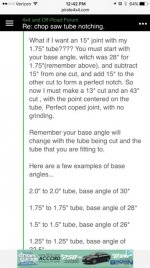

Sent from my iPhone using Tapatalk
Sent from my iPhone using Tapatalk
txvwnut
Well-known member
i dont see any cutting surfaces in the photo howz it work? is it like a punch?
how would you do fish mouth cuts for roll cages?
It has a round cuttning disc(punch) and the U shaped saddle is actually the anvil. Once you set the proper clearance for whatever size tube your notching just slap the tube in and pull the handle. if you are working an angle you just take more bite out of one side till your where you want to be. For anything greater than a 45 you cut your tube to that angle and the notch the point of the cut and your done.
I was skepticle at first when I bought my first one as I had been using an Ol' Joint jigger. What a PITA that holesaw nothcer was to use. For me with the Low Buck notcher there was a little learning curve, maybe two or three joints to hit it, but once I had the aha moment its the best thing. You'll end up with a joint the will give you a proper fillet to weld and your welds will lay down and look proper. Once you have used one of these you'll look at other tube work, for me its roll cages, and think man did my stuff used to look like that?
sailah
Well-known member
I use my lathe. I machined up an arbor that holds both size hole saws and that goes in the 3 jaw.
I made up holders out of heavy wall tube for all my tubing sizes, these go into my Aloris toolpost.
You set the angle of the cut using the compound. The height is set with the toolholder. You can easily do offset notches.
You can also get crazy accurate notches by using an angle block to "indicate" the tool block. For a test I used a 30 degree angle block to quickly set the tool block, notched the tube and then used the same angle block to check it. You could barely see daylight through the gap and probably had more to do with the tube than the notch.
With power feed, notching is easy and drama free. The holes saws last forever as I am feeding them a steady diet of heavy cutting oil.
Was almost free other than the dedicated tool block I use. It does take a couple minutes to set up but I'm not doing it for a living. Pays off when the angles are nuts on and no broken hole saws.
I used to use my big 20" drill press and a vice but even that was way too much runout and the hole saws would grab too often.


Squaring up the holder to the chuck. If I want to do an accurate angle I'll stick a 30 degree angle block in between the chuck and the holder for example. Or just use the degrees on the compound.


I use this to set the height for 1" tubing. I have others for the other tube sizes.


Other than knocking off the burr with a flapwheel this is how they come out, ready to TIG weld.


I made up holders out of heavy wall tube for all my tubing sizes, these go into my Aloris toolpost.
You set the angle of the cut using the compound. The height is set with the toolholder. You can easily do offset notches.
You can also get crazy accurate notches by using an angle block to "indicate" the tool block. For a test I used a 30 degree angle block to quickly set the tool block, notched the tube and then used the same angle block to check it. You could barely see daylight through the gap and probably had more to do with the tube than the notch.
With power feed, notching is easy and drama free. The holes saws last forever as I am feeding them a steady diet of heavy cutting oil.
Was almost free other than the dedicated tool block I use. It does take a couple minutes to set up but I'm not doing it for a living. Pays off when the angles are nuts on and no broken hole saws.
I used to use my big 20" drill press and a vice but even that was way too much runout and the hole saws would grab too often.


Squaring up the holder to the chuck. If I want to do an accurate angle I'll stick a 30 degree angle block in between the chuck and the holder for example. Or just use the degrees on the compound.


I use this to set the height for 1" tubing. I have others for the other tube sizes.


Other than knocking off the burr with a flapwheel this is how they come out, ready to TIG weld.


motofool33
Well-known member
Is that a 6inch chuck or 4inch?I use my lathe. I machined up an arbor that holds both size hole saws and that goes in the 3 jaw.
I made up holders out of heavy wall tube for all my tubing sizes, these go into my Aloris toolpost.
You set the angle of the cut using the compound. The height is set with the toolholder. You can easily do offset notches.
You can also get crazy accurate notches by using an angle block to "indicate" the tool block. For a test I used a 30 degree angle block to quickly set the tool block, notched the tube and then used the same angle block to check it. You could barely see daylight through the gap and probably had more to do with the tube than the notch.
With power feed, notching is easy and drama free. The holes saws last forever as I am feeding them a steady diet of heavy cutting oil.
Was almost free other than the dedicated tool block I use. It does take a couple minutes to set up but I'm not doing it for a living. Pays off when the angles are nuts on and no broken hole saws.
I used to use my big 20" drill press and a vice but even that was way too much runout and the hole saws would grab too often.
Squaring up the holder to the chuck. If I want to do an accurate angle I'll stick a 30 degree angle block in between the chuck and the holder for example. Or just use the degrees on the compound.
I use this to set the height for 1" tubing. I have others for the other tube sizes.
Other than knocking off the burr with a flapwheel this is how they come out, ready to TIG weld.
Sent from my SAMSUNG-SM-G900A using Tapatalk
sailah
Well-known member
Is that a 6inch chuck or 4inch?
Sent from my SAMSUNG-SM-G900A using Tapatalk
6 inch
I literally laughed out loud when I read the quote by the guy selling these punch-type notchers saying that rotary cutting for tube fitup produces fitment that is 'too good'.
There's no such thing, especially in certain situations- I've built multiple race car frames over the years, and several of them were brazed together instead of welded. No way to produce a strong brazed joint with that punch notcher, without a great deal of grinding on every single joint. A proper mill setup will produce tube joints that require nothing more than degreasing before they are braze-ready.
You have a lot more flexibility using a mill than any special tool that I know of- a mill (or the interesting lathe setup described by Sailah) can produce offset notches with extreme ease, and laser-perfect accuracy and repeatability. Not something you can do with a cheapo holesaw fixture, or a punch-type notcher. You can also notch for square, elliptical, or oval tube without a problem on a mill.
I will say this OP- if you've never notched with an end mill before, be careful. On thin wall tubing especially, it's very easy for the end mill flutes to catch the edge of the notch (on the non-climb side of the cut) and bend it, basically ruining the tube. You'll learn through experience, but there's kind of a window of feed speed you need to stay within to keep this from happening. You can also offset the tool very slightly (towards the climb-cutting side of the work) to help alleviate this problem on very thin material. A couple of thou is almost always enough, so it's not noticeable when you do final fit-up of your parts. Tool speed too high relative to feed and you'll get a lot of chatter, tool speed/feed speed too low and you'll get bent points.
When I used to have access to a CNC mill, I would just cut all of my notches with a 1" end mill regardless of size, programming the machine for the required radius. This is obviously way way overkill for 99.9% of tube notching projects, but back then I had the time and that method produced VERY pretty frames ha ha.
There's no such thing, especially in certain situations- I've built multiple race car frames over the years, and several of them were brazed together instead of welded. No way to produce a strong brazed joint with that punch notcher, without a great deal of grinding on every single joint. A proper mill setup will produce tube joints that require nothing more than degreasing before they are braze-ready.
You have a lot more flexibility using a mill than any special tool that I know of- a mill (or the interesting lathe setup described by Sailah) can produce offset notches with extreme ease, and laser-perfect accuracy and repeatability. Not something you can do with a cheapo holesaw fixture, or a punch-type notcher. You can also notch for square, elliptical, or oval tube without a problem on a mill.
I will say this OP- if you've never notched with an end mill before, be careful. On thin wall tubing especially, it's very easy for the end mill flutes to catch the edge of the notch (on the non-climb side of the cut) and bend it, basically ruining the tube. You'll learn through experience, but there's kind of a window of feed speed you need to stay within to keep this from happening. You can also offset the tool very slightly (towards the climb-cutting side of the work) to help alleviate this problem on very thin material. A couple of thou is almost always enough, so it's not noticeable when you do final fit-up of your parts. Tool speed too high relative to feed and you'll get a lot of chatter, tool speed/feed speed too low and you'll get bent points.
When I used to have access to a CNC mill, I would just cut all of my notches with a 1" end mill regardless of size, programming the machine for the required radius. This is obviously way way overkill for 99.9% of tube notching projects, but back then I had the time and that method produced VERY pretty frames ha ha.
Last edited:
theoldwizard1
Well-known member
IMHO, the absolute BEST (and totally un-affordable) notcher is the Baileigh TN-800. Basically a horizontal mill with a 1" roughing end mill. The drive is mount in an eccentric so that the drive and cutter actually rotates 360° so you can make notches for any size from 1"-3". The vice holds the work piece at any angel.
If you do hundreds of notches a week, maybe you could justify it.
Baileigh TN-800
If you do hundreds of notches a week, maybe you could justify it.
Baileigh TN-800
ilovevocs
Well-known member
I agree wth all the above but most of us have saws in our workshop and "chop saw method" creates great fitment without any specialized tooling.
If your Looking to spend money on tools then by all means go at it.
I know it sounds like it will produce poor fitment but try it once or twice and it will amaze you.
Some of the chassis I have built took several different methods. Sometimes to tubes are just too big and cumbersome for any sort of machine work and you need to break out a grinder or plasma and go at it by hand.
For a low buck simple solution that requires no specialized equipment you cannot beat the "chop saw method".
Still waiting for some of the guys with the Williams notcher a to post up some pics of joints less than 90*!
Sent from my iPhone using Tapatalk
If your Looking to spend money on tools then by all means go at it.
I know it sounds like it will produce poor fitment but try it once or twice and it will amaze you.
Some of the chassis I have built took several different methods. Sometimes to tubes are just too big and cumbersome for any sort of machine work and you need to break out a grinder or plasma and go at it by hand.
For a low buck simple solution that requires no specialized equipment you cannot beat the "chop saw method".
Still waiting for some of the guys with the Williams notcher a to post up some pics of joints less than 90*!
Sent from my iPhone using Tapatalk
Im 46, Ive had one of the lowbuck catalogs since I was in high school, so I knew about them for a long time. Ive been interested in tube fab since before high school. You don't see too many really knowledgeable fabricators using them.
I agree with ilovevocs, grab a cheap endmill (we used roughing EMs)and get some experience. You have the machine already. Just take the sharp ears off with a grinder or belt sander.
I agree with ilovevocs, grab a cheap endmill (we used roughing EMs)and get some experience. You have the machine already. Just take the sharp ears off with a grinder or belt sander.
Last edited:
I have a JD2 Notcher the bottom of the line model, I use Morse hole saws in it and it works great. Can notch up to 50 Degrees... I have a CNC Mill that I can do anything weird with... past that is A Bandsaw, Chop Saw, Dry Saw, Portaband.... and a metal cutting circular saw, heck if I get really desperate I can use the Sawzall! Never Tried the lathe but after this thread perhaps that is another method, I keep threatening to add a tube setup on my plasma table... One of these days!