

Below is a compiled spreadsheet of the specifications for three 10,000 pound capacity two-post lifts. All three are ALI/ETL Certified. In alphabetical order: BendPak, Ben Pearson, and Mohawk… I own the BendPak and Mohawk, while the Ben Pearson is at a friends work that I had the chance to view and run it through its’ paces.

One of my two-post lifts is a BendPak XPR-10ACX that I posted its’ installation here.
http://www.garagejournal.com/forum/showthread.php?t=18309 Although I haven’t used it near as much as my other lifts, so far I’m impressed with most everything about it. Overall it an outstanding value and BendPak should be number one on anyone’s list to consider when evaluating a lift purchase. It may be a few bucks more expensive than any of the re-badged Chinese lifts, it is far less than any other ALI/ETL Certified lift. And although there may be some question of the origin of all its‘ components, it is ALI/ETL Certified.
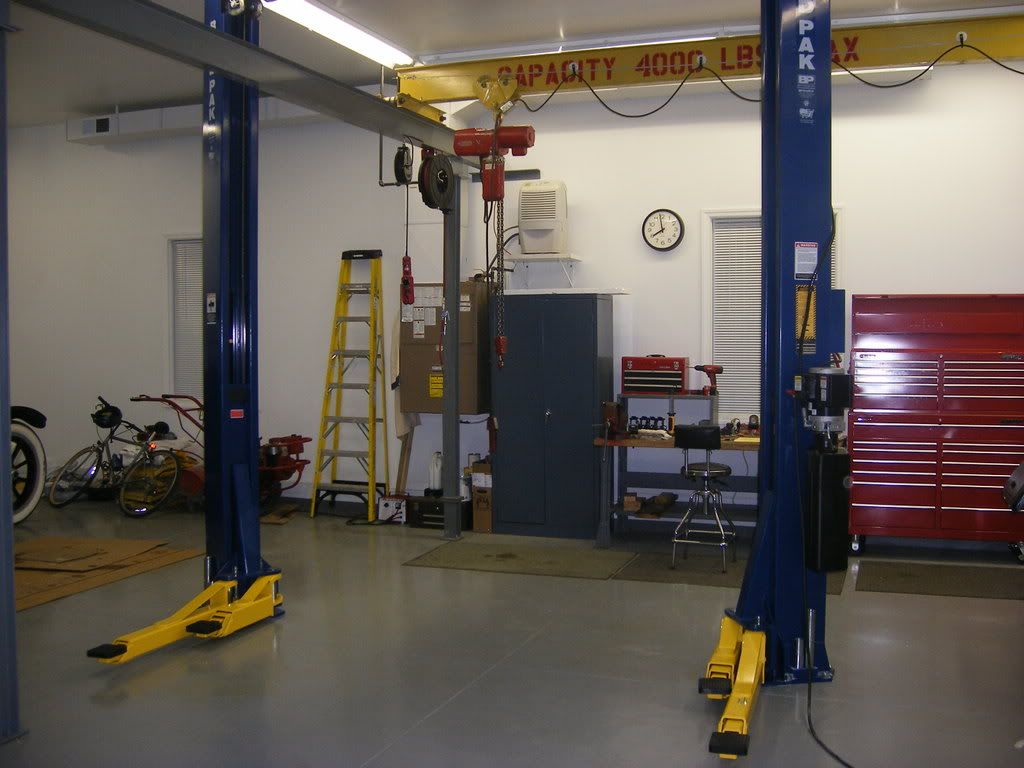
The XPR-10ACX is a true asymmetric lift. It has two different arm lengths so that a vehicle can be safely lifted more forward of the centerline approximately with the windshield lined up with the columns. The columns are also mounted at an angle. That provide for greater clearance to open the front car doors to facilitate better access to the car’s interior. This combination was engineered for and works great on front wheel cars. However it has no problem lifting my 7,000 Avalanche 2500, as you can see from the photographs.


All the welds on the BendPak Lift look very professional. And all the bolt holes lined up very well in assembling the lift. Another nice feature is the single lock release lever. It’s a well engineered lift that is top quality manufactured. And the icing on the cake is the remarkable powder coated paint job it comes with. What better way of presenting a fine piece of equipment than the paint job.
The only problem that I encountered is in locking the arms. The following sequence seems to be the best way to see that the swing arms are locked correctly. When the lift is several inches off the floor and not yet picking up the car. You need to jiggle the arms into their lock position. Then commence lifting the vehicle.
_______________________________________________________________
The Ben Pearson that I evaluated is at a friends commercial garage. It’s about three years old and has received far more use already than any lift purchase for home use. Ben Pearson has been producing lifts for over 30 years. The lift that I evaluated was manufactured in the United States and is ALI/ETL Certified. However it’s no longer available. Several years ago all their lifts with the Ben Pearson name were certified and made in the USA. To the best of my knowledge only six models are made in the United States. Of which only two are Certified, their Model 10,000SI and 12,000SI.
This Ben Pearson lift is an asymmetrical design with long and short lifting arms. However the columns are not tilted to get maximum door openings. It is similary engineered with the same quality as the BendPak. The only negative feature is the time it takes to lift a vehicle. Almost twice as long as either my BendPak or my Mohawk. Even though it has the same Baldor 2.5 HP motor as the Mohawk and the BendPak has only a 2 HP Emerson. Evidently is has been this slow since new. I do believe that there’s a restriction in the Ben Pearson’s pump or it is defective since new.
Ben Pearson lifting Cadillac Escalade

Ben Pearson Base Plate


Ben Pearson arm locking mechanism.

______________________________________________________________
The Mohawk is a lift in a class by itself. And one cannot truly compare it to many lifts manufactured today. Here’s a link to the installing my Mohawk. http://www.garagejournal.com/forum/showpost.php?p=47692&postcount=28
We’re not talking apples and oranges comparing the other two lifts to the Mohawk. To begin with the Mohawk weighs in at twice that of any of the other two. And it’s very noticeable when you see one. The floor plate and columns are massive compared to the others. Each carriage is guided by Eight roller bearings in solid ¾” thick steel channels, similar to a lift truck’s mast. The others use plastic slides riding in 1/8” formed steel. The lift cylinders have 4” diameter pistons with 2 ¾” piston rods (the others use 2 1/ 2” diameter pistons) and are guaranteed for Life. Plus you don’t need to worry about choosing an asymmetrical or symmetrical model and about the doors hitting the columns. The Mohawk’s recommended columns spacing is 10’ apart and eliminates that issue.
The Mohawk has some unique design features that made it well worth it for my particular application. The columns are only 8 ½’ tall and don’t limit me in placement under my bridge crane runway beams. Along with not having an overhead cables or a floor plate. Rather two 3/8” diameter seamless stainless steel hydraulic lines that can be routed in the cement floor or overhead. If you look at the pictures, you can see them run at an angle across the ceiling and through one of the fluorescent fixtures. The Mohawk is definitely an overkill in design, particularly for home use.
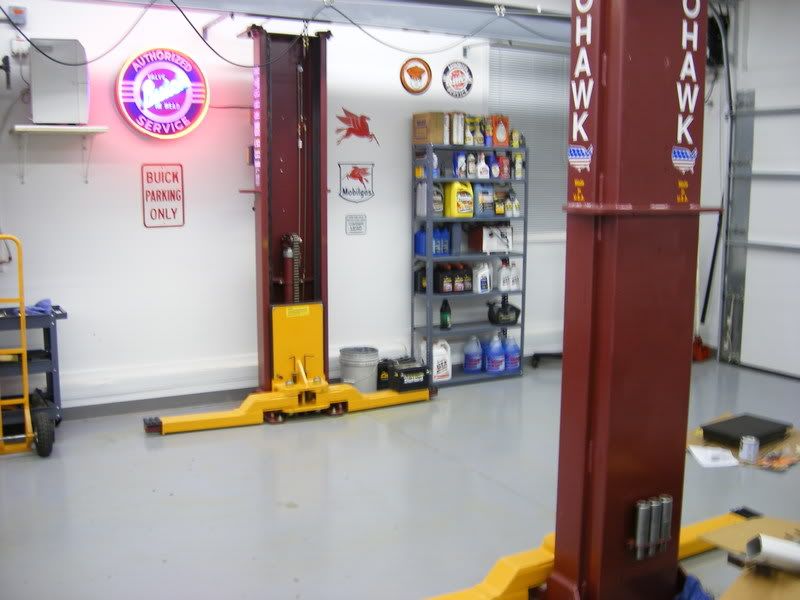
Mohawk’s massive carriage lift cylinders and chains:


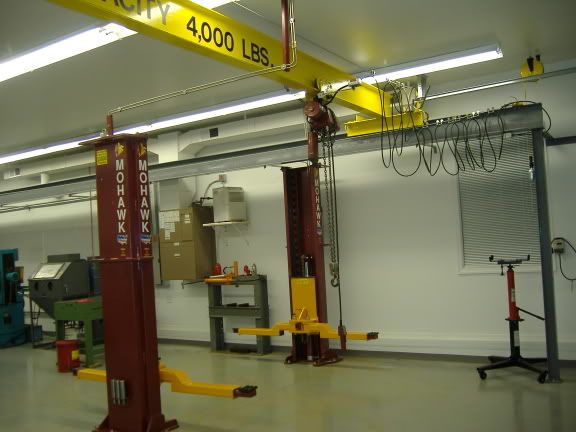
One of my two-post lifts is a BendPak XPR-10ACX that I posted its’ installation here.
http://www.garagejournal.com/forum/showthread.php?t=18309 Although I haven’t used it near as much as my other lifts, so far I’m impressed with most everything about it. Overall it an outstanding value and BendPak should be number one on anyone’s list to consider when evaluating a lift purchase. It may be a few bucks more expensive than any of the re-badged Chinese lifts, it is far less than any other ALI/ETL Certified lift. And although there may be some question of the origin of all its‘ components, it is ALI/ETL Certified.
The XPR-10ACX is a true asymmetric lift. It has two different arm lengths so that a vehicle can be safely lifted more forward of the centerline approximately with the windshield lined up with the columns. The columns are also mounted at an angle. That provide for greater clearance to open the front car doors to facilitate better access to the car’s interior. This combination was engineered for and works great on front wheel cars. However it has no problem lifting my 7,000 Avalanche 2500, as you can see from the photographs.
All the welds on the BendPak Lift look very professional. And all the bolt holes lined up very well in assembling the lift. Another nice feature is the single lock release lever. It’s a well engineered lift that is top quality manufactured. And the icing on the cake is the remarkable powder coated paint job it comes with. What better way of presenting a fine piece of equipment than the paint job.
The only problem that I encountered is in locking the arms. The following sequence seems to be the best way to see that the swing arms are locked correctly. When the lift is several inches off the floor and not yet picking up the car. You need to jiggle the arms into their lock position. Then commence lifting the vehicle.
_______________________________________________________________
The Ben Pearson that I evaluated is at a friends commercial garage. It’s about three years old and has received far more use already than any lift purchase for home use. Ben Pearson has been producing lifts for over 30 years. The lift that I evaluated was manufactured in the United States and is ALI/ETL Certified. However it’s no longer available. Several years ago all their lifts with the Ben Pearson name were certified and made in the USA. To the best of my knowledge only six models are made in the United States. Of which only two are Certified, their Model 10,000SI and 12,000SI.
This Ben Pearson lift is an asymmetrical design with long and short lifting arms. However the columns are not tilted to get maximum door openings. It is similary engineered with the same quality as the BendPak. The only negative feature is the time it takes to lift a vehicle. Almost twice as long as either my BendPak or my Mohawk. Even though it has the same Baldor 2.5 HP motor as the Mohawk and the BendPak has only a 2 HP Emerson. Evidently is has been this slow since new. I do believe that there’s a restriction in the Ben Pearson’s pump or it is defective since new.
Ben Pearson lifting Cadillac Escalade
Ben Pearson Base Plate
Ben Pearson arm locking mechanism.
______________________________________________________________
The Mohawk is a lift in a class by itself. And one cannot truly compare it to many lifts manufactured today. Here’s a link to the installing my Mohawk. http://www.garagejournal.com/forum/showpost.php?p=47692&postcount=28
We’re not talking apples and oranges comparing the other two lifts to the Mohawk. To begin with the Mohawk weighs in at twice that of any of the other two. And it’s very noticeable when you see one. The floor plate and columns are massive compared to the others. Each carriage is guided by Eight roller bearings in solid ¾” thick steel channels, similar to a lift truck’s mast. The others use plastic slides riding in 1/8” formed steel. The lift cylinders have 4” diameter pistons with 2 ¾” piston rods (the others use 2 1/ 2” diameter pistons) and are guaranteed for Life. Plus you don’t need to worry about choosing an asymmetrical or symmetrical model and about the doors hitting the columns. The Mohawk’s recommended columns spacing is 10’ apart and eliminates that issue.
The Mohawk has some unique design features that made it well worth it for my particular application. The columns are only 8 ½’ tall and don’t limit me in placement under my bridge crane runway beams. Along with not having an overhead cables or a floor plate. Rather two 3/8” diameter seamless stainless steel hydraulic lines that can be routed in the cement floor or overhead. If you look at the pictures, you can see them run at an angle across the ceiling and through one of the fluorescent fixtures. The Mohawk is definitely an overkill in design, particularly for home use.
Mohawk’s massive carriage lift cylinders and chains:
Last edited:


