To avoid these ads, REGISTER NOW!

Tyvek inside?

bobadame

Well-known member
Joined
Dec 26, 2007
Messages
1,124
I've been insulating my shop these last few days. The walls are 2X6 with R-19 fiberglass. The ceiling is R-30. It was about 20 degrees F and sometimes even colder as I was doing this. I was wearing a tyvek hooded suit while I did this. I was amazed at how warm this thin extra layer of tyvek kept me. Now I'm wishing I had used it on the outside of the building between the OSB and the siding. So my question is, "is there any reason not to use it over the paper faced fiberglass insulation , under the sheet rock"?

I believe this is my first post here. Thank you for your time.

Bob
 
To avoid these ads, REGISTER NOW!
OP
B

bobadame

Well-known member
Joined
Dec 26, 2007
Messages
1,124
Krooser can you explain why covering a vapor barrier with a permeable barrier would cause moisture problems?
 

krooser

Well-known member
Joined
Jun 3, 2005
Messages
2,377
Location
Waupaca, Wisconsin
Krooser can you explain why covering a vapor barrier with a permeable barrier would cause moisture problems?

Tyvek is a waterproof membrane.... installed on the outside it will prevent water from penetrating the wall sheathing and causing damage... it will also allow a building to "breathe"... letting the moisture out of the walls.

If you install Tyvek INSIDE it will allow moisture from the outside of the building to migrate thru the walls and it will be trapped between the Tyvek and the interior sheathing...wallboard/plywood/OSB. Mold will build up on the inside of the interior wall covering.

If you install it on the inside BACKWARDS (the Tyvek name facing the wall) moisture will still be able to penetrate the outside wall but will not go thru the Tyvek...in that case it would act like traditional plastic sheeting.


I think Bob will be better off simply using plastic sheeting over the fiberglass batts... but it's best to tape all the seams and allow a little overlap to insure an air-tight seal. I'm not sure what the cost difference would be.

When I built my shop... post and beam construction with steel siding... I was going to wrap my walls with Tyvek. I had already sheathed the outside walls with 1" blue board with foil facing. My son-in-law jumped the gun and started installing the steel siding while I was at work. He got one whole wall and half a second wall done before I got home... the Tyvek was never installed but I did wrap the inside with plastic.
 

kbs2244

Well-known member
Joined
Nov 11, 2006
Messages
14,065
Krooser has it right.

They key to understanding all this is the difference between moisture and water vapor.
Moisture is liquid water.
Water vapor is a gas. A vapor.

Tyvek is a moisture barrier. It is meant to keep liquid water out of the wall but it will let water vapor pass through it.
(Note that they call it “vapor permeable.")
So, it goes on the cold side.
That way it keeps any water that leaks through bad caulking, nail holes, etc from getting into the wall.
But it will let any water vapor that forms behind it, for whatever reason, pass through.

Poly, on the on the hand is vapor proof.
(As well as moisture proof.)
So it is a vapor barrier.
You want it on the warm side since most water vapor is generated indoors from things drying out, un-vented heaters, etc.
You want to keep that vapor out of the walls so it doesn’t condense inside the wall when it hit the cooler point inside the wall.
If it condenses into water, then we get rotting problems inside the wall.

So we want a wall to be waterproof on the outside and vapor proof on the inside.

BTW, the reason your Tyvek suit kept you so warm was it stopped any air circulation against your skin.
That stopped the evaporative cooling effect of your sweating.
You were wearing a whole body wind breaker.
 
Last edited:
OP
B

bobadame

Well-known member
Joined
Dec 26, 2007
Messages
1,124
Thank you for your responses. I understand the reasoning behind the placement of the vapor barrier and the Tyvek. I asked the question before I really thought about what was happening with the Tyvek suit. I've never owned a wind breaker so this heat retaining property was a pleasant mystery to me. I've concluded that to place Tyvek directly over tar paper vapor barrier that is stuck onto the fiberglass insulation would probably cause no harm and also do no good. I've also concluded that a Tyvek suit would be really cheap, effective cold weather survival gear. Maybe something to take along while elk hunting or snowmobiling in the back country.
 

Rosco

Well-known member
Joined
Jan 4, 2009
Messages
1,140
Location
South Georgia
Krooser has it right.

They key to understanding all this is the difference between moisture and water vapor.
Moisture is liquid water.
Water vapor is a gas. A vapor.

Tyvek is a moisture barrier. It is meant to keep liquid water out of the wall but it will let water vapor pass through it.
(Note that they call it “vapor permeable.")
So, it goes on the cold side.
That way it keeps any water that leaks through bad caulking, nail holes, etc from getting into the wall.
But it will let any water vapor that forms behind it, for whatever reason, pass through.

Poly, on the on the hand is vapor proof.
(As well as moisture proof.)
So it is a vapor barrier.
You want it on the warm side since most water vapor is generated indoors from things drying out, un-vented heaters, etc.
You want to keep that vapor out of the walls so it doesn’t condense inside the wall when it hit the cooler point inside the wall.
If it condenses into water, then we get rotting problems inside the wall.

So we want a wall to be waterproof on the outside and vapor proof on the inside.

BTW, the reason your Tyvek suit kept you so warm was it stopped any air circulation against your skin.
That stopped the evaporative cooling effect of your sweating.
You were wearing a whole body wind breaker.

Man, this is very informative! Not to highjack, but if I wrapped my shop with tyvek would it be even more beneficial to put a plastic barrier on the inside before I sheetrock?
 

Beegs

Well-known member
Joined
Oct 24, 2006
Messages
69
Location
NH
I've been insulating my shop these last few days. The walls are 2X6 with R-19 fiberglass. The ceiling is R-30. It was about 20 degrees F and sometimes even colder as I was doing this. I was wearing a tyvek hooded suit while I did this. I was amazed at how warm this thin extra layer of tyvek kept me. Now I'm wishing I had used it on the outside of the building between the OSB and the siding. So my question is, "is there any reason not to use it over the paper faced fiberglass insulation , under the sheet rock"?

I believe this is my first post here. Thank you for your time.

Bob

I hope you don't have vinyl siding.
 

KustomZ

Well-known member
Joined
Oct 27, 2008
Messages
127
Location
Dewey, OK
Whats the problem with vinyl siding Beegs? I would like to know as I'm doing some work on my garage which has vinyl siding.
 

Beegs

Well-known member
Joined
Oct 24, 2006
Messages
69
Location
NH
Whats the problem with vinyl siding Beegs? I would like to know as I'm doing some work on my garage which has vinyl siding.

Vinyl siding is not waterproof. You need a barrier on the outside of the sheathing to keep the water off the (in his case) OSB.
 

tcianci

Well-known member
Joined
Feb 7, 2009
Messages
4,242
Location
Walpole, Ma
It would be interesting to see a substantiation of the comment about using the Tyvek wrong side out (if there is a wrong side) to change the direction in which water vapor will translate through the Tyvek.
Tyvek has got to be the most miraculous stuff ever invented. It is an air infiltration barrier!...It stops water! It transmits water vapor! Now I'm told that it transmits water vapor in one direction only! It's a Diode for water vapor!
I have read the product specs for Tyvek many times and have never seen a claim by the manufacturer that it transmits water vapor in one direction only. Not to get back into my long winded posts about the complete devastation I have encountered MANY times upon servicing buildings "protected" by Tyvek. I would love to see any type of proof or information from DuPont that the stuff allows water vapor to move in one direction only.
My latest search of the DuPont website has a FAQ that specifically addresses the question of installing the wrap "back wards". They state that the composition and structure of the product allow it to function equally no matter how the sheet is applied, lettering in or out.
They also state that the product is designed to be an air infiltration barrier and not a water protection product. In essence they are telling the user that the product will pass water vapor (no matter which side of the sheet the vapor originates on) and it offers limited resistance to liquid water.
It is a great air infiltration barrier, it is extremely durable in wind situations and fastens beautifully with just common staples and has extended resistance to deterioration during the construction process. The available large roll format makes it easy to cover a complete wall right after it is sheathed and before it is stood so it fits well with common framing practices.
That's where the great stuff about Tyvek ends. I have observed many times in remodel situations where I have occasion to open up walls that have been covered in Tyvek that the vapor transmissive properties of the product have completely backfired and allowed water vapor to enter the building and completely destroy the underlying sheathing. We will not use this stuff on anything. The misconception (not at all implied by DuPont) that this stuff is for stopping water is a major problem, especially with the increased use of vinyl siding which is pretty lousy at stopping water in itself. Wind driven rain easily gets behind a vinyl job and when that rain evaporates behind the siding, you get water vapor, when the water vapor is in proximity of a membrane that is vapor permeable, it waltzes right through.
Mock and jeer fellas... most of you don't have to feed your families based on the success of your building projects, I do.
 

Beegs

Well-known member
Joined
Oct 24, 2006
Messages
69
Location
NH
It would be interesting to see a substantiation of the comment about using the Tyvek wrong side out (if there is a wrong side) to change the direction in which water vapor will translate through the Tyvek.
Tyvek has got to be the most miraculous stuff ever invented. It is an air infiltration barrier!...It stops water! It transmits water vapor! Now I'm told that it transmits water vapor in one direction only! It's a Diode for water vapor!
I have read the product specs for Tyvek many times and have never seen a claim by the manufacturer that it transmits water vapor in one direction only. Not to get back into my long winded posts about the complete devastation I have encountered MANY times upon servicing buildings "protected" by Tyvek. I would love to see any type of proof or information from DuPont that the stuff allows water vapor to move in one direction only.
My latest search of the DuPont website has a FAQ that specifically addresses the question of installing the wrap "back wards". They state that the composition and structure of the product allow it to function equally no matter how the sheet is applied, lettering in or out.
They also state that the product is designed to be an air infiltration barrier and not a water protection product. In essence they are telling the user that the product will pass water vapor (no matter which side of the sheet the vapor originates on) and it offers limited resistance to liquid water.
It is a great air infiltration barrier, it is extremely durable in wind situations and fastens beautifully with just common staples and has extended resistance to deterioration during the construction process. The available large roll format makes it easy to cover a complete wall right after it is sheathed and before it is stood so it fits well with common framing practices.
That's where the great stuff about Tyvek ends. I have observed many times in remodel situations where I have occasion to open up walls that have been covered in Tyvek that the vapor transmissive properties of the product have completely backfired and allowed water vapor to enter the building and completely destroy the underlying sheathing. We will not use this stuff on anything. The misconception (not at all implied by DuPont) that this stuff is for stopping water is a major problem, especially with the increased use of vinyl siding which is pretty lousy at stopping water in itself. Wind driven rain easily gets behind a vinyl job and when that rain evaporates behind the siding, you get water vapor, when the water vapor is in proximity of a membrane that is vapor permeable, it waltzes right through.
Mock and jeer fellas... most of you don't have to feed your families based on the success of your building projects, I do.

In a situation where OSB is being used for sheathing on a wall and vinyl siding is to be applied, are you suggesting to apply the vinyl directly to the OSB?

People have a misconception with vinyl siding. It is NOT waterproof. Look at the bottom of the panels...full of drain holes...they are there for a reason.
 

buddyboy

Well-known member
Joined
Oct 8, 2007
Messages
616
there is an air space behind the panels. if that air space is warmer than the vinyl any water vapor will condense on the inside of the vinyl panels and run down and out those drain holes.
 
OP
B

bobadame

Well-known member
Joined
Dec 26, 2007
Messages
1,124
I had been regretting that I didn't use Tyvek over the OSB until I read Tcianci's post. I really don't see how wind can get through a layer of OSB with a layer of 4' X8' siding applied directly over it. I've calked the joints and nailed the hell out of it. The building is painted with oil paint. I really don't see how anything could get through.
 
To avoid these ads, REGISTER NOW!

jmh21586

Well-known member
Joined
Aug 8, 2009
Messages
1,895
Location
Pine City, MN
Mock and jeer fellas... most of you don't have to feed your families based on the success of your building projects, I do.

No... we all do ****** work and still feed our families. you're the only one.:bowdown:


What an idiotic comment.
 

tcianci

Well-known member
Joined
Feb 7, 2009
Messages
4,242
Location
Walpole, Ma
In response to post #12, no, you need to have a weather proof barrier to protect the OSB or whatever your sheathing of choice is. We have gone back to using 15lb black felt.
The DuPont website also addresses felt in their FAQ area. They point out the drawbacks of the felt, the material is not without it's limitations, such as it's a PITA to handle especially alone, it tears easily and it does not have a multi-month life span when left exposed to the elements. However, it is inexpensive, waterproof (until it weathers away from not being covered) and it makes a great air infiltration barrier. It will not transmit water vapor.
Lets use the same assumption that DuPont does... that the source of the water vapor is the interior of the building. The wall insulation if properly installed for an application where heating is the primary conditioning, will be to have a vapor barrier on the inside of the building, behind the wall finish and on top of the studs. Now, where does the water vapor come from??? Add to that the fact that the average painted drywall is a significant vapor retarder and you are getting precious little water vapor coming through from the building interior.
So why does DuPont tout the fact that their product is vapor permeable? If you check their website, they explain that Tyvek products can and are made in different thicknesses for different applications. Tyvek of significant thickness is waterproof and therefore non permeable. Tyvek in a thickness that is sufficient to function as a great air infiltration barrier does pass water vapor. It is my feeling and observation that the vapor transmissive property of the product does nothing to enhance the general thermal efficiency of a structure and I would propose that the vapor permeability of the stuff is nothing more than a manufacturing by-product and, that the marketing guys have used this characteristic to help distinguish it from felt and other house wraps.
In other words...it's a solution looking for a problem.

In response to post #13. You are absolutely correct, water will weep out of the drain holes. It is the water in it's vaporous state that causes the problems here.

To poster #14, in your case, sheet goods applied over the OSB sheathing with the joints being staggered provides an excellent air infiltration barrier. While there is aways the possibility of liquid water entering the joints on any building exterior, if the joints are vertical, you probably have no issues.

To poster #15, since you directed your rude and sarcastic statement to me and not as a general comment, you too qualify for a reply. Unfortunately you took my comment personally... I would suggest, if the shoe fits, wear it.
 

kwb

Well-known member
Joined
May 1, 2009
Messages
1,769
Location
PNW
I recently added onto my house and was all set to use tyvek and my remodel contractor (and good friends of family) said to stick with tar paper. He used my own house as an example - the house is ~20yrs old and OSB sheeting was in great shape behind the tar paper. He said he regularly tears apart ~10-12 houses a year and the ones with tar paper have much less in the way of mold and rot issues than ones that are wrapped in tyvek even though the tyvek houses are typically newer.

I used tyvek on my shop for one reason - I am not insulating/sheetrocking and I wanted the bright white finish without having to go to the trouble of painting.
 

jmh21586

Well-known member
Joined
Aug 8, 2009
Messages
1,895
Location
Pine City, MN
To poster #15, since you directed your rude and sarcastic statement to me and not as a general comment, you too qualify for a reply. Unfortunately you took my comment personally... I would suggest, if the shoe fits, wear it.

I directed it at you because you made the stupid comment. A comment you directed at us "fellas". So it was directed at all those that had commented on the topic. That was rude and sarcastic of you was it not?? I did not take it personaly, just pointing out the arrogance of it.

Are you now a shoe salesman?:headscrat
 
Last edited:

BB767

Well-known member
Joined
Dec 24, 2009
Messages
3,724
Location
Philo, IL
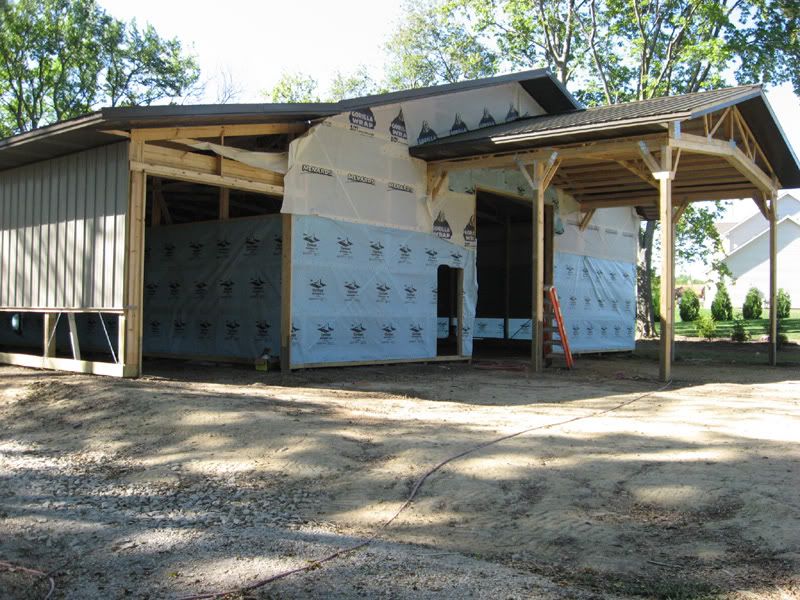
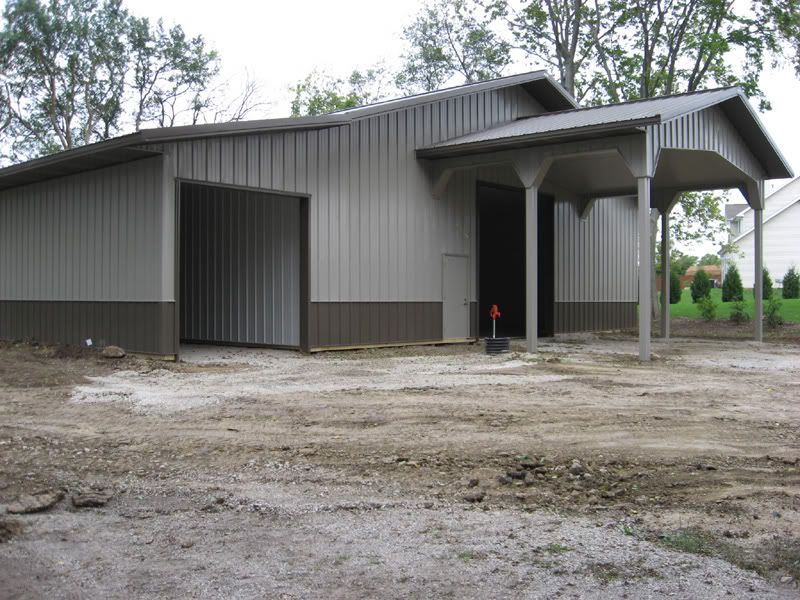
OK, I have a different, yet similar situation. I have a 48 X 72 "main" building with a 12 X 72 "lean to" building attached by a common wall. The "main" building is completely wrapped with Tyvek including the common wall.

leanto80sm.jpg


Both building spaces are insulated and heated which puts the Tyvek on the warm side of the steel "lean to" common wall.

leanto90sm.jpg


The first really cold, windy day ( 20F) I had sweating on the inside surface of the steel "lean to" common wall. It ran down the inside of the steel and showed up on the bottom of this wall. This space is heated with a propane radiate wall heater.

leantoframestartsm.jpg


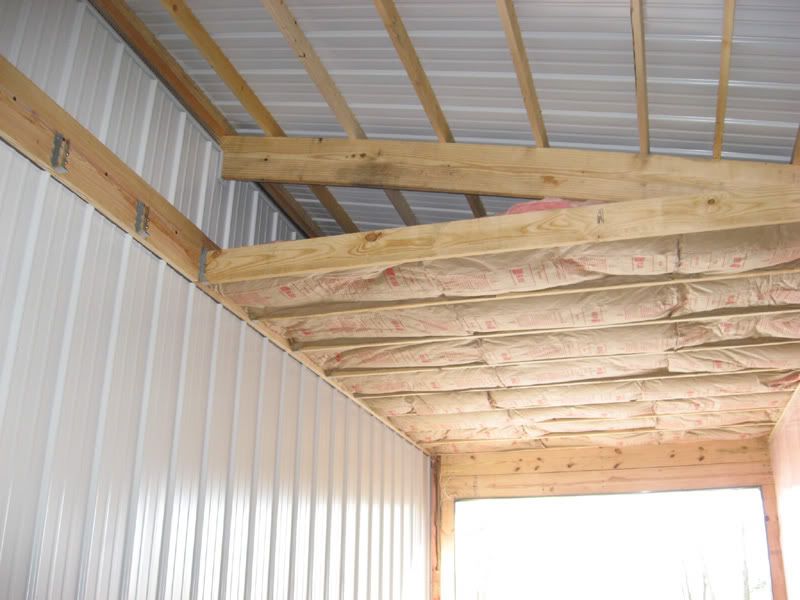
I thought this sweating was from not having a thermo break on the steel where it extends into and is exposed to the cold attic.

LeanToCeilingFramesm.jpg


Perhaps the Tyvek is playing a role in this sweating as well? What potential problems might I expect from the Tyvek being placed inside on the common wall? Thank you for any reply.

This is my first post so please excuse any format errors.

Thomas
 
Last edited:

tcianci

Well-known member
Joined
Feb 7, 2009
Messages
4,242
Location
Walpole, Ma
I think your assumption that the sweating was from not having a thermal break is correct. Sine your inside wall is not exposed to the weather, I doubt that the Tyvek is going to give you too much trouble. Any combustion produces moisture as a by-product. I have read here that propane is exhaust is particularly moisture laden. It looks like you just have a steel wall that is cool enough to condense the moisture. Your steel sheathing is finished to withstand exterior conditions, some condensation is not going to hurt it although, you may not like the fact that the water will eventually run down to your floor, you may find that to be a nuisance. You may also want to foam the voids between the wood ledger and the steel sheathing. While the steel can certainly conduct cold and make the interior wall cool enough to condense moisture, if those voids are not filled, you will have cold air just pouring down into the conditioned space.
 
Last edited:

BB767

Well-known member
Joined
Dec 24, 2009
Messages
3,724
Location
Philo, IL
Thank you tcianci for the reply. First off you should know, even though it doesn't show up very well in the picture, the voids are all filled between the 2 X 12 wood ledger and the steel wall. In fact they are filled along the top and bottom of the ledger to seal that area and keep cold air from pouring down between the wall and the wood.

Next, as I understand it propane does produce a lot of moisture so I am running a dehumidifier in that space to help control the moisture build up from that and as the new concrete cures it will produce moisture also. I used 3 coats of cure and seal on the concrete to slow down the moisture loss as it cures.

I am pretty sure I will need to prevent the steel in the attic space from coming in contact with cold attic air or else it will continue to condense and run down the wall which I really don't want to have happen! Really haven't thought about what might be the best way to do that. Probably fix Styrofoam sheets across the steel to keep air off it and seal the bottom of the steel wall by the floor to prevent warm air from raising up behind it into the attic.

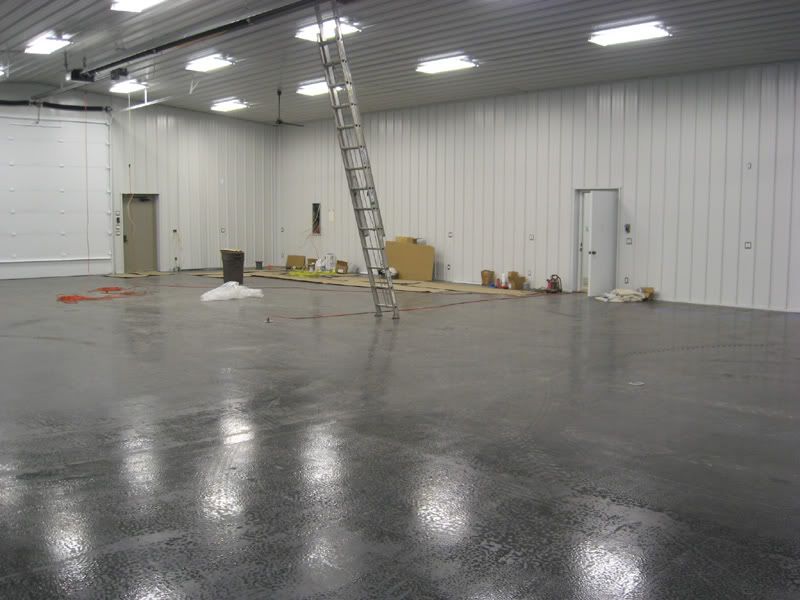
Maininsidecommonsm.jpg


This is what the other side of the common wall looks like. I've had no issues with condensation on this side. R19 walls ,R 38 ceiling on the whole building. I'll try to post some pictures as I get closer to finishing it.

Thomas
 
OP
B

bobadame

Well-known member
Joined
Dec 26, 2007
Messages
1,124
I tried the Tyvek suit out today a blizzard gear. It worked great! I spent a couple of hours clearing about 1/8 mile of driveway with a snow blower mounted to my tractor. The wind has been blowing 20 to 30 miles per hour gusting up to 50, temperature about 20 degreed F. I stayed dry and toasty warm.
 

51rider

Well-known member
Joined
Dec 21, 2009
Messages
502
Location
London, England.
It is a great air infiltration barrier, it is extremely durable in wind situations and fastens beautifully with just common staples and has extended resistance to deterioration during the construction process. The available large roll format makes it easy to cover a complete wall right after it is sheathed and before it is stood so it fits well with common framing practices.
That's where the great stuff about Tyvek ends. I have observed many times in remodel situations where I have occasion to open up walls that have been covered in Tyvek that the vapor transmissive properties of the product have completely backfired and allowed water vapor to enter the building and completely destroy the underlying sheathing. We will not use this stuff on anything.

This is very interesting: I hope to soon be embarking on my garage project & I propose to use SIP construction for the build. Standard practice is to cover the entire building in a 'tyvek' or similar membrane and then allow the surface finish to be applied.
In my case, for the walling I was intending to use Hardibacker board affixed to 25mm batten & then smooth rendered and painted, with a brick slip system at all corners to mimic piers. The roof would be battened in the usual way and clay tiles similar to those on the existing building would be used.

As I read your later post, I'd be better off using a bitumastic 'felt' sheeting all round, is that correct?

Internally, my plan was to affix 25mm batten to the inner OSB face and then foil backed 12.5mm plasterboard/sheetrock to that. This would permit all services to run behind the sheetrock/plasterboard and allow air circulation either side of the OSB/foam sandwich.

I was allowing for trickle vents on the Velux roof window lights and a 12" wall fan along with a roof mounted circulatory fan to keep it all moving.

I'd welcome your input as SIP construction is fairly new to most of the UK and much of it has come from the US and some parts of Europe.
 

tcianci

Well-known member
Joined
Feb 7, 2009
Messages
4,242
Location
Walpole, Ma
Well the felt is what we have gone back to and it had been previoulsy used here in the US for well over a hundred years. I have ocassion to work on many older buildings here and just don't see problems as a result of deterioration on those buildings. Like I said, the felt tears easily and is a PITA to install sometime but it does what it is supposed to do. I am not familiar with the composition or the characteristics of other housewrap materials. Once I was burned by Tyvek, I just went back to felt. There may be other products out there that will work well.
 
Joined
Sep 18, 2008
Messages
18
Location
Central Pennsylvania
Looks like I should Ask for some help.....

I am getting ready to frame up my garage. It is 64' x 40' x 15' high. There is going to be attic trusses installed. I am going to have my bedroom and office up in the attic area.

The building was going to be 2" x 6" construction. We were not going to sheet the outside, just wrap with Tyvek and then cover with tin. I was going to insulate the stud space with R19 and then sheth with either OSB or Drywall. After reading this it sounds like you guys don't recommend the Tyvek. Also It is very windy were I am building at which is the reason I was going to use the tyvek. I can't put up felt because I am not sheeting the outside. What should I do?
 

tcianci

Well-known member
Joined
Feb 7, 2009
Messages
4,242
Location
Walpole, Ma
Look into other air infiltration barriers, it is important to the performance of your fiberglass insulation to keep the wind out. I agree that felt would be a PITA. Since you will not have the benefit of sheathing to give you anti-shear characteristics, be sure to use proper wind bracing technique or your building will rack easily.
 
To avoid these ads, REGISTER NOW!
Top Bottom