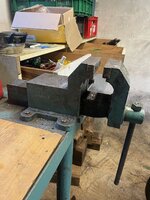
So I was contemplating about the Fireball Hardtail and a few other vise designs. I'm no machinist but I do know a fair bit about most production methods and my cousin even runs a small machine shop making mainly press dies and has a fairly big CNC mill (and I have a mill and a lathe at home as well...).
So I decided to make a nice "ultimate" vise design to maybe eventually make by myself. Something really exceptional, without compromises, that would stay in use long after I am gone. Now we all know there's no real ultimate vise, but I'd like to incorporate design aspects from all historically notable vises. Thought about the top makers I know of and like certain aspects of:


I also much prefer the design where the jaws are held on by the screws from the rear side, with threads in the jaws and not screws through the jaws. Keeps the clamping surface uniform and keeps the threads in the replaceable jaws.
Also, if the tube guide is replaceable, I might as well turn in a seat for guide bushings in the fixed housing.
So I did some sketches that I plan to follow to make a CAD model.
Still not quite determined on the size. My Koch has 190mm jaws which is around 7 1/2 inch. I think I definitely do not need a larger vise.
Used the bottom guide idea from the Koch but would love to incorporate a dovetail joint there. Give it rigidity from all sides, besides the main guide, and it would be adjustable like on a lather or a mill. Would need quite exact tolerances with the guide bar though.
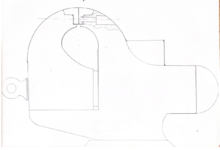


Bar probably shouldn't go in so deep to keep strength in the moving jaw.
All these drawings are just sketches, the focus on design elements is a bit different on each one.
Any further ideas would be very welcome
So I decided to make a nice "ultimate" vise design to maybe eventually make by myself. Something really exceptional, without compromises, that would stay in use long after I am gone. Now we all know there's no real ultimate vise, but I'd like to incorporate design aspects from all historically notable vises. Thought about the top makers I know of and like certain aspects of:
- Parker - love the outer jaw design, directs and spreads the force onto the support a lot better, smooth transition into the support. The top of the jaws extends far so you can hammer stuff on top of the hardened jaws. Would prefer to simplify the fit to the base a little.
- Record, Heuer - steel construction. Since I'd be making my own vise on a mill, I'll definitely start off with some steel. Probably some scrap steel I'll search for in the future. Would need at least 350-400mm diameter bar stock to compare to the fireball hardtail (may want to go a bit smaller though? Not sure). If very lucky, I might even get some scrap tool steel though I'd prefer something that isn't hard to machine. I do not want to weld anything. I assume such massive steel construction would give it unparallel strength and ductility among any bench vise, even the old cast steel Record vises (billet steel is basically forged, but would be way more massive than a drop forged Heuer). I like that the Heuer guide can be adjusted for play but hard to incorporate that into the vise.
- Reed - well, what makes these special? No crazy designs I'd know off, just very tightly made and very massive. New ones have enclosed spindle.
- Leinen, Gressel, other continental European vises - the dovetail guide is a nice engineering detail and very strong. However, dovetails on lathes and mills also have the wedge to adjust play.
- Wilton, York - Sleek design, enclosed spindle, circular guide - I feel like the circular guide would be a good option for me. Easier to achieve really good fits in the housing. Very strong in all directions. Pin in the centre of the jaws - Simple and effective means to centre the jaws and keep them centered even if the screws loosen up. I do not like dovetails on jaws, they are very hard to ever remove. I have a York with a thrust bearing that I'd definitely include in this vise too!
- Orange vise - good inspiration, also all machined... Ideally instead of making the guide a single piece with the moving jaw like on the Wilton vises, I'd make it so that a hollow piston rod would fit inside the moving jaw (piston rod like for hydraulics on excavators...). Either hard chrome coated or just hardened (not sure, would chrome start to flake off? Probably not if the diameter is large enough and tolerances are tight).
- Fireball Hardtail - enclosed guide, love the vintage knob and handle
- System Koch vise - big old German vise I already own is a big inspiration cause it already combines some nice ideas. It's on the photos below. Enclosed spindle, round guide, and I really like the front moving jaw support. The brilliant thing about it is it eliminates the need for the keyway and key that Wilton and York use.
I also much prefer the design where the jaws are held on by the screws from the rear side, with threads in the jaws and not screws through the jaws. Keeps the clamping surface uniform and keeps the threads in the replaceable jaws.
Also, if the tube guide is replaceable, I might as well turn in a seat for guide bushings in the fixed housing.
So I did some sketches that I plan to follow to make a CAD model.
Still not quite determined on the size. My Koch has 190mm jaws which is around 7 1/2 inch. I think I definitely do not need a larger vise.
Used the bottom guide idea from the Koch but would love to incorporate a dovetail joint there. Give it rigidity from all sides, besides the main guide, and it would be adjustable like on a lather or a mill. Would need quite exact tolerances with the guide bar though.
Bar probably shouldn't go in so deep to keep strength in the moving jaw.
All these drawings are just sketches, the focus on design elements is a bit different on each one.
Any further ideas would be very welcome
Last edited: