To avoid these ads, REGISTER NOW!

Underground sprinkler PSI rsting

stingry

Well-known member
Joined
Oct 14, 2006
Messages
732
Location
Western Nebraska
So if I understand correctly, I start at 90 psi, and calculate all the pressure losses through the system to the sprinkler heads based on the pressure loss tables. If my calculated pressure at the heads is still too high, then I would need a regulator, otherwise I can just plumb it as is without a regulator

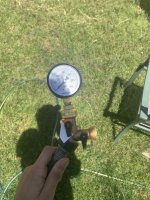
Ok, go back to my post #21. Make up a device like what is in the picture and attach to you spigot. Close the valve and open your spigot, the pressure gauge will show your static pressure which should be 90 psi. Slowly open the valve until the gauge shows the pressure that you want your heads to operate at, let’s say 40 psi. The amount of water leaving the valve will be your desired flow rate, let’s say 6 gpm for the purpose of discussion. This can be measured by running into a 5 gallon bucket and measuring the time it takes to run out 5 gallons and then calculating the gallons per minute.

Assuming the 6 gpm flow rate, you will need to pick heads that will flow 6 gpm at 40 psi, it could be 6 at 1 gpm or 3 at 2 gpm, doesn’t matter, as long as the total is 6 gpm. Then this circuit should flow 6 gpm at 40 psi. Use 3/4 tubing and you won’t have to worry about pressure losses.

Once you have installed your system and the pressure isn’t quite what you want, you can fine tune the circuit by installing different nozzles in the heads. Most heads have several nozzles available, flowing different gpm rates.

Hope this helps
 
To avoid these ads, REGISTER NOW!

Shiftless

Well-known member
Joined
Mar 9, 2014
Messages
14,558
Location
East Bay SFO
Stingry knows what he’s talking about. Excellent advice. :beer:

I only want to add to his points by saying that you can get heads that have an easily adjustable valve built into the spray head using a small screwdriver. That affects throw.

Speaking of throw, make sure to design in a good overlap in the spray patterns.
 
OP
Y

younghandyman

Well-known member
Joined
Dec 18, 2017
Messages
87
Ok, go back to my post #21. Make up a device like what is in the picture and attach to you spigot. Close the valve and open your spigot, the pressure gauge will show your static pressure which should be 90 psi. Slowly open the valve until the gauge shows the pressure that you want your heads to operate at, let’s say 40 psi. The amount of water leaving the valve will be your desired flow rate, let’s say 6 gpm for the purpose of discussion. This can be measured by running into a 5 gallon bucket and measuring the time it takes to run out 5 gallons and then calculating the gallons per minute.


Assuming the 6 gpm flow rate, you will need to pick heads that will flow 6 gpm at 40 psi, it could be 6 at 1 gpm or 3 at 2 gpm, doesn’t matter, as long as the total is 6 gpm. Then this circuit should flow 6 gpm at 40 psi. Use 3/4 tubing and you won’t have to worry about pressure losses.


Once you have installed your system and the pressure isn’t quite what you want, you can fine tune the circuit by installing different nozzles in the heads. Most heads have several nozzles available, flowing different gpm rates.


Hope this helps


Thanks a lot! This helps


Sent from my iPhone using Garage Journal
 
OP
Y

younghandyman

Well-known member
Joined
Dec 18, 2017
Messages
87
Last question, is the flow rate on the sprinkler in US GPM or imperial GPM?


Sent from my iPhone using Garage Journal
 
OP
Y

younghandyman

Well-known member
Joined
Dec 18, 2017
Messages
87
I want to get a quote from a contractor prior to starting as sometimes the prices are so low (potlights for example) that it may not make sense to do all the work for such little saving.


Sent from my iPhone using Garage Journal
 
OP
Y

younghandyman

Well-known member
Joined
Dec 18, 2017
Messages
87
Ok, go back to my post #21. Make up a device like what is in the picture and attach to you spigot. Close the valve and open your spigot, the pressure gauge will show your static pressure which should be 90 psi. Slowly open the valve until the gauge shows the pressure that you want your heads to operate at, let’s say 40 psi. The amount of water leaving the valve will be your desired flow rate, let’s say 6 gpm for the purpose of discussion. This can be measured by running into a 5 gallon bucket and measuring the time it takes to run out 5 gallons and then calculating the gallons per minute.


Assuming the 6 gpm flow rate, you will need to pick heads that will flow 6 gpm at 40 psi, it could be 6 at 1 gpm or 3 at 2 gpm, doesn’t matter, as long as the total is 6 gpm. Then this circuit should flow 6 gpm at 40 psi. Use 3/4 tubing and you won’t have to worry about pressure losses.


Once you have installed your system and the pressure isn’t quite what you want, you can fine tune the circuit by installing different nozzles in the heads. Most heads have several nozzles available, flowing different gpm rates.


Hope this helps


Just to clarify and be sure, if my water pressure is 80 psi but the sprinkler needs 30 psi to operate, won't that turn all the water into mist and waste it?

Sorry if this is a repeat question.


Sent from my iPhone using Garage Journal
 

Shiftless

Well-known member
Joined
Mar 9, 2014
Messages
14,558
Location
East Bay SFO
Without a pressure regulator you can’t be sure of the pressure in the pipes once all the heads are functioning. More heads = lower operating pressure.
You could either install a regulator, or skip that piece and hope that the operating pressure of your system will be close enough to allow proper operation and not too high which as you already know, causes misting and more water waste. Naturally, a pressure regulator will not INCREASE your pressure if you install too many heads or heads with too high a GPM rating.

You have to figure out how many GPM each head needs at what pressure and not expect too many to run on each circuit.

You mentioned getting a pro quote. Make sure whoever you talk to knows what they’re doing. Maybe talk to past customers. See if he/she has a pertinent contractor license.

Follow stingry’s advice, read the free guide he mentioned and do it yourself.

How big is your job anyway?
 
Last edited:
OP
Y

younghandyman

Well-known member
Joined
Dec 18, 2017
Messages
87
Without a pressure regulator you can’t be sure of the pressure in the pipes once all the heads are functioning. More heads = lower operating pressure.
You could either install a regulator, or skip that piece and hope that the operating pressure of your system will be close enough to allow proper operation and not too high which as you already know, causes misting and more water waste. Naturally, a pressure regulator will not INCREASE your pressure if you install too many heads or heads with too high a GPM rating.

You have to figure out how many GPM each head needs at what pressure and not expect too many to run on each circuit.

You mentioned getting a pro quote. Make sure whoever you talk to knows what they’re doing. Maybe talk to past customers. See if he/she has a pertinent contractor license.

Follow stingry’s advice, read the free guide he mentioned and do it yourself.

How big is your job anyway?


Not that big of a job, only about 2 or 3 needed in the backyard, one along the side of the house and 2 in the front.


Sent from my iPhone using Garage Journal
 

rlitman

Well-known member
Joined
Oct 18, 2010
Messages
24,642
Location
Long Island
Just to clarify and be sure, if my water pressure is 80 psi but the sprinkler needs 30 psi to operate, won't that turn all the water into mist and waste it?...

STATIC pressure is not DYNAMIC pressure. If you have 90 PSI static, and calculate 10 PSI drop due to flow, then yes, you'd have a lot of waste (and broken heads). But in reality, such math just means that you need more heads per zone to get enough flow to drop the pressure to where you need it.
 

Shiftless

Well-known member
Joined
Mar 9, 2014
Messages
14,558
Location
East Bay SFO
Not that big of a job, only about 2 or 3 needed in the backyard, one along the side of the house and 2 in the front.


Sent from my iPhone using Garage Journal

With so few heads per area, I don’t see how you will get decent coverage and not have dry areas that don’t get hit with the spray pattern.
Even for a simple square shape lawn area, I’d think you’d need at least one 90 degree spray head in each corner and one 360 in the middle with at least 50% overlapping spray patterns. That’s 5 heads for one area alone.

If you want to learn more about layout of heads and overall system design, I suggest downloading the free design handbook mentioned in the earlier post by stingry.

Here is an example of the overlapping spray patterns I’m talking about. Look around for examples of what other systems look like. Does anybody you know or live nearby have a nice lawn with an underground sprinkler system? Check it out.
 

Attachments

  • E2C9BC8A-1DBC-43CF-9EB4-64493E2A9630.jpeg
    E2C9BC8A-1DBC-43CF-9EB4-64493E2A9630.jpeg
    114.6 KB · Views: 24
Last edited:

rlitman

Well-known member
Joined
Oct 18, 2010
Messages
24,642
Location
Long Island
Ideally, you want head-to head coverage. That means that each head's spray should reach its neighboring head (NOT that the spray should meet the neighbor's spray). The easy way to do this is to space the heads by their intended radius, but there's a little more to creating an efficient pattern than this.
 
OP
Y

younghandyman

Well-known member
Joined
Dec 18, 2017
Messages
87
So I measured the flow using the attached method at 30-35 psi.

I got 8.57 us gallon per minute or 6.25 imperial gallon per minute.

Time to guy sprinklers.

Does anyone know an effective way to drain the water using a gravity drain versus using an air compressor? If I put a ball valve at the lowest point in the line and open it, will it just gravity bleed on its own.

IMG_0926.jpg


Sent from my iPhone using Garage Journal
 

Innovate1

Well-known member
Joined
Jul 28, 2014
Messages
4,291
Location
Illinois near St. Louis, Missouri
Here's a good site with sprinkler info:

https://www.irrigationtutorials.com/

I would be buying name brand sprinklers such as rainbird or hunter. You can change nozzles in them depending on the water pressure and flow available and what area you need to cover. Same for valves and controllers. Some of the local big box store stuff is off brand stuff and hard to get parts for. At some point you will probably need to replace a solenoid or diaphragm - a lot easier than changing the whole unit if you can't get parts.
 

Innovate1

Well-known member
Joined
Jul 28, 2014
Messages
4,291
Location
Illinois near St. Louis, Missouri
So I measured the flow using the attached method at 30-35 psi.

I got 8.57 us gallon per minute or 6.25 imperial gallon per minute.

Time to guy sprinklers.

Does anyone know an effective way to drain the water using a gravity drain versus using an air compressor? If I put a ball valve at the lowest point in the line and open it, will it just gravity bleed on its own.

IMG_0926.jpg


Sent from my iPhone using Garage Journal
That seems pretty low. Someone mentioned 3/4" pipe to not have pressure problems. Many systems use bigger (1" is pretty common for professional residential install) so that's not accurate in general but you may have other limitations that don't allow enough flow to need bigger than 3/4.

You don't need many sprinklers so that helps. You probably want no more than 2 sprinklers/zone but that's just a guess.

If you try to stretch that you may have trouble with sprinklers not popping up. They leak some as they wear and as they pop up so you want some margin. Once fully up they seal better. I have had some trouble with that.
 
Last edited:

stingry

Well-known member
Joined
Oct 14, 2006
Messages
732
Location
Western Nebraska
So I measured the flow using the attached method at 30-35 psi.

I got 8.57 us gallon per minute or 6.25 imperial gallon per minute.

Time to guy sprinklers.

Does anyone know an effective way to drain the water using a gravity drain versus using an air compressor? If I put a ball valve at the lowest point in the line and open it, will it just gravity bleed on its own.


Good start. I would try to be closer to 40 psi which shouldn't lower your flow rate much. I believe my system produced about 10 gpm at 40 psi and I run 4 Rainbird 5000 series pop up rotors. They shoot about 35 feet with the nozzles that I use. I have been using Rainbird products since I put in my first system almost 45 years ago. I've had good luck with them and that is all I use. Not saying that other brands are bad just that Rainbird has worked for me.

As for self draining, you can use a self-draining valve at the lowest point of the circuit. They work OK although I have had them leak and I no longer use them. As I said, they are placed at the lowest point of each individual circuit. Water pressure holds them closed while the sprinklers are operating and they open when pressure is released. Gravel or rock needs to be placed under them so the water has a place to drain. A manual valve placed at the lowest point will also work but will be somewhat unhandy. The sprinklers will break the vacuum and allow the system to drain.

I would recommend using black poly pipe and not pvc. The poly can freeze while the pvc will break if frozen.


Sent from my iPhone using Garage Journal
 
To avoid these ads, REGISTER NOW!

Innovate1

Well-known member
Joined
Jul 28, 2014
Messages
4,291
Location
Illinois near St. Louis, Missouri

Innovate1

Well-known member
Joined
Jul 28, 2014
Messages
4,291
Location
Illinois near St. Louis, Missouri
I have Hunter I-20 and Rainbird 5000 rotors - put in at different times. The I-20 has a way to shut off the head and the basic 5000 does not. At times I have wanted to just use some of the heads such as when planting grass in a small section. There is a version of the 5000 that has a way to turn it off. Just something you might want to consider...
 
OP
Y

younghandyman

Well-known member
Joined
Dec 18, 2017
Messages
87
Good start. I would try to be closer to 40 psi which shouldn't lower your flow rate much. I believe my system produced about 10 gpm at 40 psi and I run 4 Rainbird 5000 series pop up rotors. They shoot about 35 feet with the nozzles that I use. I have been using Rainbird products since I put in my first system almost 45 years ago. I've had good luck with them and that is all I use. Not saying that other brands are bad just that Rainbird has worked for me.


As for self draining, you can use a self-draining valve at the lowest point of the circuit. They work OK although I have had them leak and I no longer use them. As I said, they are placed at the lowest point of each individual circuit. Water pressure holds them closed while the sprinklers are operating and they open when pressure is released. Gravel or rock needs to be placed under them so the water has a place to drain. A manual valve placed at the lowest point will also work but will be somewhat unhandy. The sprinklers will break the vacuum and allow the system to drain.


I would recommend using black poly pipe and not pvc. The poly can freeze while the pvc will break if frozen.


Sent from my iPhone using Garage Journal


I plan on using the orbit line so that I don't have to drain it out every year. I had a talk with a neighbor who used it and he says he has had it for several seasons with no freezing issues.


Sent from my iPhone using Garage Journal
 
OP
Y

younghandyman

Well-known member
Joined
Dec 18, 2017
Messages
87
Here's the rainbird 5000 manual with nozzle tables showing flow rate for various pressures. Other brands will be similar. You can put in a smaller nozzle to get lower flow rate if you lack flow - just need to run it longer. You should also consider how the sprinklers may affect pressure for other uses in the house if your pressure/flow is a bit low.

https://www.rainbird.com/sites/default/files/media/documents/2018-02/man_5000_5000Plus_PRS.pdf


Thanks! This helps.

Do you know what the first number in the column directly to the right of the pressure reading is?

And why are some of the rows in the tables greyed out?


Sent from my iPhone using Garage Journal
 

Innovate1

Well-known member
Joined
Jul 28, 2014
Messages
4,291
Location
Illinois near St. Louis, Missouri
The second column is the nozzle number as noted at the top of the column. The shaded lines appear to be the default nozzle - probably the one you get if you buy it at a big box store. If you buy it at an irrigation supply it will come without a nozzle and you can get a nozzle "tree" - a strip of plastic with the whole selection of nozzles. You just pick the one you need based on available flow rate. When I switched from city supply to a pump I put in smaller nozzles because I had a bit less flow/pressure with the pump.

You don't list your location but if you get anything more than light freezes you are asking for trouble by not blowing out your system. I don't see where one brand will be better than the other. What's the coldest it gets at your location?
 
OP
Y

younghandyman

Well-known member
Joined
Dec 18, 2017
Messages
87
The second column is the nozzle number as noted at the top of the column. The shaded lines appear to be the default nozzle - probably the one you get if you buy it at a big box store. If you buy it at an irrigation supply it will come without a nozzle and you can get a nozzle "tree" - a strip of plastic with the whole selection of nozzles. You just pick the one you need based on available flow rate. When I switched from city supply to a pump I put in smaller nozzles because I had a bit less flow/pressure with the pump.

You don't list your location but if you get anything more than light freezes you are asking for trouble by not blowing out your system. I don't see where one brand will be better than the other. What's the coldest it gets at your location?


Ahh I see, thanks for clarifying because when I went to home depot, I didn't see anything about different nozzle sizes.

I'm in Toronto. Gets to about -30 at absolute worst but that's rare.


Sent from my iPhone using Garage Journal
 
OP
Y

younghandyman

Well-known member
Joined
Dec 18, 2017
Messages
87
That seems pretty low. Someone mentioned 3/4" pipe to not have pressure problems. Many systems use bigger (1" is pretty common for professional residential install) so that's not accurate in general but you may have other limitations that don't allow enough flow to need bigger than 3/4.

You don't need many sprinklers so that helps. You probably want no more than 2 sprinklers/zone but that's just a guess.

If you try to stretch that you may have trouble with sprinklers not popping up. They leak some as they wear and as they pop up so you want some margin. Once fully up they seal better. I have had some trouble with that.


I believe I only need 2 per zone. Will draw it out this week!


Sent from my iPhone using Garage Journal
 
OP
Y

younghandyman

Well-known member
Joined
Dec 18, 2017
Messages
87
Doing the project this weekend. Found this flow chart table for the sprinklers I will use. Is the GPM listed in the image assuming it's spraying a full 360 degrees. If I'm only spraying it 90 degrees, do I need to divide that number by 4?

Thanks,

4ec11bd1fd264484bc97670c2e6eead0.jpg


Sent from my iPhone using Garage Journal
 

Innovate1

Well-known member
Joined
Jul 28, 2014
Messages
4,291
Location
Illinois near St. Louis, Missouri
Doing the project this weekend. Found this flow chart table for the sprinklers I will use. Is the GPM listed in the image assuming it's spraying a full 360 degrees. If I'm only spraying it 90 degrees, do I need to divide that number by 4?

Thanks,

4ec11bd1fd264484bc97670c2e6eead0.jpg


Sent from my iPhone using Garage Journal

The rotation has nothing to do with the flow. The nozzle outputs the same flow for a given pressure no matter where it is pointing.

It puts that water on a smaller area so some adjustment of time may be needed.
 

rlitman

Well-known member
Joined
Oct 18, 2010
Messages
24,642
Location
Long Island
The rotation has nothing to do with the flow. The nozzle outputs the same flow for a given pressure no matter where it is pointing.

It puts that water on a smaller area so some adjustment of time may be needed.

The arc has everything to do with the precipitation rate! Constant flow is all good, but when you take a 360 degree arc at some flow and get some precip rate off the chart, you can double the rate when you change it to 180 degrees, so you'll need a nozzle with half the flow to match the rate.

It's spelled out more simply here:
https://www.irrigationtutorials.com/sprinkler-coverage-nozzle-selection-sprinkler-spacings/

But if you need the full details, the precip rates on the chart are NOT simply the rate that a single rotor will deliver. The charts are based on the precip rate within the radius of the rotor, ASSUMING head to head spacing, also assuming your neighboring rotors are applying at the same precip rate, and the rotor you're looking up is rotating a full circle. One column assumes square corner spacing, and the other assumes triangle corner spacing (hence a slightly higher rate). You then select the correct nozzle based on the angle.
 
OP
Y

younghandyman

Well-known member
Joined
Dec 18, 2017
Messages
87
Completed the project 3 or 4 weeks ago, only needed 2 in my backyard. Front yard will be done next summer as concrete was being completed around the house so I couldn't do the front.

Appreciate everyone's help here!


Sent from my iPhone using Garage Journal
 
To avoid these ads, REGISTER NOW!
Top Bottom