stingry
Well-known member
So if I understand correctly, I start at 90 psi, and calculate all the pressure losses through the system to the sprinkler heads based on the pressure loss tables. If my calculated pressure at the heads is still too high, then I would need a regulator, otherwise I can just plumb it as is without a regulator
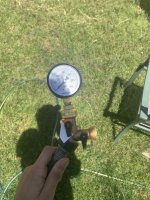
Ok, go back to my post #21. Make up a device like what is in the picture and attach to you spigot. Close the valve and open your spigot, the pressure gauge will show your static pressure which should be 90 psi. Slowly open the valve until the gauge shows the pressure that you want your heads to operate at, let’s say 40 psi. The amount of water leaving the valve will be your desired flow rate, let’s say 6 gpm for the purpose of discussion. This can be measured by running into a 5 gallon bucket and measuring the time it takes to run out 5 gallons and then calculating the gallons per minute.
Assuming the 6 gpm flow rate, you will need to pick heads that will flow 6 gpm at 40 psi, it could be 6 at 1 gpm or 3 at 2 gpm, doesn’t matter, as long as the total is 6 gpm. Then this circuit should flow 6 gpm at 40 psi. Use 3/4 tubing and you won’t have to worry about pressure losses.
Once you have installed your system and the pressure isn’t quite what you want, you can fine tune the circuit by installing different nozzles in the heads. Most heads have several nozzles available, flowing different gpm rates.
Hope this helps