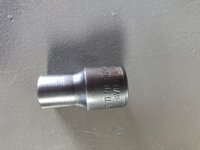
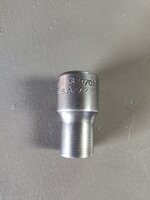
Is this a WWII socket (guessing because it is stamped 'Not Guaranteed')
It's a myth that all tools made by Snap-on during WWII had no guarantee based on the myth that all production during WWII was for the military. Snap-on had commercial and industrial production and sales during WWII and there is no evidence they discontinued their guarantee. Any tools they thought were susceptible to breakage were exempt from the guarantee. They are denoted throughout every catalog with a star symbol as forewarned with a Note, on the Introduction page (typically, page 2 or 3), where the guarantee was stated, starting in 1939 (Catalog N).
Common sense dictates some of these (e.g., cellulose tipped hammers). Also anything with a tiny, thin, easily damaged edge or tip, for example, such as all the smallest sizes (/32nds) in pin, starter, and drift punches, and all Phillips head screwdrivers. Sockets that were not guaranteed fall into one of two categories: (1) special small sockets with tiny forged structures that could easily be damaged, such as Midget drive (1/4-inch) carburetor sockets with prongs, refrigeration sockets for packing gland nuts, and all Midget and Ferret (3/8-inch) drive screwdriver attachments, and (2) special connecting rod sockets (for Ford, Cadillac, Buick, etc) which had really thin walls for access.
As for your socket in particular...
I have a NO GUAR S-9702. No Snap-On logo, no date code. Just the model number, service opening size (7/16), COO, and the 'NO GUAR' marking.
These were used on connecting rod bolts on Cadillac and LaSalle which, per Snap-On Catalogs in 1939 throughout the 1940's, were "drawn down extremely tight" and had "unusually small hex heads" resulting in "frequent socket breakage when standard sockets are used."
Among all Snap-On no guarantee tools, as a category, that's the farthest they go in terms of language in explaining the policy in a catalog description.