To avoid these ads, REGISTER NOW!

Unsticking a Wilton - Fail

paulsomlo

Well-known member
Joined
Jul 16, 2013
Messages
3,897
Location
Northern Colorado
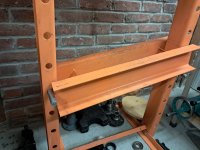
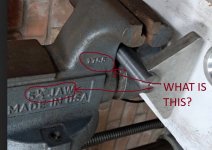
I had the vise upright on my HF 20t press, 1" solid rod between the two jaws resting on aluminum yokes, as shown. I had the yokes blocked from the front to keep the vise from sliding and had a bottle jack horizontal between the press upright and the base of the vise to keep the base vertical. The aluminum disk was interposed between the ram of the press and the back end dynamic jaw. Apparently, the upright bowed with the result as shown - now I have to figure out how to unstick the beam of the press, which got lodged in there pretty good when things let loose. And I've still got a vise that's stuck - doesn't seem to be any rust, just dried up grease.
 

Attachments

  • attachment (79).jpeg
    attachment (79).jpeg
    220.6 KB · Views: 264
  • attachment_2.jpeg
    attachment_2.jpeg
    207.9 KB · Views: 260
To avoid these ads, REGISTER NOW!

RoninB4

Well-known member
Joined
Jul 22, 2020
Messages
3,575
Location
Under My House
-If it's the horizontal beam (two C channels) stuck against the box section I'd try knocking the shaft though the box section. There's less contact patch on the shaft.

-For the vise, looks like a job for a Kroil soak. Good luck. Repot, when you can, what caused the vise to stick so badly.

-Not a fail, this ain't over yet...
 

senlow

Well-known member
Joined
Apr 26, 2008
Messages
2,237
Location
Wheat Ridge, Colorado
Carefully spread the columns with a porta-power and you should be able to move the beam back in place.

I agree with Ron on the vise. Soak it in penetrating fluid. Don't rush the process. Be sure to let it soak for several days. Some heat should be helpful.
 
OP
P

paulsomlo

Well-known member
Joined
Jul 16, 2013
Messages
3,897
Location
Northern Colorado
I've tried soaking with Kroil and WD-40 from both ends for days/weeks - I've been working on this on and off for a long time. I think it's so bound up that the penetrant just can't make much headway. As far as heat, it's gonna take oxy acetylene with a rosebud, which will destroy the original paint, which would be nice to retain.

I gave the shaft through the box section a couple of wacks, didn't seem to move much.

I'll report back when I've made some progress.
 

LopezBart

Well-known member
Joined
Oct 13, 2023
Messages
2,548
Location
Lopez Island, WA
You might try using some of that citric acid based rust remover left to soak in the seam...


If you have some dry ice, combined w/ acetone it makes for powerful cooling bath and soaking the back end of the vice may help loosen things up...
 

larry_g

Well-known member
Joined
Apr 28, 2007
Messages
16,888
Location
oregon
On the press, can you release the horizontal brace that is near the floor to let the columns spread apart?

On the vise, if you have some separation on the jaws run a piece of allthread through the center and pull the jaws together to get some motion going.

lg
 

RoninB4

Well-known member
Joined
Jul 22, 2020
Messages
3,575
Location
Under My House
I've tried soaking with Kroil and WD-40 from both ends for days/weeks - I've been working on this on and off for a long time. I think it's so bound up that the penetrant just can't make much headway.
-When rust in involved it's a **** shoot whether moving components are now integral. We had a dinner table size injection mold that was seized from improper storage, couldn't get the halves to split. Foreman took to soaking the pins and slides in Kroil, minimal clearance between pins/bushings was also difficult for penetration. Once a week he'd suspend one half the mold, allowing the other half subject to gravity. Then he'd begin "therapy" with a heavy rawhide mallet for a few minutes before re-oiling and putting the mold away for next week. This went on for many weeks and I even gave up hope that it was going to separate. It molded tail lenses for 54 Fords and was too expensive to make a new mold. After about a month or two of mallet therapy it dropped the gravity half, I was amazed.

-May I presume that you're trying to move the slide in two directions or just one? Much like removing a stubborn bolt it sometimes helps to move/rotate in two directions to scrub off some of the rust/oxidation to "unlock" it.
I gave the shaft through the box section a couple of wacks, didn't seem to move much.
-Well phooey. Where does it appear to be contact locking?

I'll report back when I've made some progress.
-Good luck to you.
 
OP
P

paulsomlo

Well-known member
Joined
Jul 16, 2013
Messages
3,897
Location
Northern Colorado
You might try using some of that citric acid based rust remover left to soak in the seam...

If you have some dry ice, combined w/ acetone it makes for powerful cooling bath and soaking the back end of the vice may help loosen things up...
I don't believe that it's rust that's holding it - I think it's a vice with very little wear, thus a tight fit, and dried up grease.
 
OP
P

paulsomlo

Well-known member
Joined
Jul 16, 2013
Messages
3,897
Location
Northern Colorado
On the press, can you release the horizontal brace that is near the floor to let the columns spread apart?

On the vise, if you have some separation on the jaws run a piece of allthread through the center and pull the jaws together to get some motion going.

lg
Nope - the bottom brace is welded.

I did that initially; I was able to fully close the jaws, because the geometry of doing so on the press favored it. But it didn't seem to break anything loose.
 

whateg01

Well-known member
Joined
Mar 13, 2006
Messages
11,374
Location
doo dah, kansas, usa
You should know this now, but this is a weakness in the design of many hydraulic presses. Better ones will have a way of preventing the splaying of the columns. As an operator, you should be watching everything for movement. Many a stained-pants moment has resulted from something moving or breaking suddenly and a large part under a lot of force suddenly flying out of the press.

You'll have to spread the columns somehow. A portapower has been suggested. You might be able to use a bottle Jack or even a floor jack if held in the correct orientation. Those aren't going to be stable operations though, so again something could come shooting out of place. Once you get it unstuck, you need to figure out how to straighten the column or it will be even more likely to happen again in the future. I suggest welding a small piece of metal on the bottom of the bed so that the pins are trapped and can't get out of position. Done by notching in this pic, but you get the idea. Or add a strap around the ends of the bed so the column is trapped.
1000026200.jpg
 
Last edited:
OP
P

paulsomlo

Well-known member
Joined
Jul 16, 2013
Messages
3,897
Location
Northern Colorado
-When rust in involved it's a **** shoot whether moving components are now integral. We had a dinner table size injection mold that was seized from improper storage, couldn't get the halves to split. Foreman took to soaking the pins and slides in Kroil, minimal clearance between pins/bushings was also difficult for penetration. Once a week he'd suspend one half the mold, allowing the other half subject to gravity. Then he'd begin "therapy" with a heavy rawhide mallet for a few minutes before re-oiling and putting the mold away for next week. This went on for many weeks and I even gave up hope that it was going to separate. It molded tail lenses for 54 Fords and was too expensive to make a new mold. After about a month or two of mallet therapy it dropped the gravity half, I was amazed.

-May I presume that you're trying to move the slide in two directions or just one? Much like removing a stubborn bolt it sometimes helps to move/rotate in two directions to scrub off some of the rust/oxidation to "unlock" it.

-Well phooey. Where does it appear to be contact locking?


-Good luck to you.
I'm only trying to move the slide axially, no rotation - that's hampered by the key. And given that having closed the jaws on the press initially didn't break anything free, I'm not sure that rotation would help.

I was able to knock the press pin out of one side, then it angled and stuck on the other side. I tried a crowbar on the inside of the upright - it slipped and wacked my thumb pretty good. After some ice and an ibuprofen, I'm almost ready to tackle it again.

I know one thing - me and this crappy Harbor Freight shop press are most likely parting ways. It's frustrated me for a long time and I don't need tools that elicit obscenities from me.
 
OP
P

paulsomlo

Well-known member
Joined
Jul 16, 2013
Messages
3,897
Location
Northern Colorado
You should know this now, but this is a weakness in the design of many hydraulic presses. Better ones will have a way of preventing the splaying of the columns. As an operator, you should be watching everything for movement. Many a stained-pants moment has resulted from something moving or breaking suddenly and a large part under a lot of force suddenly flying out of the press.

You'll have to spread the columns somehow. A portapower has been suggested. You might be able to use a bottle Jack or even a floor jack if held in the correct orientation. Those aren't going to be stable operations though, so again something could come shooting out of place. Once you get it unstuck, you need to figure out how to straighten the column or it will be even more likely to happen again in the future. I suggest welding a small piece of metal on the bottom of the bed so that the pins are trapped and can't get out of position. Done by notching in this pic, but you get the idea. Or add a strap around the ends of the bed so the column is trapped.
1000026200.jpg
I played with a bottle jack and some metal rods, even a 2x4, but trying to hold all that with one hand and pump the bottle jack with the other proved too cumbersome. Maybe with the entire frame on it's side?

The pin didn't become disengaged - what I think happened, is that the bed slid all the way to one side and then the column bent.
 

Shiftless

Well-known member
Joined
Mar 9, 2014
Messages
14,553
Location
East Bay SFO
Do you know anybody with an induction stove?
That would heat the entire vise very evenly and melt any old grease. If you’re careful, it shouldn’t get hot enough to destroy the paint.

How about this plan?

1. Fix old press or get a new one
2. Heat the vise on induction stove
3. Using hot pads and thick gloves, move vise to the press.
4. Apply force with the previous set up.

edit: While it is hot, squirt in more penetrating oil before pressing.

Long ago, I had a 4 inch Wilton bullet machinist vise that was badly stuck. No apparent rust. I struggled greatly and finally got it to move and saw just a small ring of rust inside that was the cause of the problem.

Good luck with your project. Keep us posted… we are cheering for you. 🍻
 
Last edited:

alfadan

Well-known member
Joined
Mar 9, 2007
Messages
2,109
Location
Augusta, ks
I wonder if driving a wedge between the jaws with steady pressure in the press while supporting the jaw from beneath would work. As in, putting pressure on the wedge overnight, or over a few days.
 
To avoid these ads, REGISTER NOW!

whateg01

Well-known member
Joined
Mar 13, 2006
Messages
11,374
Location
doo dah, kansas, usa
I played with a bottle jack and some metal rods, even a 2x4, but trying to hold all that with one hand and pump the bottle jack with the other proved too cumbersome. Maybe with the entire frame on it's side?

The pin didn't become disengaged - what I think happened, is that the bed slid all the way to one side and then the column bent.
Regardless which thing moved, in practice the bed moves to the side but more importantly, it flexes, which gives it very slight wedge shape which pushes outward on the pin, which, since it's in a hole in the column, pushes outward on the column which means the pin is no longer supporting the bed. Hence it is no longer engaged with the bed. The point is, forcing the pin to stay under the bed prevents that whole chain of events from happening. Or just leave it like it is and take your chances. What's
 
OP
P

paulsomlo

Well-known member
Joined
Jul 16, 2013
Messages
3,897
Location
Northern Colorado
The beast has been slain - one of them, anyway. I removed the bottle jack, took the frame outside, laid it on it's side and gave the bed a few wacks with a deadblow. I'll move this thing to the garage, as I really don't have the shop space for it anyway and it's taking up valuable real estate, given that I only use it a few times a year at most.

attachment (80).jpeg
 

Shiftless

Well-known member
Joined
Mar 9, 2014
Messages
14,553
Location
East Bay SFO
Idea #2

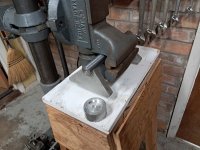
Change your set up to horizontal using a piece of steel or concrete against a solid wall as the “base”… the white board in your pic.
That way you could fabricate something that would lay right up against and pressing on the back of the slide and extend out a few inches,

With that set up you could swing a 10 pound sledge hammer against the back end and probably get some movement. Either a big sledge hammer or maybe even better… a demolition hammer. The vibrations might help. Either way, going violent might get you some success,

404D3E38-0E25-47F2-87D7-87F5FED543F8.jpeg
 
Last edited:
OP
P

paulsomlo

Well-known member
Joined
Jul 16, 2013
Messages
3,897
Location
Northern Colorado
Idea #2

Change your set up to horizontal using a piece of steel or concrete against a solid wall as the “base”… the white board in your pic.
That way you could fabricate something that would lay right up against and pressing on the back of the slide and extend out a few inches,

With that set up you could swing a 10 pound sledge hammer against the back end and probably get some movement. Either a big sledge hammer or maybe even better… a demolition hammer. The vibrations might help. Either way, going violent might get you some success,
I've thought about going horizontal with this; I did try clamping down the base and using a deadblow/metal rod on the back of the slide, but no go. I have thought maybe an SDS hammer drill on the backside?
 

danski0224

Well-known member
Joined
Jan 29, 2005
Messages
13,444
Location
Near Naperville, IL
I had to remove an aluminum blower wheel from a steel motor shaft, and it barely came apart. There was a small spot of corrosion, maybe 3/8" around, that was the culprit. The shaft was 1.5" in diameter.
 
OP
P

paulsomlo

Well-known member
Joined
Jul 16, 2013
Messages
3,897
Location
Northern Colorado
I had to remove an aluminum blower wheel from a steel motor shaft, and it barely came apart. There was a small spot of corrosion, maybe 3/8" around, that was the culprit. The shaft was 1.5" in diameter.
This is testament to the tolerances to which these vices were made, I suppose.
 

danski0224

Well-known member
Joined
Jan 29, 2005
Messages
13,444
Location
Near Naperville, IL
This is testament to the tolerances to which these vices were made, I suppose.
Doesn't take much. The identical setup above the problem child was a slip fit- the wheel just pulled off the motor shaft.

The other one only came apart after cutting the shaft (motor was junk), supporting the center of the aluminum fan assembly, and beating the shaft piece out with a 32oz dead blow hammer with a metal face, and a brass drift pin.

If the fan broke, we would have been effed, but the project manager did not listen to me and order a spare and bill it to the customer.
 

RoninB4

Well-known member
Joined
Jul 22, 2020
Messages
3,575
Location
Under My House
I'm only trying to move the slide axially, no rotation - that's hampered by the key.
-Yeah I only used "rotation" as an illustration of reversing direction to help break the lock. I wouldn't imagine the vise slide would rotate even when brand new.
I know one thing - me and this crappy Harbor Freight shop press are most likely parting ways.
-I've got one too and really don't like it either, never have.
I don't need tools that elicit obscenities from me.
-I refer to them as magic spells because I don't seem to get results until I've uttered one. Glad to hear you've battled your way back despite the collateral damage.
 

OccupantRJ

Well-known member
Joined
May 15, 2009
Messages
11,153
Location
Eastern North Carolina
A bearing puller attached at the round area between the jaws coupled with two threaded rods and a cross bar at the rear of the vise may help. That is a direct line pull where needed.
 

whateg01

Well-known member
Joined
Mar 13, 2006
Messages
11,374
Location
doo dah, kansas, usa
I wonder if driving a wedge between the jaws with steady pressure in the press while supporting the jaw from beneath would work. As in, putting pressure on the wedge overnight, or over a few days.
As long as that pressure isn't excessive. I would think applying pressure that way and then a good smack on the back might help just it loose. Somebody mentioned a demolition hammer.
 
OP
P

paulsomlo

Well-known member
Joined
Jul 16, 2013
Messages
3,897
Location
Northern Colorado
-Yeah I only used "rotation" as an illustration of reversing direction to help break the lock. I wouldn't imagine the vise slide would rotate even when brand new.
Ahh, yes - I tried switching end for end; I did get the vise to close, but now I can't open it back up. That's what makes me think that maybe it's not rust.
 
OP
P

paulsomlo

Well-known member
Joined
Jul 16, 2013
Messages
3,897
Location
Northern Colorado
A bearing puller attached at the round area between the jaws coupled with two threaded rods and a cross bar at the rear of the vise may help. That is a direct line pull where needed.
I don't have a bearing puller large enough to get around the slide, and I'm dubious that one large enough would be up to the task without cracking. But, something improvised might be in order.
 

whateg01

Well-known member
Joined
Mar 13, 2006
Messages
11,374
Location
doo dah, kansas, usa
Ahh, yes - I tried switching end for end; I did get the vise to close, but now I can't open it back up. That's what makes me think that maybe it's not rust.
Ok, I think we all thought it was just flat stuck. It moved then stopped moving means you need to stop trying to force it and figure out why it stopped moving. Undo that and it'll likely move again.
 
OP
P

paulsomlo

Well-known member
Joined
Jul 16, 2013
Messages
3,897
Location
Northern Colorado
Ok, I think we all thought it was just flat stuck. It moved then stopped moving means you need to stop trying to force it and figure out why it stopped moving. Undo that and it'll likely move again.
Oh, it's stuck all right - it took a fair amount of force on the shop press to get it to close. The problem, is that closing it was a much easier process due to the geometry of things on the press. The fixturing for opening is much less forgiving.
 

RoninB4

Well-known member
Joined
Jul 22, 2020
Messages
3,575
Location
Under My House
-Ok I'll ask the dumb questions. Back cap off and nut out? The vises I have (Reed, Prentiss, etc.) are different from the Wilton design. From the images below I don't see much to lock things up. By the description from @paulsomlo it doesn't sound like rust is the major factor here preventing movement. I'm wondering if the guide rail (#17) or the rail pins (#18) are ploughing the guide rail slot/groove? I've seen shaft keys get skewed/lifted (rust/debris or loose fit) enough to dig into the surrounding metal, making component removal difficult. Just one sharp/square edge starting to dig in can lead to further galling as more metal gets ploughed up. The result can lock up movement by compression or friction welding far more than one would think possible. I'm out of wild guesses here.

Exploded.jpg X-Section.jpg
 

Shiftless

Well-known member
Joined
Mar 9, 2014
Messages
14,553
Location
East Bay SFO
From the images below I don't see much to lock things up.
You show a diagram of a Wilton “bullet” machinist vise. Look again at the picture in the first post. The one Paulsomlo is working on is NOT a bullet and is more like the vises you mentioned… Reed, Prentiss etc.

If the slide is a bit bent or deformed, it can wedge itself pretty tightly into the vise body. I bet that is what happened to the vise in question.

D2FC80CE-2BC1-47B2-985E-D8115B130A59.jpeg
 
Last edited:

Mike007

Well-known member
Joined
Dec 4, 2010
Messages
2,611
If the slide is a bit bent or deformed, it can wedge itself pretty tightly into the vise body. I bet that is what happened to the vise in question.
This seems to fit with the scenario. I can't imagine the force required to bend the slide. When this gets resolved the answer will be interesting.
 

RoninB4

Well-known member
Joined
Jul 22, 2020
Messages
3,575
Location
Under My House
You show a diagram of a Wilton “bullet” machinist vise.
-The images were used because it showed the exploded diagram and cross section of a round slide vise from Wilton. The vise in question from the OP appears to be a round slide like a Tradesman or Bullet. The info in the image below might help clear things up if you cross reference the numbers to the Wilton website. If it's not then perhaps you could post some info? I'll wait.

1755.jpg
Look again at the picture in the first post. The one Paulsomlo is working on is NOT a bullet and is more like the vises you mentioned… Reed, Prentiss etc.
-Maybe yours are but neither of my vises are similar to the Wilton except in overall shape. Mine have square slides and the nut is entirely different in design and function. Do you own either of the models I have that supports your contention? Here's a link below

 
To avoid these ads, REGISTER NOW!
Top Bottom